Fire Extinguisher Servicing: the 3 Intervals and the Law Behind Them
Walk to the nearest fire extinguisher in your building and look at the label. There will be a service sticker with a date. If that date is more than a year old, or the sticker belongs to a contractor nobody remembers appointing, you have found one of the most common fire safety failures in offices and schools. It is also one of the cheapest to fix.
Extinguishers are bought once and then ignored. They hang on a bracket for a decade, get moved to prop a door, lose their pin, or sit quietly depressurised behind a filing cabinet. Nobody notices, because nobody needs one until the day they do.
The law does notice. It does not name a service interval, but it requires a system of maintenance, and the official guidance and British Standards fill in the detail. The result is three intervals, each done by a different person, and a short list of questions around them: how many you need, who is responsible in a leased building, and what your staff must be told.
This guide sets those out for employers in England and Wales, with the United States alongside, where the rules are written very differently.
The law in two articles
Two provisions of the Regulatory Reform (Fire Safety) Order 2005 do the work.
Article 13 requires the responsible person to ensure that, where necessary to safeguard relevant persons, the premises are equipped to the extent appropriate with appropriate fire-fighting equipment, and that any non-automatic equipment is easily accessible, simple to use and indicated by signs. What is appropriate depends on the dimensions and use of the premises, the equipment in them, the substances likely to be present and the maximum number of people who may be there.
Article 17 requires that equipment provided under the Order is subject to a suitable system of maintenance and is maintained in an efficient state, in efficient working order and in good repair.
Neither says annually. The interval comes from guidance and standards, which matters for one reason: the legal test is whether your system of maintenance is suitable, not whether a sticker exists. A sticker from a contractor who never weighed the cylinder satisfies nobody.
The three intervals
1. Monthly: the visual check, done by you
The government's fire safety risk assessment guide for offices and shops advises brief checks to ensure extinguishers remain serviceable, and says that in normal conditions a monthly check should be enough. Where vandalism or a harsh environment is likely, check more often.
This is not a technical task and needs no contractor. A fire warden, facilities assistant or site manager walks the route and confirms that each extinguisher:
- is where the plan says it should be, on its bracket or stand, with its sign;
- is not obstructed, and is not being used as a door stop;
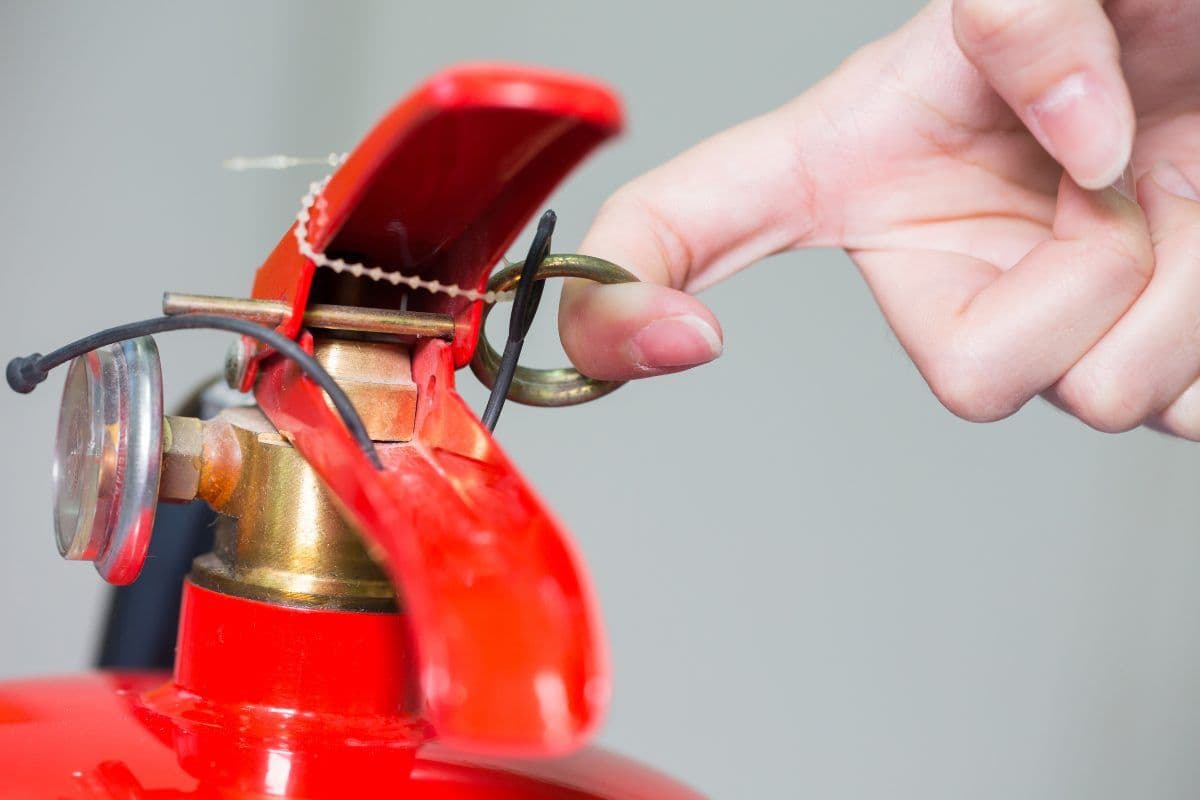
- has its safety pin and tamper seal in place;
- shows a pressure gauge in the green, where it has a gauge;
- has no visible damage, corrosion or leakage, and a readable label;
- carries a service date within the last year.
Record the walk, even if only as a dated tick sheet. The check takes minutes per floor, and it is the only one of the three that will catch an extinguisher that went missing in March.
2. Annual: the service, done by a competent person
The same guide states that maintenance by a competent person should be carried out annually, and points to BS 5306-3 for maintenance. This is the service most people mean when they search for fire extinguisher servicing.
A proper annual service is more than a glance and a new sticker. The technician should examine each extinguisher against the standard, check its weight or pressure, inspect the hose, horn and operating mechanism, replace the tamper seal and any defective parts, and update the label. You should receive a written report listing every extinguisher by location, what was done to it and anything condemned or replaced.
Competence is your responsibility to check. Ask which standard the technician works to, what training and third party certification the company holds, and whether the report will identify each unit individually. A provider who cannot answer those three questions is selling stickers.
3. Extended: the periodic overhaul or replacement
Beyond the annual service, the British Standard provides for a more thorough service at longer intervals, in which the extinguisher is discharged, examined internally and refilled, or pressure tested. As commonly applied, that falls at five years for water, foam and powder extinguishers and ten years for carbon dioxide. Confirm the exact intervals for your equipment with your service provider, because they depend on the type and on the standard as currently published.
In practice many organisations replace smaller extinguishers at these points instead of overhauling them, because a new unit can cost less than the extended service. That is a legitimate choice. What is not legitimate is an extinguisher with a manufacture date fifteen years old and a row of annual stickers, with no evidence that it has ever been opened or tested.
How many, and where
Need Expert H&S Guidance?
Our qualified consultants can help you implement the right health & safety measures for your business.
Servicing the wrong provision is wasted money, so the first annual visit is a good moment to check the provision itself.
The government guide gives a starting point for ordinary combustible risks: typically one water based extinguisher for approximately every 200 square metres of floor space, with a minimum of two extinguishers per floor. Where there are other classes of fire risk, the appropriate type, number and size should be provided, and the guide refers to BS 5306-8 for selection and installation. New extinguishers should comply with BS EN 3-7.
On position, where the risk is not confined to one location, extinguishers should be on escape routes, close to the exit from the room or floor. Specific risks, such as a server room or a kitchen, need the right type nearby. Choosing between types is the subject of our guide to fire extinguisher colours.
Two changes in modern offices are worth raising with whoever carries out your fire risk assessment. Kitchens with deep fat frying need an extinguisher suited to cooking oil. And lithium ion batteries, in e-bikes, scooters and device stores, burn in a way standard extinguishers handle poorly, as we explain in our piece on vapes and lithium ion batteries. For those risks the better controls are storage, charging rules and evacuation, not a bigger extinguisher.
Who is responsible in a leased building
In a multi let office the extinguishers in the lobby, stairs and corridors usually belong to the landlord, and those inside the demise to the tenant. Article 17 anticipates this. Where premises form part of a building, the responsible person may make arrangements with the occupier of other premises to ensure the maintenance duty is met, and that occupier must co-operate.
The practical failure is the gap. The landlord's contractor services the common parts and walks past your floor. Your own contract lapsed when the office manager left. Each party assumes the other has it. Ask for the landlord's service report, keep your own, and compare the dates. Our guide to landlord health and safety documentation lists what a tenant should expect to receive.
What your staff need to know
An extinguisher that nobody is willing or able to use is decoration. Article 13 also requires the responsible person, where necessary, to nominate competent persons to implement fire-fighting measures and to ensure their number, training and equipment are adequate.
That does not mean training every employee to fight fires. For most offices the sound policy is that everyone knows the alarm and the way out, and a smaller group of wardens has practical extinguisher training and knows when not to try. What that group should cover is in our guide to fire marshal training. Whatever you decide, write it down, because an untrained employee who tackles a fire and is injured will ask what your policy told them to do.
Five failures we find most often
None of these needs a specialist to spot, which is why they are worth checking before the next service visit.
- The count does not match. The service report lists fewer extinguishers than are on the walls, so some have never been serviced.
- Extinguishers have migrated. Units bought for a kitchen or server room have drifted to a corridor, leaving the specific risk uncovered.
- The fit out changed and the provision did not. A new floor layout moved the exits, and the extinguishers now sit in the middle of a room instead of beside the way out.
- Condemned units are still hanging. The technician marked them as failed, nobody ordered replacements, and they remain on the bracket.
- Nobody owns the monthly check. It was one person's habit, and it stopped when they left.
The government's summary of workplace fire safety responsibilities is a useful short reference to share with whoever takes the task on.
The three intervals at a glance
| Interval | What | Who | Evidence |
|---|---|---|---|
| Monthly | Visual check: location, pin, seal, gauge, damage, date | Your own staff | Dated check sheet |
| Annual | Service to BS 5306-3 | Competent technician | Report listing every extinguisher |
| Extended | Discharge and internal examination, overhaul or replacement | Competent technician | Report, new label or new unit |
The international picture
The British approach is a general duty with intervals in guidance. The United States writes the intervals into the regulation itself.
Under OSHA's standard on portable fire extinguishers, the employer is responsible for inspection, maintenance and testing of all portable extinguishers in the workplace. They must be visually inspected monthly and subjected to an annual maintenance check, with the annual maintenance date recorded and the record retained. Stored pressure dry chemical extinguishers that require a 12 year hydrostatic test must be emptied and maintained every six years. Extinguishers for ordinary combustibles must be distributed so that travel distance to one is 75 feet or less. And where extinguishers are provided for employee use, the employer must provide an educational programme on their use on initial employment and at least annually.
The monthly and annual rhythm is the same on both sides of the Atlantic. The differences are in the detail: travel distance in place of floor area, hydrostatic test periods in place of extended service intervals, and annual employee education as an express rule. A group with offices in the United States cannot assume its British schedule satisfies OSHA, or the reverse.
Elsewhere, most countries follow the same pattern of periodic inspection by a qualified technician, with intervals and certification set nationally. For a multinational the workable standard is simple to state: every site holds a register of extinguishers, a monthly check record and a current service report from a locally competent provider. Our international health and safety consultants map that standard onto each country's own rules.
Where Arinite fits
Arinite is a firm of health and safety consultants, not an extinguisher service company, and we do not sell or service equipment. That independence lets us check what you are being sold. In a fire risk assessment or one of our health and safety audits we look at whether the provision matches the risk, whether all three intervals are happening, whether the service reports stand up, and whether landlord and tenant records meet in the middle. It sits alongside the other routine checks in our guide to emergency lighting and fire alarm testing.
Keeping the register, the monthly checks and the service dates in one system, with reminders, is where health and safety consultants and software work best together. We have done this for more than 15 years, with over 1,500 businesses, across more than 50 countries and over 100,000 employees, and we retain more than 95% of the clients who start with us. Our global health and safety consultants support office and education estates where equipment is spread across many buildings.
When did someone in your organisation last look at the date on that sticker?
Related Articles
Written by
Arinite Health & Safety Consultants
Health & Safety Expert at Arinite