Fire Doors in Offices: 8 Checks and the Frequency Question
Search for fire door inspection requirements and almost everything you find will be about residential buildings. Quarterly checks of doors in common parts, annual checks of flat entrance doors, buildings above eleven metres.
Those obligations are real and they come from the Fire Safety (England) Regulations 2022, specifically regulation 10, which applies to buildings containing two or more sets of domestic premises. If you occupy an office, they are not your obligations, and two opposite errors follow from that.
Some organisations conclude they have no duty at all. Others adopt the residential frequencies without asking whether they suit their building. Both are wrong, and the correct position is more useful than either.
What actually applies to an office
Two provisions in the Regulatory Reform (Fire Safety) Order 2005.
Article 17 requires the responsible person to ensure that the premises and any facilities, equipment and devices provided are subject to a suitable system of maintenance and are maintained in an efficient state, in efficient working order and in good repair. Fire doors are such a device, and they are among the few that fail invisibly.
Article 9 requires the fire risk assessment, which is where the frequency of maintenance is determined. There is no prescribed interval for an office, because the appropriate interval depends on the building, the door, the traffic it takes and what the assessment concludes.
So the honest answer to "how often" is that your fire risk assessment should say, and if it does not, that is the first gap to close. In practice many offices settle on six-monthly checks with higher-traffic doors looked at more often, and that is a defensible starting point rather than a rule.
The eight things to look at
A fire door is a system rather than a slab of wood. All of it has to work, and any one of these failing compromises the whole assembly.
1. The gaps. Around the leaf, typically around three millimetres at the sides and top, and consistent along their length. Too wide and smoke passes. Too tight and the door binds and gets propped.
2. The seals. Intumescent strips expand in heat and cold smoke seals block smoke at ambient temperature. Check they are present in the frame or leaf, continuous, undamaged and not painted over. Painted-over strips are extremely common after a redecoration.
3. The hinges. Usually three, firmly fixed, with no missing or loose screws and no sign of the leaf dropping. A dropped door is the most frequent cause of the gaps in point one going wrong.
4. The closer. The door must close fully from any angle and engage the latch, not stop an inch short. Test it from fifteen degrees, not from wide open. Closers weakened by age or adjusted to make a door easier to open are a routine finding.
5. Whether it is being held open. Wedges, extinguishers used as doorstops, bins, boxes. This is the single most common failure and the only one everybody in the building can see. Where a door genuinely needs to stay open, the answer is an electromagnetic hold-open device linked to the alarm rather than a wedge.
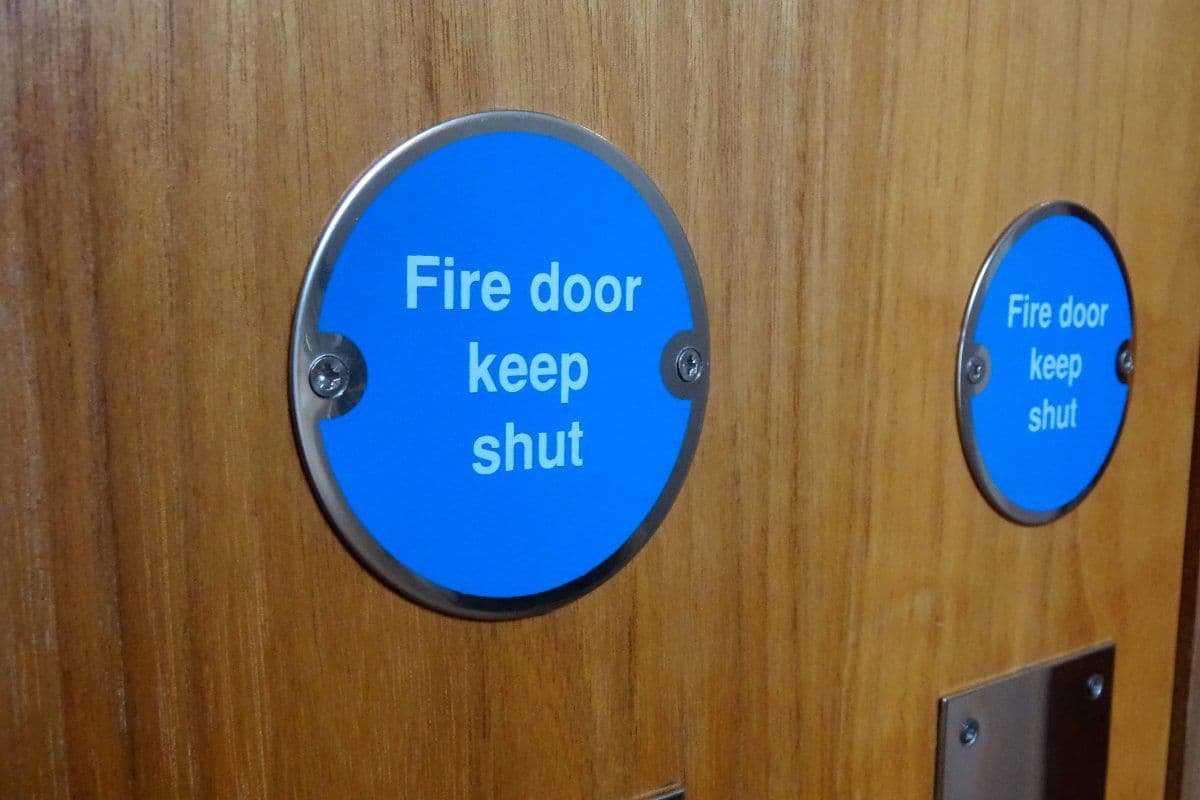
6. Glazing and signage. Vision panels should be fire-rated, intact and correctly beaded. Signage should match the door's function, and a self-closing door needs the appropriate keep-shut message.
7. Unauthorised modifications. The classic office failure. Cables drilled through a door for a meeting room screen, a letterplate cut in, a cat flap in a converted building, additional locks fitted. Any penetration not made by the manufacturer can void the door's rating.
8. The frame and the wall around it. The assembly includes the frame and its fixings, and the compartment wall the door sits in. Service penetrations above ceilings, made when cabling was run, undo the compartmentation the door exists to preserve.
Where offices go wrong
Need Expert H&S Guidance?
Our qualified consultants can help you implement the right health & safety measures for your business.
Four patterns, all fixable.
Nobody owns them. Fire doors sit between facilities, property and health and safety, and in leased buildings between tenant and landlord as well. An unowned asset is an unmaintained asset.
The fit-out changed the building. New partitions, moved doors, a reconfigured meeting suite. Compartmentation is a design feature, and altering the layout without revisiting it is how a compliant building becomes a non-compliant one quietly.
Checks happen but nothing is recorded. Article 17 requires a suitable system of maintenance, and an unrecorded walk-around is difficult to evidence as a system.
The findings do not get closed. A check that identifies a dropped door and produces no repair is worse than no check, because it evidences knowledge without action.
Frequency, decided properly
| Factor | Points toward more frequent checks | |---|---| | Traffic | Doors on main circulation routes, kitchens, stairwells | | History | Doors previously found wedged, dropped or damaged | | Recent works | Any area subject to fit-out, cabling or partitioning | | Building type | Complex layouts, multiple tenants, shared escape routes | | Occupancy | Higher density, sleeping risk, people needing assistance | | Ownership | Doors where responsibility is split or unclear |
Set an interval, record the reasoning, and adjust it based on what the checks find. A building where every check is clean can extend intervals with evidence. A building where doors are repeatedly found wedged needs a different conversation, and probably a hold-open solution rather than more inspections.
In leased and multi-tenant buildings
The recurring question with a fire-door-specific answer.
Doors in common parts, stairwells and risers are generally the landlord or operator's responsibility. Doors within your demise are generally yours. Doors on the boundary, particularly those onto a common corridor, are exactly where the ambiguity sits and exactly where the escape route depends on them working.
Where more than one responsible person has duties in respect of the same premises, they must co-operate and co-ordinate. Establish in writing who inspects which doors, at what frequency, and how findings are shared. Government guidance on workplace fire safety responsibilities sets out the framework, and the Fire Safety (England) Regulations 2022 explain the residential duties that may apply to your landlord for other parts of a mixed-use building.
For international groups
Fire safety is among the most nationally specific areas in this series, and fire door regimes vary in certification, rating conventions and inspection expectations.
A group standard describing what good looks like transfers. A frequency, a checklist format and a certification reference frequently do not. The workable approach is a group requirement that every site has a documented maintenance system for fire doors with a justified frequency, and a local determination of what that means in each jurisdiction.
Holding inspection records, findings and closure dates for every site in one register is where health and safety consultants and software are worth more together than either alone, and periodic health and safety audits confirm the checks are happening and the findings are being closed.
Where Arinite fits
Arinite's fire safety work covers the assessment that sets the frequency and the arrangements that follow from it. We support 1,500+ businesses across 50+ countries and protect 100,000+ employees, with 95%+ client retention over 15+ years. Our health and safety consultants work extensively with legal, finance and banking and IT and software organisations, most of them occupying premises they do not control, and a current fire risk assessment is what determines what your building actually needs.
Where sites span several countries, our global health and safety consultants establish local requirements, and our international health and safety consultants keep that current as buildings are refitted.
If your last fit-out moved walls and nobody revisited compartmentation, a free gap analysis will tell you what changed with them.
Related Articles
Written by
Arinite Health & Safety Consultants
Health & Safety Expert at Arinite