Skip to content

HSE inspections up 47% - HSE carried out over 13,200 workplace inspections in 2024/25.

ISO 45001 Consultants

ISO 45001 Certification:
Implementation, Audit, and Ongoing Support

Arinite's Chartered health and safety consultants deliver ISO 45001:2018 implementation, gap analysis, internal audits, and certification support for UK and international businesses. We take you from wherever you are today to a certified occupational health and safety management system ready for external audit.

Arinite is itself certified to ISO 45001:2018. We run the standard, we deliver the standard, and we support our clients through every stage of the certification process.

1,500+ Businesses Protected
50+ Countries
95%+ Retention
IOSH Chartered
ISO 45001:2018 Certified
Annex SL Aligned
Get in Touch

Contact Arinite Today

Fill out the form below and our team will get back to you within 24 hours.

By submitting, you agree to our Privacy Policy and consent to Arinite contacting you.

INTERNATIONAL STANDARD

What Is
ISO 45001?

ISO 45001:2018 is the international standard for occupational health and safety management systems. Published by the International Organization for Standardization in March 2018, it replaced the previous standard OHSAS 18001 after a three-year transition period that ended in March 2021.

The standard provides a framework for managing occupational health and safety risks systematically and improving performance over time. Certification to ISO 45001 demonstrates to employees, clients, regulators, and insurers that the organisation has a documented, implemented, and audited management system.

ISO 45001 is not a legal requirement in any jurisdiction. It is a voluntary management standard. However, it is often required or strongly expected by major clients, particularly in construction, manufacturing, and public sector procurement. For businesses bidding on international contracts, ISO 45001 is increasingly the minimum accreditation that procurement teams require.

LEGAL REQUIREMENT

Is ISO 45001
a Legal Requirement?

No. ISO 45001 is not a legal requirement anywhere in the world. It is a voluntary management system standard.

However, that does not mean it is optional for every business. Three scenarios commonly make ISO 45001 effectively mandatory:

1

Client requirements

Many major clients (particularly public sector bodies, construction principals, and multinational corporations) specify ISO 45001 as a prequalification condition for suppliers and contractors.

2

Tender requirements

ISO 45001 is commonly required or scored heavily in international tenders. It is the global equivalent of UK schemes like CHAS and SafeContractor.

3

Group policy or parent company requirements

Many multinational groups mandate ISO 45001 for all subsidiaries to ensure consistent global standards.

Achieving ISO 45001 does not replace the need to comply with local occupational health and safety law. In the UK, the Health and Safety at Work Act 1974 and its supporting regulations remain fully applicable. ISO 45001 sits on top of legal compliance as a management system framework.

STANDARD STRUCTURE

The Structure of ISO 45001:
Annex SL and the PDCA Cycle

ISO 45001 follows the Annex SL high level structure used by all modern ISO management system standards (ISO 9001, ISO 14001, ISO 27001, and others). This means ISO 45001 integrates with any other ISO management system an organisation holds.

The standard is built around the Plan-Do-Check-Act (PDCA) cycle:

P

Plan (Clauses 4-6)

Understanding the organisation and its context, identifying workers and interested parties, defining the scope of the management system, establishing leadership and commitment, assessing OH&S risks and opportunities, identifying legal and other requirements, and setting OH&S objectives.

D

Do (Clauses 7-8)

Providing resources, ensuring competence, building awareness, establishing communication, controlling documented information, implementing operational controls, managing change, and preparing for emergencies.

C

Check (Clause 9)

Monitoring, measuring, analysing, and evaluating performance. Conducting internal audits. Management review of the system's effectiveness.

A

Act (Clause 10)

Identifying and responding to incidents, nonconformities, and opportunities for improvement. Implementing corrective action. Continually improving the system.

OHSAS TRANSITION

ISO 45001 vs OHSAS 18001:
The Transition Explained

OHSAS 18001 was the previous occupational health and safety management standard, published by the British Standards Institution in 1999 and updated in 2007. It was replaced by ISO 45001:2018 on 12 March 2018, with a three-year transition period ending 11 March 2021.

Since March 2021, OHSAS 18001 certificates are no longer valid. Organisations that have not transitioned must achieve ISO 45001 certification from scratch rather than transitioning from OHSAS 18001.

The main differences between the two standards:

1

Context of the organisation

ISO 45001 requires understanding internal and external issues that affect the OH&S management system. OHSAS 18001 did not.

2

Leadership and worker participation

ISO 45001 places significantly greater emphasis on top management accountability and direct worker involvement in the OH&S management system.

3

Risk-based thinking

ISO 45001 adopts the risk and opportunity thinking common to all modern ISO standards. OHSAS 18001 was hazard-focused only.

4

Integration with other management systems

ISO 45001 uses the Annex SL high level structure, so it integrates cleanly with ISO 9001, ISO 14001, and others. OHSAS 18001 had a different structure.

5

Supply chain and procurement

ISO 45001 explicitly covers contractors, outsourced processes, and procurement. OHSAS 18001's coverage was weaker.

For organisations still holding expired OHSAS 18001 certificates or those that never migrated, Arinite provides full transition and implementation support.

BENEFITS

Benefits of ISO
45001 Certification

ISO 45001 certification delivers benefits across multiple dimensions:

1

Commercial benefits

Access to tenders that specify ISO 45001 as a prequalification requirement. Competitive advantage in supplier selection processes. Credibility with multinational clients and parent companies.

2

Operational benefits

Systematic identification and control of OH&S risks across the organisation. Clear ownership and accountability for health and safety at every level. Integration with other management systems if ISO 9001 or ISO 14001 are already in place. Continual improvement through the PDCA cycle.

3

Legal and regulatory benefits

Documented evidence of the employer's due diligence. Structured approach to identifying and meeting legal requirements. Reduction in the risk of enforcement action through demonstrable management of risk.

4

Reputational and employee benefits

Demonstrable commitment to employee wellbeing. Improved safety culture and worker engagement. Reduced insurance premiums in some cases.

For international businesses, ISO 45001 is particularly valuable because it provides a single framework that applies globally. Local legal compliance still varies by jurisdiction, but the management system itself is consistent across every country of operation.

CERTIFICATION PROCESS

The ISO 45001
Certification Process

The typical route to ISO 45001 certification follows five stages:

1

Stage 1: Gap Analysis

A review of current arrangements against the full requirements of ISO 45001. Produces a detailed gap register prioritising what needs to be created, updated, or improved. Typically takes 2-4 weeks depending on organisation size.

2

Stage 2: Implementation

Building the management system to address the identified gaps. Creating or updating policies, procedures, risk registers, objectives, operational controls, emergency arrangements, training records, and measurement frameworks. Typically takes 3-9 months depending on starting position and organisation complexity.

3

Stage 3: Internal Audit

A full internal audit of the management system to verify it meets the requirements of the standard and operates as documented. Identifies any remaining gaps before the external audit. Typically takes 1-2 weeks.

4

Stage 4: Management Review

A formal review by top management of the system's performance, improvement opportunities, resource needs, and objectives. Required before certification audit. Typically a structured half-day to full-day session.

5

Stage 5: Certification Audit

Conducted by an accredited certification body (not Arinite). Stage 1 audit reviews documentation. Stage 2 audit verifies implementation. A successful Stage 2 results in the ISO 45001 certificate, typically valid for three years with annual surveillance audits.

HOW WE HELP

How Arinite Supports
ISO 45001 Certification

Arinite provides end-to-end support from initial gap analysis through to successful certification, and beyond into ongoing surveillance and recertification. Our role stops only at the external audit itself, which must be conducted by an independent accredited certification body.

1

Gap analysis

Structured assessment of current arrangements against all ten clauses of the standard, with a prioritised action plan.

2

Implementation support

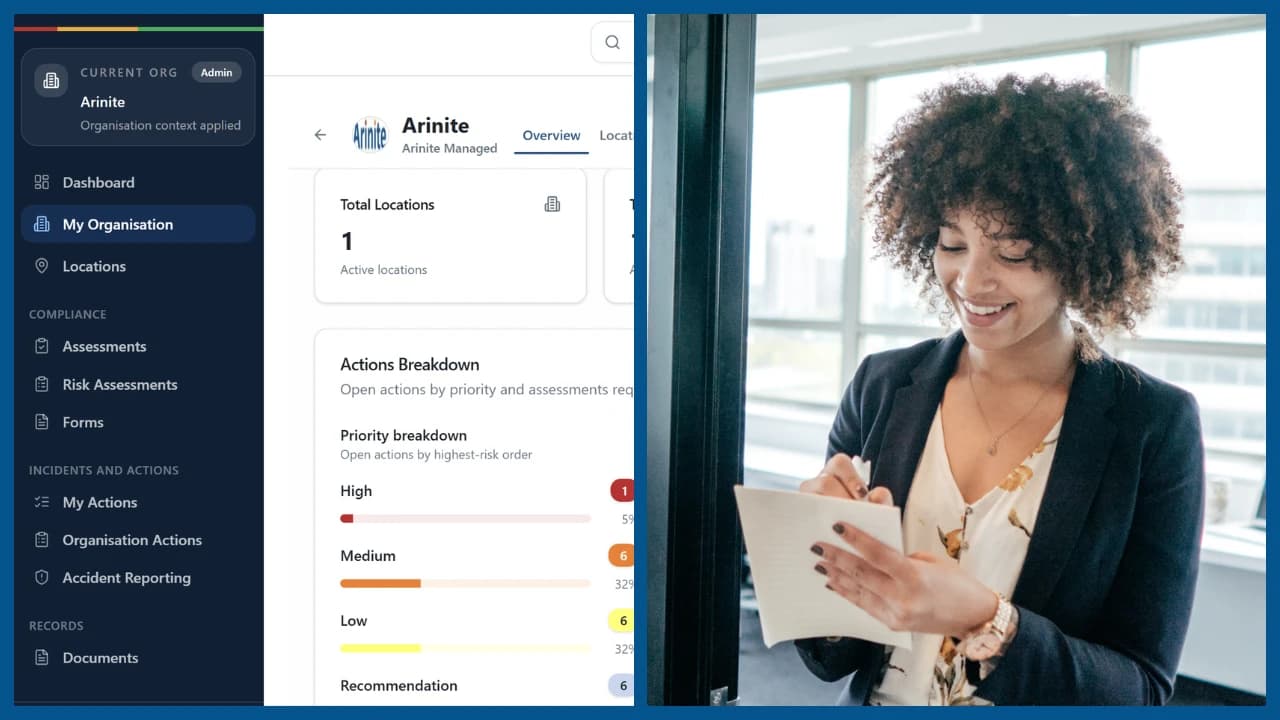
Building or rebuilding the management system with your internal team, delivering the documentation, procedures, and controls the standard requires. All deliverables maintained in Arinite's health and safety software platform.

3

Internal audit

Independent internal audit of the implemented system, conducted by a qualified lead auditor. Produces the internal audit report required by the standard and identifies any findings that need to be addressed before external audit.

4

Management review facilitation

We facilitate the management review session, producing the documented outputs the standard requires.

5

Certification audit support

Preparation of your team for the Stage 1 and Stage 2 audits, attendance and support during the audit where appropriate, and response to any findings.

6

Ongoing surveillance

After certification, the management system must be maintained, audited annually, and reassessed at three-year intervals. Arinite's outsourced health and safety packages include ISO 45001 maintenance as standard.

PRICING

How Much Does ISO
45001 Certification Cost?

ISO 45001 certification cost depends on organisation size, complexity, existing arrangements, and the certification body chosen. Every implementation is scoped and priced individually. The total cost typically falls across three main components:

£

Consultancy support

Gap analysis, implementation, internal audit: scoped against your starting position. Less is required if an existing management system is in place. Arinite provides detailed scoped quotes at the start of any engagement.

Certification body fees

Stage 1 and Stage 2 audits plus annual surveillance: paid directly to the certification body, with fees varying significantly by body, industry, and geographic reach. We help clients select an appropriate body.

Internal time and resource

The management system requires internal ownership. Expect 0.25 to 0.5 FTE of a suitable internal lead during implementation, reducing to minimal effort once the system is running.

For businesses on Arinite's Done For You or Done With You outsourced packages, ISO 45001 maintenance is included in the monthly fee once the system is in place. Initial implementation is typically a separate project fee on top of the monthly package.

For larger, multi-site, or international organisations, certification is scoped individually. Multi-site certification can be structured efficiently under ISO 45001's sampling provisions.

Get ISO 45001 Certified

Whether you need to achieve ISO 45001 from scratch, transition from expired OHSAS 18001, or maintain an existing certification, Arinite's Chartered consultants take you from today's starting position through to certification and beyond.

Book a free gap analysis call. In 30 minutes, one of our consultants will assess your current position against the standard, identify the priorities, and provide an indicative timeline and cost.