HSE inspections up 47% - HSE carried out over 13,200 workplace inspections in 2024/25.
Arinite delivers lone working compliance for UK businesses: risk assessments, policies, training, and monitoring arrangements for every employee who works without direct colleague supervision. Office-based businesses with field staff, home workers, early/late shift workers, and client-site visits all sit within the lone working scope under UK law.
Lone working is any work situation where an employee carries out their role without close or direct supervision from colleagues. HSE guidance INDG73 defines a lone worker as someone who works by themselves without close or direct supervision, whether for all or part of their working day.
Lone working is not confined to any one sector. Common lone working situations include field engineers visiting customer sites, estate agents conducting property viewings, community nurses and social workers visiting service users, security guards on overnight or weekend duty, retail staff opening or closing premises alone, home workers without shared workplace presence, reception or office staff working outside core hours, and cleaners working early morning or late evening.
Lone working is not inherently dangerous. Most lone working is routine and safe. The employer duty is to identify which lone working situations carry elevated risk, assess those risks systematically, and put appropriate controls in place.
No single piece of UK legislation specifically addresses lone working. The duty is derived from the general health and safety framework:
Section 2 places a general duty on every employer to ensure, so far as is reasonably practicable, the health, safety, and welfare at work of all employees. This general duty covers lone workers the same way it covers any other worker.
Regulation 3 requires employers to conduct a suitable and sufficient assessment of the risks to employees in the course of their work. Where lone working creates specific risks, these must be specifically assessed. Regulation 4 requires the principles of prevention to be applied to identified risks. Regulation 10 requires information to be provided to employees about risks and control measures.
HSE’s key guidance document for lone workers. Sets out the employer approach to lone working risk assessment, control measures, and monitoring arrangements. Not legally binding itself but widely cited as the practical standard for reasonable practicability.
Additional regulations apply depending on the lone worker's role. The Working Time Regulations 1998 cover hours and rest breaks. The Workplace Regulations 1992 cover welfare facilities. Specific hazards (manual handling, DSE, noise, vibration) are covered by their own regulations.
Common law duty of care and the Corporate Manslaughter and Corporate Homicide Act 2007 both extend to lone workers. Where a lone worker is harmed and the employer has failed to assess or control the risk, civil and criminal liability both apply.
Lone workers face the same general workplace risks as colleagues plus elevated exposure to specific categories where isolation increases harm potential.
Workers meeting members of the public (estate agents, field engineers in homes, social workers, community healthcare, retail closing shifts) face elevated risk of verbal abuse, threats, and physical violence. The risk is amplified because no colleague is present to assist or witness.
Medical emergencies (heart attacks, strokes, accidents) that would be minor among colleagues can become fatal when the worker cannot raise the alarm. Epilepsy, diabetes, and other medical conditions create specific lone working risk.
Extreme temperatures, poor lighting, hazardous terrain, and challenging weather all carry higher risk when working alone. A slip, trip, or fall that would be inconvenient in a staffed environment becomes serious when the worker is incapacitated and unable to seek help.
Prolonged isolation, absence of team support, and exposure to difficult client interactions without debrief contribute to stress, anxiety, and burnout. Work-related stress is a specific legal risk assessment category.
Field workers drive significant miles and face road traffic risks. Breakdowns, accidents, and fatigue-related incidents are higher when travelling alone.
A lone worker moving equipment, samples, or stock has no colleague assistance for heavy or awkward loads. Injury risk is higher and response to injury is slower.
Cash handling, valuables in transit, or access to controlled premises alone all present elevated crime risk, particularly out-of-hours.
Under the combined legal framework, every employer with lone workers must:
Identify who is working alone. Audit the workforce to identify all situations where employees work without direct colleague supervision. Include part-time, temporary, and contractor arrangements.
Assess the risks specific to lone working. Go beyond the general workplace risk assessment. Address each category of lone working separately (field staff face different risks to home workers who face different risks to shift workers).
Implement controls proportionate to identified risk. Follow the hierarchy: eliminate the lone working where possible, substitute (pair workers or reschedule), engineer controls (monitoring systems, lone worker devices), administrative controls (policies, check-in procedures, training), and personal equipment only as supporting measures.
Establish communication and check-in protocols. No lone worker should be out of contact during the working day. Check-in schedules, response protocols, and escalation arrangements should all be documented.
Provide lone working training. Every lone worker should understand the risks specific to their role, the controls in place, how to raise the alarm, and what to do if they feel threatened or unwell. Training should be refreshed periodically.
Provide lone working monitoring where risk warrants. For higher-risk roles, physical or electronic monitoring (dedicated devices, smartphone apps, check-in services) may be appropriate.
Have emergency response arrangements. When a lone worker fails to check in, raises the alarm, or is known to be at risk, the employer response should be clear, rapid, and documented.
Review arrangements when circumstances change. New roles, changes to client mix, changes to sites visited, or incidents should all trigger review of lone working arrangements.
Comply with RIDDOR for reportable incidents. Lone worker injuries that meet the RIDDOR threshold are reportable the same as any other workplace incident.
Document the lone working system. Risk assessment, policy, training records, monitoring arrangements, and incident reports should all be maintained and available for inspection.
Failure to comply exposes the business to HSE enforcement, civil claims, and personal liability for directors under Section 37 of the Health and Safety at Work Act 1974.
A lone working risk assessment follows the standard five-step HSE methodology but with specific considerations for isolation as a risk multiplier.
List every lone working situation in the business. For each, list the specific hazards: who is the worker, where are they working, what are they doing, who might they encounter, what could go wrong.
The primary risk is to the lone worker, but consider third parties (clients, members of the public) who could be affected by incidents. Consider workers with specific vulnerabilities: pregnant workers, young workers, those with medical conditions, new starters.
For each identified hazard, assess the likelihood and severity. Consider whether the lone working arrangement itself increases the severity (for example, a fall becomes more serious when response time is longer).
Document the assessment including the arrangements, controls, check-in procedures, monitoring systems, and emergency response plans. The documented assessment is the foundation for the lone working policy.
Review the assessment periodically and when circumstances change. New roles, incidents, client complaints, or near-misses should all trigger review.
Key control categories to consider include pairing workers or scheduling overlapping visits (eliminate the lone working), site-specific procedures (controlled access, visitor logging, panic buttons), communication technology (lone worker apps, check-in systems, dedicated devices), training and pre-visit risk assessment (client-specific risk ratings, red flag procedures), and incident response protocols (what happens when a check-in is missed, who responds, how quickly). See our health and safety audit service for wider compliance assessment.
A lone working policy sets out how the business manages lone working compliance day-to-day. It should cover: See also our health and safety policy guidance.
Scope and definitions. Who is a lone worker in the business, which roles are in scope, and how lone working situations are identified.
Responsibilities. Who owns the lone working programme (typically HR, Operations, or a named Health and Safety lead), what line managers must do, and what individual lone workers must do.
Risk assessment arrangements. How risks are assessed for each lone working situation, how often assessments are reviewed, and how findings drive controls.
Communication and check-in protocols. How workers report start/end of work, how check-ins are scheduled and escalated, what channels are used.
Monitoring arrangements. What monitoring tools are used (apps, devices, call-back services), how they are managed, and who responds to alerts.
Training requirements. What training each lone worker must receive, how often it is refreshed, and how it is documented.
Incident reporting. How lone working incidents (near misses, actual incidents, violence, threats) are reported, who investigates, and how findings drive improvements.
Emergency response. What the business does when a lone worker is known to be at risk, including call trees, out-of-hours response, and coordination with emergency services.
Review cycle. When the policy is reviewed, what triggers interim review, and how changes are communicated.
The policy is worthless without genuine implementation. Many UK businesses have a lone working policy on file that is not followed in practice. HSE inspectors and tribunal claims both look beyond the documentation to actual working arrangements.
Lone working risk varies significantly by sector. Arinite supports lone working compliance across the sectors below.
Estate agents face elevated lone working risk during property viewings: meeting unknown individuals at residential addresses, often out of standard working hours, sometimes with no prior identity verification. High-profile incidents (including the 1986 disappearance of Suzy Lamplugh) have driven sector-specific guidance including pre-viewing client verification, buddy systems, check-in procedures, and escalation protocols. The Suzy Lamplugh Trust provides sector-specific guidance that complements the general HSE framework.
Community nurses, social workers, occupational therapists, and home care workers visit vulnerable service users often in challenging home environments. Risks include medical emergencies during the visit, violence from family members or other occupants, infection control without facilities support, and psychological burden from repeated difficult visits. NHS lone worker policies typically include GPS-tracked monitoring devices and 24/7 monitoring services.
Telecoms engineers, utility workers, HVAC technicians, and similar field staff work at customer sites often in technical environments with specific hazards (working at height, confined spaces, electrical systems). Combine travel risk, manual handling, technical hazards, and occasional exposure to aggressive customers. Vehicle-based lone working adds vehicle accident risk and fatigue management.
Security officers, building wardens, night shift staff, and early morning/late evening workers face specific lone working risks including confrontation with intruders, health emergencies without colleagues, isolation during long shifts, and fatigue-related incidents. Sector-specific guidance and often specific licensing requirements apply.
Retail workers opening or closing alone face cash handling risk, customer aggression, and incident response without colleagues. Hospitality workers doing late shifts, cleaning staff arriving early, and staff working in remote parts of the premises all fall into lone working. Risk is highest at opening, closing, and during off-peak hours.
Home working creates lone working situations even when workers are not physically at risk. Mental health risks (isolation, overwork, lack of support), ergonomic risks (uncontrolled workstation via DSE assessment), and emergency response all apply. Hybrid working has increased lone working exposure significantly since 2020.
Delivery drivers, couriers, and distribution workers face vehicle risk, manual handling (often without assistance), time pressure, and occasional customer aggression. Vehicle breakdowns, route deviations, and fatigue all create additional risk categories.
Technology-based monitoring has become a standard component of lone working programmes for medium to higher-risk roles. Common categories include:
Smartphone-based apps provide check-in functionality, panic alarm activation, GPS tracking, and escalation to monitoring centres. Accessible and inexpensive but depend on phone battery, signal, and worker compliance.
Standalone devices with longer battery life, dedicated panic buttons, fall detection, and direct connection to monitoring centres. Higher upfront cost but more reliable than app-based solutions for higher-risk roles.
Human or automated services that contact lone workers at scheduled intervals and escalate if no response. Used in sectors where technology-based monitoring is less practical.
Location tracking with alerts if workers deviate from expected routes or enter flagged areas. Particularly useful for field staff and community healthcare.
Used in higher-risk sectors (retail, security, some healthcare) to deter incidents and capture evidence. Specific GDPR and privacy considerations apply.
The British Standard for lone worker monitoring services. Accredited providers meet specific response time, reliability, and process standards. Using a BS 8484 accredited service provides documented evidence of reasonable practicability.
Arinite does not sell lone worker devices or monitoring services. We provide independent assessment of what monitoring is appropriate for each lone worker category, help specify the requirements, and support procurement and implementation. This keeps our advice genuinely independent rather than tied to any specific product.
Every lone worker should receive training proportionate to their risk exposure. Typical training content includes: See our health and safety training service.
Awareness of lone working risks. General awareness of the specific risks in the worker’s role, the controls in place, and the rationale behind monitoring and check-in requirements.
Personal safety techniques. Conflict avoidance, de-escalation, recognising warning signs of potential violence, and safe retreat procedures. Particularly important for workers meeting members of the public.
Use of monitoring technology. Practical training on any app, device, or check-in system provided, including what triggers escalation and what to expect when the alarm is activated.
Emergency procedures. What to do in medical emergencies, violent incidents, or situations where the worker feels threatened. Including how to summon help when communication is restricted.
Reporting and near-miss procedures. How to report incidents, near-misses, and concerns. Building a reporting culture where concerns are raised before incidents occur.
Sector-specific content. Additional training relevant to the specific sector (property viewing protocols for estate agents, home visit safety for healthcare, forecourt safety for retail, etc).
Arinite delivers lone working training on-site or online, tailored to the specific roles in your business. Training is documented in Arinite’s health and safety software platform with individual certificates, attendance records, and content summaries.
Arinite's Chartered consultants deliver lone working compliance as part of our wider outsourced health and safety service.
Identification of all lone working situations in your business, often uncovering roles that were not previously recognised as lone working (particularly home workers, hybrid workers, and late-shift office staff).
Role-by-role assessment covering each lone working category with specific hazards, controls, and monitoring requirements.
Tailored policy covering scope, responsibilities, risk assessment arrangements, communication protocols, monitoring, training, incident reporting, and review cycle.
Independent advice on what monitoring technology is appropriate for each lone worker category, specification of requirements, and support through procurement and implementation.
Lone working awareness training for managers and lone workers, tailored to your specific sector and role profile.
Support when lone working incidents occur, including initial response coordination, investigation under the Management of Health and Safety at Work Regulations, and RIDDOR reporting where applicable.
Lone working documentation maintained in Arinite's health and safety software platform, with automated review scheduling, training refresh tracking, and incident logging.
For businesses on Arinite's Done For You or Done With You packages, lone working compliance is included in the service.
Lone working compliance costs vary significantly based on several factors: the number of lone worker categories in the business, the scope of monitoring technology deployed, whether training is delivered to a small team or across multiple locations, and whether ongoing compliance maintenance is required.
Number of lone worker roles and categories. A business with one lone worker role (for example, property agents) is quicker to assess and policy than one with six distinct lone worker categories (field engineers, home workers, late shift staff, reception, cleaning, security).
Workforce size. Training delivery scales with the number of lone workers requiring training.
Monitoring technology. App-based monitoring is typically lower cost than dedicated devices. Monitoring centre services add ongoing subscription costs. The right solution depends on the risk profile, not the cheapest option.
Geographic spread. Multi-site or multi-country businesses require additional coordination.
Ongoing vs project. A one-off risk assessment and policy costs less than ongoing compliance maintenance but provides no refresh or incident response capability.
Project-based: a one-off lone working audit, risk assessment, and policy package, scoped against the specific lone worker categories in the business.
Ongoing retainer: lone working compliance maintained as part of a Done For You or Done With You monthly arrangement, including refresh of assessments, training coordination, incident response, and documentation.
Hybrid: initial project to establish the programme followed by ongoing light-touch maintenance.
Rather than publish generic rates that rarely match any specific client situation, Arinite provides a tailored quote after a brief discovery call. A free gap analysis call with one of our Chartered consultants will give you a clear estimate for your specific situation, along with our recommendation on which engagement type fits.
Lone working is often the compliance area where businesses have the biggest gap between what their policy says and what actually happens. Home workers uncovered in the risk assessment. Field staff with no check-in procedure. Late shift workers no one thinks about.
Book a free gap analysis call. In 30 minutes, one of our Chartered consultants will review your current lone working arrangements, identify the gaps that matter, and give you a clear recommendation and indicative cost.
From Reactive Firefighting to Proactive Health & Safety Compliance
No formal HSE systems in place. Everything is reactive, waiting for something to go wrong. Documentation is missing or outdated.
This isn't just "non-compliant." It's criminally negligent. Directors face personal prosecution.
Basic HSE documentation is in place. Minimum legal requirements met. You can pass a basic audit.
Compliance is where most consultants get you, then leave. You're legal, but you're not optimised.
Systems run proactively, preventing problems before they occur. Compliance is distributed, not dependent on one person.
That's why 95%+ of clients renew year after year.

Robert Winsloe
Managing Director, Arinite
“We work with you to deliver peace of mind. We tailor our service provision to your business to provide proactive, pragmatic health and safety advice and that helps reduce costs by ensuring compliance with relevant health and safety legislation.”
Other Consultants
Get you to Stage 2 (Compliant) and disappear.
Arinite
Gets you to Stage 3 (Proactive) and keeps you there.
That's why we call it transformation, not just compliance.
Compliance
Traditional consultancies audit, report and leave. You get a document and the job of implementing it.
Control
Software companies give you dashboards and workflows without the knowledge to use them.
Coverage
Global businesses need consultants who know compliance in every jurisdiction.
Arinite
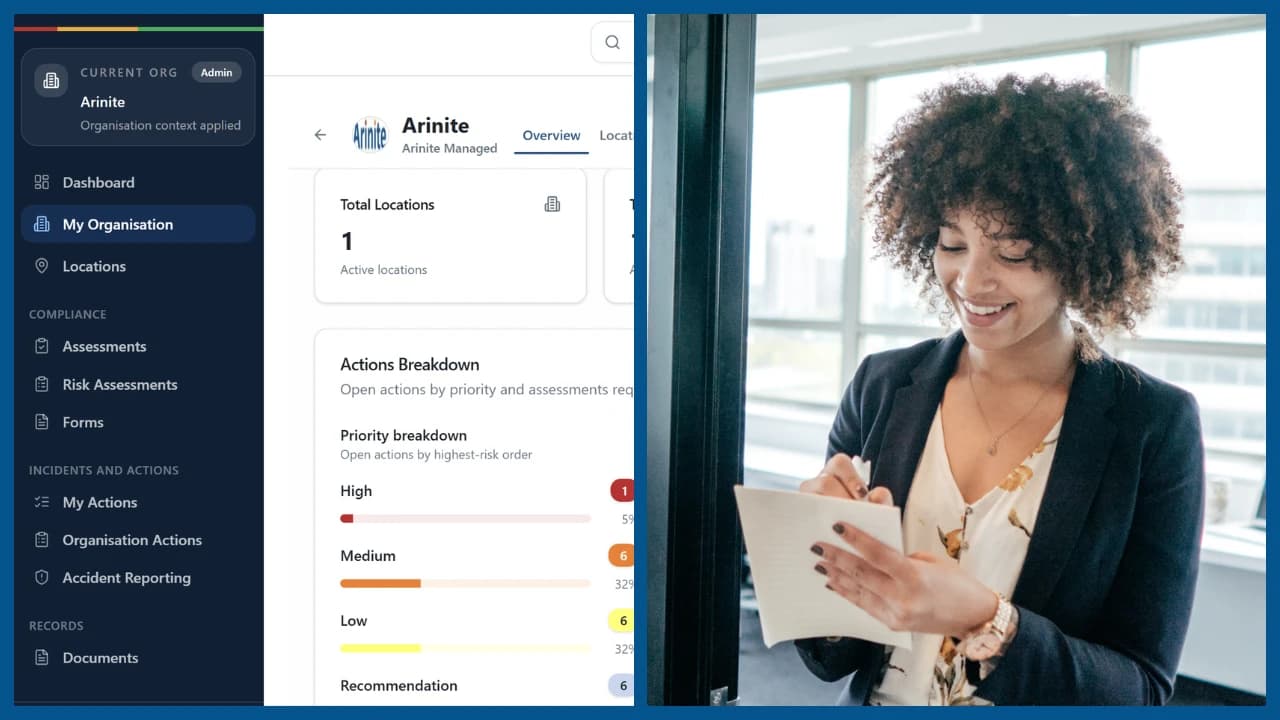
We are not a consultancy that adds external software. We are not a software company that recommends consultants.
We are the place where those two things finally become one.
50+ Countries. Global Safety. Local Trust.
Headquartered in London, UK, with Chartered health and safety consultants in 50+ countries. Whether you need a health and safety audit in Manchester, a fire risk assessment in Birmingham, or outsourced workplace health and safety compliance in Singapore, we have consultants near you.
We're expanding globally

Operations Director, Arinite
I have been in the health and safety business for 35+ years. In that time, I have had one consistent experience across every sector and every country I have worked in.
Every business we speak to already knows, somewhere, that their workplace health and safety compliance has not kept pace with their growth. It is not ignorance. It is busyness. It is the assumption that because nothing has gone wrong yet, the gaps are probably manageable.
What stops most businesses from doing something about it is not the cost of outsourcing health and safety support. It is the fear of finding out how significant the gaps are.
The Free Gap Analysis Call exists for exactly that moment.
You get the full picture of your workplace health and safety position in 30 minutes.
“In 35+ years, I have not once had someone tell us they wished they had stayed in the dark.”
No video testimonials available at the moment.
Join 1,500+ organisations that trust Arinite as their health and safety consultants.
Common questions about lone working compliance, risk assessment, policy, and monitoring
Our IOSH Chartered health and safety consultants are here to help with any queries about workplace safety, compliance, or our services.
Download our comprehensive library of expert guides, checklists, and templates.
Browse LibraryHave a question or need expert advice? We're here to help.
Fill out the form below and our team will get back to you within 24 hours.
Headquarters
29 Throgmorton St
London EC2N 2AT