Skip to content

HSE inspections up 47% - HSE carried out over 13,200 workplace inspections in 2024/25.

Spain Specialists

Health and Safety in Spain:
LPRL Compliance, Prevention Services, and Training for UK Businesses

Ley 31/1995 · Servicio de Prevención Ajeno · LISOS · Inspección de Trabajo

Arinite delivers full health and safety compliance for UK businesses operating in Spain. From the Ley de Prevención de Riesgos Laborales (LPRL) and its implementing decrees to the mandatory Servicio de Prevención arrangement, Delegados de Prevención elections, health surveillance, and Inspección de Trabajo readiness. One compliance partner. UK-managed. Spanish-delivered.

1,500+ Businesses Protected
50+ Countries
95%+ Retention
Ley 31/1995
SPA Accredited Partners
International Coverage
Get in Touch

Contact Arinite Today

Fill out the form below and our team will get back to you within 24 hours.

By submitting, you agree to our Privacy Policy and consent to Arinite contacting you.

LPRL

What Is the Ley de
Prevención de Riesgos Laborales?

The Ley de Prevención de Riesgos Laborales (LPRL), enacted as Ley 31/1995 of 8 November 1995, is Spain's foundational workplace health and safety law. It implements EU Directive 89/391/EEC and applies to every employer in Spain regardless of sector, size, or ownership.

The LPRL sets out the general employer duty to protect worker health and safety, the rights of workers to information, training, consultation, and participation, and the structure of the Spanish prevention system. It has been amended multiple times, most significantly by Ley 54/2003 (reform of the framework) and subsequent legislative packages.

The LPRL is supported by a set of Reales Decretos (Royal Decrees) that implement specific areas in detail. The most important for UK businesses operating in Spain are Real Decreto 39/1997 (Reglamento de los Servicios de Prevención), Real Decreto 486/1997 (workplace minimum conditions), Real Decreto 485/1997 (safety signage), Real Decreto 487/1997 (manual handling), and Real Decreto 488/1997 (DSE and visual display equipment).

REGULATORY FRAMEWORK

The Spanish Occupational
Safety Framework

The LPRL sits at the centre of a wider Spanish regulatory framework that UK businesses need to understand:

1

Primary Legislation

Ley 31/1995 (LPRL): the foundational law. Ley 54/2003: the 2003 reform strengthening integration of prevention into business management. Ley sobre Infracciones y Sanciones en el Orden Social (LISOS): the sanctions regime setting fines for non-compliance.

2

Real Decretos (Implementing Decrees)

Real Decreto 39/1997 (Reglamento de los Servicios de Prevención) on prevention service organisation. Real Decreto 486/1997 on workplace minimum conditions. Real Decreto 485/1997 on safety signage. Real Decreto 487/1997 on manual handling. Real Decreto 488/1997 on DSE. Real Decreto 171/2004 on Article 24 coordination of business activities. Plus sector-specific decrees for construction, chemicals, and other higher-risk activities.

3

Regulatory Bodies

Inspección de Trabajo y Seguridad Social (ITSS): the Spanish Labour and Social Security Inspectorate, with powers to inspect, issue requerimientos, impose sanctions, and halt dangerous work. Instituto Nacional de Seguridad y Salud en el Trabajo (INSST): the national technical body producing the Notas Técnicas de Prevención guidance documents. Comisión Nacional de Seguridad y Salud en el Trabajo (CNSST): the tripartite national advisory body.

4

Autonomous Community Bodies

Each Autonomous Community has its own regional authority: INVASSAT (Valencia), OSALAN (Basque Country), ISSGA (Galicia), INSHT for Madrid region, and equivalents elsewhere. These regional bodies accredit local prevention services, run regional inspection programmes, and publish regional guidance.

5

EU Framework

Spain implements the EU Framework Directive 89/391/EEC and the specific directives on workplace conditions, manual handling, DSE, PPE, chemical agents, and others. For UK businesses, the EU framework provides familiar territory even where the Spanish implementation details differ.

PREVENTION SERVICES

The Four Prevention Service
Models in Spain

Spanish law requires every employer to organise their prevention activity through one of four formal models. This is the single most important practical concept for UK businesses operating in Spain and has no UK equivalent.

1

Model 1: Asunción Personal (Employer Assumption)

Available only for businesses with fewer than 10 employees (up to 25 in single-centre premises) in lower-risk activities. The employer personally takes on prevention activities. Requires formal prevention qualifications at nivel básico minimum (50-hour course for low-risk sectors, 30-hour course for specific lower-risk activities). Rarely suitable for UK businesses with Spanish operations.

2

Model 2: Trabajador Designado (Designated Worker)

The employer designates one or more employees to perform prevention activities. The designated workers must hold formal prevention qualifications (nivel básico, intermedio, or superior depending on the specialism). Must have sufficient time and resources. Available to any employer. Uncommon in UK-operated Spanish businesses because it requires qualified internal Spanish staff.

3

Model 3: Servicio de Prevención Propio (Internal Prevention Service)

Mandatory for businesses with 500+ employees in Spain (or 250+ in higher-risk sectors). The business operates its own internal prevention service with qualified personnel covering the required specialist disciplines. Significant fixed cost; typically only justified for large operations.

4

Model 4: Servicio de Prevención Ajeno (External Prevention Service)

The employer contracts with an officially accredited external prevention service (SPA). This is the model used by the overwhelming majority of small and medium businesses in Spain and by almost every UK business with Spanish operations. The SPA must be accredited by the relevant Autonomous Community authority and must cover the four mandatory specialist disciplines: Seguridad en el Trabajo (safety at work), Higiene Industrial (industrial hygiene), Ergonomía y Psicosociología Aplicada (ergonomics and applied psychosociology), and Medicina del Trabajo (occupational medicine).

EMPLOYER DUTIES

Employer Duties Under
the LPRL

Under Article 14 and subsequent articles of the LPRL, every Spanish employer must:

1

Guarantee worker health and safety in all aspects related to work. This is the foundational duty from which specific obligations flow.

2

Conduct an evaluación de riesgos (risk evaluation) of every workstation and work activity, covering physical, chemical, biological, ergonomic, and psychosocial risks (riesgos psicosociales). Updated when conditions change and periodically in any case.

3

Develop a plan de prevención (prevention plan) integrated into the business management system under LPRL Article 16. A collection of disconnected documents does not satisfy this.

4

Plan and implement preventive activity based on the risk evaluation, following the principles of prevention in Article 15 LPRL (avoid risks where possible, evaluate those that cannot be avoided, combat at source, adapt work to the worker, replace dangerous with less dangerous, integrate prevention into planning, prioritise collective over individual protection, provide appropriate instructions).

5

Organise prevention through one of the four models, with appropriate formal documentation (concierto with an SPA, internal service documentation, or personal qualifications).

6

Provide formación (training) and información to every worker on risks specific to their role, preventive measures in place, and emergency arrangements. Training must be delivered on hiring, when tasks or technologies change, and periodically.

7

Provide vigilancia de la salud (health surveillance) where indicated by the risk evaluation, through qualified occupational medicine.

8

Consult workers through Delegados de Prevención (elected in businesses with 6+ employees) and, for businesses with 50+ employees, through a Comité de Seguridad y Salud.

9

Report workplace accidents and occupational diseases. Accidents causing more than one day of absence must be reported within five working days; fatal accidents or those affecting four or more workers must be notified within 24 hours.

10

Comply with Article 24 coordination obligations where multiple employers work at the same site.

11

Maintain documentation available to the Inspección de Trabajo on request.

Failure to comply can result in administrative sanctions, criminal prosecution, civil liability, and personal liability for company directors.

BY SECTOR

Health and Safety in
Spain by Sector

Arinite supports UK businesses across every office-based sector operating in Spain. The specific applicable ATECO-equivalent CNAE classification affects the training hours required, the SPA specialist emphasis, and the risk category, but the core compliance framework applies to all.

1

Health and Safety for Offices in Madrid

Madrid hosts the largest concentration of UK subsidiaries in Spain, particularly in finance, legal, professional services, and tech. Typical challenges include evaluation of office workstations for DSE and ergonomic risk under RD 488/1997, psychosocial risk assessment for high-pressure professional environments, and coordination with building-level fire safety and emergency arrangements. Madrid is part of the Comunidad de Madrid autonomous community.

2

Health and Safety for Offices in Barcelona

Barcelona is the second major UK business hub, particularly strong in technology, digital, fintech, and professional services. Operates under the Generalitat de Catalunya autonomous community framework, which has additional specific guidance through the Centre de Seguretat i Condicions de Salut en el Treball (Department of Business and Labour). Documentation must typically be available in both Castilian and Catalan in some contexts.

3

Technology and SaaS Companies in Spain

Tech companies face specific risk patterns: intensive DSE use, psychosocial risk from high-growth pressure and hybrid working, ergonomic issues in rapid-scale office environments, and often significant use of contractors and freelance workers (triggering Article 24 coordination). CNAE code 62 (computer programming, consultancy, related activities) is the typical classification.

4

Financial Services and Banking Operations

UK financial services subsidiaries in Spain face the standard office risk profile with additional regulatory scrutiny through sector-specific labour inspection priorities. Psychosocial risk assessment is particularly scrutinised in investment banking, trading, and client-facing roles. CNAE code 64 and 66 classifications apply.

5

Legal and Professional Services

Law firms, consulting firms, and accountancy practices operating in Spain. Risk profile similar to financial services. Particular attention to international travel, client-site working, and the coordination implications when professionals work at client premises.

6

Marketing, Creative, and Digital Agencies

Typically smaller operations (often under 50 employees), meaning a formal Comité de Seguridad y Salud may not be required but Delegados de Prevención still apply from 6 employees. Focus on ergonomic workstation assessment, psychosocial risk management, and integration of preventive culture into a fast-moving creative environment.

TRAINING

Prevention Training in Spain
(Formación en PRL)

Training under the LPRL is mandatory and prescriptively defined. The framework specifies both content and duration based on the risk level and role. Arinite's health and safety training service covers international delivery including Spain.

1

Formación general

Awareness-level prevention training for every worker, typically 6 hours, delivered on hiring. Covers the LPRL framework, worker rights and duties, general preventive principles, and emergency arrangements.

2

Formación específica

Workstation-specific training covering the particular risks and controls relevant to the worker's role. Duration varies by CNAE classification and role risk.

3

Formación de Delegados de Prevención

Specific training for elected prevention delegates on their legal rights, the risk evaluation, consultation procedures, and workplace inspection rights.

4

Formación de nivel básico, intermedio, y superior

Qualification training for prevention personnel. Nivel básico (basic level, 30-60 hours) suits the asunción personal model and designated worker role in lower-risk sectors. Nivel intermedio (intermediate, 300 hours) and nivel superior (superior, 600 hours plus specialist modules) suit internal prevention service personnel and SPA consultants.

Arinite delivers prevention training through our Spanish SPA partners in Spanish. Training is documented to the standard expected by the Inspección de Trabajo, with individual certificates, attendance records, and content summaries maintained in Arinite's health and safety software platform.

SANCTIONS

Sanctions and Enforcement
Under LISOS

Spanish sanctions for LPRL breaches are significantly higher than typical UK fines. Administrative fines under the Ley sobre Infracciones y Sanciones en el Orden Social (LISOS) are graded:

1

Leves (minor infractions)

Fines from €40 to €2,450. Cover documentation failures, minor procedural breaches, and similar issues.

2

Graves (serious infractions)

Fines from €2,451 to €49,180. Cover most substantive breaches including failure to conduct risk evaluations, failure to organise prevention services properly, failure to provide required training, or failure to maintain required records.

3

Muy graves (very serious infractions)

Fines from €49,181 to €983,736. Cover the most serious breaches including failure to act on identified grave and imminent risks, unsafe exposure to carcinogens or other extremely hazardous agents, repeated failures, and breaches linked to serious accidents.

Beyond administrative fines, the Inspección de Trabajo can issue requerimientos (formal notices) requiring specific corrective action within set timescales, order paralización (work halt) where grave and imminent risk exists, and refer cases to the Ministerio Fiscal for criminal prosecution.

Criminal penalties under Articles 316 and 317 of the Spanish Penal Code include fines and imprisonment of up to three years for wilful or negligent breaches that put workers at grave risk. Company directors and managers can be personally prosecuted.

Civil claims for worker injuries are pursued through the social courts (jurisdicción social) and can result in substantial compensation awards, often significantly higher than equivalent UK awards due to the Spanish lucro cesante (lost earnings) calculation methodology.

UK BUSINESS GAPS

Common Health and Safety Compliance Gaps for
UK Businesses in Spain

UK businesses with Spanish operations routinely fail Spanish compliance in predictable ways. The most common gaps are:

1

No formal prevention service arrangement

Every Spanish employer must have a formal Servicio de Prevención arrangement. UK businesses frequently operate for months or years without a concierto with an accredited SPA, believing that internal UK arrangements suffice.

2

No evaluación de riesgos in Spanish format

UK risk assessments do not satisfy the Spanish legal format. The evaluation must be in Spanish, cover every workstation, and include the specific psychosocial element.

3

Missing evaluación de riesgos psicosociales

Psychosocial risk evaluation is explicitly required under LPRL and is commonly missed by UK businesses applying UK-style templates that treat stress as a wellbeing topic rather than a mandatory risk assessment category.

4

No Delegados de Prevención elections

For businesses with 6+ employees, workers must elect prevention delegates. UK businesses routinely fail to organise these elections or even understand the obligation.

5

No Comité de Seguridad y Salud

For businesses with 50+ employees, the Committee is mandatory. UK businesses often treat it as a UK-style voluntary H&S committee rather than the prescriptive statutory body it is in Spain.

6

No plan de prevención under Article 16

A collection of documents is not a plan. LPRL Article 16 requires a written integrated plan setting out how prevention is organised within the business management system.

7

Health surveillance not organised

Vigilancia de la salud through qualified occupational medicine must be arranged where the risk evaluation indicates. UK businesses often confuse this with private health insurance. They are not the same.

8

Documentation in English only

All prevention documentation must be accessible to Spanish-speaking employees, Delegados de Prevención, and the Inspección de Trabajo. English-only documents fail the accessibility requirement.

9

No Article 24 coordination arrangements

Where multiple employers work at the same site (shared offices, client premises, contractor arrangements), coordination obligations apply. UK businesses routinely miss these.

10

Incorrect CNAE classification

The CNAE code affects training hours, SPA specialist emphasis, and risk category. Misclassification is common and creates cumulative compliance and cost issues.

Arinite's international health and safety service identifies and resolves each of these gaps as part of standard Spanish compliance onboarding.

HOW WE HELP

How Arinite Delivers Spanish
Health and Safety Compliance

Arinite provides Spanish compliance as part of our international health and safety service combining UK-based programme management with officially accredited Spanish SPA partners. Delivered as part of our outsourced health and safety model.

1

Accredited SPA partnership

Our Spanish partners hold official SPA accreditation from the relevant Autonomous Community authority and cover the four mandatory specialist disciplines: Seguridad en el Trabajo, Higiene Industrial, Ergonomía y Psicosociología Aplicada, and Medicina del Trabajo. The concierto with the SPA is in place from day one of your engagement.

2

Evaluación de riesgos and plan de prevención

Our Spanish consultants prepare the risk evaluation in the Spanish legal format, including the psychosocial element (evaluación de riesgos psicosociales), and develop the plan de prevención integrated with your business operations.

3

Delegados de Prevención support

Where worker representation structures are required, we support the election process, provide formación to the elected delegates, and facilitate the Comité de Seguridad y Salud in larger operations.

4

Vigilancia de la salud coordination

Health surveillance is organised through our Spanish occupational medicine partners (Medicina del Trabajo), with appointments, examinations, and aptitud laboral opinions integrated into the overall programme.

5

Formación delivery

Mandatory prevention training delivered in Spanish by qualified Spanish trainers, with individual certificates and records maintained in Arinite's health and safety software platform.

6

Inspección de Trabajo readiness

Documentation maintained in the format, language, and completeness the ITSS expects. Where an inspection occurs, your Spanish consultant attends on your behalf.

7

UK-based coordination

Your named Chartered consultant at Arinite UK manages the programme. You have a single UK point of contact who coordinates Spanish and any other international compliance activity, reports to your UK board or HQ, and ensures the programme aligns with your wider international strategy.

8

Consolidated reporting

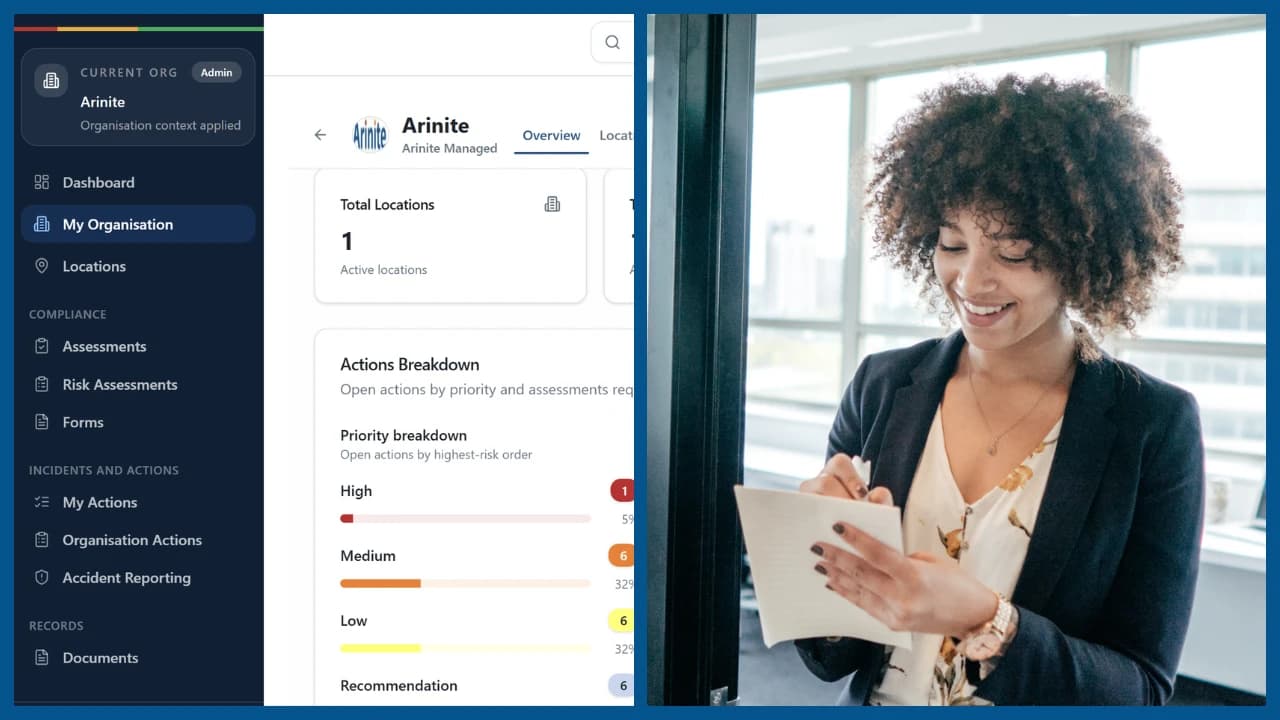
All Spanish compliance activity is maintained in Arinite's health and safety software platform alongside your UK and other international operations. One dashboard, every country.

9

Continuous maintenance

The LPRL framework, its implementing decrees, and Autonomous Community-level requirements evolve. We monitor changes and update your documentation as required.

PRICING

How Much Does Spanish Health
and Safety Compliance Cost?

Spanish compliance costs depend on company size, CNAE risk classification, number of sites, and scope of services required. Every engagement is scoped and priced individually. Cost typically falls across these components:

1

SPA concierto (external prevention service contract)

Annual concierto with the accredited Spanish SPA partner, scoped against headcount, CNAE classification, and the four mandatory disciplines. Larger operations scoped individually.

2

Initial evaluación de riesgos and plan de prevención setup

One-off setup scoped against the specific workstations and activities in scope.

3

Annual health surveillance (vigilancia de la salud)

Priced per employee depending on the examination protocol required by the risk evaluation. Standard office DSE protocols are lighter; chemical or specialist protocols heavier.

4

Formación (prevention training)

Priced per employee for formación general, with formación específica scoped against the specific role.

5

Delegados de Prevención formación

Priced per delegate for the required training package.

6

Ongoing Spanish compliance maintenance

As part of Arinite's Done For You or Done With You international packages: included in the monthly fee from your UK-managed account.

Rather than publish generic rates, Arinite provides a tailored quote after a brief discovery call. For UK businesses with multiple Spanish sites or planning rapid scaling in Spain, programme-level pricing is typically significantly more cost-efficient than commissioning services separately per site.

Get Spanish Health and Safety Compliance Right

Whether you are opening your first Spanish office or managing compliance across a mature multi-site Spanish operation, Arinite delivers locally accredited health and safety support coordinated from the UK.

Book a free international gap analysis call. In 30 minutes, one of our Chartered consultants will review your Spanish arrangements against the LPRL framework, identify the gaps that matter, and recommend the right approach.