Skip to content

HSE inspections up 47% - HSE carried out over 13,200 workplace inspections in 2024/25.

Manual Handling Guide

Manual Handling: Regulations,
Risk Assessment, and Workplace Compliance

A guide to manual handling compliance for UK businesses. This page covers the Manual Handling Operations Regulations 1992, the TILE framework for risk assessment, employer duties, common injuries, and how to stay compliant across offices, warehouses, healthcare, and other workplaces. Written by Chartered health and safety consultants.

Manual handling compliance for UK businesses. MHOR 1992, TILE framework, employer duties, sector-specific guidance.

1,500+ Businesses Protected
50+ Countries
95%+ Retention
IOSH Chartered
MHOR 1992
Free Gap Analysis
Get in Touch

Contact Arinite Today

Fill out the form below and our team will get back to you within 24 hours.

By submitting, you agree to our Privacy Policy and consent to Arinite contacting you.

UNDERSTANDING MANUAL HANDLING

What Is
Manual Handling?

Manual handling is any activity involving the transporting or supporting of a load by human effort, including lifting, lowering, carrying, pushing, pulling, holding, throwing, and restraining. A 'load' can be a box, a piece of equipment, a tool, a patient, an animal, or any other object moved by physical effort.

The Manual Handling Operations Regulations 1992 (MHOR) require employers to manage the risks associated with these activities. Manual handling remains one of the most common causes of workplace injury in the UK, accounting for more than a third of all reported non-fatal injuries according to HSE statistics.

Manual handling risk is not limited to heavy lifting. Repetitive movements, awkward postures, and prolonged carrying can all cause injury even when individual loads are light.

REGULATIONS

The Manual Handling
Operations Regulations 1992

The Manual Handling Operations Regulations 1992 (MHOR) are the primary legislation governing manual handling in the UK. They apply to every employer and every work activity involving manual handling.

The Regulations establish a clear hierarchy of controls that employers must follow:

1

Avoid

Avoid hazardous manual handling operations so far as is reasonably practicable. Use mechanical aids, redesign the process, or eliminate the handling activity entirely where possible.

2

Assess

Where manual handling cannot be avoided, assess the risk. This is the manual handling risk assessment.

3

Reduce

Reduce the risk of injury to the lowest level reasonably practicable. Use mechanical aids, change the load, modify the environment, or provide training.

There is no specific weight limit in the Regulations. Instead, the employer must consider the task, the individual, the load, and the environment together. The HSE publishes guideline figures for typical handling operations, but these are not legal limits. They are starting points for assessment.

Enforcement can result in improvement notices, prohibition notices, or prosecution. Fines are unlimited in the Crown Court.

TILE FRAMEWORK

The TILE Framework for
Manual Handling Risk Assessment

The TILE framework is the standard method for conducting a manual handling risk assessment under MHOR. TILE stands for Task, Individual, Load, Environment.

T

TTask

What is being done? How often? For how long? Does the task involve twisting, stooping, reaching up, or sudden movement? Are there frequent lifts or repetitive movements? Is the task performed at speed or under pressure?

I

IIndividual

Who is doing the task? Do they have the physical capability required? Have they been trained? Are they pregnant, young, or returning from injury? Are there individual factors that increase risk?

L

LLoad

What is being handled? How heavy is it? Is it bulky, awkwardly shaped, or difficult to grip? Is it unstable, hot, sharp, or contaminated? Can the load be divided, reshaped, or replaced with a lighter alternative?

E

EEnvironment

Where is the task taking place? Are there space constraints, uneven floors, obstacles, poor lighting, extreme temperatures, or noise? Is the environment itself contributing to the risk?

EMPLOYER DUTIES

Employer Duties
Under MHOR

The Manual Handling Operations Regulations 1992 place specific duties on employers:

1

Avoid hazardous manual handling where reasonably practicable, through mechanical assistance, process redesign, or elimination.

2

Assess the risk of any manual handling operation that cannot be avoided, using a structured framework such as TILE.

3

Reduce the risk of injury to the lowest level reasonably practicable, through engineering controls, administrative controls, and where necessary personal protective equipment.

4

Provide information and training to employees about the risks of manual handling and the controls in place.

5

Review assessments when circumstances change or at least periodically as good practice.

6

Record assessments and the decisions made, particularly for non-trivial operations.

Failure to comply can result in enforcement action, prosecution, and personal civil or criminal liability for directors under Section 37 of the Health and Safety at Work Act 1974.

COMMON INJURIES

Common Manual
Handling Injuries

Manual handling injuries are the single largest category of workplace injury in the UK. The most common injuries include:

1

Back injuries

Strains, sprains, and disc injuries are the most frequent. The lower back is particularly vulnerable to sudden lifts, twisting movements, and prolonged static postures.

2

Musculoskeletal disorders (MSDs)

Repetitive strain injuries affecting shoulders, elbows, wrists, and hands. Often develop over time from cumulative exposure rather than a single incident.

3

Slips, trips, and falls

Carrying a load reduces balance and visibility. Manual handling incidents frequently combine with slip or trip hazards.

4

Crush and impact injuries

Caused by dropping loads, loads falling from height, or collisions with equipment or structures.

Most manual handling injuries are preventable with appropriate assessment, control, and training. The economic cost of a single serious back injury (sick leave, temporary staff, retraining, potential litigation) typically exceeds the cost of a comprehensive workplace manual handling programme.

SAFE LIFTING

Safe Lifting Techniques

Where manual handling cannot be avoided, the following techniques reduce the risk of injury:

1

Plan the lift. Check the weight and balance of the load. Confirm the destination is clear. Consider whether mechanical aids or assistance from colleagues would be safer.

2

Adopt a stable position. Feet shoulder-width apart, one foot slightly forward for balance.

3

Get a firm grip. Hold the load close to the body. Use handles where available.

4

Keep the back straight. Bend at the knees and hips, not the waist. Lift with the legs, not the back.

5

Do not twist. Turn the feet rather than rotating the spine. Avoid bending sideways.

6

Move smoothly. No jerky movements. Keep the head up and looking forward.

7

Put the load down at waist height where possible. Reverse the lifting technique.

These techniques are taught in manual handling training and should be practised regularly to reinforce safe habits.

BY SECTOR

Manual Handling in
Different Workplaces

Manual handling risk varies significantly by sector. Arinite delivers sector-specific manual handling support across the industries below.

1

Manual Handling in Offices

Office manual handling is often underestimated. Risks include moving deliveries and supplies, relocating equipment, handling archive boxes, rearranging furniture, and awkward postures from DSE-related activities. Training should address the specific manual handling tasks your office employees actually perform.

2

Manual Handling in Warehouses and Distribution

High-risk environment with frequent lifting, carrying, and loading. Risk assessment must address pallet handling, stock picking, loading bay activities, and the use of mechanical aids. Training must be practical and task-specific, not generic.

3

Manual Handling in Healthcare and Care Homes

Specialist area involving patient handling, equipment handling, and pharmaceutical handling. Governed by MHOR plus additional sector guidance from bodies such as the National Back Exchange. Hoists, slide sheets, and other mechanical aids are the expected standard for patient moving and handling.

4

Manual Handling in Retail and Hospitality

Risks include stock replenishment, cash handling bags, catering equipment, furniture rearrangement, and delivery receipt. Often combined with time pressure and varied shifts, which increase injury risk.

5

Manual Handling in Construction and Facilities

Heavy loads, awkward environments, and frequent handling make construction and facilities management one of the highest-risk sectors. Strict adherence to the hierarchy of controls (avoid, assess, reduce) is essential.

TRAINING

Manual Handling Training

Manual handling training is a legal requirement for employees whose work involves manual handling. Under Regulation 4(1)(b)(ii) of MHOR, employers must provide 'appropriate training' and keep it current.

Effective training is practical, not theoretical. A classroom session on the Regulations is useful but insufficient on its own. Training should include demonstration of correct techniques for the specific loads and tasks in the workplace, hands-on practice by participants under supervision, discussion of the TILE framework with workplace examples, and refresher training to reinforce safe habits.

Arinite delivers manual handling training on-site or online by experienced trainers with real-world sector experience. Courses are tailored to your workplace, your actual loads, and your actual tasks. We do not deliver generic content.

For businesses that want their own employees to assess manual handling risks internally, we also deliver manual handling assessor training. For full course details, pricing, and booking, visit our health and safety training page.

HOW WE HELP

How Arinite Supports
Manual Handling Compliance

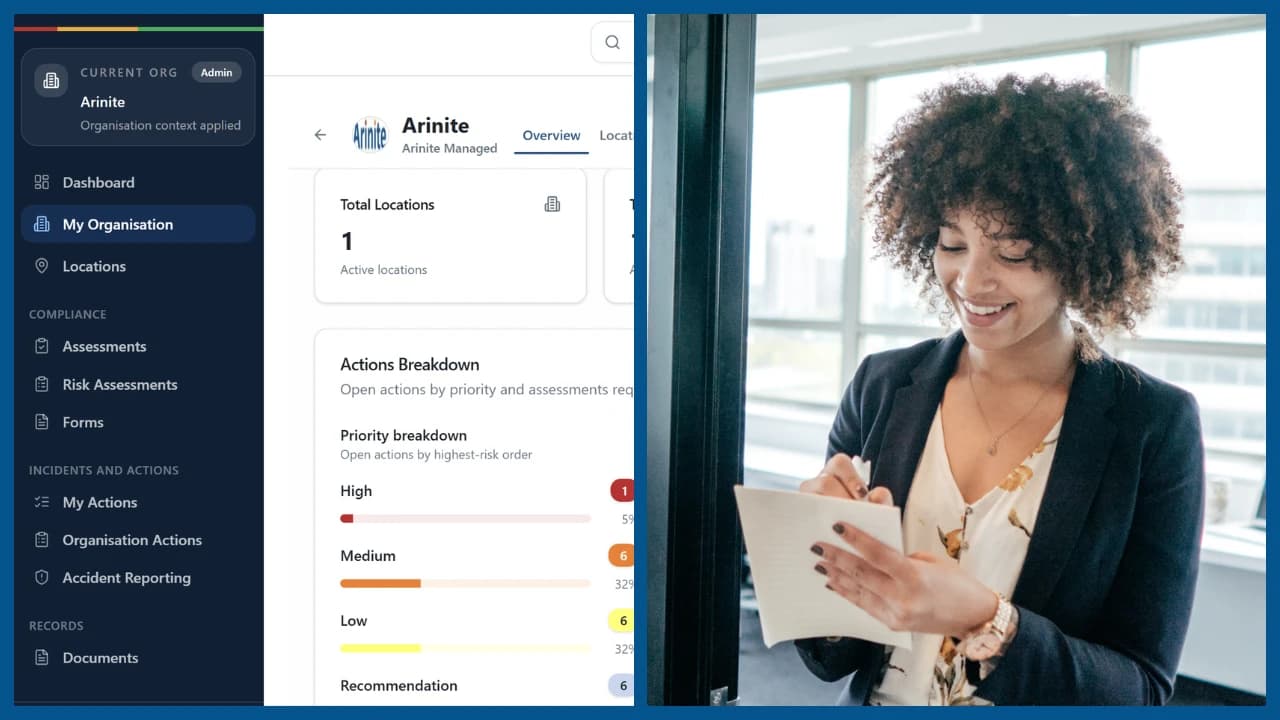
Arinite's Chartered health and safety consultants provide manual handling compliance support as a standalone service or as part of an ongoing outsourced health and safety package. The service includes structured manual handling risk assessments for every task type in your workplace, development of manual handling policies and safe systems of work, delivery of sector-specific manual handling training at all required levels, recommendation of mechanical aids and process improvements to reduce handling risk, and ongoing maintenance of manual handling records within Arinite's health and safety software platform.

For businesses on Done For You or Done With You packages, manual handling compliance is included in the service. For businesses seeking standalone support, all services are available individually.

Get Your Manual Handling Compliance Right

Manual handling accounts for more than a third of reported workplace injuries in the UK. Most are preventable with proper assessment, control, and training.

Book a free gap analysis call. In 30 minutes, one of our Chartered consultants will review your current manual handling arrangements and recommend the right approach for your workplace.