HSE inspections up 47% - HSE carried out over 13,200 workplace inspections in 2024/25.
Australian work health and safety (WHS) is governed by a nationally harmonised system built on the model WHS laws developed by Safe Work Australia. The Commonwealth, New South Wales, Queensland, South Australia, Tasmania, the Australian Capital Territory, the Northern Territory and Western Australia have each enacted a Work Health and Safety Act based on the model. Victoria operates under its own Occupational Health and Safety Act 2004. Every Australian jurisdiction now has a positive duty on Persons Conducting a Business or Undertaking (PCBUs) and their officers, a separate officer due diligence duty under Section 27, mandatory management of psychosocial hazards, and a criminal offence of industrial manslaughter carrying penalties of up to $20 million for body corporates and 25 years imprisonment for individuals. Arinite delivers the compliance framework Australian and international businesses need: WHS gap analysis, risk management, psychosocial risk controls, officer due diligence support, policy and consultation systems, and ongoing compliance monitoring. One compliance partner. One integrated H&S system. Across every Australian jurisdiction.
Work health and safety (WHS) is the term used across Australia for the statutory framework governing the protection of workers and others affected by work. The framework is built on the model Work Health and Safety Act developed by Safe Work Australia in 2011 and adopted, with minor jurisdictional variations, by the Commonwealth and every state and territory except Victoria. Victoria continues to operate under the Occupational Health and Safety Act 2004, which delivers substantially similar duties using older OHS terminology.
The model WHS laws are made up of three components that operate together: the model WHS Act, the model WHS Regulations, and a suite of model Codes of Practice. The Act establishes who holds duties and what those duties are. The Regulations set out specific, prescriptive requirements for particular hazards and activities. The Codes of Practice provide practical guidance on how to comply, are admissible in court proceedings, and may be relied upon by courts as evidence of what is reasonably practicable.
Safe Work Australia develops and maintains the model laws. It does not enforce them. Enforcement sits with the WHS regulator in each jurisdiction: SafeWork NSW, Workplace Health and Safety Queensland, SafeWork SA, WorkSafe ACT, NT WorkSafe, WorkSafe Tasmania, WorkSafe WA, Comcare (for the Commonwealth scheme) and WorkSafe Victoria (under the Victorian OHS regime). Each regulator inspects workplaces, issues notices, prosecutes offences, and operates the workers compensation scheme in its jurisdiction.
WHS law in Australia is built around three foundational concepts. First, the duty holder is broadly defined: the term Person Conducting a Business or Undertaking (PCBU) deliberately captures companies, partnerships, sole traders, unincorporated associations, government agencies and not-for-profits. Second, duties are owed not only to direct employees but to all workers (including contractors, subcontractors, labour hire, volunteers and work experience participants) and to any other person who could be put at risk by the work. Third, the standard of compliance is "reasonably practicable", which requires the duty holder to weigh likelihood, harm, knowledge and cost when determining the control measures it must implement.
PCBU is the foundational duty-holder concept in Australian WHS law. A PCBU is any person or entity conducting a business or undertaking, whether alone or with others, whether or not for profit or gain. The definition deliberately captures every working arrangement and structure: incorporated companies, unincorporated associations, partnerships, sole traders, self-employed persons, government departments and agencies, public authorities, schools, universities, and not-for-profit organisations. Partners in a partnership are individually and collectively a PCBU. A PCBU is usually the employer in the traditional sense, but the term captures relationships that older OHS terminology missed: principal contractors, head contractors, labour hire firms, franchisors in some circumstances, and any entity whose business involves work being done by another person. PCBUs hold the Section 19 primary duty of care, and their officers hold the separate Section 27 due diligence duty.
WHS interacts with several adjacent legal frameworks including the Fair Work Act 2009, state workers compensation legislation, anti-discrimination law, and sector-specific regulators. For comparable international frameworks see our pages on HSE (UK), OSHA (USA), HSA (Ireland), and ISO 45001.
The framework rests on three foundational concepts:
Broadly defined duty holders (PCBUs) capturing every working arrangement and structure
Duties owed to all workers including contractors, labour hire, volunteers and any other person at risk
A "reasonably practicable" standard that weighs likelihood, harm, knowledge and cost
Australian WHS compliance is not derived from a single statute. The duty holder must operate within a layered framework of model laws, jurisdictional Acts, Regulations, Codes of Practice and case law. See our health and safety legislation guide for cross-jurisdictional comparison.
Developed by Safe Work Australia and finalised in June 2011, the model WHS Act is the template adopted (with jurisdictional variations) by the Commonwealth, NSW, QLD, SA, Tas, ACT, NT and WA. It sets out the primary duty of care, the duties of officers and workers, consultation requirements, enforcement powers, the role of Health and Safety Representatives (HSRs), and the category 1, 2 and 3 offence structure. Western Australia harmonised in March 2022. Victoria has not adopted the model and operates under the Occupational Health and Safety Act 2004 (Vic).
Section 19 of the WHS Act places the primary duty of care on the PCBU: to ensure, so far as is reasonably practicable, the health and safety of workers while at work in the business or undertaking, and of any other person who may be put at risk from work carried out as part of the business or undertaking. "Health" is defined to include both physical and psychological health. The duty cannot be transferred or delegated.
Officers (directors, secretaries, partners, and any person making decisions that affect the whole or a substantial part of the business) hold a separate and concurrent duty under Section 27. They must exercise due diligence to ensure the PCBU complies with its WHS duties. Due diligence has six prescribed elements: acquiring up-to-date WHS knowledge, understanding the nature of the business, ensuring appropriate resources, ensuring information about hazards and incidents is received and responded to, ensuring processes for legal compliance, and verifying the provision and use of those resources and processes.
Workers must take reasonable care for their own health and safety, take reasonable care that their acts or omissions do not adversely affect others, comply with reasonable WHS instructions, and cooperate with WHS policies and procedures of the PCBU.
The Regulations sit beneath the Act and prescribe specific requirements for managing identified hazards: hazardous chemicals, hazardous manual tasks, plant and equipment, electrical safety, confined spaces, work at heights, asbestos, lead, noise, remote and isolated work, high-risk construction work, major hazard facilities, and (since 1 April 2023 at Commonwealth level) psychosocial hazards. Each jurisdiction has its own version of the Regulations.
Codes of Practice are approved practical guides to compliance. Where a Code is approved in a jurisdiction it is admissible in court as evidence of what is known about a hazard, risk or control. Courts may rely on a Code to determine what is reasonably practicable. In Queensland and (from 2025) New South Wales, Codes have additional force: PCBUs must comply with the Code or manage hazards to an equivalent or higher standard.
Following the 2018 Boland Review of the model WHS laws, amended Regulations on psychosocial hazards commenced in the Commonwealth jurisdiction on 1 April 2023 and have since rolled out across the country: NT (1 July 2023), SA (25 December 2023), and Victoria's standalone psychosocial regulations (December 2025). PCBUs must now specifically identify and manage psychosocial hazards including high job demands, low job control, poor support, low role clarity, poor change management, poor organisational justice, traumatic events, remote or isolated work, violence and aggression, and bullying and harassment.
Industrial manslaughter is now a criminal offence in every Australian jurisdiction. The offence applies where a PCBU or officer engages in conduct that causes the death of a worker and was negligent or reckless. Penalties vary: NSW carries the highest financial penalty at $20 million for body corporates and 25 years imprisonment for individuals. The Northern Territory and Tasmania carry life imprisonment for individuals. There is generally no limitation period for industrial manslaughter proceedings.
Each state and territory operates its own workers compensation scheme through its WHS regulator (SafeWork NSW, WorkCover QLD, ReturnToWorkSA, etc.) or through dedicated insurers. The Commonwealth scheme is administered by Comcare. Workers compensation is separate from WHS compliance but is often the first place psychosocial injury claims surface, and is therefore a leading indicator of WHS exposure.
The Fair Work Act intersects with WHS at several points: the general protections provisions protect workers exercising WHS rights, the anti-bullying jurisdiction of the Fair Work Commission provides a parallel pathway to WHS for workers experiencing workplace bullying, and recent amendments criminalising industrial manslaughter at Commonwealth level were enacted through the Fair Work Legislation Amendment (Closing Loopholes) Act 2023.
The standard of compliance under the WHS Act is "so far as is reasonably practicable". This is the single most important phrase in Australian WHS law. Section 18 of the Act defines what duty holders must take into account when determining what is reasonably practicable.
How likely is the hazard or risk to occur? Higher likelihood demands more rigorous controls.
What is the severity of harm that might result if the hazard or risk eventuated? Higher potential harm demands more rigorous controls. Fatal or serious harm justifies controls that would not be required for minor harm.
What does the duty holder know, or what ought it reasonably to know, about the hazard, the risk, and the ways of eliminating or minimising it? Industry knowledge, regulator guidance, Codes of Practice, sector standards and incident history all inform what is reasonably knowable.
What controls are available to eliminate or minimise the hazard or risk, and are they suitable for the work? Controls higher in the hierarchy of control (elimination, substitution, engineering, administrative, PPE) are presumed more reasonably practicable than those lower in the hierarchy.
After the first four factors have been considered, cost is relevant only if it is grossly disproportionate to the risk. Cost is the last consideration, not the first. The model laws are explicit that the cost of compliance does not override the duty.
The hierarchy of control is mandatory under the WHS Regulations. PCBUs must first attempt to eliminate the hazard. If elimination is not reasonably practicable, the PCBU must minimise the risk through substitution, isolation or engineering controls (in that order). Administrative controls and personal protective equipment are the lowest forms of control and must not be relied upon where higher controls are reasonably practicable.
The PCBU primary duty under Section 19 is operationalised through a series of specific duties. Every PCBU, regardless of size or sector, must:
Provide and maintain a work environment without risks to health and safety, including the physical workplace, plant, structures, substances and systems of work.
Provide and maintain safe plant, structures and systems of work, including processes for managing change.
Ensure the safe use, handling and storage of plant, structures and substances.
Provide adequate facilities for the welfare of workers, including drinking water, washing facilities, eating areas, toilets and personal storage.
Provide information, training, instruction and supervision necessary to protect workers from risks to their health and safety, in a form accessible to workers.
Monitor the health of workers and the conditions at the workplace for the purpose of preventing illness or injury.
Consult, cooperate and coordinate with other duty holders who hold concurrent duties (for example, on shared sites, in supply chains, in labour hire arrangements, or with landlords and property managers).
Consult with workers on WHS matters that directly affect them, including risk assessments, control measures, changes that may affect health and safety, and decisions about welfare facilities.
Facilitate the election of Health and Safety Representatives (HSRs) where requested, and respond to requests, recommendations and Provisional Improvement Notices (PINs) issued by HSRs.
Notify the regulator of notifiable incidents (death, serious injury or illness, or dangerous incidents) and preserve the incident site until the inspector arrives or authorises otherwise.
Identify, assess and control psychosocial hazards in accordance with Part 3.2 Division 11 of the WHS Regulations and the relevant Code of Practice. This is a specific, prescribed duty, not a general wellbeing obligation.
Maintain records demonstrating risk management activity, training, consultation, incident notification, and review.
Failure to comply exposes the business to regulator enforcement (improvement notices, prohibition notices, infringement notices, prosecution), category 1, 2 or 3 offences, industrial manslaughter prosecution where a worker has died, workers compensation premium impact, civil claims, and reputational damage. For outsourced WHS support covering each of these duties, see our service tiers.
Officers of a PCBU (including directors, partners, and senior executives who make decisions affecting the whole or a substantial part of the business) carry their own personal duty under Section 27 of the WHS Act. They cannot discharge this duty by delegation. Section 27(5) prescribes six specific elements of due diligence. Courts have made clear that simply employing a WHS manager is not sufficient: officers must take an active and inquisitive role.
Acquire and keep up to date knowledge of work health and safety matters. Officers must demonstrate ongoing engagement with regulatory change, sector incident trends, and emerging hazards. Annual board briefings, regulator updates and ongoing professional development are evidence.
Gain an understanding of the nature of the operations of the business or undertaking and the hazards and risks associated with those operations. Officers cannot rely on generic WHS knowledge: they must understand the specific risk profile of their business.
Ensure the PCBU has available for use, and uses, appropriate resources and processes to eliminate or minimise risks. This includes financial, human and informational resources. Underfunded WHS programmes are an officer due diligence failure.
Ensure the PCBU has appropriate processes for receiving and considering information about incidents, hazards and risks, and for responding in a timely way. Board-level WHS reporting, incident escalation pathways and review of close calls are evidence.
Ensure the PCBU has, and implements, processes for complying with its duties and obligations under the WHS Act and Regulations. This is the audit and management system evidence: policies, procedures, training records, risk registers, consultation records.
Verify the provision and use of the resources and processes referred to above. Officers cannot accept assurances passively. They must check, test, audit, and document. The 2023 NSW District Court decision in SafeWork NSW v Miller Logistics & Doble confirmed that an officer's "hands on" verification was central to a successful due diligence defence.
Officer due diligence is documented through board minutes, sub-committee reports, audit findings, incident logs, training records and the personal records of the officer. Arinite supports officers and boards directly with WHS audits, board reporting, and due diligence advisory.
Following the 2018 Boland Review, the model WHS Regulations were amended to specifically address psychosocial hazards. The Commonwealth Regulations took effect on 1 April 2023. Other jurisdictions have followed: Northern Territory (1 July 2023), South Australia (25 December 2023), and Victoria's standalone psychosocial regulations (December 2025). NSW overhauled its WHS Regulation in August 2025.
Under the amended Regulations, a psychosocial hazard is defined as a hazard that arises from, or relates to, the design or management of work, a work environment, plant at the workplace, or workplace interactions or behaviours, and may cause psychological harm (whether or not it may also cause physical harm). PCBUs must apply the standard risk management process (identify, assess, control, review) to psychosocial hazards on the same footing as physical hazards.
Workloads, work pace, time pressure, emotional demands and cognitive demands that are either excessive or insufficient.
Limited ability to influence how, when or where work is done. Low autonomy, low decision-latitude, and rigid procedures.
Inadequate practical assistance, information, equipment, training or emotional support from supervisors and colleagues.
Unclear or conflicting expectations about responsibilities, outcomes and standards of work.
Restructures, technology changes, leadership changes or other change handled without adequate consultation, planning or support.
Inconsistent, unfair or non-transparent decision-making about pay, promotion, performance, allocation of work, or grievances.
Exposure to actual or threatened death, serious injury, sexual violence, abuse or neglect, including secondary exposure for those who must respond to or process such material.
Work performed in isolation from others, with limited assistance available in the event of an emergency or distress.
Heat, cold, noise, poor air quality, poor lighting, or otherwise unpleasant or hazardous physical conditions that contribute to psychological strain.
Verbal abuse, threats, intimidation, physical assault, including from customers, clients, patients and members of the public.
Repeated unreasonable behaviour directed at a worker that creates a risk to health and safety.
Unwelcome conduct that a reasonable person would anticipate could humiliate, offend, intimidate or threaten. Sexual harassment is a specific risk category with parallel duties under the Sex Discrimination Act 1984 (Cth) and state equal opportunity legislation.
Persistent interpersonal conflict, including team dysfunction, that is not effectively managed.
For deeper guidance on psychosocial risk frameworks compared internationally, see our stress and mental health at work page. ISO 45003:2021 provides an aligned international standard that integrates psychosocial risk management into an ISO 45001 management system.
The model WHS Act creates a three-tier offence structure for breaches of WHS duties, with industrial manslaughter sitting above as a separate criminal offence. Penalty unit values are indexed annually and vary by jurisdiction. NSW values (2025-26) are shown as illustrative; other jurisdictions follow comparable structures with their own penalty unit values.
The duty holder, without reasonable excuse, engages in conduct that exposes a person to a risk of death or serious injury or illness, and is reckless as to that risk. In NSW (2025-26), maximum penalties are approximately $1.1 million for an individual (5 to 10 years imprisonment), $2.3 million for a PCBU or officer who is an individual, and $11.1 million for a body corporate.
The duty holder fails to comply with a health and safety duty and the failure exposes a person to a risk of death or serious injury or illness. Recklessness is not required. In NSW (2025-26), maximum penalties are approximately $223,000 for an individual, $447,000 for a PCBU or officer, and $2.2 million for a body corporate.
The duty holder fails to comply with a health and safety duty. No exposure to risk of death or serious injury is required. Lower-tier offence but still significant: in NSW (2025-26), maximum penalties run into the hundreds of thousands for body corporates.
Where a PCBU or officer engages in conduct that causes the death of a worker, and was negligent or reckless about causing the death, industrial manslaughter applies. All Australian jurisdictions now have this offence. NSW carries the highest financial penalty ($20 million for body corporates, 25 years imprisonment for individuals). The Northern Territory and Tasmania carry life imprisonment for individuals. There is generally no statutory limitation period.
Beyond prosecution, regulators issue improvement notices (requiring correction within a specified period), prohibition notices (immediately stopping unsafe work), infringement notices (on-the-spot fines), enforceable undertakings (regulator-agreed compliance programmes in place of prosecution), and remedial orders. Inspector powers of entry, document production and interview are extensive.
A growing number of jurisdictions (WA, Victoria, NSW) prohibit PCBUs and officers from being insured or indemnified against WHS penalties. Officers cannot rely on D&O insurance to cover WHS fines in those jurisdictions. This makes due diligence personal in financial as well as legal terms.
The WHS Regulations require duty holders to manage risks using a four-step process. The model Code of Practice "How to Manage Work Health and Safety Risks" sets out the methodology and is admissible in court.
Walk the workplace, consult workers, review incidents and near misses, review inspection reports, examine tasks and processes, review supplier and contractor documentation, and check regulator alerts. Include physical, chemical, biological, ergonomic and psychosocial hazards. New hazards may arise from new equipment, new processes, new people, or organisational change.
Determine the likelihood that a hazard will cause harm, and the consequence if it does. Consider the duration, frequency and intensity of exposure. Consider how hazards interact (psychosocial hazards in particular tend to combine and compound). Consult workers and their HSRs as part of the assessment.
Apply the hierarchy of control in order. First, eliminate the hazard. If elimination is not reasonably practicable, minimise by substitution, isolation or engineering controls. Only if those are not reasonably practicable should administrative controls (training, procedures, signage, rosters) be used. PPE is the last resort. Document why higher-order controls were not reasonably practicable where lower-order controls have been chosen.
Review controls regularly, after incidents, after changes to work, after new information about hazards, and at intervals specified in the Regulations. Review must verify that the control is being used, is effective, and remains the most reasonably practicable option.
Consultation with workers and HSRs is a specific legal duty under Sections 47-49 of the WHS Act, not a courtesy. Consultation must occur when identifying hazards, when assessing risks, when deciding on controls, when proposing changes that may affect health and safety, and when reviewing arrangements. Documented evidence of consultation is core to defending due diligence.
The most defensible WHS programmes integrate hazard identification, risk assessment, control records, training records, incident reports, audit findings and consultation records into a single management system. Arinite's health and safety software platform supports this integration across multi-site Australian operations.
WHS risk profiles vary by sector and so do regulator priorities. Arinite supports Australian businesses and global businesses with Australian operations across the sectors where compliance is most acute.
High-demand, fast-growth, hybrid and remote-heavy workforces. Psychosocial risk (especially high demands, low role clarity, poor change management) is the dominant exposure. New psychosocial regulations apply equally to office-based and remote workers. ISO 45001 and ISO 45003 increasingly appear in enterprise procurement and supply chain requirements.
Long-hours cultures, high performance pressure, client demands, hybrid working. Psychosocial regulations bite particularly hard. Officer due diligence expectations are elevated in regulated industries where corporate governance is already under scrutiny.
Documented sector-wide mental health exposure (refer to Tristan Jepson Memorial Foundation and Minds Count research). Long hours, billable pressure, isolation, vicarious trauma in particular practice areas. Direct relevance of psychosocial regulations.
Elevated exposure to violence and aggression, vicarious trauma, fatigue from shift work, manual handling, and biological hazards. Heightened regulator focus following healthcare sector psychosocial incidents.
Workload, behaviour management, parental and regulatory pressure. Specific sector guidance from state regulators. Bullying and harassment exposure including from students and parents.
Customer-facing aggression, sexual harassment exposure (a specific psychosocial hazard with parallel duties under sex discrimination legislation), unsocial hours, manual handling, slips and trips, young worker exposure.
High-risk construction work is heavily prescribed in the WHS Regulations. A Safe Work Method Statement (SWMS) is mandatory before any high-risk construction work begins: 18 categories of work are prescribed, including work at heights above two metres (three in SA), work involving asbestos, work near energised electrical installations, work in confined spaces, demolition, work near traffic, and work involving structural alterations. The SWMS must identify the hazards, set out the control measures, name the person responsible, and be readily accessible on site. Licensing, induction (the "white card"), falls prevention, scaffolding, plant operator competencies, and principal contractor duties are all separately regulated. Industrial manslaughter prosecutions concentrate in this sector.
Plant, machinery, hazardous chemicals, manual handling, traffic management, noise. Heavily regulated and inspector-active. Multiple Codes of Practice apply concurrently.
For broader sector views see our sectors overview.
The model WHS laws produce strong consistency across Australia but each jurisdiction has variations. PCBUs operating across state and territory borders must understand the differences.
The Work Health and Safety Act 2011 (Cth) covers Commonwealth public service, public authorities and a small number of non-Commonwealth licensees. Amended psychosocial regulations effective 1 April 2023. Industrial manslaughter offence commenced 1 July 2024 under Section 30A. Penalty amounts indexed annually.
Work Health and Safety Act 2011 (NSW). Penalty unit value $123.31 (2025-26). Industrial manslaughter commenced 16 September 2024 under Section 34C, carrying the highest penalty in Australia at $20 million for body corporates. Significant 2025 amendments to the WHS Regulation and to Codes of Practice (Codes now operating as enforceable minimum standards). PIN notification to SafeWork NSW now mandatory.
Work Health and Safety Act 2011 (Qld). Penalty unit value fixed at $100. First Australian jurisdiction to record an industrial manslaughter conviction. Codes of Practice carry enforceable status: compliance with the Code, or an equivalent standard, is required. Specific Psychosocial Code of Practice in force.
Work Health and Safety Act 2012 (SA). Industrial manslaughter commenced 1 July 2024. Psychosocial Risks Amendment Regulations from 25 December 2023 with a dedicated Code of Practice released by SafeWork SA in February 2024.
Work Health and Safety Act 2020 (WA), operational from 31 March 2022. Harmonised but with some retained WA-specific features. Industrial manslaughter from 31 March 2022. Maximum body corporate penalty $10 million; individual penalty 20 years imprisonment plus $5 million.
Work Health and Safety Act 2012 (Tas). Tasmania was the last jurisdiction to legislate industrial manslaughter. Under the Tasmanian reforms the offence carries up to 21 years imprisonment for individuals and $18 million for body corporates, with no limitation period.
Work Health and Safety Act 2011 (ACT). Industrial manslaughter offence under the Crimes Act 1900 (ACT), one of the earliest jurisdictions to legislate. Active psychosocial inspection programme.
Work Health and Safety (National Uniform Legislation) Act. Psychosocial regulations effective 1 July 2023. Industrial manslaughter carries life imprisonment for individuals. Multiple PCBUs have been charged.
Occupational Health and Safety Act 2004 (Vic). Not harmonised with the model WHS Act, but operates on substantially similar principles. Penalty unit value $203.51 (2025-26). Workplace manslaughter offence (note: "workplace" not "industrial") since 2020, maximum body corporate penalty $16.5 million, individual penalty 25 years imprisonment. Standalone psychosocial regulations commenced December 2025.
Even well-resourced Australian businesses, and international businesses with mature health and safety programmes in their home jurisdictions, routinely fall short on Australian WHS compliance in predictable ways.
No documented hazard register or risk assessment under the WHS Regulations. Generic policies exist but no current, written assessment for the workplace as required.
Psychosocial hazards not specifically managed. Wellbeing programmes, EAPs and mental health first aiders are in place but no psychosocial risk assessment under Regulation 55A-55D (or jurisdictional equivalent) has been conducted.
Officer due diligence cannot be evidenced. Board WHS reporting is sparse, sub-committee minutes do not record substantive engagement, and officer personal records are absent. The 2023 NSW District Court decision in Doble made clear that the records are the defence.
No consultation evidence. Workers may have been informed but not consulted. There are no consultation records, no HSR election where requested, and no documented response to PINs or worker concerns.
Codes of Practice not followed and no documented equivalent. PCBU has chosen its own approach but cannot demonstrate that the approach delivers an equivalent or higher standard than the relevant Code, which is increasingly required in QLD and NSW.
Notifiable incidents not notified within statutory timeframes, or sites not preserved. Both are separate offences under Sections 38-39.
Contractor and labour hire arrangements not managed. Concurrent duties under Section 16, consultation, coordination and cooperation under Section 46, and contractor selection due diligence have not been operationalised.
International parent organisation policies imported wholesale. UK, US, EU or other home-jurisdiction policies do not satisfy Australian WHS terminology (PCBU, officer, HSR, reasonably practicable, notifiable incident) and create defensibility gaps.
WHS management system not aligned to ISO 45001. While ISO 45001 certification is not mandatory, alignment with its requirements is the most efficient way to evidence a systematic approach in any prosecution or audit.
Training records incomplete. WHS training delivered but not recorded against named individuals with dates, content and competency outcomes.
HSR support inadequate. HSRs elected but not given paid time, training, access to information, or facilities. HSR functions under Sections 68-72 not enabled.
Industrial manslaughter risk not understood at board level. Officers unaware that the offence is now criminal, that insurance cannot indemnify the financial penalty in several jurisdictions, and that the no-limitation-period rule means exposure persists indefinitely.
Arinite's Australian WHS compliance programme identifies and resolves each of these gaps as part of standard onboarding for businesses operating in Australia.
Arinite delivers WHS compliance for businesses operating in Australia as part of an integrated international H&S service. We build and maintain the WHS management system end to end: gap analysis, risk management, psychosocial controls, officer due diligence, consultation, audit and ongoing monitoring. Delivered by Qualified consultants with cross-jurisdictional expertise. See our outsourced health and safety service for full scope.
Structured review against the Section 19 primary duty, Section 27 officer due diligence, applicable WHS Regulations (including psychosocial), applicable Codes of Practice, and ISO 45001. Delivered as a documented gap analysis with prioritised remediation plan and a target-state WHS management system architecture.
Hazard identification, written risk assessments aligned to the model Code of Practice "How to Manage Work Health and Safety Risks", hierarchy of control implementation, and ongoing review cycles. Covers physical, chemical, biological, ergonomic and psychosocial hazards.
Specific assessment under the amended Regulations covering all prescribed psychosocial hazard categories. Worker consultation, evidence triangulation (workers compensation data, absence, turnover, grievance, exit interviews), and documented control framework. Aligned with ISO 45003.
Section 27 due diligence framework: knowledge programme, business understanding documentation, resource verification, incident reporting pathway, legal compliance processes, and verification activity. Designed to be defensible in a Category 1 prosecution or industrial manslaughter inquiry.
Australian-jurisdiction WHS policy, procedures, consultation arrangements, incident management procedures, change management procedures, contractor management procedures, all referencing the correct WHS Act sections and Regulations for the relevant jurisdiction.
HSR support, work group consultation, joint H&S committees where applicable, documented consultation records. Specific PIN response and management process.
24/7 incident notification advisory, site preservation guidance, regulator liaison, and post-incident investigation. Includes officer reporting pathway to discharge Section 27(5)(d).
All-worker WHS induction, role-specific hazard training, HSR training, supervisor and manager training, and officer/board WHS briefings. Documented in our health and safety software platform with individual records.
Where the business is pursuing or maintains ISO 45001 certification, Arinite integrates Australian WHS compliance into the WHS management system. ISO 45001 provides the structural backbone; ISO 45003 alignment addresses the psychosocial regulations efficiently within an existing 45001 system. The result is a single, certifiable WHS management system that satisfies Australian statutory duties and group-level certification requirements together.
For businesses operating across multiple Australian states and territories, Arinite delivers a single WHS management system with jurisdictional overlays for variations (industrial manslaughter penalties, Code of Practice status, penalty units, Victorian OHS adaptations). One system, one source of truth, with jurisdictional differences handled in the overlays rather than in parallel documentation.
Scheduled WHS audits, regulator change tracking, annual policy review, ongoing officer briefings, and reporting into board WHS governance.
For businesses on Arinite's Done For You or Done With You service tiers, Australian WHS compliance is included as part of the integrated international service. The WHS management system is maintained in Arinite's health and safety software platform with cross-jurisdictional access controls.
WHS compliance costs vary significantly. There is no single price because the scope is determined by several factors that differ from business to business.
Risk management, training delivery, consultation arrangements and HSR support scale with worker numbers.
A PCBU operating in NSW only is materially less complex than one operating in NSW, QLD, VIC and WA, where penalty units, Codes of Practice status, industrial manslaughter elements and psychosocial code variations all differ.
A multi-site warehousing operation faces different exposures than a single-office professional services firm.
Businesses starting from a low base require foundational work; businesses with mature programmes require gap closure and integration.
Higher-risk sectors (construction, manufacturing, healthcare) attract more inspector activity, more Codes of Practice, and more documented controls than lower-risk office sectors.
Building or maintaining a certified management system adds depth but amortises across the wider programme.
Businesses with parent organisations in the UK, US, EU or elsewhere often require harmonisation of group policies into Australian-jurisdiction-defensible documents.
One-off WHS gap analysis, psychosocial risk assessment, officer due diligence framework, or ISO 45001 readiness assessment.
Australian WHS compliance maintained as part of Done For You or Done With You monthly arrangements, including audit cycle, training, advisory, incident response, and regulator change tracking.
Initial project establishment followed by ongoing light-touch advisory, audit and case support.
Rather than publish generic rates, Arinite provides a tailored quote following a brief discovery call. A free gap analysis call with one of our Qualified consultants gives you a clear estimate for your specific situation, jurisdictions and workforce.
WHS in Australia is one of the most prescriptive and most actively enforced occupational safety regimes in the world. The combination of broadly defined PCBU duties, personal officer due diligence, mandatory psychosocial risk management and industrial manslaughter offences in every jurisdiction means the cost of non-compliance is no longer theoretical.
Book a free gap analysis call. In 30 minutes, one of our Qualified consultants will review your current Australian arrangements (or your readiness to operate in Australia), identify the gaps that matter, and give you a clear recommendation and indicative cost.
From Reactive Firefighting to Proactive Health & Safety Compliance
No formal HSE systems in place. Everything is reactive, waiting for something to go wrong. Documentation is missing or outdated.
This isn't just "non-compliant." It's criminally negligent. Directors face personal prosecution.
Basic HSE documentation is in place. Minimum legal requirements met. You can pass a basic audit.
Compliance is where most consultants get you, then leave. You're legal, but you're not optimised.
Systems run proactively, preventing problems before they occur. Compliance is distributed, not dependent on one person.
That's why 95%+ of clients renew year after year.

Robert Winsloe
Managing Director, Arinite
“We work with you to deliver peace of mind. We tailor our service provision to your business to provide proactive, pragmatic health and safety advice and that helps reduce costs by ensuring compliance with relevant health and safety legislation.”
Other Consultants
Get you to Stage 2 (Compliant) and disappear.
Arinite
Gets you to Stage 3 (Proactive) and keeps you there.
That's why we call it transformation, not just compliance.
Compliance
Traditional consultancies audit, report and leave. You get a document and the job of implementing it.
Control
Software companies give you dashboards and workflows without the knowledge to use them.
Coverage
Global businesses need consultants who know compliance in every jurisdiction.
Arinite
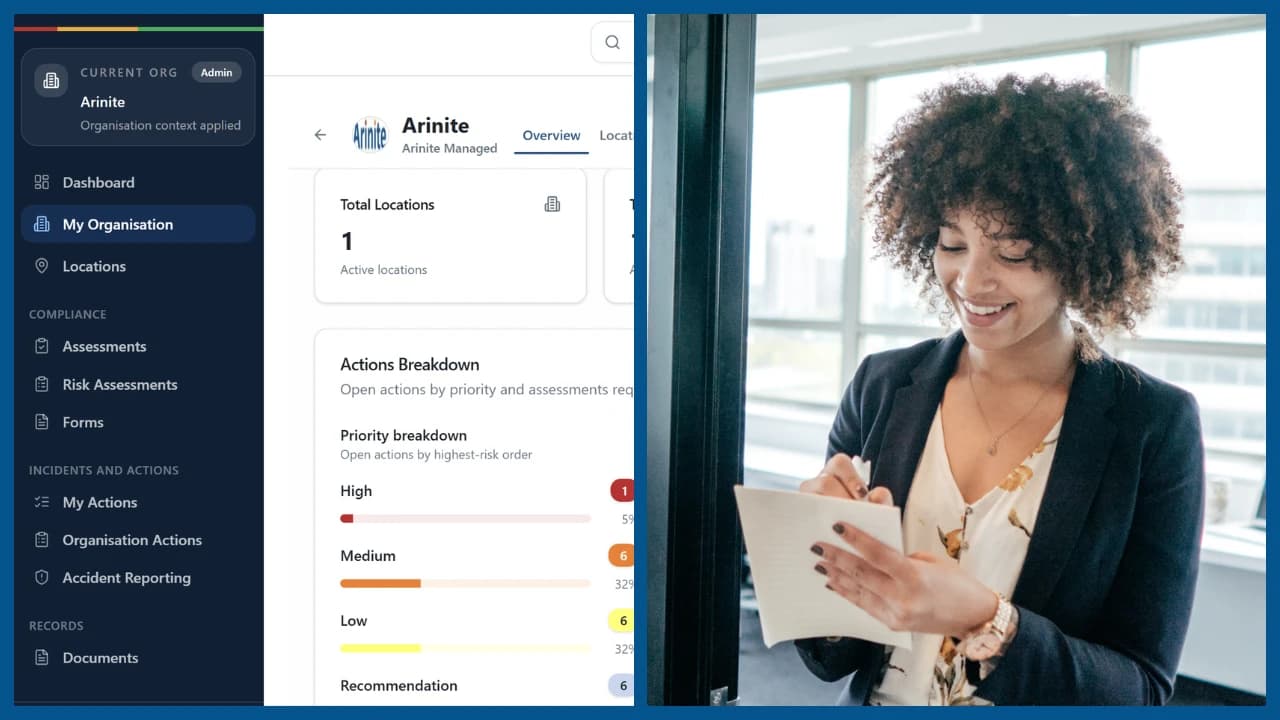
We are not a consultancy that adds external software. We are not a software company that recommends consultants.
We are the place where those two things finally become one.
50+ Countries. Global Safety. Local Trust.
Headquartered in London, UK, with Qualified health and safety consultants in 50+ countries. Whether you need a health and safety audit in Manchester, a fire risk assessment in Birmingham, or outsourced workplace health and safety compliance in Singapore, we have consultants near you.
We're expanding globally

Operations Director, Arinite
I have been in the health and safety business for 35+ years. In that time, I have had one consistent experience across every sector and every country I have worked in.
Every business we speak to already knows, somewhere, that their workplace health and safety compliance has not kept pace with their growth. It is not ignorance. It is business. It is the assumption that because nothing has gone wrong yet, the gaps are probably manageable.
What stops most businesses from doing something about it is not the cost of outsourcing health and safety support. It is the fear of finding out how significant the gaps are.
The Free Gap Analysis Call exists for exactly that moment.
You get the full picture of your workplace health and safety position in 30 minutes.
“In 35+ years, I have not once had someone tell us they wished they had stayed in the dark.”
No video testimonials available at the moment.
Join 1,500+ organisations that trust Arinite as their health and safety consultants.
Common questions about PCBUs, officer due diligence, psychosocial hazards, industrial manslaughter, and Australian WHS compliance
Our Qualified health and safety consultants are here to help with any queries about workplace safety, compliance, or our services.
Download our comprehensive library of expert guides, checklists, and templates.
Browse LibraryHave a question or need expert advice? We're here to help.
Fill out the form below and our team will get back to you within 24 hours.
Headquarters
29 Throgmorton St
London EC2N 2AT