HSE inspections up 47% - HSE carried out over 13,200 workplace inspections in 2024/25.
Singapore operates one of the most performance-driven workplace health and safety regimes in Asia. Every employer is required by law to conduct a formal Risk Assessment for all work activities under the Workplace Safety and Health (Risk Management) Regulations 2006, regardless of whether the workplace is a construction site or a low-risk office in the CBD. Compliance is enforced by the Ministry of Manpower (MOM), supported by the Workplace Safety and Health Council (WSHC), and reinforced by the bizSAFE certification programme, the Work Injury Compensation Act (WICA), and the Code of Practice on Chief Executives' and Board of Directors' WSH Duties. Arinite delivers the full Singapore compliance framework: WSH risk assessment, safe work procedures, training, bizSAFE preparation, WICA-aligned incident response, and ongoing MOM inspection readiness. One compliance partner across the UK, Singapore, and your other international locations. One integrated health and safety system.
In Singapore, workplace health and safety is governed under a single integrated framework known as Workplace Safety and Health (WSH). The framework was introduced in 2006 when the Workplace Safety and Health Act replaced the older Factories Act and extended coverage from factories to all workplaces and all industries, including offices, retail, hospitality, healthcare, education, and professional services.
The framework is enforced by the Ministry of Manpower (MOM) through its Occupational Safety and Health Division. The Workplace Safety and Health Council (WSHC), a statutory body under MOM, supports compliance through the bizSAFE programme, training accreditation, and industry guidance. The Work Injury Compensation Act (WICA) provides a no-fault insurance-backed compensation route for workers injured in the course of employment.
Singapore is consistently ranked among the safest workplace jurisdictions globally, alongside the Netherlands, the United Kingdom, Germany, and Sweden. In 2025, Singapore's workplace fatal injury rate reached a record low of 0.96 per 100,000 workers. This performance is the direct result of MOM's data-driven enforcement and the WSH Act's risk management discipline.
The framework rests on three principles:
Employers must take measures that are reasonably practicable to eliminate or control workplace risks, not merely the bare minimum prescribed.
Compliance is built around systematic risk assessment, hazard control, and continuous review, rather than rule-by-rule prescription.
Duties are placed on employers, occupiers, principals (contracting parties), self-employed persons, employees, manufacturers, and suppliers, with overlapping responsibility along the chain of control.
For other Asia-Pacific and international jurisdictions Arinite supports, see our country guides for the USA (OSHA), Germany (DGUV), France (DUERP), Italy (RSPP), Spain (LPRL), the Netherlands (RI&E), Belgium (EDPBW), and Ireland (HSA).
Singapore workplace safety law is built on a principal Act, a series of subsidiary regulations covering risk management, general provisions, incident reporting, and sector-specific hazards, plus a growing body of approved Codes of Practice that operationalise senior leadership accountability. See our health and safety legislation guide for cross-jurisdictional context.
The principal statute. Replaced the Factories Act and extended workplace safety obligations to all workplaces and all industries. Establishes the duty on every employer to take reasonably practicable measures to ensure the safety and health of employees and any other person who may be affected by the workplace. Imposes parallel duties on occupiers, principals, manufacturers and suppliers, self-employed persons, and employees themselves.
The single most important subsidiary regulation for any business operating in Singapore. Requires every employer to conduct a formal Risk Assessment for all work activities, in all workplaces, including low-risk offices. The assessment must be documented in writing, reviewed at least once every three years (or earlier if there is a relevant change), made available to employees and MOM inspectors on request, and used to drive implemented control measures with residual risks communicated to workers.
Cross-cutting requirements on the workplace itself: lighting, ventilation, sanitation, drinking water, first aid, machinery guarding, handling of hazardous substances, manual handling, and personal protective equipment.
Mandatory reporting to MOM of workplace accidents, dangerous occurrences, and occupational diseases. Fatal accidents must be reported immediately. Non-fatal accidents resulting in hospitalisation or more than three days of medical leave must be reported within ten days.
Detailed subsidiary regulations covering construction, shipbuilding and ship repair, confined spaces, work at heights, scaffolds, operation of cranes, explosive powered tools, noise, asbestos, and other elevated-hazard activities. Higher-risk sectors typically require a documented Safety Management System (SMS) in addition to risk assessment.
Introduced by MOM in response to elevated workplace fatalities and updated in subsequent revisions. Establishes specific duties on CEOs and boards to set the WSH culture, allocate resources, review WSH performance, and act on identified risks. Treated as supplementary to the WSH Act and reflected in MOM's sentencing framework, with personal accountability for senior leaders.
No-fault compensation framework for workers injured in the course of employment or who contract listed occupational diseases. Mandatory WICA insurance for almost all employees, including foreign workers and platform workers. Administered by MOM. Compensation covers medical leave wages, medical expenses, and permanent incapacity or death benefits within statutory caps.
In force from 1 January 2025. Extends WSH Act safety protections and WICA injury compensation coverage to platform workers (ride-hail and delivery personnel). Work-related injuries involving platform workers must be reported to MOM.
The Tripartite Guidelines on Flexible Work Arrangements (effective 1 December 2024) place process duties on employers in considering formal FWA requests. Where home-based work is approved, employers retain duties under the WSH framework, including consideration of ergonomic and psychosocial risk.
A growing library of MOM-issued Codes of Practice and Singapore Standards (SS) that operationalise statutory duties. Compliance with a Code of Practice is not strictly mandatory but is treated as evidence of having taken reasonably practicable measures.
The Risk Management Regulations are the operational foundation of WSH compliance in Singapore. Every employer must build their compliance posture on a documented Risk Assessment that addresses all work activities, not just those that look hazardous on the surface.
Under the WSH (Risk Management) Regulations 2006, employers must conduct a formal Risk Assessment for every work activity carried out in the workplace.
This includes low-risk offices, professional services, and white-collar environments. The Regulations do not exempt office activities. The duty exists regardless of perceived risk level.
A risk assessment held only in someone's head, or referenced verbally, does not satisfy the Regulations. The documented record is the primary evidence of compliance.
The Regulations set a maximum three-year review interval. Review must happen earlier whenever there is a relevant change: new equipment, new work processes, new layout, a workplace incident, a near miss, or significant organisational change.
The Risk Assessment must be made available to employees and to MOM inspectors on request. Withholding it, losing it, or not being able to produce it on request is itself an indicator of non-compliance.
Identification of risk without implementation of controls fails the Regulations. The Risk Assessment must result in actual measures that eliminate, substitute, engineer-out, administratively control, or PPE-mitigate the identified risks.
Workers must be informed of risks that remain after controls are applied. This is the basis for safe work procedures, training, and toolbox briefings.
MOM's risk management methodology follows a structured three-step cycle, supported by WSHC training and bizSAFE Level 2:
Systematic walkthrough of each work activity to identify all hazards: physical, chemical, biological, ergonomic, and psychosocial.
For each hazard, estimate the severity of potential harm and the likelihood of occurrence, then categorise residual risk (low, medium, high).
Apply the hierarchy of control: elimination, substitution, engineering controls, administrative controls (including safe work procedures), and personal protective equipment. Document the controls, assign owners, and set review timelines.
A Risk Assessment is required for every workplace in Singapore, including offices. The legal duty does not vary by sector. MOM's enforcement pattern, however, does.
The majority of workplace accidents in Singapore occur in high-risk industries like construction, transport and storage, marine, and manufacturing. MOM's enforcement resources are concentrated where the risk of serious injury or fatality is highest. This is observable in the published WSH performance reports: enforcement actions, stop-work orders, and composition fines cluster in those higher-risk sectors.
In practice, this creates an important nuance for office-based employers operating in Singapore: while it is a legal requirement to conduct Risk Assessments for office activities, such activities are generally considered low-risk in nature, and MOM is also aware of this practical context. Compared to higher-risk industries or operations, MOM inspectors typically do not conduct intensive spot checks specifically on office-related Risk Assessments unless there are concerns or past reported workplace incident cases.
Office-based employers operating in Singapore should not interpret the lighter inspection footprint as an exemption. There are four operational reasons to maintain a fully compliant office Risk Assessment regardless of MOM's day-to-day inspection rhythm:
The WSH (Risk Management) Regulations 2006 apply uniformly. Absence of a current, documented Risk Assessment is a contravention whether or not it is detected on a routine inspection.
The instant a workplace incident is reported (under the WSH (Incident Reporting) Regulations or via an employee complaint), MOM's enforcement posture shifts. The first document an inspector asks for is the Risk Assessment relevant to the activity involved. Inability to produce one materially worsens the enforcement outcome.
A documented Risk Assessment is core evidence in defending Work Injury Compensation Act claims and any parallel common law negligence claims. Its absence weakens the employer's position significantly.
Almost all government tenders and a growing share of private-sector contracts require bizSAFE Level 3 or higher, which is built on the Risk Assessment. Even office-based businesses bidding for or servicing those contracts must hold the underlying documentation.
The penalty framework reflects the framework's seriousness. Under the WSH Act, general duty breaches by corporate employers can attract fines up to S$500,000 for a first offence and up to S$1,000,000 for repeat offences, with stop-work orders, remedial orders, and composition fines available to MOM. Negligent acts causing death attract fines up to S$400,000 and imprisonment of up to two years for individuals. The Code of Practice on CE and Board WSH Duties extends personal accountability to senior leaders.
bizSAFE is Singapore's national workplace safety and health capability-building programme, managed by the WSHC under MOM. It is a structured five-level programme (plus a "Star" tier) that takes companies from initial leadership commitment to a fully integrated WSH management system. For office-based and lower-risk employers, bizSAFE Level 3 is the practical compliance target.
Senior management attends a one-day course on the CEO's WSH responsibilities. Commits the company to building WSH capability.
A nominated company representative completes accredited Risk Management training, equipping them to lead the company's Risk Assessment programme.
Third-party audit confirms the company has implemented a Risk Management system that complies with the WSH (Risk Management) Regulations 2006. This is the practical compliance benchmark for office-based businesses and the minimum entry requirement for most Singapore government tenders.
Company implements a documented WSH Management System aligned with Singapore Standard SS 506 / ISO 45001. Higher-risk sectors typically progress to this level.
External certification of the SS 506 / ISO 45001 management system. Recognised as world-class WSH capability.
bizSAFE certification is more than a compliance signal. It is increasingly a commercial gating mechanism. Government agencies routinely require bizSAFE Level 3 as a minimum for contractors and suppliers. Large private-sector buyers, insurers, and investors use bizSAFE level as a baseline assessment of supplier WSH capability. Insurers offer preferential WICA and liability premiums to bizSAFE-certified businesses.
The WICA sits alongside the WSH Act and provides a no-fault compensation route for workers injured in the course of employment or who contract listed occupational diseases. Three points matter for compliance posture:
Every employer must hold a valid WICA insurance policy from a MOM-approved insurer covering all relevant employees. This is non-negotiable. Operating without WICA cover is an offence.
WICA applies to almost all local and foreign employees performing manual work regardless of salary, and to non-manual workers up to the statutory salary cap. Platform workers have been brought into scope from 1 January 2025 under the Platform Workers Act 2024.
WICA compensation is computed on a fixed formula and capped statutorily. Severe injuries with clear employer negligence may also be pursued under common law, in which case the worker elects between the two routes. Documented WSH compliance (Risk Assessment, safe work procedures, training records) is the central defence in either route.
Under the combined framework, every employer with workers in Singapore must:
Conduct a documented Risk Assessment for all work activities under the WSH (Risk Management) Regulations 2006, reviewed at least every three years or sooner on relevant change.
Implement reasonably practicable control measures identified in the Risk Assessment, following the hierarchy of control.
Communicate residual risks to affected workers through safe work procedures, induction training, and ongoing toolbox briefings.
Develop and maintain safe work procedures (SWPs) for medium and high-risk activities, accessible at the workplace and reflected in training.
Provide WSH induction and ongoing training appropriate to each worker's role, hazards, and the workplace.
Establish an incident reporting and investigation system aligned with the WSH (Incident Reporting) Regulations, including immediate reporting of fatalities and the 10-day reporting window for hospitalisations and 3+ day MC injuries.
Maintain a valid WICA insurance policy from a MOM-approved insurer covering all relevant employees and platform workers where applicable.
Appoint a WSH coordinator, officer, or committee where required by sector, scale, or hazard profile. Higher-risk sites carry specific staffing requirements.
Maintain workplace structures, machinery, and equipment in safe condition through preventive maintenance, inspections, and defect rectification.
Provide appropriate personal protective equipment at no cost to workers, ensure proper fit, and train workers in use and maintenance where engineering and administrative controls cannot adequately mitigate risk.
Address psychosocial risks including stress, fatigue, and harassment as part of the Risk Assessment, with particular attention to long-hours environments and customer-facing roles. For UK psychosocial frameworks, see our stress and mental health at work page.
Comply with the Code of Practice on CE and Board WSH Duties, including documented leadership engagement, WSH performance review, and resource allocation.
For employers offering flexible work arrangements, consider WSH implications of home-based work including ergonomic and psychosocial factors, in line with the Tripartite FWA Guidelines effective 1 December 2024.
Maintain documentation evidencing compliance: Risk Assessments, safe work procedures, training records, incident records, maintenance records, and Code of Practice evidence.
Failure to comply exposes the business to MOM enforcement (warnings, composition fines, stop-work orders, prosecution), reputational damage, increased WICA and liability insurance premiums, civil claims, and personal liability for CEOs and directors under the Code of Practice.
A compliant Singapore WSH programme is built on a documented system. The minimum documentation set includes:
Signed by the CEO, communicating leadership commitment and the framework's scope.
Covering all work activities, reviewed at least every three years and on relevant change, with version control and named owners.
For medium and high-risk activities, written in plain language and accessible at the workplace.
Mapping each role to required training, induction, periodic refresh, and competency evidence.
Aligned with WSH (Incident Reporting) Regulations and WICA notification, with logs of incidents, near misses, and dangerous occurrences.
And renewal schedule, plus the list of covered employees including foreign workers and platform workers where relevant.
Evidencing CE and Board engagement under the Code of Practice, including periodic reviews, KPIs, and action tracking.
For businesses seeking or maintaining Level 3 or higher certification.
For fire, medical emergencies, and serious or imminent danger, including evacuation routes and assembly points.
Including pre-engagement WSH assessment, on-site monitoring, and incident attribution.
This should integrate with your wider health and safety policy and management system.
WSH applies uniformly across all workplaces, but the practical compliance profile and MOM enforcement footprint vary significantly by sector. Arinite supports clients across Singapore in the sectors below.
Office-based environments. Low physical risk, but the Risk Assessment duty is unchanged. Focus areas: DSE and ergonomics for office and hybrid workers, psychosocial risk (long hours, hybrid working, always-on culture), business travel, and the WSH implications of formal flexible work arrangements. bizSAFE Level 3 is the practical target for tender eligibility and contractual access.
Singapore is a major regional financial centre. Compliance posture combines standard office WSH duties with MAS-aligned operational resilience expectations, harassment prevention, and elevated focus on psychosocial risk and CE / Board accountability under the Code of Practice.
Long-hours environments and demanding client-facing pressure place psychosocial risk and fatigue management at the centre of the Risk Assessment. The Workplace Fairness Act and harassment prevention obligations add scope.
Higher-hazard category. Biological agents, sharps, manual handling, shift work, psychosocial demand, and patient-facing aggression. Detailed Safety Management System expectations and specific Codes of Practice.
Highest-hazard category in Singapore. Mandatory Safety Management System under WSH (Construction) Regulations, project-level WSH plans, dedicated WSH officers, sub-contractor management, and intensive MOM inspection. bizSAFE Level 3 minimum is the floor; many projects require higher.
Manual handling, vehicle-pedestrian interface, working at height, racking, shift work, and ergonomic risk. Increased MOM attention given the sector's contribution to non-fatal injury statistics.
Detailed subsidiary regulations on machinery guarding, hazardous substances, noise, confined spaces, and explosive powered tools. Higher-tier bizSAFE expectations from major buyers.
Sector-specific WSH (Shipbuilding and Ship-repairing) Regulations. Among the highest-fatality sectors historically, with intensive MOM oversight.
Customer-facing aggression, lone working, shift work, and harassment prevention duties. Risk Assessment scope often underestimated for front-of-house roles.
Training is a specific WSH duty and one of the most effective interventions available. WSHC accredits training providers under the bizSAFE programme. See our health and safety training service for international delivery options.
Half-day to one-day course for senior management on CEO WSH responsibilities. Entry point into the bizSAFE programme.
Two-day accredited Risk Management training equipping a nominated company representative ("RM Champion") to lead the company's risk assessment programme.
Every worker must receive WSH induction covering hazards of their role, prevention measures, safe work procedures, emergency procedures, and the right to raise concerns. Refresh on significant change or at defined intervals.
Required for higher-risk sites or where mandated by sector regulation. Accredited courses delivered by WSHC-approved providers.
Senior leader briefings on the Code of Practice on CE and Board WSH Duties, covering personal accountability, sentencing exposure, governance, and resource allocation.
Working at height, confined spaces, manual handling, fire safety, electrical safety, chemical handling, and other Codex-specific hazards each carry distinct training duties.
Increasingly expected as part of the broader Risk Assessment. Mental Health First Aid awareness, line manager training on recognising stress and burnout, and prevention through work design.
Practical training to support the office Risk Assessment, including home-based work where flexible work arrangements have been approved.
Arinite delivers training in English and other relevant languages through Qualified consultants and accredited Singapore training partners, with records maintained in Arinite's health and safety software platform.
International employers entering Singapore, and Singapore employers that have grown faster than their compliance systems, routinely show the same gaps under MOM inspection or post-incident review.
No documented Risk Assessment, or a Risk Assessment more than three years old. The single most common gap for office-based businesses, often assumed to be unnecessary because "the office is low-risk."
Risk Assessment exists but does not cover all work activities. Common omissions: lone working, business travel, off-site client visits, hybrid and home-based work, and customer-facing roles.
Risk Assessment identified controls but controls were never implemented or were implemented and then drifted out of use.
No safe work procedures for medium and higher-risk activities, or SWPs exist but are not communicated, trained, or accessible at the workplace.
Training records absent or generic. No evidence of WSH induction, periodic refresh, or role-specific competency.
Incident reporting process informal. Fatalities, hospitalisations, and 3+ day MC injuries not reported within statutory timelines under the WSH (Incident Reporting) Regulations.
WICA insurance lapsed, under-cover, or not extended to platform workers from 1 January 2025 onwards.
bizSAFE certification expired, never obtained, or held at a level below what current tenders and contracts require.
CE and Board engagement on WSH not documented. Code of Practice expectations on leadership review, resource allocation, and KPI tracking not met.
Flexible work arrangements approved without WSH risk consideration. Home-based working environments unassessed for ergonomic and psychosocial risk.
Contractor management informal. No pre-engagement assessment, no on-site monitoring, no documented attribution of WSH duties along the principal-contractor-subcontractor chain.
Foreign workforce training delivered in a language not accessible to the worker. The duty to train is the duty to train effectively.
Documentation held only in head office overseas, not accessible at the Singapore workplace for production to a MOM inspector.
Arinite's Singapore compliance programme identifies and resolves each of these gaps as part of standard onboarding.
Arinite acts as the central health and safety partner across all of your jurisdictions. In Singapore, our Qualified consultants deliver the WSH compliance system end to end, in coordination with accredited Singapore training partners and bizSAFE auditors. Delivered as part of our outsourced health and safety service.
Documented Risk Assessment under the WSH (Risk Management) Regulations 2006, covering all work activities, with three-yearly review built into the maintenance cycle and earlier triggers on relevant change.
Drafting, validation, and worker training on safe work procedures for medium and higher-risk activities, integrated with the Risk Assessment.
Pathway management from Level 1 through Level 3 (and beyond where appropriate), including pre-audit preparation, gap closure, and audit support.
Briefings, governance design, KPI definition, and documentation of leadership engagement under the Code of Practice on CE and Board WSH Duties.
Process design, response readiness, MOM notification support, root cause investigation, and corrective action tracking.
Review of WICA cover and broker liaison to confirm scope is adequate for the workforce composition including platform workers and foreign workers.
Specific assessment of psychosocial and ergonomic risk including office, hybrid, and home-based work environments under the Tripartite FWA Guidelines.
Worker induction, line manager training, bizSAFE-aligned courses, and specific hazard training through accredited Singapore partners.
Pre-inspection audit, documentation review, on-the-day support, and response to inspector findings or composition fines.
For multi-country businesses, Arinite operates as a single compliance partner across the UK, Singapore, and 50+ other jurisdictions, with consistent governance and a single set of records in our health and safety software platform.
For businesses on Arinite's Done For You or Done With You packages, Singapore compliance is included.
Singapore compliance cost varies meaningfully based on several factors. We do not publish generic rates because the inputs vary too widely to be useful in advance of a discovery call.
Local-only versus mixed local, foreign, and platform workforce changes the WICA scope, training scope, and language requirements.
Single Singapore office versus multi-site operations including warehousing, manufacturing, or retail footprints.
Office-based services versus construction, healthcare, marine, or manufacturing carry materially different Risk Assessment, Safety Management System, and training expectations.
Employers already holding bizSAFE Level 3 with a current Risk Assessment need different support than employers starting from scratch.
Level 3 (tender minimum) versus Level 4 / Star (full WSH Management System aligned to SS 506 / ISO 45001).
Singapore-only versus Singapore-as-one-of-many jurisdictions changes the operating model.
One-off compliance baseline: Risk Assessment, safe work procedures, bizSAFE Level 3 pathway, initial training rollout, and WICA review.
Singapore compliance maintained as part of Done For You or Done With You monthly arrangements, including periodic Risk Assessment review, training, advisory, MOM inspection readiness, and incident response.
Initial project establishment followed by ongoing light-touch maintenance and advisory.
A free gap analysis call with one of our Qualified consultants will give you a clear estimate for your specific situation in Singapore.
Singapore has one of the most performance-driven workplace safety regimes globally. The framework is enforceable, well-resourced by MOM inspectors and the WSHC, and increasingly reinforced by personal accountability for CEOs and boards under the Code of Practice. Office-based employers in particular should not interpret the lighter routine inspection footprint as an exemption: the WSH (Risk Management) Regulations 2006 apply to all workplaces, and the document MOM inspectors ask for first after any reported incident is the Risk Assessment.
Book a free gap analysis call. In 30 minutes, one of our Qualified consultants will review your current Singapore arrangements, identify the gaps that matter, and give you a clear recommendation and indicative cost.
From Reactive Firefighting to Proactive Health & Safety Compliance
No formal HSE systems in place. Everything is reactive, waiting for something to go wrong. Documentation is missing or outdated.
This isn't just "non-compliant." It's criminally negligent. Directors face personal prosecution.
Basic HSE documentation is in place. Minimum legal requirements met. You can pass a basic audit.
Compliance is where most consultants get you, then leave. You're legal, but you're not optimised.
Systems run proactively, preventing problems before they occur. Compliance is distributed, not dependent on one person.
That's why 95%+ of clients renew year after year.

Robert Winsloe
Managing Director, Arinite
“We work with you to deliver peace of mind. We tailor our service provision to your business to provide proactive, pragmatic health and safety advice and that helps reduce costs by ensuring compliance with relevant health and safety legislation.”
Other Consultants
Get you to Stage 2 (Compliant) and disappear.
Arinite
Gets you to Stage 3 (Proactive) and keeps you there.
That's why we call it transformation, not just compliance.
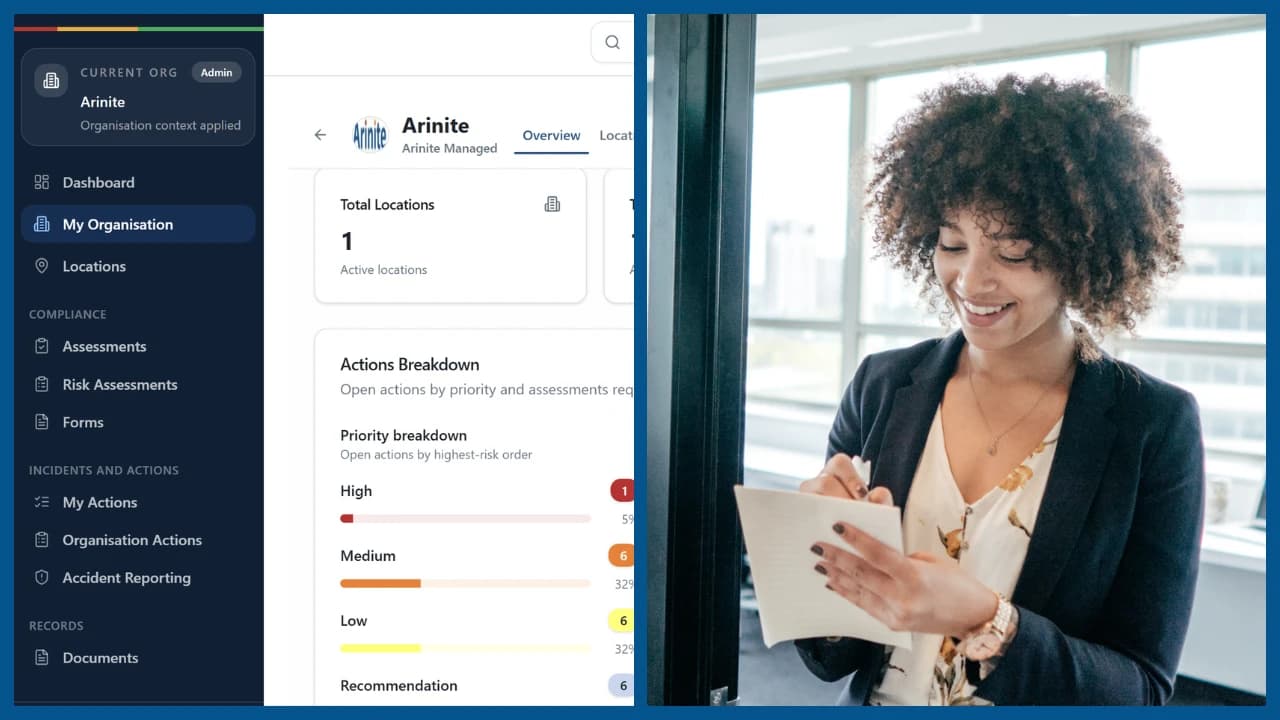
Compliance
Traditional consultancies audit, report and leave. You get a document and the job of implementing it.
Control
Software companies give you dashboards and workflows without the knowledge to use them.
Coverage
Global businesses need consultants who know compliance in every jurisdiction.
Arinite
We are not a consultancy that adds external software. We are not a software company that recommends consultants.
We are the place where those two things finally become one.
50+ Countries. Global Safety. Local Trust.
Headquartered in London, UK, with Qualified health and safety consultants in 50+ countries. Whether you need a health and safety audit in Manchester, a fire risk assessment in Birmingham, or outsourced workplace health and safety compliance in Singapore, we have consultants near you.
We're expanding globally

Operations Director, Arinite
I have been in the health and safety business for 35+ years. In that time, I have had one consistent experience across every sector and every country I have worked in.
Every business we speak to already knows, somewhere, that their workplace health and safety compliance has not kept pace with their growth. It is not ignorance. It is business. It is the assumption that because nothing has gone wrong yet, the gaps are probably manageable.
What stops most businesses from doing something about it is not the cost of outsourcing health and safety support. It is the fear of finding out how significant the gaps are.
The Free Gap Analysis Call exists for exactly that moment.
You get the full picture of your workplace health and safety position in 30 minutes.
“In 35+ years, I have not once had someone tell us they wished they had stayed in the dark.”
No video testimonials available at the moment.
Join 1,500+ organisations that trust Arinite as their health and safety consultants.
Common questions about the WSH Act, Risk Management Regulations, MOM enforcement, bizSAFE, WICA, and Singapore workplace compliance
Our Qualified health and safety consultants are here to help with any queries about workplace safety, compliance, or our services.
Download our comprehensive library of expert guides, checklists, and templates.
Browse LibraryHave a question or need expert advice? We're here to help.
Fill out the form below and our team will get back to you within 24 hours.
Headquarters
29 Throgmorton St
London EC2N 2AT