HSE inspections up 47% - HSE carried out over 13,200 workplace inspections in 2024/25.
Health and safety compliance in Italy for UK businesses. RSPP appointment, DVR preparation, D.Lgs. 81/08, INAIL, and international support.
RSPP stands for Responsabile del Servizio di Prevenzione e Protezione (Head of the Prevention and Protection Service). It is the designated person responsible for coordinating workplace health and safety in every Italian employer, required under Article 31 of Decreto Legislativo 81/2008 (D.Lgs. 81/08), known as the Testo Unico sulla Sicurezza sul Lavoro.
The RSPP is not the equivalent of a UK Health and Safety Manager. The role has specific statutory qualifications, prescribed duties, and mandatory interaction with other named safety roles (medico competente, RLS, and where applicable ASPP). Appointment of an RSPP is mandatory for every employer in Italy from the first employee, with no size threshold.
The RSPP can be the employer themselves (datore di lavoro – RSPP, for micro and small businesses in lower-risk sectors), an internal employee with appropriate qualifications (RSPP interno), or an external certified consultant (RSPP esterno). UK businesses with Italian operations typically appoint an external certified RSPP because the qualifications required are country-specific and practically impossible for a UK-based HR or H&S team to hold.
Understanding the RSPP role requires understanding the wider Italian occupational safety framework. The key elements are:
The Testo Unico sulla Sicurezza sul Lavoro, the consolidated act on occupational safety. Implements EU health and safety directives and replaces earlier fragmented legislation. The central reference for every safety question in Italy.
The corrective decree that amended and integrated D.Lgs. 81/08 shortly after its original publication. The two decrees are always read together.
The Italian sector classification (equivalent to SIC/NACE codes) used to determine the applicable safety training duration, the RSPP qualification level required, and the risk category for the business.
The employer under Italian law, with primary statutory responsibility for safety. Cannot delegate the core legal duties, though day-to-day management can be delegated to the RSPP and other roles.
The competent doctor, required where health surveillance (sorveglianza sanitaria) is indicated by the DVR. Must be independently qualified and appointed in writing. Conducts periodic medical examinations and issues fitness-for-work opinions.
The workers’ safety representative. Elected by employees in businesses with more than 15 employees; smaller businesses may have a territorial representative (RLST). Must be consulted on the DVR and health and safety matters.
The Italian National Labour Inspectorate, created by D.Lgs. 149/2015 and operational from 2017. Conducts inspections and enforcement.
The Istituto Nazionale per l’Assicurazione contro gli Infortuni sul Lavoro, the national workplace accident insurance institute. Every Italian employer must register with INAIL and pay contributions, which fund compensation for workplace injuries and occupational diseases.
The local public health authority. Has inspection and enforcement powers for workplace health matters alongside the INL.
The DVR (Documento di Valutazione dei Rischi, Document of Risk Evaluation) is Italy’s mandatory workplace risk assessment document, required of every employer under Article 28 of D.Lgs. 81/08.
Every Italian employer must prepare the DVR from day one of employment, update it whenever significant changes occur, and retain it at the workplace for inspection. Unlike the French DUERP, the DVR does not have a 40-year retention requirement, but the document must reflect current conditions accurately.
All occupational risks identified: physical, chemical, biological, ergonomic, and psychosocial (stress lavoro-correlato, work-related stress, is a specific assessment requirement since 2010).
The evaluation methodology used and the criteria for risk ranking.
The prevention and protection measures adopted and those planned.
The names of the RSPP, the medico competente where appointed, and the RLS/RLST.
The roles responsible for implementing prevention measures.
The training and information programme for workers.
The DVR must be prepared in collaboration with the RSPP, the medico competente (where appointed), and in consultation with the RLS. It is signed by the datore di lavoro and carries legal weight as evidence of the employer’s compliance. In serious cases, particularly where a workplace accident occurs, prosecutors routinely request the DVR to assess whether the risk was properly identified.
Beyond the RSPP appointment and DVR, Italian employers have specific duties that UK businesses often underestimate:
Appoint the RSPP in writing and ensure they hold the appropriate certification for the business’s ATECO risk category.
Prepare and maintain the DVR, including the specific work-related stress assessment (stress lavoro-correlato), updated whenever significant changes occur.
Appoint a medico competente where health surveillance is indicated. Not every business requires one, but most do.
Ensure the election of an RLS (in businesses with more than 15 employees) or access to the territorial RLST (for smaller businesses).
Appoint and train the workplace emergency team: Addetti al Primo Soccorso (first aid personnel) and Addetti Antincendio (fire wardens). Specific minimum numbers and training hours apply by ATECO risk category.
Provide safety training (formazione) to all workers on hiring, with the training content and duration determined by the ATECO risk category. General training (formazione generale), specific training (formazione specifica), and periodic refresher training are all mandatory.
Register with INAIL and pay contributions accurately. Misclassification of the ATECO code is a common compliance failure.
Report workplace accidents to INAIL and, for serious accidents, to the Ispettorato and the public prosecutor (Procura della Repubblica) within defined timescales.
Make the DVR and safety documentation available to the RSPP, the RLS, the medico competente, the Ispettorato, the ASL, and INAIL on request.
Failure to comply can result in criminal penalties (Italian safety law uses criminal sanctions extensively, not just administrative fines), personal liability for the datore di lavoro, and in serious cases temporary suspension of the business by the Ispettorato.
UK businesses with Italian operations routinely fail Italian compliance in predictable ways. The most common gaps are:
UK businesses sometimes assume their UK Health and Safety Manager covers the Italian requirement. They do not. The RSPP must be formally appointed in writing and must hold Italian-specific certification (Modulo A, B, and where applicable C training with sector-specific qualification). Without a valid appointment, the employer is non-compliant from day one.
The DVR must follow the Italian statutory format, cover specific required elements (including work-related stress), and be prepared in collaboration with the RSPP and in consultation with the RLS. Translated UK risk assessments do not satisfy this.
Work-related stress is a specific legal assessment requirement in Italy since 2010, using the INAIL methodology (or a methodology demonstrably equivalent). UK risk assessments typically do not cover it.
Health surveillance is required whenever the DVR identifies risks that warrant medical monitoring (DSE users, chemical exposure, noise, vibration, shift work). Missing the medico competente where required is a common failure.
Misclassification affects the training hours required, the RSPP qualification required, INAIL contributions, and the overall risk category. Errors are frequent and can result in retrospective contribution adjustments and penalties.
In businesses with more than 15 employees, the RLS election is mandatory. Smaller businesses must arrange access to the territorial RLST. UK businesses often miss this requirement entirely.
The DVR and safety documentation must be accessible to Italian-speaking employees, the RLS, and the Ispettorato. English-only documentation fails the accessibility requirement.
Italian law prescribes specific training content and durations. Records must demonstrate that training was delivered, by whom, covering what, and to which named employees.
Arinite’s international health and safety service identifies and resolves each of these gaps as part of standard Italian compliance onboarding.
Arinite provides Italian compliance as part of our international health and safety service. The model combines UK-based programme management with locally certified Italian consultants.
Our Italian consultants hold the certifications required to act as RSPP esterno (external RSPP) across the ATECO risk categories relevant to our clients, typically including low and medium-risk office-based sectors. They prepare the DVR, conduct the stress lavoro-correlato assessment, liaise with the medico competente and the RLS, and interface with the Ispettorato and the ASL.
For most UK clients with Italian operations, Arinite acts as the appointed RSPP esterno, providing both the formal appointment and the day-to-day prevention and protection service. This removes the burden of identifying, qualifying, and managing an Italian employee or independent consultant for the role.
Your named Chartered consultant at Arinite UK manages the programme. You have a single UK point of contact who coordinates Italian (and any other international) compliance activity, reports to your UK board or HQ, and ensures the programme aligns with your wider international health and safety strategy.
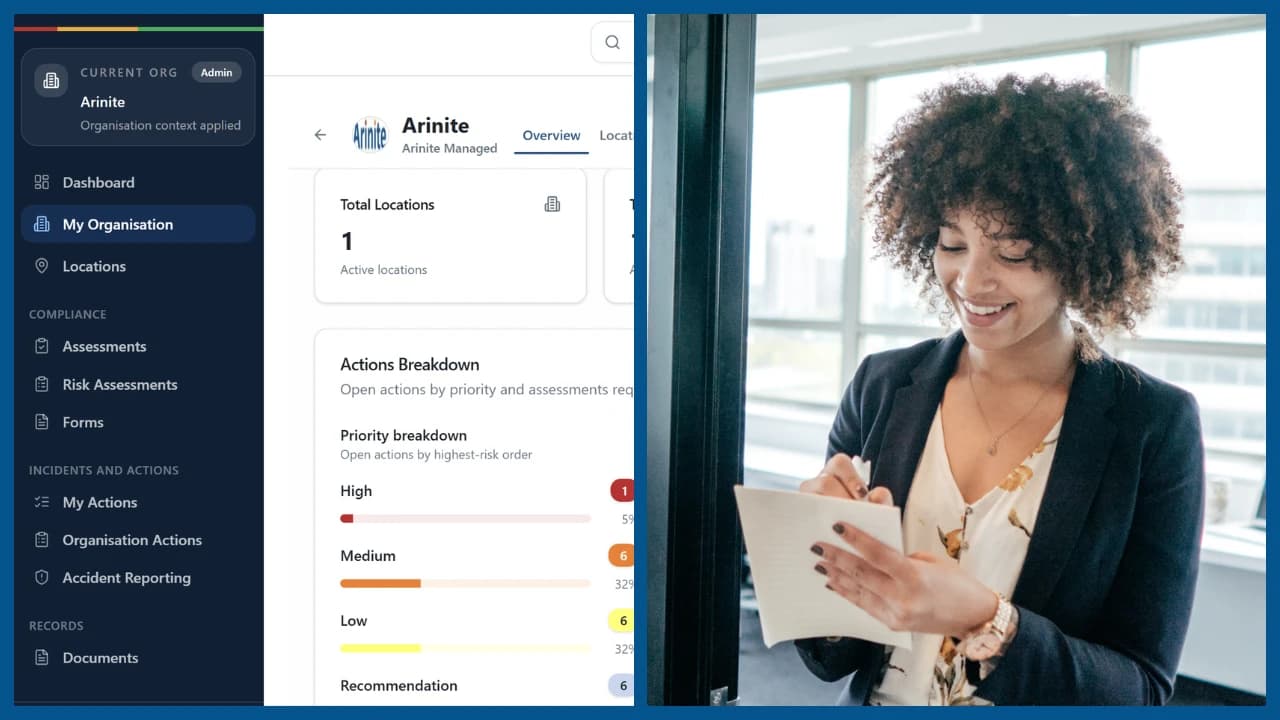
All Italian compliance activity is maintained in Arinite’s health and safety software platform alongside your UK and other international operations. One dashboard, every country.
D.Lgs. 81/08 is amended periodically and Ispettorato enforcement priorities shift. We monitor changes and update your DVR, training, and arrangements as required.
Whether you are opening your first Italian office or managing compliance across a mature Italian operation, Arinite delivers locally compliant health and safety support coordinated from the UK, including the option for Arinite to act as your appointed RSPP esterno.
Book a free international gap analysis call. In 30 minutes, one of our Chartered consultants will review your Italian arrangements, identify the gaps that matter, and recommend the right approach.
From Reactive Firefighting to Proactive Health & Safety Compliance
No formal HSE systems in place. Everything is reactive, waiting for something to go wrong. Documentation is missing or outdated.
This isn't just "non-compliant." It's criminally negligent. Directors face personal prosecution.
Basic HSE documentation is in place. Minimum legal requirements met. You can pass a basic audit.
Compliance is where most consultants get you, then leave. You're legal, but you're not optimised.
Systems run proactively, preventing problems before they occur. Compliance is distributed, not dependent on one person.
That's why 95%+ of clients renew year after year.

Robert Winsloe
Managing Director, Arinite
“We work with you to deliver peace of mind. We tailor our service provision to your business to provide proactive, pragmatic health and safety advice and that helps reduce costs by ensuring compliance with relevant health and safety legislation.”
Other Consultants
Get you to Stage 2 (Compliant) and disappear.
Arinite
Gets you to Stage 3 (Proactive) and keeps you there.
That's why we call it transformation, not just compliance.
Compliance
Traditional consultancies audit, report and leave. You get a document and the job of implementing it.
Control
Software companies give you dashboards and workflows without the knowledge to use them.
Coverage
Global businesses need consultants who know compliance in every jurisdiction.
Arinite
We are not a consultancy that adds external software. We are not a software company that recommends consultants.
We are the place where those two things finally become one.
50+ Countries. Global Safety. Local Trust.
Headquartered in London, UK, with Chartered health and safety consultants in 50+ countries. Whether you need a health and safety audit in Manchester, a fire risk assessment in Birmingham, or outsourced workplace health and safety compliance in Singapore, we have consultants near you.
We're expanding globally

Operations Director, Arinite
I have been in the health and safety business for 35+ years. In that time, I have had one consistent experience across every sector and every country I have worked in.
Every business we speak to already knows, somewhere, that their workplace health and safety compliance has not kept pace with their growth. It is not ignorance. It is business. It is the assumption that because nothing has gone wrong yet, the gaps are probably manageable.
What stops most businesses from doing something about it is not the cost of outsourcing health and safety support. It is the fear of finding out how significant the gaps are.
The Free Gap Analysis Call exists for exactly that moment.
You get the full picture of your workplace health and safety position in 30 minutes.
“In 35+ years, I have not once had someone tell us they wished they had stayed in the dark.”
No video testimonials available at the moment.
Join 1,500+ organisations that trust Arinite as their health and safety consultants.
Common questions about RSPP, D.Lgs. 81/08, DVR, INAIL, and Italian compliance
Our IOSH Chartered health and safety consultants are here to help with any queries about workplace safety, compliance, or our services.
Download our comprehensive library of expert guides, checklists, and templates.
Browse LibraryHave a question or need expert advice? We're here to help.
Fill out the form below and our team will get back to you within 24 hours.
Headquarters
29 Throgmorton St
London EC2N 2AT