Skip to content

HSE inspections up 47% - HSE carried out over 13,200 workplace inspections in 2024/25.

International Compliance: Ireland

Health and Safety in Ireland:
HSA Compliance for UK Businesses

UK-managed. Irish-compliant. One point of contact.

A guide to health and safety compliance in Ireland for UK businesses with Irish subsidiaries, offices, or employees. This page covers the Safety, Health and Welfare at Work Act 2005, the mandatory Safety Statement required under Section 20 of the Act, the General Application Regulations 2007, the role of the Health and Safety Authority (HSA), and how Arinite delivers Irish compliance as part of international health and safety support for UK-headquartered businesses.

1,500+ Businesses Protected
50+ Countries
95%+ Retention
Chartered IOSH
Irish Partners
50+ Countries
Get in Touch

Contact Arinite Today

Fill out the form below and our team will get back to you within 24 hours.

By submitting, you agree to our Privacy Policy and consent to Arinite contacting you.

DEFINITION

What Is the Health
and Safety Authority (HSA)?

The Health and Safety Authority (HSA) is Ireland’s national authority for workplace safety, established under the Safety, Health and Welfare at Work Act 2005 (SHWWA 2005). Headquartered at the Metropolitan Building in Dublin with regional offices including Galway, it operates under the aegis of the Department of Enterprise, Trade and Employment.

HSA’s remit covers virtually every employer in Ireland. Its core functions are administering and enforcing Irish workplace safety legislation, conducting inspections (approximately 9,000 inspections and investigations per year), providing guidance and training, investigating workplace incidents, and prosecuting breaches through the Irish courts.

HSA is the Irish equivalent of the UK’s Health and Safety Executive (HSE) but is a consolidated single body rather than the combined HSE plus Local Authority model used in Great Britain. This consolidated structure means Irish workplace safety enforcement is more unified than the UK equivalent.

HSA publishes annual statistics on workplace fatalities, enforcement activity, and sector trends. The Authority reported 58 workplace fatalities in Ireland during 2025, a 61% increase on the 36 fatalities in 2024. Recent enforcement activity has included significant fines against employers following fatal and serious incidents, with 2026 cases to date including fines of €225,000, €150,000, and €80,000 imposed by Irish circuit courts.

Note on the acronym: "HSA" is also commonly used in North American contexts for Health Savings Account, a completely different topic. In UK and Irish business contexts, HSA refers to the Health and Safety Authority.

For other international factsheets, see DGUV (Germany), DUERP (France), RI&E (Netherlands), RSPP (Italy), LPRL (Spain), PAPRIPACT (France), OSHA (USA).

LEGAL FRAMEWORK

The Irish Health and
Safety Legal Framework

The Irish framework is structured similarly to the UK’s at a high level but differs in significant details that UK businesses need to understand.

1

Safety, Health and Welfare at Work Act 2005 (SHWWA 2005)

The foundational statute. Establishes HSA as the regulator, creates general duties of employers, employees, and others. Key provisions: Section 8 (general employer duty), Section 19 (risk assessment), Section 20 (Safety Statement), Section 25 (Safety Representatives), Section 26 (Safety Committees), Section 34 (HSA functions), Section 58 (inspector powers), Sections 77–85 (offences and penalties).

2

General Application Regulations 2007

The primary implementing regulations (S.I. No. 299 of 2007). Covers workplace requirements (temperature, lighting, ventilation), work equipment, Display Screen Equipment, manual handling, PPE, first aid, pregnant and postnatal employees, night workers, shift workers, and vulnerable workers. This is the main regulation UK businesses need to operationalise.

3

Sector-Specific Regulations

Construction Regulations 2013 (S.I. No. 291 of 2013), Chemical Agents Regulations 2001, Biological Agents Regulations 2013, Quarries Regulations 2008, and regulations on noise, vibration, asbestos, lead, and ionising radiation.

4

Chemicals Acts 2008 and 2010

Provides HSA’s remit for chemical regulation including REACH, CLP, and Rotterdam Convention compliance. UK businesses transitioning from UK REACH to EU REACH after Brexit typically need Irish-facing advice.

5

Workplace Relations Commission (WRC)

The Irish equivalent of the UK Employment Tribunal. Handles employment disputes including penalisation claims under Section 27 SHWWA 2005 and breaches of the Organisation of Working Time Act 1997.

6

Injuries Resolution Board (formerly PIAB)

Assesses personal injury claims including workplace injuries before court proceedings. Separate from HSA’s regulatory enforcement but relevant in the wider compliance picture.

7

Common Law Duty of Care

Irish common law imposes a duty of care on employers similar to the English common law duty. Civil claims pursued through the Injuries Resolution Board and the Irish courts.

COVERAGE

Who Does
HSA Cover?

1

Covered employers: Every employer in Ireland regardless of size, sector, or ownership. No employee-count threshold.

2

Self-employed individuals: Covered under Section 13 SHWWA 2005 with duties equivalent to employers.

3

Designers, manufacturers, importers, and suppliers: Covered under Sections 15–17 for the safety of articles and substances.

4

Employees: Duties to employers and to themselves and others under Section 13.

5

Persons in control of places of work: Landlords, building managers, and others who control premises have specific duties under Section 15.

6

Public sector: Covered. Irish public sector is subject to the same framework.

7

Agency workers and contractors: Specific provisions apply. The principal contractor or employer often retains coordination duties.

For UK businesses: if you have any Irish-based employee on your payroll, or do business in Ireland involving presence of workers, the SHWWA 2005 applies. From the first employee, with no size threshold. UK businesses establishing Dublin offices routinely assume UK HSE arrangements discharge Irish duties — they do not.

SAFETY STATEMENT

The Safety Statement:
Ireland’s Distinctive Mandatory Document

The Safety Statement is the single most important concept for UK businesses to understand about Irish compliance and is the most commonly missed requirement. It has no direct UK equivalent. Compare with the UK health and safety policy.

1

What Is a Safety Statement?

Under Section 20 of SHWWA 2005, every employer must prepare a written Safety Statement specifying: hazards identified and risk assessment findings, preventive and protective measures, resources to maintain those measures, names of persons with specific safety responsibilities, and consultation arrangements with employees.

2

How Does It Differ From a UK H&S Policy?

A UK H&S policy is typically a short declaration of intent. A UK risk assessment is a separate document. The Irish Safety Statement combines both: it is the integrated document demonstrating how the business has identified and is managing workplace risks, with named responsibilities, documented controls, and consultation arrangements.

3

Mandatory Content Requirements

The Statement must be specific to the workplace. Generic templates downloaded from the internet do not satisfy Section 20. HSA inspectors look for evidence that the Statement reflects actual hazards and arrangements.

4

Accessibility

The Safety Statement must be accessible to employees in a form they can actually read and understand. For workplaces with non-English-speaking employees, practical accessibility may require translation.

5

Small Employers

Employers with three or fewer employees can rely on HSA’s published Code of Practice templates instead of a fully bespoke Statement, provided the templates cover actual risks. Above three employees, a bespoke Statement is required.

6

Review Requirements

The Statement must be reviewed and updated when circumstances change or when there is reason to believe it is no longer valid. At minimum, review annually.

7

Distribution and Display

The Statement does not need to be posted on the wall, but employees must be given access. Many employers distribute a summary and keep the full Statement available for reference. HSA inspectors expect to see it on request.

EMPLOYER DUTIES

Employer Duties Under
the SHWWA 2005

Under Sections 8–11 of the SHWWA 2005 and subsequent Regulations, every employer in Ireland must:

1

Ensure the safety, health and welfare at work of all employees so far as is reasonably practicable (Section 8).

2

Manage and conduct work activities to prevent improper conduct or behaviour likely to put safety at risk.

3

Provide a safe place of work including safe means of access and egress.

4

Provide safe systems of work including safe work processes and procedures.

5

Provide information, instruction, training, and supervision necessary for safety.

6

Conduct a written risk assessment under Section 19.

7

Prepare and maintain a Safety Statement under Section 20 based on the risk assessment.

8

Consult employees on safety matters including preparation of the Safety Statement.

9

Facilitate election of Safety Representatives where employees wish to elect them under Section 25.

10

Establish a Safety Committee where requested by employees under Section 26.

11

Report workplace incidents to HSA within required thresholds (more than three days’ absence).

12

Provide emergency arrangements including first aid, fire safety, and evacuation procedures.

13

Provide PPE at no cost where identified by the risk assessment.

14

Provide health surveillance where identified as necessary.

15

Not penalise employees for raising safety concerns under Section 27.

16

Cooperate with other employers in shared workplaces.

17

Comply with specific applicable Regulations (General Application Regulations 2007, sector-specific).

Failure to comply can result in HSA enforcement (Improvement Notices, Prohibition Notices, on-the-spot fines, prosecution), civil claims through the Injuries Resolution Board, and personal liability for directors and officers under Section 80 SHWWA 2005.

INSPECTIONS

HSA Inspections
and Enforcement

HSA conducts approximately 9,000 inspections and investigations per year across Ireland.

1

Inspection Types

Programmed inspections (sector risk, regional priorities, themed campaigns), incident-triggered inspections, complaint-driven inspections, and follow-up inspections verifying previous issues addressed.

2

Inspector Powers

Under Sections 58–66 SHWWA 2005: enter workplaces at any reasonable time, conduct examinations and tests, require production of documents including the Safety Statement, interview persons, take samples and photographs, seize and detain dangerous articles.

3

Enforcement Options

Graduated scale: verbal advice, written advice, Improvement Notice (Section 66, minimum 14 days), Prohibition Notice (Section 67, immediate prohibition for serious risk), on-the-spot fines up to €1,000 per offence, and prosecution through District, Circuit, or Central Criminal Court.

4

Right of Appeal

Improvement and Prohibition Notices can be appealed to the District Court within 14 days. Appeal against a Prohibition Notice does not suspend its effect unless the Court orders otherwise.

5

Publication of Enforcement

HSA publishes details of prosecutions, Improvement Notices, and Prohibition Notices on its website. Reputational consequences are typically as significant as the financial penalty.

PENALTIES

Penalties Under the
SHWWA 2005

The 2005 Act introduced significantly higher penalties than the earlier 1989 Act. Under Sections 77–85:

1

Summary Conviction (District Court)

Up to €5,000 fine and/or up to 12 months imprisonment.

2

Indictable Conviction (Circuit/Central Criminal Court)

Up to €3 million fine and/or up to 2 years imprisonment.

3

On-the-Spot Fines

Up to €1,000 per prescribed offence, issued by inspectors without court proceedings.

4

Daily Fines

For continuing offences, daily fines accumulate for each day the offence continues.

5

Personal Liability (Section 80)

Where an offence is committed by a body corporate with the consent, connivance, or neglect of a director, manager, secretary, or similar officer, that person is personally guilty and liable. Irish courts have imposed personal fines and, in rare cases, custodial sentences.

Recent Enforcement (2026)

Recent 2026 prosecutions: Kildare Chilling Company €225,000 (Kildare Circuit Court, January 2026), Meade Potato Company €150,000 (Trim Circuit Court, February 2026), Flanagan Concrete Products €80,000 (Naas Circuit Court, March 2026). Typical fines for serious breaches run from tens of thousands to several hundred thousand euros.

Separate from HSA penalties, civil claims are assessed by the Injuries Resolution Board and proceed through the Irish courts if not settled.

Employers’ Liability Insurance is not legally mandatory in Ireland (unlike the UK where it is required). However, the absence of insurance does not diminish liability. UK businesses should check that UK policies extend to Irish operations or arrange specific Irish policies.

TRAINING

Training Requirements Under
Irish H&S Law

Training is specifically required under Section 10 SHWWA 2005 at several defined points: on commencement, on assignment to new tasks, on introduction of new technology, and regularly thereafter. See our health and safety training service.

1

Induction safety training

Covering the Safety Statement, workplace hazards, emergency arrangements, first aid, fire safety, and consultation arrangements. Delivered on commencement.

2

Task-specific training

Covering specific hazards and controls for the worker’s role. DSE training for office workers is a common example.

3

Manual handling training

Required where work involves manual handling, under Chapter 4 of Part 2 of the General Application Regulations 2007.

4

Emergency response training

First aiders, fire wardens, and incident response personnel.

5

Safety Representative training

Any elected Safety Representative is entitled to paid time off for appropriate training (Section 25(6) SHWWA 2005).

6

Safe Pass (Construction)

Construction workers typically hold a Safe Pass card. No direct UK equivalent.

7

Training Records

Records must be maintained and available for HSA inspection. Content covered, duration, trainer, date, and attendee names. Training that cannot be evidenced is treated as training that did not occur.

Differences From UK Training Norms

  • Irish Safe Pass for construction has no direct UK equivalent.
  • Irish Safety Representative training differs from UK H&S Reps under the Safety Representatives and Safety Committees Regulations 1977.
  • Irish induction safety training is expected to specifically cover the Safety Statement.

Arinite delivers training through our Irish partners in English or with multilingual support, with records maintained in Arinite’s health and safety software platform.

BY LOCATION

Health and Safety in
Ireland by Location

Irish compliance does not vary by region (unlike US State Plans), but UK business concentration and sector mix differ between Irish cities.

1

Health and Safety in Dublin

Dublin hosts the overwhelming majority of UK business presence: IFSC, Silicon Docks, South Dublin technology corridor. Concentrated UK presence in financial services (post-Brexit EU passporting), technology, legal, insurance, and professional services. Office-based risk with specific attention to hybrid working, multi-occupied buildings, and Section 19(2) coordination.

2

Health and Safety in Cork

Ireland’s second city. Significant pharmaceutical, tech, and professional services. UK presence growing in tech (Apple, Qualcomm suppliers), fintech, and life sciences.

3

Health and Safety in Galway

Hosts HSA’s regional office and significant medical device manufacturing (Medtronic, Boston Scientific suppliers). UK business presence in tech and professional services. HSA regional office proximity may mean higher inspection frequency.

4

Health and Safety in Limerick

Significant UK presence in professional services, tech, and aviation-adjacent operations (Shannon). Growing tech cluster in the Limerick-Shannon corridor.

5

Multi-Site Irish Operations

Multi-site compliance requires consistent Safety Statements, training records, and coordinated Safety Representative arrangements. Arinite operates integrated programmes across multi-site Irish operations.

6

Northern Ireland Note

Northern Ireland is part of the UK, not the Republic. Regulated by HSENI (Health and Safety Executive for Northern Ireland) under a distinct framework. UK businesses operating in both jurisdictions need separate arrangements; they are not interchangeable.

BY SECTOR

Health and Safety in
Ireland by Sector

Risk profiles and applicable Regulations vary by sector.

1

Technology and SaaS Companies in Ireland

General Application Regulations 2007 (particularly DSE), psychosocial risk from high-growth pressure, hybrid working, and contractor/freelancer use. Dublin’s Silicon Docks hosts European HQs of major firms. Section 19(2) coordination in multi-occupied buildings.

2

Financial Services in Ireland

Post-Brexit, many UK financial services firms established Irish subsidiaries for EU passporting. Office risk with attention to trading floor ergonomics, high-pressure psychosocial risk, and IFSC coordination.

3

Legal and Professional Services in Ireland

Office risk with attention to lone working for solicitors, international travel safety, and Section 19(2) coordination at client sites.

4

Pharmaceutical and Life Sciences in Ireland

Ireland hosts 9 of 10 largest global pharma companies. Beyond general framework: Chemical Agents Regulations, Biological Agents Regulations, and sector-specific manufacturing requirements.

5

Medical Devices in Ireland

Significant sector particularly in Galway. Clean rooms, specialist equipment, chemical handling safety requirements.

6

Healthcare and Care in Ireland

General Application Regulations 2007 plus sector-specific guidance. UK healthcare businesses face the full Irish framework.

7

Retail and Hospitality in Ireland

Manual handling, slips and trips, violence and aggression, working time under the Organisation of Working Time Act 1997.

8

Property and Commercial Real Estate

UK commercial landlords with Irish holdings. Section 15 SHWWA 2005 duties for persons controlling places of work. Coordination obligations in multi-occupied buildings.

COMPLIANCE GAPS

Common Irish Compliance Gaps
for UK Businesses

UK businesses with Irish operations routinely fail Irish compliance in predictable ways.

1

No Safety Statement, or generic template treated as compliant. Section 20 requires a workplace-specific document integrating risk assessment, controls, resources, named responsibilities, and consultation. UK H&S policies and generic templates do not satisfy this.

2

Risk assessment not in Irish format. Section 19 requires Irish workplace-specific assessment. UK risk assessments do not transfer directly.

3

No Safety Representative election offered. Section 25 gives employees the right to elect Safety Representatives. UK businesses routinely neither inform employees of this right nor facilitate elections.

4

No Safety Committee in workplaces where required. Section 26 requires Safety Committees at employee request in larger workplaces.

5

Failure to report within Irish thresholds. Irish reporting: more than three days’ absence. UK RIDDOR: over seven days. UK businesses using UK criteria miss reportable Irish incidents.

6

No Section 19(2) coordination in shared workplaces. Multi-employer workplace coordination (IFSC, shared service centres) is commonly missed.

7

Documentation in English only with non-English-speaking workforce. Safety Statement and key documents must be practically accessible, which may require translation.

8

No recognition of Section 27 penalisation protection. Employees cannot be penalised for raising safety concerns. UK businesses may not address this in Irish employment arrangements.

9

No directors’ personal liability awareness under Section 80. UK parent company directors are potentially exposed for offences committed with their consent, connivance, or neglect.

10

Construction Regulations 2013 not applied. Office fit-outs bring Project Supervisor duties that have no direct UK equivalent.

11

Insurance arrangements incorrect. UK EL insurance may not extend to Ireland, and Irish law does not require EL insurance (unlike the UK).

12

No HSA inspection response plan. Without documented Safety Statement immediately available and trained personnel, inspections produce worse outcomes.

Arinite’s international health and safety service identifies and resolves each of these gaps as part of standard Irish compliance onboarding.

HOW WE HELP

How Arinite Delivers Irish
Health and Safety Compliance

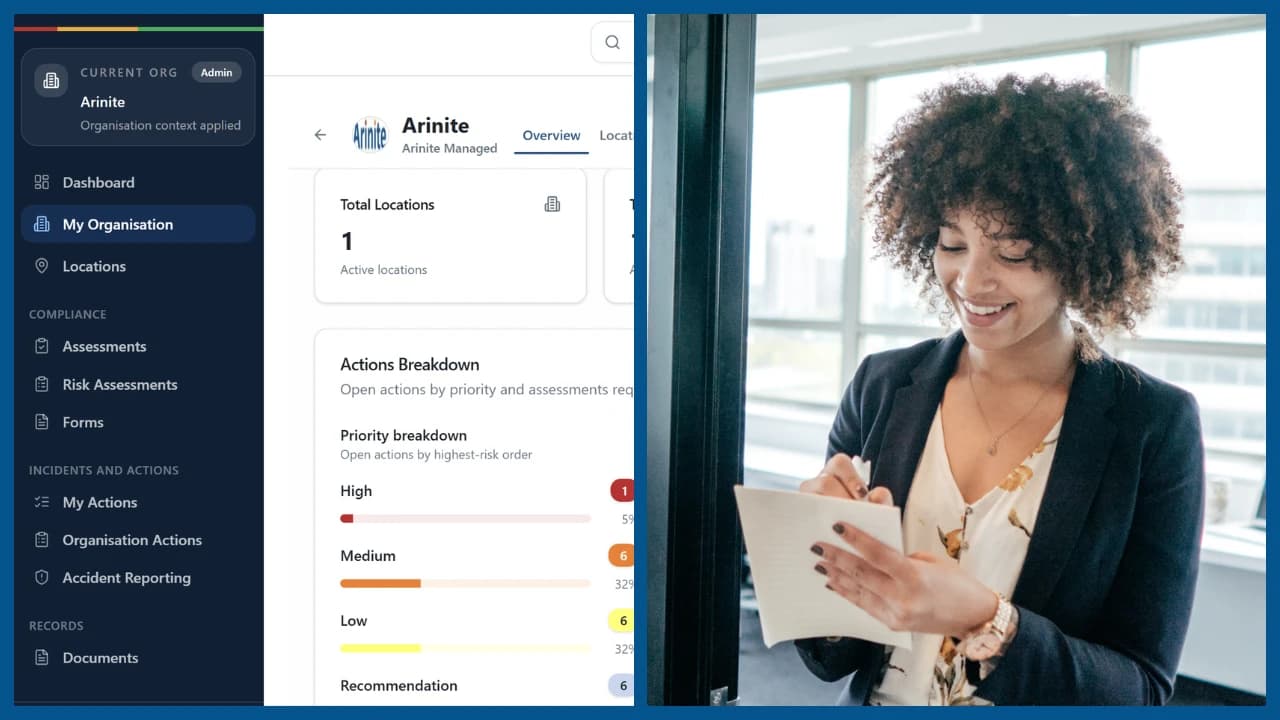
Arinite provides Irish compliance as part of our international health and safety service combining UK-based programme management with Irish-qualified specialists. Part of our international health and safety service, delivered by Chartered consultants. Managed through health and safety software with outsourced health and safety coordination.

1

Irish partnership model

Our Irish partners are qualified health and safety professionals familiar with the SHWWA 2005 framework and General Application Regulations 2007.

2

Safety Statement preparation

Workplace-specific Safety Statement under Section 20, incorporating Section 19 risk assessment, control measures, resources, named responsibilities, and consultation. Reviewed annually.

3

Risk assessment

Workplace-specific Irish risk assessment methodology covering all applicable hazard categories.

4

Safety Representative support

Election process support, training for elected Representatives under Section 25(6), and Safety Committee facilitation where Section 26 applies.

5

Training delivery

Induction, task-specific, manual handling, DSE, first aid, fire safety delivered to Irish standards. Records maintained in Arinite’s health and safety software platform.

6

HSA inspection readiness and support

Documentation maintained to HSA expectations. Your Irish consultant attends inspections on your behalf.

7

HSA reporting

Accident and dangerous occurrence reporting to HSA within correct thresholds (note: Irish thresholds differ from UK RIDDOR).

8

Coordination arrangements

Section 19(2) coordination for multi-occupied buildings and shared workplaces, documented and implemented.

9

UK-based coordination

Named Chartered consultant at Arinite UK manages the programme. Single UK point of contact across all international compliance.

10

Consolidated reporting

All Irish compliance maintained in Arinite’s health and safety software platform alongside UK and other international operations.

11

Continuous maintenance

SHWWA 2005 framework and HSA enforcement priorities evolve. We monitor changes and update documentation.

PRICING

How Much Does Irish Health
and Safety Compliance Cost?

Irish compliance costs vary based on: number of Irish sites, number of Irish employees, sector risk profile, scope of training, and whether ongoing maintenance or one-off setup is required.

Factors That Drive Cost

1

Number of Irish locations. Single Dublin office vs multi-city operations.

2

Workforce size. Training delivery and Safety Representative arrangements scale with employee count.

3

Sector. Pharmaceutical, medical devices, and construction-adjacent activities face more intensive regulation.

4

Post-Brexit establishment complexity. First Irish subsidiary requires more setup work.

5

Multi-occupied building context. Section 19(2) coordination adds complexity.

6

Ongoing vs project. Initial setup (Safety Statement, risk assessment, training, Safety Representative facilitation) is one-time; maintenance is ongoing.

Typical Engagement Types

1

Project-based: one-off Irish compliance establishment including Safety Statement, risk assessment, initial training, and HSA inspection readiness.

2

Ongoing retainer: Irish compliance maintained as part of a Done For You or Done With You international package.

3

Hybrid: initial project followed by ongoing light-touch maintenance coordinated through your UK Arinite consultant.

Rather than publish generic rates, Arinite provides a tailored quote after a brief discovery call. A free international gap analysis call with one of our Chartered consultants will give you a clear estimate.

Get Irish Health and Safety Compliance Right

Ireland is often the compliance moment where UK businesses realise their UK frameworks don’t transfer cleanly to another jurisdiction. Whether you’re establishing your first Irish subsidiary, expanding an existing Dublin presence, or responding to HSA engagement, Arinite delivers locally qualified Irish compliance coordinated from the UK.

Book a free international gap analysis call. In 30 minutes, one of our Chartered consultants will review your Irish arrangements, identify the gaps that matter, and recommend the right approach.