HSE inspections up 47% - HSE carried out over 13,200 workplace inspections in 2024/25.
Belgium operates one of the most prescriptive workplace health and safety regimes in Europe. Every employer with one or more workers must appoint an External Service for Prevention and Protection at Work (EDPBW / SEPPT), recognised by the FOD WASO, alongside an Internal Service (IDPBW), a Dynamic Risk Management System, a Global Prevention Plan, and an Annual Action Plan. Arinite delivers the full Belgian framework: EDPBW liaison, internal service support, Codex risk analysis, Committee (CPBW) administration, psychosocial risk management, and ongoing compliance monitoring. One compliance partner across the UK, Belgium, and your other European locations.
In Belgium, workplace health and safety is governed under a single integrated concept known as "well-being of workers in the performance of their work" (in Dutch: welzijn op het werk, in French: bien-etre au travail). The framework is broader than the UK definition of "health and safety" and covers eight statutory areas.
Every employer operating in Belgium, whether Belgian, foreign, or operating through posted workers, must build a documented prevention policy across all eight areas. This duty does not depend on company size. It applies from the first employee.
The framework is enforced by the FOD WASO (Federale Overheidsdienst Werkgelegenheid, Arbeid en Sociaal Overleg), also known as SPF Emploi in French. The Supervision of Well-being at Work directorate carries out inspections, issues warnings, imposes administrative fines, and refers serious breaches to the Public Prosecutor under the Social Penal Code. Belgian welfare law transposes EU framework Directive 89/391/EEC.
The eight statutory areas of well-being at work are:
Occupational safety
Protection of workers' health at work
Psychosocial aspects of work (stress, burnout, harassment, violence)
Ergonomics
Occupational hygiene
Beautification of workplaces
Measures relating to the environment, insofar as they affect the other seven areas
Protection against violence, bullying, and unwanted sexual behaviour at work
Belgian workplace safety law is built on two pillars: a primary statute that defines duties at a high level, and a consolidated regulatory Codex that sets out detailed technical requirements. See our health and safety legislation guide for cross-jurisdictional context.
The "Well-being Act" (Wet welzijn op het werk / Loi sur le bien-etre au travail) is the principal statute. It transposes EU Directive 89/391/EEC into Belgian law and applies to every employer with workers in Belgium regardless of nationality, place of establishment, or contract duration. It sets out the eight areas of well-being, the duty to organise prevention services, the duty to consult workers, and the principles of the Dynamic Risk Management System.
The consolidated regulatory code (Dutch: Codex over het welzijn op het werk, French: Code du bien-etre au travail) brings together all royal decrees adopted under the Welfare at Work Act. It is organised into 10 books covering general principles, internal and external prevention services, workplaces, work equipment, physical/chemical/biological agents, ergonomics, collective and personal protective equipment, and specific worker categories.
Most welfare-at-work duties are reinforced by criminal sanctions under the Social Penal Code. Infringements are categorised by severity (levels 1 to 4) and may attract administrative fines, criminal penalties, or imprisonment. A special public prosecutor for social affairs can refer serious cases to the criminal courts.
Sets out the size, structure, and minimum tasks of the IDPBW (Internal Service for Prevention and Protection at Work) that every employer must establish. The internal service is categorised A, B, C, or D depending on workforce size and risk profile.
Sets out the accreditation, organisation, and minimum service offering of the EDPBW (External Service for Prevention and Protection at Work). An EDPBW must be officially recognised by the FOD WASO under Article 40 of the Welfare at Work Act. Every employer that does not provide a particular prevention function internally must affiliate with an accredited EDPBW.
Specific framework on psychosocial risks: stress, burnout, conflicts, violence, moral harassment, and sexual harassment at work. Requires a documented psychosocial risk analysis, a Prevention Advisor for Psychosocial Aspects (internal or external), and confidential internal procedures.
Reintegration of workers absent due to long-term sickness. Updated to "Reintegration 3.0" effective from 30 December 2025, introducing the TRIO platform for data exchange between the Prevention Advisor-Occupational Physician (PA-OP) and treating physicians.
Employers with at least 20 workers must include the right to disconnect in their work rules or in a company-level Collective Bargaining Agreement (CBA). Modalities, training, and awareness must be defined.
The EDPBW (Externe Dienst voor Preventie en Bescherming op het Werk, French: SEPPT) is the cornerstone of operational compliance in Belgium. Every employer with one or more workers must be affiliated with an accredited EDPBW for any prevention competence not covered internally.
The Welfare at Work Act requires every employer to have access to specialist prevention competences. In practice, only the largest Category A employers can staff every competence internally. Smaller employers are required by Article 40 to call on an external service for the disciplines they do not provide themselves. For the vast majority of employers, this means:
Delivered through the EDPBW. The Prevention Advisor-Occupational Physician (PA-OP) carries out periodic medical examinations, fitness assessments, return-to-work medicals, vaccinations, and the reintegration pathway.
Typically delivered through the EDPBW for employers below 50 workers, through a Prevention Advisor for Psychosocial Aspects who handles risk analysis, confidential interventions, and harassment complaints.
Including ergonomics, occupational hygiene, and industrial hygiene, accessed through the EDPBW where these are not held internally.
An EDPBW cannot operate in Belgium without official accreditation from the FOD WASO. Accreditation is granted by the Directorate-General for Humanisation of Work following an application that demonstrates compliance with statutory staffing, competence, governance, and quality requirements. Accreditation can be limited, time-bound, or refused. A non-compliant EDPBW can have its accreditation restricted, suspended, or withdrawn. The list of accredited EDPBWs is maintained publicly by the FOD WASO.
The EDPBW relationship is a long-term operational partnership, not a once-a-year audit relationship. Common pitfalls for international businesses entering Belgium include:
Affiliating with an EDPBW but never integrating its outputs (risk analyses, occupational health findings, psychosocial reports) into a documented Global Prevention Plan.
Treating the EDPBW as the entire compliance system. The EDPBW provides specialist competences. The employer retains primary legal responsibility for prevention, the internal service, the Committee, and documentation.
Failing to maintain the internal Prevention Advisor, which is a statutory role even where most disciplines are externalised.
Not coordinating the EDPBW with the wider European compliance system. International employers with sites in Germany, France, the Netherlands, and Belgium typically run parallel arrangements that should be governed centrally.
Arinite acts as the central health and safety partner across all your jurisdictions and coordinates day-to-day with your Belgian EDPBW so that nothing falls between the two services.
Every employer must also organise an Internal Service for Prevention and Protection at Work (IDPBW). The size and minimum staffing depend on workforce size and risk profile. The Royal Decree on Internal Services categorises employers into four classes:
Employers with at least 1,000 workers, or at least 50 workers in higher-hazard industries (such as petrochemical, mining, certain manufacturing). Category A internal services must contain almost all prevention disciplines internally: safety, occupational medicine, psychosocial aspects, ergonomics, and industrial hygiene, all staffed by Level I-qualified Prevention Advisors.
Mid-sized employers (typically 200 to 1,000 workers, or 20 to 50 in higher-hazard industries). At least one Level II-qualified Prevention Advisor for safety, supported by an EDPBW for the remaining disciplines.
Smaller employers (typically 20 to 200 workers in lower-hazard sectors). A Prevention Advisor for safety with basic training. Most disciplines including occupational medicine and psychosocial risks delegated to the EDPBW.
Employers with fewer than 20 workers in lower-hazard sectors. The employer may take on the role of Prevention Advisor personally without formal qualification, provided basic knowledge requirements are met. Occupational medicine and other specialist disciplines must still be obtained from an accredited EDPBW.
The Royal Decree of 26 March 2024 (in force from 1 July 2024) simplified the procedure for creating common internal services shared between multiple employers. Small common services can be set up with up to 10 affiliated employers and a maximum of 2,000 workers, without medical surveillance, by demonstrating to the Social Inspection that legal requirements are met. This is useful for group structures and small businesses sharing facilities.
Employers with at least 50 workers must establish a Committee for Prevention and Protection at Work (CPBW, in French: CPPT). The Committee is a co-determination body composed of employer representatives, employee representatives elected through social elections, and the internal Prevention Advisor. It has extensive statutory powers, including:
Issuing prior opinions on all matters relating to well-being at work, including risk analyses, the Global Prevention Plan, the Annual Action Plan, and significant workplace changes.
Receiving the annual report of the Internal Service, the EDPBW's annual report, and accident statistics.
Conducting periodic workplace inspections jointly with the Prevention Advisor and the employer.
Maintaining direct relations with the FOD WASO Supervision of Well-being at Work directorate, including the right to escalate concerns to the inspectorate.
Approving (or refusing to approve) the appointment, replacement, or dismissal of the internal Prevention Advisor.
For employers with 20 to 49 workers, Committee functions are exercised by the Trade Union Delegation. For employers with fewer than 20 workers, functions are exercised directly with the workers themselves.
Belgian welfare law does not specify "do a risk assessment" in the abstract terms used by UK MHSWR Regulation 3. It mandates a structured, ongoing Dynamic Risk Management System (DRMS) covering all eight well-being areas. See our health and safety audit service for the equivalent in other jurisdictions.
Define the objectives of the prevention policy and the means required to achieve them. Establish governance, accountabilities, and resourcing.
Determine the methods, tasks, obligations, and means of the persons concerned. Map activities, timelines, and ownership.
Operationalise prevention measures across the workplace, the line organisation, and individual roles.
Measure outcomes, review effectiveness, and feed findings back into the next cycle.
Risk analysis is conducted on three levels concurrently:
Overall prevention strategy and corporate-level risks.
Departmental and job-family level risks.
Personal exposures, fitness for task, and specific vulnerabilities (young workers, pregnant workers, workers with disabilities).
Outputs of the DRMS are documented in two mandatory plans:
A five-year plan describing the results of the risk analysis, priority objectives, activities, resources, and roles. Updated at least every five years.
Operationalises the GPP year by year. Sets out specific activities for the coming year, taking into account the previous year's incidents, accidents, Committee opinions, and the Internal Service's annual report.
Both plans require prior advice from the CPBW (where one exists). Both are produced jointly by the employer, the Internal Service, and the EDPBW.
Under the combined framework, every employer with workers in Belgium must:
Establish an Internal Service for Prevention and Protection at Work (IDPBW) with a designated Prevention Advisor, sized and staffed according to the applicable category (A, B, C, or D).
Affiliate with an accredited External Service for Prevention and Protection at Work (EDPBW), recognised by the FOD WASO, for any prevention competences not held internally.
Conduct risk analysis under the Dynamic Risk Management System across all three levels (organisation, function, individual) and all eight well-being areas.
Produce and maintain a five-year Global Prevention Plan and an Annual Action Plan, with prior Committee consultation where applicable.
Establish a Committee for Prevention and Protection at Work (CPBW) where the workforce reaches 50, or operate through the Trade Union Delegation or directly with workers in smaller organisations.
Conduct a specific psychosocial risk analysis and appoint or access a Prevention Advisor for Psychosocial Aspects. Maintain internal procedures for psychosocial complaints, harassment, and violence.
Organise health surveillance for at-risk workers through the EDPBW's Prevention Advisor-Occupational Physician, including pre-employment medicals, periodic medicals, return-to-work medicals, and reintegration pathway support.
Provide information and training to workers on prevention measures, risks, emergency procedures, and the right to raise concerns. Training must be appropriate to role, language, and risk.
Operate the reintegration pathway for workers on long-term sick leave under the updated rules (Reintegration 3.0), including TRIO platform usage and documented consent.
For employers with at least 20 workers, define and communicate the right to disconnect through work rules or a company CBA, with associated awareness and training.
Maintain documentation evidencing compliance: risk analyses, prevention plans, training records, medical surveillance records, Committee minutes, EDPBW correspondence, and Internal Service annual reports.
Notify and record serious accidents, occupational diseases, and incidents in accordance with the Codex and EU notification requirements.
Comply with sector-specific Codex provisions for construction, healthcare, chemicals, transport, and other regulated activities.
Failure to comply exposes the business to FOD WASO enforcement (warnings, administrative fines, work stoppage orders), criminal sanctions under the Social Penal Code (up to imprisonment for serious breaches), civil claims for occupational injury, and personal liability for company officers.
A compliant Belgian prevention policy is not a single document. It is a documented system. The minimum documentation set includes:
Signed by senior management, committing to the eight well-being areas and to the Dynamic Risk Management System.
The five-year strategic prevention plan.
The current-year operational plan.
Across the three levels (organisation, function, individual) and all eight well-being areas.
Documented, with internal procedures for complaints, harassment, violence, and confidential interventions.
Covering fire, serious and imminent danger, and first aid arrangements.
For employers of 20 or more workers, in the work rules or a company CBA, with implementation modalities.
Describing how the employer manages long-term sickness absence, supports return to work, and engages the PA-OP under the Reintegration 3.0 framework.
Evidencing initial training, periodic refresh, and specialist training for line managers and Prevention Advisors.
Of the Internal Service and the EDPBW, retained on file for inspection by FOD WASO.
This should integrate with your wider health and safety policy at group level.
Belgian welfare law applies uniformly to every employer, but the practical compliance profile varies materially by sector. Arinite supports clients across Belgium in the sectors below.
Typically Category C or D internal services. Lower physical risk but elevated exposure on psychosocial risks (workload, hybrid working, always-on culture), DSE and ergonomics for office-based and remote workers, and the right to disconnect duty (20+ workers). Common gap: under-investment in psychosocial risk analysis on the assumption that an EAP covers it.
Brussels hosts significant EU and pan-European financial institutions. Combination of office-based welfare duties, regulatory expectations on conduct and culture, harassment prevention obligations, and reintegration pathway management.
Higher-hazard category. Biological agents, sharps, manual handling, shift work, psychosocial demand, and patient-facing aggression. Category A or B internal services common. Detailed Codex Book V duties on chemical and biological agents.
Specific Codex Book IX duties (collective and personal protective equipment) and dedicated Construction Safety and Health Plan requirements for projects. Temporary or mobile worksites require a Safety and Health Coordinator. Higher-hazard category internal services.
Manual handling, vehicle-pedestrian interface, working at height, racking, and shift work. Ergonomics under Codex Book VIII. Increased focus from FOD WASO inspections in this sector.
Wide range of physical, chemical, and mechanical hazards. Category A internal service common. Detailed conformity duties on work equipment (Codex Book IV) and hazardous agents (Codex Book V), and the requirement to maintain a "Hygiene and Safety Coordinator" function.
Violence and aggression exposure, lone working, shift work, and harassment prevention duties. Psychosocial risk analysis particularly important. Workplace inspections in this sector often respond to anonymous complaints.
Specific public-sector arrangements but the same underlying welfare framework. Education, in particular, faces heightened psychosocial risk analysis expectations.
Training is a specific Codex obligation under Book I, Title 2. Initial induction, periodic refresh, and role-specific training must be documented. See our health and safety training service for international delivery options.
The internal Prevention Advisor must hold appropriate qualification according to the employer's category. Level I (university-equivalent multidisciplinary training) for Category A and B Safety Prevention Advisors. Level II (advanced vocational) for Category B and C. Basic training for Category C and D. Recognised training providers are accredited by FOD WASO.
Every worker must receive training on the risks of their workstation, prevention measures, emergency procedures, and the right to raise concerns. Training language and format must be appropriate to the worker. Periodic refresh on significant change or at defined intervals.
Hierarchical line members have specific welfare duties under the Welfare at Work Act. Training must cover risk recognition, intervention, escalation, and the manager's role in the Dynamic Risk Management System.
Awareness training for all workers, with specific training for line managers and "confidential counsellors" (vertrouwenspersonen) where appointed. The Royal Decree on Psychosocial Risks requires confidential counsellor training of at least 5 days plus annual supervision.
A minimum number of trained first aiders must be designated according to workforce size and risk profile. Training must be delivered by an accredited provider and refreshed annually.
Working at height, confined spaces, fire safety, manual handling, electrical safety, chemical handling, and other Codex-specific hazards each carry distinct training duties.
Employers with at least 20 workers must provide training or awareness-raising on healthy digital tool use and the risks of over-connection, alongside the documented right to disconnect.
Arinite delivers training in English, Dutch, and French through Chartered consultants and accredited Belgian training partners, with records maintained in Arinite's health and safety software platform.
International employers entering Belgium, and Belgian employers that have grown faster than their compliance systems, routinely show the same gaps under FOD WASO inspection.
No formal EDPBW affiliation, or an EDPBW affiliation that is paid for but not operationally integrated. The single most common gap for foreign-headquartered businesses.
No designated internal Prevention Advisor, or a Prevention Advisor designated on paper but without the time, training, or authority to perform the role.
No Global Prevention Plan, or a Global Prevention Plan that is more than five years old.
No Annual Action Plan, or an Annual Action Plan that is not derived from the GPP and the previous year's evidence.
Risk analysis incomplete: covering safety but not psychosocial aspects, ergonomics, or occupational hygiene.
CPBW not constituted at the 50-worker threshold, or constituted but not consulted on required matters (GPP, AAP, significant changes, accident statistics).
Psychosocial risk analysis missing or generic. Confidential counsellor not appointed where appropriate. Internal procedures for harassment and violence not documented.
Right to disconnect policy missing despite the 20-worker threshold being crossed, or policy present but without modalities, training, or CBA support.
Reintegration pathway not operated. Long-term absentees managed informally without PA-OP engagement, missing the Reintegration 3.0 requirements.
Annual report of the Internal Service not produced, or produced but not submitted to the Committee and retained for inspection.
Training records absent or generic. No evidence of induction training, periodic refresh, or role-specific training.
Posted workers operating in Belgium under their home-country regime alone, without Belgian welfare arrangements. The Welfare Act applies to posted workers regardless of nationality or duration.
Documentation in English only. The Codex expects worker-facing communications in the worker's language: Dutch, French, or German depending on the region, with English supplementing.
Arinite's Belgium compliance programme identifies and resolves each of these gaps as part of standard onboarding.
Arinite acts as the central health and safety partner across all of your jurisdictions. In Belgium, we coordinate day-to-day with your accredited EDPBW and deliver the internal compliance system that the EDPBW does not. Delivered by Chartered consultants as part of our outsourced health and safety service.
Where you do not yet have an EDPBW, we run a structured selection process across accredited providers, manage onboarding, and integrate the EDPBW into your internal compliance system. Where you already have an EDPBW, we audit the relationship and lift its operational value.
Category assessment, Prevention Advisor designation, role definition, and ongoing competence support for the internal Prevention Advisor.
Risk analysis across the three levels and the eight well-being areas, documented in your management system.
Drafting, Committee consultation, board sign-off, and annual review cycle.
Specific psychosocial risk analysis, confidential counsellor selection and training, internal procedures, and ongoing case advisory.
Committee constitution where you have crossed the 50-worker threshold, agenda preparation, minutes, and integration into the wider prevention governance.
Operating the Reintegration 3.0 framework, coordinating with the PA-OP, and documenting outcomes.
Policy drafting, modalities definition, work rules integration or CBA support, and worker awareness.
Worker induction, line manager training, confidential counsellor training, first aid, and specific hazard training, in English, Dutch, and French.
Pre-inspection audit, documentation review, on-the-day support, and response to inspector findings.
For multi-country businesses, Arinite operates as a single compliance partner across the UK, Belgium, the Netherlands, France, Germany, Italy, Spain, and Ireland, with consistent governance and a single set of records in our health and safety software platform.
For businesses on Arinite's Done For You or Done With You packages, Belgian compliance is included.
Belgian compliance cost varies meaningfully based on several factors. We do not publish generic rates because the inputs vary too widely to be useful in advance of a discovery call.
Internal service category (A, B, C, D) is determined by number of workers and risk profile. Each category carries different staffing and training expectations.
Multi-site employers carry more risk analysis, more EDPBW coordination, and more Committee activity.
Construction, manufacturing, healthcare, and chemicals require deeper risk analysis, more specialist competences, and more frequent inspection readiness than office-based sectors.
Employers already affiliated with an accredited EDPBW need different support than employers starting from scratch.
Committee constitution and support is additional scope.
Belgium-only versus Belgium-as-one-of-many jurisdictions changes the operating model.
The Codex expects worker-facing communications in Dutch, French, or German depending on region. Translation scope influences cost.
One-off compliance baseline: EDPBW selection or audit, Internal Service setup, initial risk analysis, GPP and AAP drafting, and initial training rollout.
Belgian compliance maintained as part of Done For You or Done With You monthly arrangements, including annual GPP and AAP review, training, advisory, FOD WASO inspection readiness, and incident response.
Initial project establishment followed by ongoing light-touch maintenance and advisory.
A free gap analysis call with one of our Chartered consultants will give you a clear estimate for your specific situation in Belgium.
Belgium has one of the most prescriptive welfare-at-work regimes in Europe. The framework is enforceable, well-resourced by FOD WASO inspectors, and reinforced by criminal sanctions under the Social Penal Code.
International employers entering Belgium and Belgian employers that have outgrown their compliance system both share the same risk profile: an EDPBW relationship that exists on paper but is not driving operational compliance, no Global Prevention Plan, no Annual Action Plan, and no documented psychosocial risk analysis.
Book a free gap analysis call. In 30 minutes, one of our Chartered consultants will review your current Belgian arrangements, identify the gaps that matter, and give you a clear recommendation and indicative cost.
From Reactive Firefighting to Proactive Health & Safety Compliance
No formal HSE systems in place. Everything is reactive, waiting for something to go wrong. Documentation is missing or outdated.
This isn't just "non-compliant." It's criminally negligent. Directors face personal prosecution.
Basic HSE documentation is in place. Minimum legal requirements met. You can pass a basic audit.
Compliance is where most consultants get you, then leave. You're legal, but you're not optimised.
Systems run proactively, preventing problems before they occur. Compliance is distributed, not dependent on one person.
That's why 95%+ of clients renew year after year.

Robert Winsloe
Managing Director, Arinite
“We work with you to deliver peace of mind. We tailor our service provision to your business to provide proactive, pragmatic health and safety advice and that helps reduce costs by ensuring compliance with relevant health and safety legislation.”
Other Consultants
Get you to Stage 2 (Compliant) and disappear.
Arinite
Gets you to Stage 3 (Proactive) and keeps you there.
That's why we call it transformation, not just compliance.
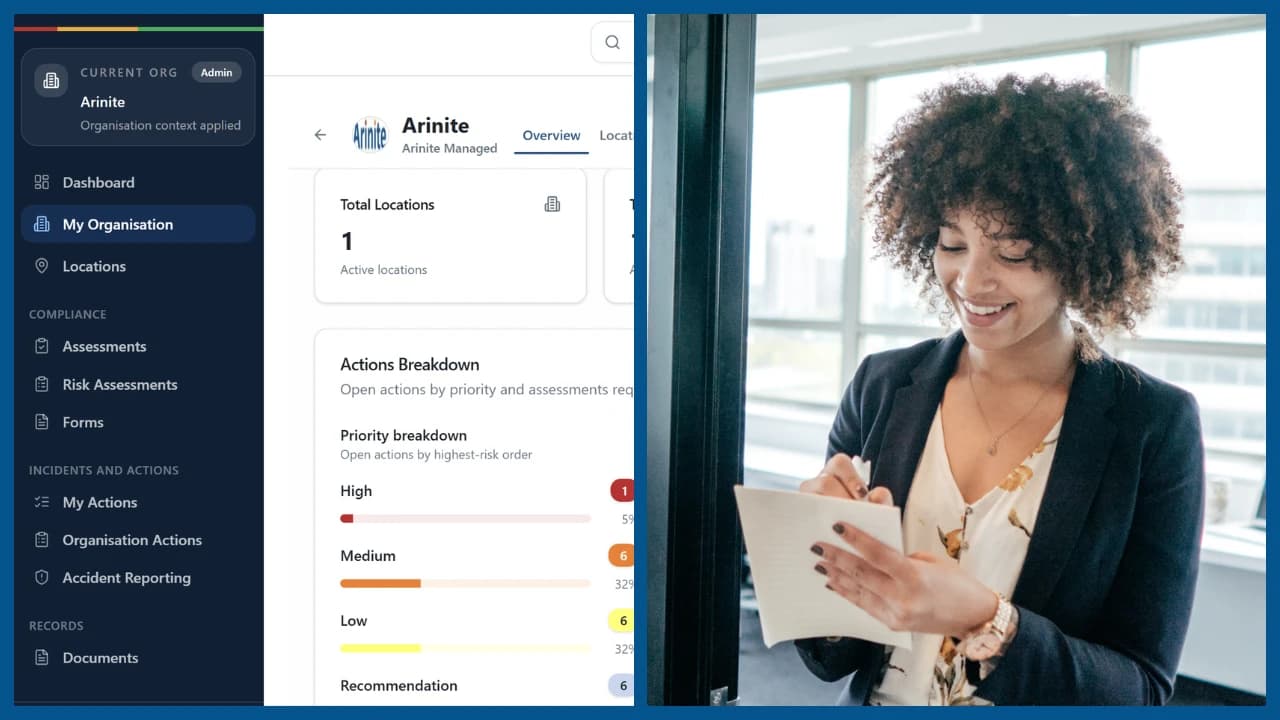
Compliance
Traditional consultancies audit, report and leave. You get a document and the job of implementing it.
Control
Software companies give you dashboards and workflows without the knowledge to use them.
Coverage
Global businesses need consultants who know compliance in every jurisdiction.
Arinite
We are not a consultancy that adds external software. We are not a software company that recommends consultants.
We are the place where those two things finally become one.
50+ Countries. Global Safety. Local Trust.
Headquartered in London, UK, with Chartered health and safety consultants in 50+ countries. Whether you need a health and safety audit in Manchester, a fire risk assessment in Birmingham, or outsourced workplace health and safety compliance in Singapore, we have consultants near you.
We're expanding globally

Operations Director, Arinite
I have been in the health and safety business for 35+ years. In that time, I have had one consistent experience across every sector and every country I have worked in.
Every business we speak to already knows, somewhere, that their workplace health and safety compliance has not kept pace with their growth. It is not ignorance. It is business. It is the assumption that because nothing has gone wrong yet, the gaps are probably manageable.
What stops most businesses from doing something about it is not the cost of outsourcing health and safety support. It is the fear of finding out how significant the gaps are.
The Free Gap Analysis Call exists for exactly that moment.
You get the full picture of your workplace health and safety position in 30 minutes.
“In 35+ years, I have not once had someone tell us they wished they had stayed in the dark.”
No video testimonials available at the moment.
Join 1,500+ organisations that trust Arinite as their health and safety consultants.
Common questions about the EDPBW, IDPBW, CPBW, the Codex, and FOD WASO compliance for employers in Belgium
Our IOSH Chartered health and safety consultants are here to help with any queries about workplace safety, compliance, or our services.
Download our comprehensive library of expert guides, checklists, and templates.
Browse LibraryHave a question or need expert advice? We're here to help.
Fill out the form below and our team will get back to you within 24 hours.
Headquarters
29 Throgmorton St
London EC2N 2AT