HSE inspections up 47% - HSE carried out over 13,200 workplace inspections in 2024/25.
A guide to the PAPRIPACT (Programme Annuel de Prévention des Risques Professionnels et d'Amélioration des Conditions de Travail) for UK businesses with French operations of 50+ employees. This page covers the legal requirement under the Loi du 2 août 2021, the relationship to the DUERP, the CSE consultation process, and how Arinite delivers PAPRIPACT as part of French compliance support.
PAPRIPACT stands for Programme Annuel de Prévention des Risques Professionnels et d'Amélioration des Conditions de Travail (Annual Programme of Occupational Risk Prevention and Working Conditions Improvement). It is France's mandatory annual risk prevention action programme, required of every employer in France with 50 or more employees under Article L. 4121-3-1 of the French Labour Code (Code du Travail).
The PAPRIPACT is the action plan that accompanies the DUERP (Document Unique d'Évaluation des Risques Professionnels). Where the DUERP identifies and assesses the risks, the PAPRIPACT sets out what the employer will actually do about them over the next 12 months: the specific prevention actions, the resources allocated, the deadlines, the responsible parties, and the performance indicators used to track progress.
The PAPRIPACT was strengthened and formalised by the Loi du 2 août 2021 on occupational health prevention, which replaced the earlier and less prescriptive 'plan d'action' requirement. For businesses below the 50-employee threshold, a simplified list of prevention actions accompanying the DUERP is required instead.
PAPRIPACT sits within the wider French occupational safety framework. The key elements are:
Establishes the PAPRIPACT requirement for businesses with 50+ employees. Defines the minimum content and consultation requirements.
The general employer duty to ensure the health and physical and mental safety of workers. The foundational legal obligation from which the DUERP and PAPRIPACT both flow.
The DUERP requirements. The PAPRIPACT is linked operationally to the DUERP.
Significantly strengthened both DUERP and PAPRIPACT requirements, introduced the 40-year retention obligation for historical DUERP versions, and formalised the annual action programme as PAPRIPACT.
The employee representative body required in businesses with 11+ employees. Must be consulted on the PAPRIPACT, which is a specific legal step in the development cycle. For businesses with 300+ employees, the specialist health and safety commission (CSSCT) operates within the CSE and typically leads on PAPRIPACT consultation.
Occupational health physicians (through the Service de Prévention et de Santé au Travail, SPST) who contribute technical input to the PAPRIPACT where occupational health issues are identified in the DUERP.
The French labour inspectorate. Has powers to review the PAPRIPACT during workplace inspections and to issue formal notices (mise en demeure) where it is missing, inadequate, or not implemented.
The PAPRIPACT obligation applies based on business size:
Must prepare a full PAPRIPACT in the format set out by Article L. 4121-3-1, updated annually and consulted with the CSE.
Must maintain a list of prevention actions accompanying the DUERP. The format is less prescriptive than the full PAPRIPACT but the content requirements are similar: actions planned, deadlines, responsible parties.
Must still maintain the DUERP and implement prevention actions, but there is no specific PAPRIPACT or action list format required. Good practice is still to document planned actions alongside the DUERP.
For UK groups operating in France, the threshold applies at the French legal entity level. A UK parent company of 2,000 employees with a French subsidiary of 30 employees does not trigger the full PAPRIPACT at French level, but the 30-employee subsidiary must maintain the 11-49 employee prevention action list.
When calculating the 50-employee threshold, the standard French employee counting rules apply (headcount calculation, including some provisions for part-time workers and temporary staff). In doubt, professional advice on the specific calculation is recommended.
Under Article L. 4121-3-1, the PAPRIPACT must include:
A list of prevention actions to be implemented during the year covered by the programme, linked explicitly to the risks identified in the current DUERP.
For each action: the objectives pursued (what risk is being addressed and what outcome is targeted), the means and resources allocated (budget, equipment, training, staff time), the deadlines for implementation, the individual or team responsible, and the indicators used to measure progress and effectiveness.
An explanation of the rationale for action priorities, demonstrating that the most significant risks identified in the DUERP are addressed first.
A summary of the actions implemented during the previous year, with an evaluation of their effectiveness.
The minutes or record of the CSE consultation on the programme.
The PAPRIPACT must cover all categories of occupational risk addressed in the DUERP: physical, chemical, biological, ergonomic, and psychosocial (risques psychosociaux, RPS). It must also address the specific requirements on training, information, and the organisation of work.
A compliant PAPRIPACT is developed through an annual cycle:
Review the current DUERP. Update the risk evaluation to reflect any new risks, changes to work conditions, or incidents since the last review. The PAPRIPACT cannot be drafted without a current DUERP.
Identify the actions required. For each risk in the DUERP, determine whether action is required, what action, and when. Actions should follow the French nine principles of prevention set out in Article L. 4121-2 of the Code du Travail (avoid, evaluate, combat at source, adapt work to workers, adapt to technical progress, replace dangerous with less dangerous, plan coherently, prioritise collective protection, provide appropriate instructions).
Prioritise and schedule. Not every action can be taken in one year. The PAPRIPACT must demonstrate that priorities have been set based on the severity and likelihood of risks, with the most significant risks addressed first.
Allocate resources. Each action requires specified resources: budget, equipment, staff time, external support. Without allocated resources, the PAPRIPACT is not credible.
Draft the programme. In the required format, with all content elements present.
Consult the CSE. The programme must be submitted to the CSE for consultation. The CSE may propose amendments; the employer must consider them but has the final decision.
Publish and implement. Make the PAPRIPACT available to employees, the medico competente, and on request to the Inspection du Travail. Implement the actions on the scheduled timeline.
Monitor and report. Track progress against the indicators defined in the PAPRIPACT. Include the previous year's implementation summary in the next year's programme.
UK businesses that have crossed the 50-employee threshold in France routinely fail PAPRIPACT compliance in predictable ways:
UK businesses frequently underestimate the 50-employee threshold significance. Once crossed, a full PAPRIPACT is mandatory from that annual review cycle onwards.
UK businesses often produce a list of planned health and safety activities but without the PAPRIPACT's specific content requirements (objectives, resources, deadlines, responsible parties, indicators, previous-year summary, CSE consultation record).
The CSE must be consulted during the development of the PAPRIPACT, not presented with a finished document. Late-stage consultation is a compliance failure.
The PAPRIPACT must explicitly address the risks identified in the current DUERP. A PAPRIPACT that contains generic health and safety activities not linked to specific DUERP risks fails the Code du Travail requirement.
Where the DUERP identifies psychosocial risks (as it must), the PAPRIPACT must include specific prevention actions for them. UK businesses often miss this because psychosocial risk management is weaker in UK frameworks.
The document must be accessible to French-speaking employees, the CSE, and the Inspection du Travail. English-only documentation fails the accessibility requirement.
Once drafted and consulted, the PAPRIPACT must actually be implemented and tracked. Missing implementation records make the programme unenforceable and a compliance risk.
Arinite's international health and safety service addresses each of these gaps as part of French compliance onboarding for growing UK businesses.
Arinite provides PAPRIPACT as part of our international health and safety service for UK businesses with French operations.
Our French consultants hold recognised qualifications and work directly with clients in French. They update the DUERP as required, draft the PAPRIPACT in the correct format, support the CSE consultation process, and produce the documentation the Inspection du Travail expects.
Because Arinite covers both documents, they are developed as a linked pair rather than two disconnected compliance activities. This ensures the PAPRIPACT addresses the specific risks identified in the current DUERP, which is the core legal requirement.
We provide guidance on the consultation timeline, prepare the materials the CSE needs, and where useful attend CSE meetings to explain technical elements of the programme.
Your named Chartered consultant at Arinite UK manages the programme, coordinates French (and any other international) compliance activity, and reports to your UK board or HQ.
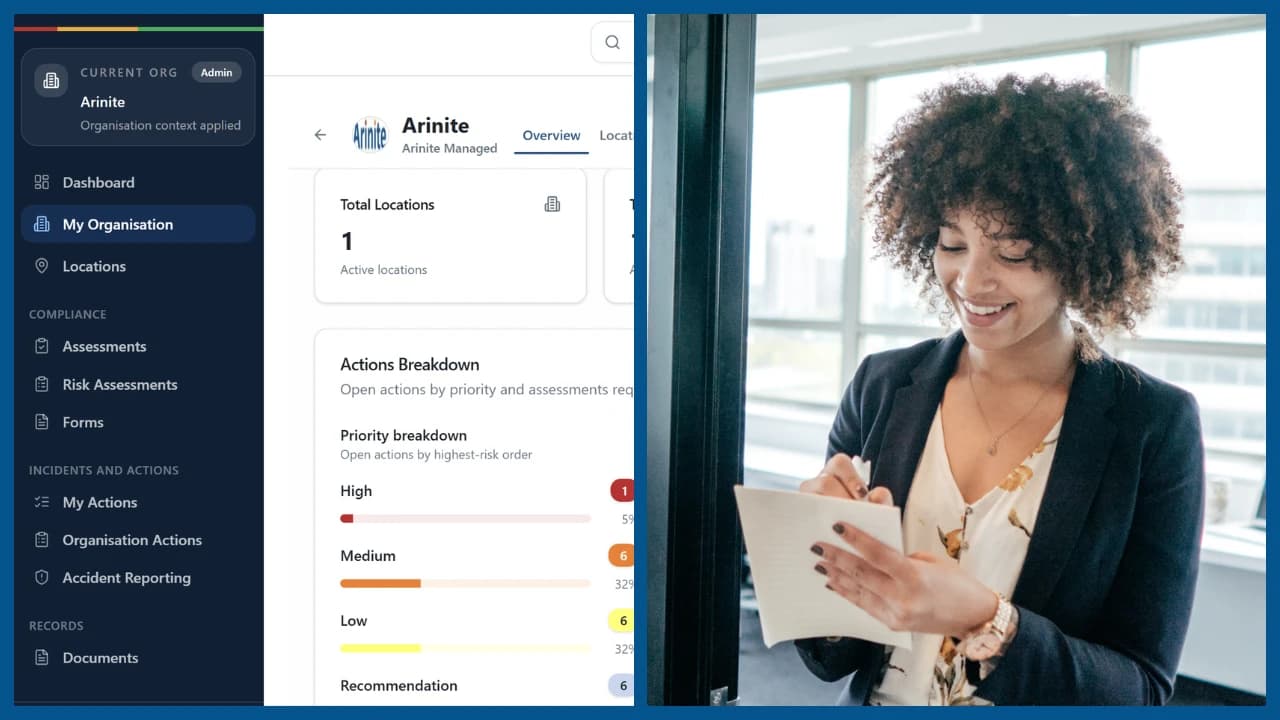
All French compliance activity, including the PAPRIPACT and its implementation tracking, is maintained in Arinite's health and safety software platform alongside your UK and other international operations.
The PAPRIPACT is an annual cycle, not a one-off project. Our ongoing support ensures the programme is refreshed each year with the same methodology, same documentation standards, and same CSE engagement.
Crossing the 50-employee threshold in France triggers specific PAPRIPACT obligations that do not apply to smaller operations. For UK businesses growing their French subsidiary across this threshold, PAPRIPACT is often the first specifically French compliance requirement they encounter that has no direct UK equivalent.
Book a free international gap analysis call. In 30 minutes, one of our Chartered consultants will review your current French arrangements, identify whether PAPRIPACT applies to you, and recommend the right approach.
From Reactive Firefighting to Proactive Health & Safety Compliance
No formal HSE systems in place. Everything is reactive, waiting for something to go wrong. Documentation is missing or outdated.
This isn't just "non-compliant." It's criminally negligent. Directors face personal prosecution.
Basic HSE documentation is in place. Minimum legal requirements met. You can pass a basic audit.
Compliance is where most consultants get you, then leave. You're legal, but you're not optimised.
Systems run proactively, preventing problems before they occur. Compliance is distributed, not dependent on one person.
That's why 95%+ of clients renew year after year.

Robert Winsloe
Managing Director, Arinite
“We work with you to deliver peace of mind. We tailor our service provision to your business to provide proactive, pragmatic health and safety advice and that helps reduce costs by ensuring compliance with relevant health and safety legislation.”
Other Consultants
Get you to Stage 2 (Compliant) and disappear.
Arinite
Gets you to Stage 3 (Proactive) and keeps you there.
That's why we call it transformation, not just compliance.
Compliance
Traditional consultancies audit, report and leave. You get a document and the job of implementing it.
Control
Software companies give you dashboards and workflows without the knowledge to use them.
Coverage
Global businesses need consultants who know compliance in every jurisdiction.
Arinite
We are not a consultancy that adds external software. We are not a software company that recommends consultants.
We are the place where those two things finally become one.
50+ Countries. Global Safety. Local Trust.
Headquartered in London, UK, with Chartered health and safety consultants in 50+ countries. Whether you need a health and safety audit in Manchester, a fire risk assessment in Birmingham, or outsourced workplace health and safety compliance in Singapore, we have consultants near you.
We're expanding globally

Operations Director, Arinite
I have been in the health and safety business for 35+ years. In that time, I have had one consistent experience across every sector and every country I have worked in.
Every business we speak to already knows, somewhere, that their workplace health and safety compliance has not kept pace with their growth. It is not ignorance. It is business. It is the assumption that because nothing has gone wrong yet, the gaps are probably manageable.
What stops most businesses from doing something about it is not the cost of outsourcing health and safety support. It is the fear of finding out how significant the gaps are.
The Free Gap Analysis Call exists for exactly that moment.
You get the full picture of your workplace health and safety position in 30 minutes.
“In 35+ years, I have not once had someone tell us they wished they had stayed in the dark.”
No video testimonials available at the moment.
Join 1,500+ organisations that trust Arinite as their health and safety consultants.
Common questions about PAPRIPACT, DUERP integration, and French compliance
Our IOSH Chartered health and safety consultants are here to help with any queries about workplace safety, compliance, or our services.
Download our comprehensive library of expert guides, checklists, and templates.
Browse LibraryHave a question or need expert advice? We're here to help.
Fill out the form below and our team will get back to you within 24 hours.
Headquarters
29 Throgmorton St
London EC2N 2AT