Skip to content

HSE inspections up 47% - HSE carried out over 13,200 workplace inspections in 2024/25.

Netherlands Specialists

Health and Safety in the Netherlands:
RI&E Compliance for UK Businesses

Arbowet · Plan van Aanpak · Kerndeskundige · Arbodienst

A guide to health and safety compliance in the Netherlands for UK businesses with Dutch subsidiaries, offices, or employees. This page covers the RI&E (Risico-Inventarisatie en -Evaluatie), the Dutch legal framework, employer duties, and how Arinite delivers Dutch compliance as part of international health and safety support.

1,500+ Businesses Protected
50+ Countries
95%+ Retention
Arbowet Compliant
Kerndeskundige
International Coverage
Get in Touch

Contact Arinite Today

Fill out the form below and our team will get back to you within 24 hours.

By submitting, you agree to our Privacy Policy and consent to Arinite contacting you.

RI&E

What Is
an RI&E?

RI&E stands for Risico-Inventarisatie en -Evaluatie (Risk Inventory and Evaluation). It is the Netherlands' mandatory workplace risk assessment, required of every employer in the Netherlands under Article 5 of the Dutch Working Conditions Act (Arbeidsomstandighedenwet, commonly abbreviated as Arbowet).

An RI&E is not a UK-style risk assessment. It is a specific Dutch legal document with defined content requirements, format expectations, and, for most employers, a mandatory independent expert review (toetsing). It must be available to employees, the works council (Ondernemingsraad or OR), and the Nederlandse Arbeidsinspectie (Dutch labour inspectorate) on request.

Every employer in the Netherlands must have an RI&E from day one of employment, maintain it as a current document, and accompany it with a Plan van Aanpak (PvA, Plan of Action) setting out how identified risks will be addressed. Failure to maintain a compliant RI&E is subject to administrative fines by the Arbeidsinspectie and can result in personal liability for directors in serious cases.

For comparable obligations in other European jurisdictions, see also the DGUV system in Germany and the DUERP in France.

LEGAL FRAMEWORK

The Dutch Health and
Safety Legal Framework

Understanding the RI&E requires understanding the wider Dutch occupational safety framework. The key elements are:

1

Arbeidsomstandighedenwet (Arbowet)

The primary Working Conditions Act. Establishes the general duty of every employer to provide safe and healthy working conditions and the specific requirement for the RI&E.

2

Arbeidsomstandighedenbesluit (Arbobesluit)

The implementing decree setting out detailed working conditions rules covering areas such as workstations, chemical agents, physical agents, and biological agents. Supplements the Arbowet with operational specifics.

3

Arbeidsomstandighedenregeling (Arboregeling)

Further technical implementing rules under the Arbobesluit.

4

Arbocatalogus

Sector-specific working conditions catalogues that employers and employee representatives jointly develop and that set the practical norms for a given sector. Following the relevant Arbocatalogus is evidence of compliance with the general Arbowet duties.

5

The Ondernemingsraad (OR, works council)

Required in businesses with 50+ employees. Must consent to the RI&E and the PvA. For smaller businesses, a Personeelsvertegenwoordiging (PVT, employee representation) or direct consultation applies.

6

The Arbodienst

A certified occupational health service. Every employer must either have an in-house occupational health professional (kerndeskundige) or contract with an external Arbodienst for services such as absence guidance, occupational health examinations, and RI&E review.

7

The Nederlandse Arbeidsinspectie

The Dutch labour inspectorate (the current name since 2022, previously known as Inspectie SZW). Has powers to inspect workplaces, require documentation, and impose fines.

WHO NEEDS ONE

Who Must Have
an RI&E?

The RI&E obligation applies to every employer in the Netherlands from the first employee, but the specific requirements scale with business size.

1

Micro-employers (up to 25 employees)

Still require an RI&E. However, employers using a recognised RI&E instrument (branche-RI&E) from an approved sector association may be exempted from independent expert review (toetsing), provided certain conditions are met.

2

Small employers (26 to 100 employees)

Or those above 25 not using an approved branche-RI&E: must have the RI&E reviewed by a certified kerndeskundige (core expert) from one of the four recognised disciplines: occupational health and safety expert, safety engineer, occupational hygienist, or company doctor.

3

Medium and larger employers (100+ employees)

Or operating in high-risk sectors: must have the RI&E reviewed by a certified kerndeskundige regardless of other factors. Many engage an Arbodienst to provide this review as part of a broader occupational health service contract.

There is no size threshold below which the RI&E is optional. A single-employee subsidiary has the same obligation as a 500-employee organisation. The level of review required varies; the obligation to have an RI&E does not.

RI&E CONTENTS

What a Compliant
RI&E Must Contain

A RI&E must address, for every work activity and work unit in the organisation:

1

All Workplace Hazards

Physical, chemical, biological, ergonomic, and psychosocial hazards. The psychosocial element (PSA, psychosociale arbeidsbelasting) includes work pressure, aggression at work, sexual harassment, discrimination, and bullying. This is a specific legal requirement in the Netherlands since 2007 and is commonly missed by UK businesses applying UK-style risk assessment templates.

2

Who Might Be Harmed

Employees, temporary workers, contractors, visitors, and third parties who could be affected. Particular groups requiring specific consideration include pregnant workers, young workers under 18, older workers, and workers with reduced capacity.

3

Risk Evaluation

A structured assessment of the probability and severity of each hazard causing harm. The evaluation must be documented and rigorous enough to support the prioritisation in the Plan van Aanpak.

4

The RI&E Document

A written document recording all of the above, maintained in the Dutch language so it is accessible to employees, the OR, and the Arbeidsinspectie. English-only RI&Es do not satisfy the accessibility requirement.

5

The Plan van Aanpak (PvA)

A separate but linked document setting out what action will be taken for each identified risk, who is responsible, what deadline applies, and what resources are allocated. The PvA is the operational companion to the RI&E and must be consulted on with the OR where one exists.

6

Independent Expert Review (toetsing)

For most employers above 25 employees, the completed RI&E must be reviewed by a certified kerndeskundige (core expert). The review verifies that the RI&E is complete, current, reliable, and compliant with Arbowet requirements. Micro-employers using an approved branche-RI&E may be exempted.

EMPLOYER DUTIES

Employer Duties in
the Netherlands

Beyond the RI&E itself, Dutch employers have specific duties that UK businesses often underestimate:

1

Prepare and maintain the RI&E from day one of employment, not just for businesses over a certain size.

2

Consult the OR (or PVT, for smaller employers) on the RI&E, the PvA, and any significant change affecting work conditions.

3

Contract with an Arbodienst or appoint a kerndeskundige to provide the legally required occupational health services including absence counselling and periodic health examinations.

4

Provide a preventiemedewerker (prevention officer): at least one employee must be designated to assist with the RI&E and day-to-day health and safety management. For businesses up to 25 employees, the employer may perform this role personally.

5

Provide safety instruction to all employees at hire, periodically, and when work conditions change. Training must be documented.

6

Report serious workplace accidents to the Nederlandse Arbeidsinspectie immediately and in writing within 24 hours.

7

Make the RI&E and related documents available to employees, the OR, the Arbodienst, and the Arbeidsinspectie.

8

Respond to any formal notice or eis (requirement) from the Arbeidsinspectie within the specified timescale.

Failure to comply can result in administrative fines (bestuurlijke boetes), criminal prosecution for serious offences, and personal liability for directors.

UK BUSINESS GAPS

Common Health and Safety Compliance Gaps for UK
Businesses in the Netherlands

UK businesses with Dutch operations routinely fail Dutch compliance in predictable ways. The most common gaps are:

No RI&E at all

UK businesses sometimes assume their UK risk assessment satisfies the Dutch requirement. It does not. The RI&E is a specific Dutch legal document with defined format, content, and independent review requirements.

RI&E in English only

The RI&E must be accessible to Dutch-speaking employees, the OR, and the Arbeidsinspectie. English-only documentation fails the accessibility requirement.

Missing psychosociale arbeidsbelasting (PSA) assessment

UK risk assessment templates typically do not include PSA. Dutch law requires it explicitly since 2007.

No Plan van Aanpak (PvA)

The PvA is not optional. Having an RI&E without a current, implemented PvA is non-compliant.

No kerndeskundige toetsing (independent expert review)

Most UK businesses assume an internal risk assessment is sufficient. For employers above 25 employees not using an approved branche-RI&E, independent certified review is mandatory.

No Arbodienst contract

Having no occupational health service contract is a serious compliance failure. Every Dutch employer must have one, regardless of size.

No preventiemedewerker designated

Every Dutch employer must designate at least one employee as prevention officer. Missing this appointment is a frequent small-business gap.

No OR consultation on the RI&E

For businesses above 50 employees, the OR must consent to the RI&E. UK businesses often treat the OR as purely an employee-relations body.

Arinite's international health and safety service identifies and resolves each of these gaps as part of standard Dutch compliance onboarding.

HOW WE HELP

How Arinite Delivers Dutch
Health and Safety Compliance

Arinite provides Dutch compliance as part of our international health and safety service. The model combines UK-based programme management with locally qualified Dutch consultants.

1

Locally qualified consultants

Our Dutch consultants hold recognised qualifications (kerndeskundige certification, Arbo-coordinator status, occupational hygiene certification) and work directly with clients in Dutch. They prepare the RI&E, develop the Plan van Aanpak, provide kerndeskundige toetsing where we act as the independent reviewer, and interface with the OR and Arbeidsinspectie.

2

Arbodienst coordination

Where the client requires a full Arbodienst contract (covering absence management and occupational health examinations), Arinite coordinates with a certified Arbodienst partner to provide the full service.

3

UK-based coordinationChartered

Your named Chartered consultant at Arinite UK manages the programme. You have a single UK point of contact who coordinates Dutch (and any other international) compliance activity, reports to your UK board or HQ, and ensures the programme aligns with your wider international health and safety strategy.

4

Consolidated reporting

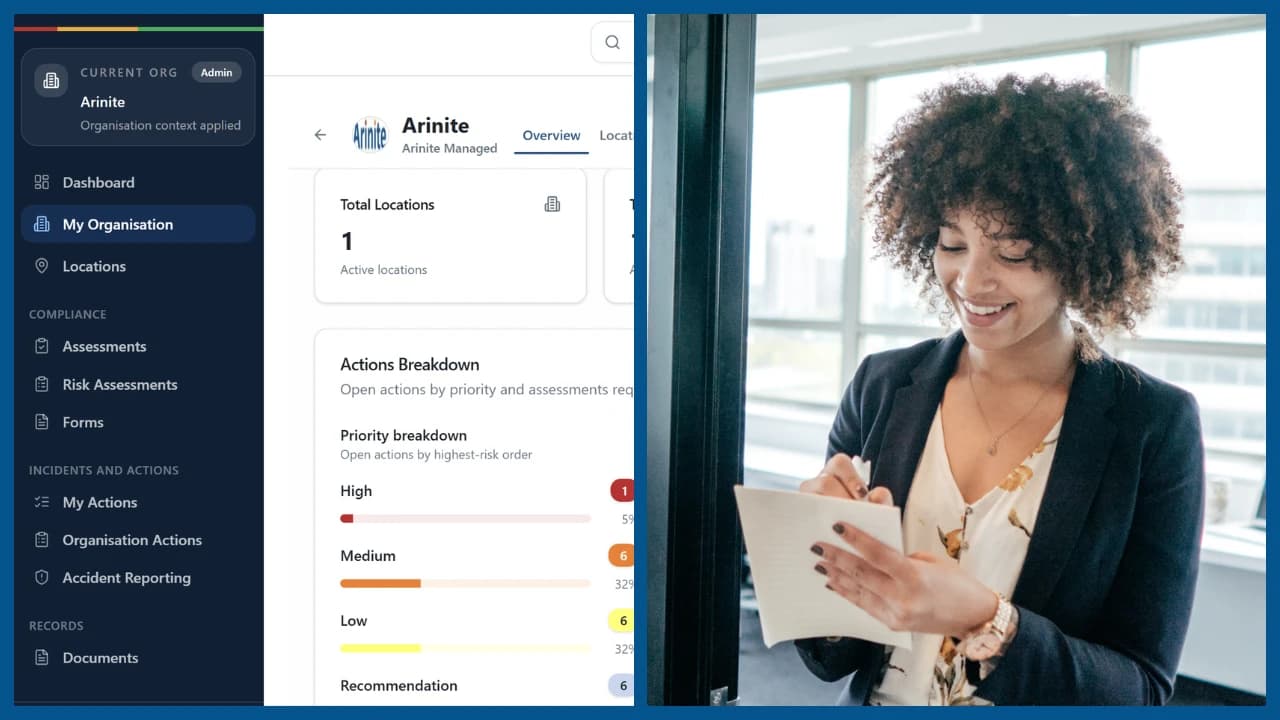
All Dutch compliance activity is maintained in Arinite's health and safety software platform alongside your UK and other international operations. One dashboard, every country.

5

Continuous maintenance

The Arbowet and Arbobesluit are updated periodically. Sector Arbocatalogi are revised. Arbeidsinspectie enforcement priorities shift. We monitor changes and update your documentation as required.

Get Dutch Health and Safety Compliance Right

Whether you are opening your first Dutch office or managing compliance across a mature Dutch operation, Arinite delivers locally compliant health and safety support coordinated from the UK.

Book a free international gap analysis call. In 30 minutes, one of our Chartered consultants will review your Dutch arrangements, identify the gaps that matter, and recommend the right approach.