Skip to content

HSE inspections up 47% - HSE carried out over 13,200 workplace inspections in 2024/25.

Office Health and Safety Consultants:DSE, Fire Risk Assessments, and Compliance

Qualified office health and safety consultants. DSE assessments · Fire risk assessments · Workplace risk assessments · Competent person · Ongoing compliance across the UK and 50+ countries.

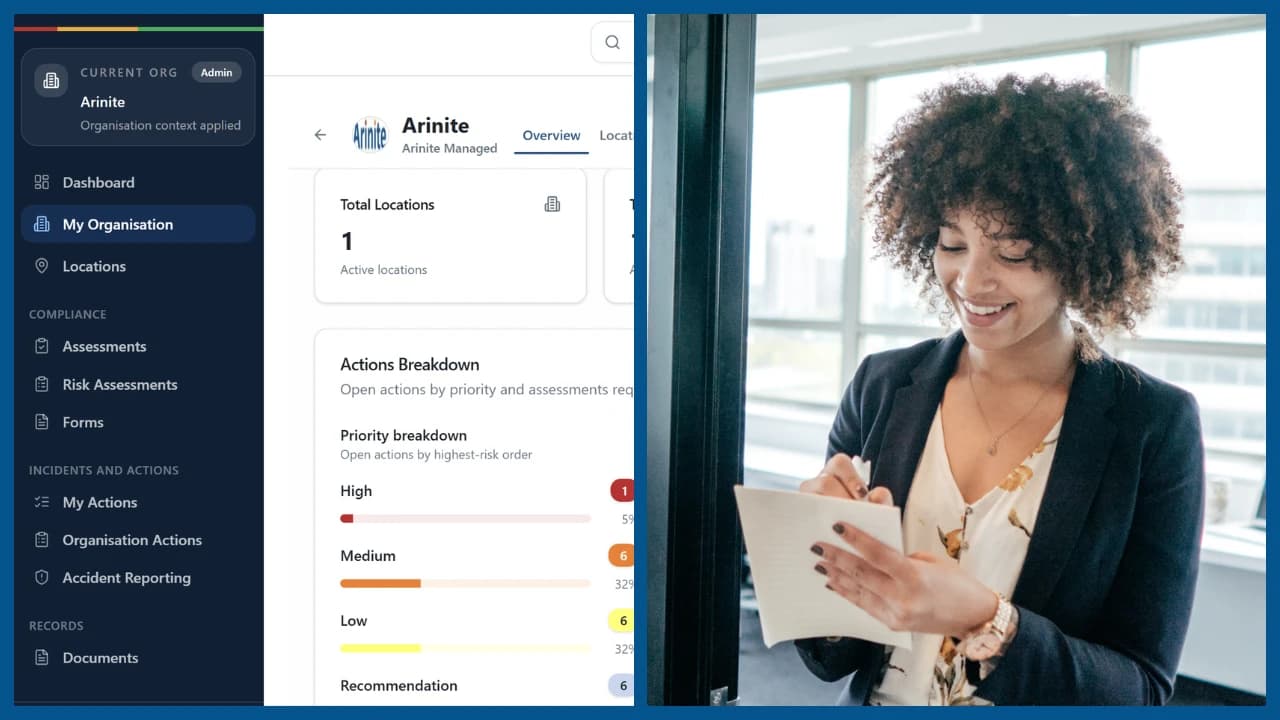
Office environments are often assumed to be low risk. The Health and Safety Executive disagrees. Every employer operating an office, whether a five-person startup or a 5,000-seat corporate headquarters, has the same legal obligation to assess risks, appoint a competent person, conduct DSE assessments for every habitual screen user (including home and hybrid workers), and maintain a documented fire risk assessment. Arinite delivers all of it through Qualified health and safety consultants and integrated compliance software, configured for the realities of modern office and hybrid working.

1,500+ businesses
50+ countries
95%+ retention
Qualified Consultants
UK & International
Free Gap Analysis
Get in Touch

Contact Arinite Today

Fill out the form below and our team will get back to you within 24 hours.

By submitting, you agree to our Privacy Policy and consent to Arinite contacting you.

ABOUT

About This Sector

Office environments are often assumed to be low risk. Health and safety inspectors disagree. Every employer operating an office, whether a five-person startup or a 5,000-seat corporate headquarters, has the same legal obligation to assess risks, appoint a competent person, and maintain documented compliance. The shift to hybrid working has expanded the legal scope significantly: every home-based screen user is in scope for DSE assessment, and home and hybrid working environments must be covered in the workplace risk assessment.

Arinite provides Qualified health and safety consultants and compliance software to office-based businesses across the UK and 50+ countries, including tech and SaaS companies, financial services, legal and consulting firms, marketing agencies, and corporate head offices.

COMPLIANCE GAPS

Common Compliance Failures We
Find in Offices

These are the office health and safety failures Arinite's Qualified consultants find most frequently in this sector. Each one is a real exposure to HSE enforcement, civil claims, and director liability under Section 37 HSWA 1974.

No DSE assessments for home or hybrid workers

The single most common compliance gap in office environments since the shift to hybrid working. The Display Screen Equipment Regulations 1992 do not stop at the office door.

Office risk assessment never updated

Written at setup and not reviewed since the shift to hybrid working, an office move, headcount growth, or a layout change. A risk assessment that doesn't reflect current operations is not "suitable and sufficient" under MHSWR Regulation 3.

No documented fire risk assessment

Or a fire risk assessment that has not been reviewed since the last change of layout, headcount, occupancy, or building use under the Regulatory Reform (Fire Safety) Order 2005.

No appointed competent person for health and safety

Many office-based businesses assume they do not need one because they are "just an office." Regulation 7 of the Management of Health and Safety at Work Regulations 1999 says otherwise.

No office health and safety policy

Or a policy that exists but has not been reviewed, signed by a director, or communicated to employees. Mandatory in writing for any employer with five or more employees.

No accident reporting procedure

And no mechanism for recording near misses, leaving the business unable to comply with RIDDOR or to demonstrate proactive management when challenged.

Mental health and psychosocial risk treated as HR, not H&S

Stress, burnout, and psychosocial factors are statutory risk assessment categories under MHSWR 1999, not optional wellbeing initiatives.

DSE ASSESSMENTS

DSE Assessments for Office
and Hybrid Workers

The Health and Safety (Display Screen Equipment) Regulations 1992 require a documented DSE assessment for every habitual user of display screen equipment, defined broadly as anyone using a screen as a significant part of their normal work. In modern office environments that is effectively every employee.

Who Counts as a DSE User

1

Anyone using a screen for an hour or more continuously, on most working days, falls within scope.

2

The duty applies to laptops, desktops, tablets, and any other display screen equipment in normal use.

3

The scope extends to home and hybrid workers in exactly the same way. Working from a kitchen table does not exempt an employer from the DSE assessment duty.

What a Compliant DSE Assessment Includes

1

Workstation suitability: screen, keyboard, mouse, chair, desk, footrest, and adequate working space.

2

Environment: lighting, glare, noise, temperature, and ventilation.

3

Software: usability, training, and accessibility for users with specific needs.

4

User-specific factors: eyesight test entitlement, breaks, posture, and any reported discomfort.

5

For home and hybrid workers: practical assessment of the home working environment, equipment provision, and the employer's duty to fund reasonable adjustments.

How Often DSE Assessments Must Be Reviewed

DSE assessments must be reviewed when the workstation, user, equipment, or working pattern changes significantly, including when an employee moves from full-time office working to hybrid working, or relocates their home working setup. Best practice for most office-based employers is annual review with interim review on change.

Common DSE Assessment Failures

The most common failure is a single self-declaration questionnaire issued at induction and never repeated. Self-declarations satisfy the assessment duty only if they identify and escalate issues to a competent assessor. They do not replace assessment. The second most common failure is treating home workers as out of scope.

OFFICE RISK ASSESSMENTS

Office Risk Assessments
and Hybrid Working

Regulation 3 of the Management of Health and Safety at Work Regulations 1999 requires every employer to conduct a suitable and sufficient risk assessment covering all work activities. For office-based employers, the scope is broader than most realise.

1

All work activities, not just office activities

Business travel, client visits, off-site events, and home and hybrid working are all in scope.

2

All locations

The risk assessment must cover every office occupied, plus home and remote working environments where work is regularly carried out.

3

All categories of worker

Permanent employees, contractors, agency workers, new and expectant mothers, young workers, lone workers, and disabled workers each carry specific assessment expectations.

4

Physical, chemical, biological, ergonomic, and psychosocial hazards

All five statutory hazard categories must be addressed. Psychosocial risk (stress, harassment, fatigue) is the most commonly missed in office settings.

5

Reviewed on change

Office moves, fit-outs, headcount changes, organisational changes, and significant shifts in working pattern (full office to hybrid, hybrid to full remote) all trigger review.

For office-based businesses, the risk assessment is the foundation of every other compliance document: the policy, the safe systems of work, the training programme, and the inspection regime all flow from it. A risk assessment that has not been updated since the move to hybrid working is the single most common evidence of broader non-compliance.

FIRE RISK ASSESSMENTS

Fire Risk Assessments
for Office Premises

The Regulatory Reform (Fire Safety) Order 2005 requires a documented fire risk assessment for every non-domestic premises in England and Wales, including every office, regardless of size. Equivalent duties apply in Scotland (Fire (Scotland) Act 2005) and Northern Ireland.

What a Compliant Office Fire Risk Assessment Covers

1

Identification of fire hazards: ignition sources, fuel sources, oxygen sources, and structural risk.

2

Identification of people at risk: employees, visitors, contractors, mobility-impaired persons, lone workers, and out-of-hours occupants.

3

Evaluation, removal, and reduction of risks through the hierarchy of control.

4

Emergency plan: evacuation routes, assembly points, fire wardens, drills, and provision for disabled users.

5

Documentation and review: a fire risk assessment must be reviewed regularly and whenever there is reason to suspect it is no longer valid (after a change of layout, occupancy, or building use).

PAS 79 Methodology

Arinite's office fire risk assessments are delivered to PAS 79:2020 methodology, the British Standard recognised by fire and rescue authorities, insurers, and landlords as the practical benchmark for non-domestic fire risk assessment.

Multi-Tenant Buildings and Landlord Coordination

Office occupiers in multi-tenant buildings carry their own statutory duty separate from the building's responsible person. Common areas, fire alarm systems, and evacuation arrangements typically involve the landlord, but the occupier's own risk assessment for the demised premises is non-delegable. Arinite coordinates with landlords, managing agents, and other occupiers where required.

COMPETENT PERSON

Competent Person for
Office Employers

Regulation 7 of the Management of Health and Safety at Work Regulations 1999 requires every employer to appoint one or more competent persons to assist in undertaking the measures needed to comply with health and safety law. This duty applies to office-based employers in exactly the same way as it applies to construction or manufacturing employers.

What "Competent" Means in Practice

A competent person has sufficient training, experience, knowledge, and other qualities to enable them to assist the employer. HSE guidance is clear that the role cannot be filled by an HR generalist, a facilities manager, or a senior administrator unless they hold specific health and safety competence appropriate to the workplace risks.

Why Office-Based Businesses Routinely Get This Wrong

Many office-based businesses assume the competent person duty applies only to higher-risk sectors. It does not. The duty is universal. Arinite's competent person service provides an external Qualified competent person on a retainer basis, satisfying Regulation 7 without the cost of an internal hire and without the bottleneck of relying on a single individual.

MENTAL HEALTH

Mental Health and Psychosocial
Risk in Offices

Stress, burnout, harassment, and other psychosocial factors are statutory risk assessment categories under MHSWR Regulation 3, not optional wellbeing initiatives. The HSE Management Standards and ISO 45003:2021 set the practical framework. The Worker Protection Act 2023 adds a specific preventative duty on sexual harassment.

Mental health is typically the compliance area where office-based businesses have the biggest gap between what their HR function is doing (Employee Assistance Programme, mental health first aiders, wellbeing benefits) and what health and safety law actually requires (documented psychosocial risk assessment, line manager training, reasonable adjustments, documented Worker Protection Act reasonable steps).

REGULATIONS

Sector-Specific Regulations for
Office Employers

The full legislative framework that applies to every office employer in Great Britain.

The Health and Safety at Work etc. Act 1974

Section 2 places the general duty on every employer to ensure, so far as is reasonably practicable, the health, safety, and welfare at work of all employees. Section 3 extends this to non-employees affected by the work. Section 37 attaches personal liability to directors and managers.

The Management of Health and Safety at Work Regulations 1999

Regulation 3 requires a suitable and sufficient risk assessment. Regulation 7 requires the appointment of one or more competent persons. Regulation 10 requires worker information.

The Health and Safety (Display Screen Equipment) Regulations 1992

DSE assessment, eyesight test provision, breaks, training, and information for every habitual user including home and hybrid workers.

The Regulatory Reform (Fire Safety) Order 2005

Documented fire risk assessment, emergency plan, fire safety arrangements, and review on change for every non-domestic premises.

The Workplace (Health, Safety and Welfare) Regulations 1992

Minimum standards for temperature, ventilation, lighting, space, sanitation, drinking water, rest facilities, and accessibility.

The Reporting of Injuries, Diseases and Dangerous Occurrences Regulations 2013 (RIDDOR)

Mandatory reporting of specified workplace injuries, diseases, and dangerous occurrences to HSE.

The Equality Act 2010

Reasonable adjustments duty for workers with disabilities, intersecting directly with DSE assessment, workplace layout, and office accessibility.

The Worker Protection Act 2023

Preventative duty on sexual harassment in force from 26 October 2024, requiring documented reasonable steps including risk assessment, policy, and training.

OUR SERVICES

Our Office Health
and Safety Services

Arinite delivers the full range of office health and safety services through Qualified consultants and integrated health and safety software. One partner. One audit trail. One quarterly review cycle.

DSE assessments

Workstation-level DSE assessments for office, hybrid, and home-based workers, with assessor escalation, action tracking, and software-managed renewal cycles.

Office risk assessments

Workplace risk assessments covering all activities, all locations, and all categories of worker, in line with MHSWR Regulation 3.

Fire risk assessments

PAS 79:2020 fire risk assessments for office premises in single-tenant and multi-tenant buildings, with landlord and managing-agent coordination where required.

Competent person retainer

External Qualified competent person on a retainer basis, satisfying MHSWR Regulation 7 for offices that do not employ an internal H&S specialist.

Health and safety policy

Documented policy in line with HSE expectations, signed by a director, reviewed annually, and communicated to employees.

Health and safety audits

Documented audits identifying gaps against the HSWA 1974, MHSWR 1999, and sector-specific regulations, with prioritised remediation plans.

Health and safety training

DSE awareness, fire safety, manager-level H&S, accident investigation, and mental health awareness, delivered online or in-person.

Health and safety software

Centralised platform for risk assessments, DSE records, fire risk assessments, training, incidents, and audits, configured for multi-site and hybrid working operations.

Mental health and psychosocial risk

HSE Management Standards-aligned psychosocial risk assessment, line manager training, and Worker Protection Act 2023 documentation.

Accident and incident management

RIDDOR reporting support, root cause investigation, and post-incident risk assessment review.

POLICY

Office Health and
Safety Policy

The Health and Safety at Work Act 1974 requires every employer with five or more employees to maintain a written health and safety policy, reviewed and revised as appropriate. For office-based employers, a compliant policy covers:

Statement of intent

A signed statement of intent from a director, confirming the organisation's commitment to its health and safety obligations.

Organisation structure

A documented organisation structure identifying the appointed competent person, line management responsibilities, and consultation arrangements.

Arrangements

Documented arrangements covering risk assessment, DSE, fire safety, accident reporting, training, contractors, lone working, home and hybrid working, mental health and psychosocial risk, and review of the policy itself.

A policy that exists but has not been reviewed, signed, or communicated is treated by inspectors and tribunals as no policy at all. Arinite provides policy creation, annual review, and communication support as part of standard onboarding.

TRAINING

DSE and Health and Safety
Training for Office Workers

Training is a specific legal requirement under MHSWR Regulation 10 and one of the most effective interventions available. For office-based employers, the core training stack covers:

DSE user awareness

For every habitual screen user, covering posture, workstation setup, breaks, eyesight tests, and reporting discomfort.

Fire safety induction

And fire warden training appropriate to the premises and occupancy.

Manager-level health and safety training

For line managers with people-management responsibilities.

Mental health awareness

For all employees and dedicated mental health training for line managers.

Accident reporting and investigation

For designated first aiders and managers.

Worker Protection Act 2023 training

On harassment prevention and bystander intervention.

Training is documented in Arinite's software platform with individual certificates and attendance records.

TYPICAL ENGAGEMENT

A Typical Office
Engagement With Arinite

The following is an illustrative example of how Arinite engagement typically runs for an office-based employer, drawn from common patterns across our office client base.

A 350-employee professional services business across three UK offices (London, Manchester, Bristol) and a hybrid working pattern approaches Arinite after an HR-led internal review flags the absence of a documented DSE programme for home and hybrid workers. The firm holds a basic health and safety policy and a fire risk assessment for the London office last reviewed three years ago. There is no documented psychosocial risk assessment, no Worker Protection Act 2023 documentation, and no competent person appointed.

Mo
1

Arinite's free gap analysis call identifies the priority gaps. We agree a 90-day remediation programme. In month one, we deliver: a refreshed health and safety policy signed by the COO, a current MHSWR Regulation 3 risk assessment covering office, home, and hybrid working, a competent person appointment, and deployment of DSE self-declarations to all 350 employees through Arinite's software platform with assessor escalation for any reported discomfort.

Mo
2

In month two: we deliver PAS 79:2020 fire risk assessments for the three offices, run the psychosocial risk assessment using HSE Stress Indicator Tool, document Worker Protection Act 2023 reasonable steps including provisions for third-party harassment from clients and visitors, and configure incident reporting through Arinite's software.

Mo
3

In month three: we deliver line manager mental health training, brief the senior leadership team on Section 37 personal liability, complete an integrated health and safety audit, and hand over to ongoing competent person retainer with quarterly reviews.

The firm now operates an integrated office health and safety system across three sites with software-managed renewal cycles. The competent person retainer continues, satisfying MHSWR Regulation 7 for the year ahead.

WHY ARINITE

Why Office-Based Employers
Choose Arinite

Five practical reasons office employers appoint Arinite as their outsourced competent person:

Software-led DSE programme

Self-declarations, assessor escalation, equipment provision tracking, and renewal cycles all managed through Arinite's platform.

Multi-site coverage as standard

Offices in different UK cities or different countries are coordinated through one engagement, not several.

Hybrid and home working configured by default

Risk assessment, DSE, and Worker Protection Act 2023 reasonable steps all cover home and hybrid as standard, not as bolt-ons.

International coverage

For employers with offices across multiple jurisdictions, Arinite coordinates UK employer duty with local law in 50+ countries.

Qualified consultants, not generalists

MHSWR Regulation 7 requires competent advice.

Book a Free Gap Analysis Call

Book a free gap analysis call with one of our Qualified health and safety consultants. In 30 minutes, we will assess your current office health and safety arrangements, identify the compliance gaps that matter most, and give you a clear recommendation and indicative cost.