Skip to content

HSE inspections up 47% - HSE carried out over 13,200 workplace inspections in 2024/25.

International Compliance: USA

Health and Safety in the USA:
OSHA Compliance for UK Businesses

UK-managed. US-compliant. One point of contact.

A guide to health and safety compliance in the United States for UK businesses with US subsidiaries, offices, or employees. This page covers the Occupational Safety and Health Act of 1970, the 29 CFR standards administered by OSHA, the State Plans that operate in parallel in many states, OSHA training requirements including OSHA 10 and OSHA 30, the current penalty framework, and how Arinite delivers US compliance as part of international health and safety support.

1,500+ Businesses Protected
50+ Countries
95%+ Retention
Chartered IOSH
50+ Countries
OSHA Specialists
Get in Touch

Contact Arinite Today

Fill out the form below and our team will get back to you within 24 hours.

By submitting, you agree to our Privacy Policy and consent to Arinite contacting you.

DEFINITION

What Is OSHA?

OSHA (the Occupational Safety and Health Administration) is the US federal agency responsible for regulating workplace health and safety. Established under the Occupational Safety and Health Act of 1970 (the OSH Act), it operates as an agency within the US Department of Labor.

OSHA’s remit covers virtually every private-sector employer in the United States, plus certain public-sector employers. Its core functions are setting health and safety standards (codified in Title 29 of the Code of Federal Regulations), conducting workplace inspections, issuing citations and penalties for violations, and providing training, outreach, and education.

OSHA is not the UK Health and Safety Executive. The two agencies have similar missions but operate under different legal frameworks, use different approaches to enforcement, and have different expectations of employers. UK compliance does not satisfy OSHA requirements and vice versa.

Many states operate OSHA-approved State Plans that regulate health and safety within their borders instead of federal OSHA. These State Plans must be at least as effective as the federal framework and often impose additional requirements. California (Cal/OSHA), Michigan (MIOSHA), Washington State, Oregon, and North Carolina are among the most prominent State Plans.

Note: EU-OSHA (European Agency for Safety and Health at Work) is a separate EU body based in Bilbao, Spain. This page covers US OSHA only. For European compliance, see DGUV (Germany), DUERP (France), RI&E (Netherlands), RSPP (Italy), LPRL (Spain), PAPRIPACT (France).

LEGAL FRAMEWORK

The US Health and
Safety Legal Framework

OSHA operates within a layered framework that UK businesses need to understand before designing US compliance arrangements.

1

The Occupational Safety and Health Act of 1970

The foundational federal statute. Establishes OSHA as an agency, creates the general duty of employers to provide workplaces free from recognised hazards, and authorises OSHA to promulgate binding safety standards. Section 5(a)(1) — the General Duty Clause — is the catch-all provision used to cite employers where no specific standard applies.

2

29 CFR Standards

OSHA’s specific regulations, codified in Title 29 of the Code of Federal Regulations. 29 CFR Part 1910 (General Industry) applies to most office-based, retail, healthcare, hospitality, and professional services operations. 29 CFR Part 1926 (Construction) applies to construction work specifically. 29 CFR Part 1928 (Agriculture) and Parts 1915–1919 (Maritime) have narrow specialist application.

3

OSHA State Plans

Approximately 22 states plus several territories operate their own OSHA-approved State Plans covering private-sector employers. State Plans must meet or exceed federal requirements and often impose additional rules. Significant State Plans for UK businesses: California (Cal/OSHA), Michigan (MIOSHA), Washington State (DOSH), Oregon (Oregon OSHA), and North Carolina. Significant non-State-Plan states: New York, Texas, Illinois, Massachusetts, Florida, Pennsylvania, Georgia.

4

Federal Agencies Beyond OSHA

Other federal regulators touch workplace safety: the Environmental Protection Agency (EPA) for chemical safety, the Department of Transportation (DOT) for transport-related safety, the Equal Employment Opportunity Commission (EEOC) for discrimination-related workplace issues, and the National Institute for Occupational Safety and Health (NIOSH) for research and recommendations.

5

Workers’ Compensation (Separate Regime)

Workers’ compensation insurance is regulated state-by-state, separate from OSHA. Every state except Texas requires employers to carry workers’ comp coverage. Workers’ comp compensates injured workers regardless of fault; OSHA addresses the regulatory compliance that should have prevented the injury. Both regimes apply in parallel after a workplace incident.

COVERAGE

Who Does
OSHA Cover?

OSHA coverage is broad but has specific carve-outs that UK businesses need to understand:

1

Covered employers: Every private-sector employer with one or more employees engaged in interstate commerce. In practice, this means essentially every private-sector employer in the United States.

2

State and local government employees: Covered in State Plan states. Not covered by federal OSHA in non-State-Plan states.

3

Federal government employees: Covered by a separate Federal Employee Occupational Safety and Health Programme under Executive Order 12196.

4

Self-employed individuals: Not covered.

5

Immediate family members on family farms: Not covered.

6

Some religious organisations: Complex case-by-case coverage.

7

Independent contractors: Not directly covered as employees of the principal, but complex determinations arise in staffing and gig work arrangements.

For UK businesses: if you have any US-based employees on your payroll (whether working in offices, remotely from home, visiting clients, or otherwise performing services), OSHA applies. This is from the first employee, with no size threshold.

STANDARDS

Key OSHA Standards
for UK Businesses

Under 29 CFR Part 1910 (General Industry), the standards most likely to apply to office-based UK businesses operating in the US include:

1

Subpart D — Walking-Working Surfaces (1910.21–30)

Slips, trips, falls, ladders, stairways, and working at height. Applies to every workplace.

2

Subpart E — Exit Routes, Emergency Action Plans (1910.33–39)

Emergency evacuation planning, exit route requirements, fire prevention programmes. Critical for every office.

3

Subpart G — Occupational Health (1910.94–100)

Ventilation, indoor air quality, occupational noise exposure. Relevant to most premises.

4

Subpart I — Personal Protective Equipment (1910.132–140)

PPE provision, hazard assessment, employee training. Particularly relevant where any client-site visits or field work is involved.

5

Subpart J — General Environmental Controls (1910.141–148)

Sanitation, first aid, confined spaces. The first aid provisions apply to every workplace.

6

Subpart K — Medical and First Aid (1910.151–152)

Medical services and first aid provision requirements.

7

Subpart L — Fire Protection (1910.155–165)

Fire extinguishers, fire suppression systems, employee fire response training.

8

Subpart Z — Toxic and Hazardous Substances (1910.1000–1450)

Chemical exposure limits including the Hazard Communication Standard (1910.1200), the US equivalent of the UK COSHH framework. Applies to any chemicals in the workplace including routine office cleaning products.

The General Duty Clause

Beyond the specific standards, Section 5(a)(1) of the OSH Act requires every employer to provide a place of employment free from recognised hazards that are causing or likely to cause death or serious physical harm. The General Duty Clause is invoked when a hazard exists but no specific standard covers it. It is a significant compliance risk because it cannot be satisfied simply by following a checklist.

EMPLOYER DUTIES

Employer Duties
Under OSHA

Every US employer must:

1

Provide a workplace free from recognised hazards (the General Duty Clause, Section 5(a)(1) OSH Act).

2

Comply with specific 29 CFR standards applicable to the workplace and industry.

3

Conduct a hazard assessment of the workplace and identify applicable OSHA standards.

4

Provide required training to employees on applicable OSHA standards.

5

Provide required PPE at no cost to employees where the hazard assessment indicates it is needed.

6

Maintain OSHA injury and illness records (Forms 300, 300A, 301) for covered employers.

7

Report fatalities within 8 hours. Hospitalisations, amputations, and loss of an eye within 24 hours.

8

Post the OSHA "It’s the Law" poster in a visible workplace location.

9

Allow OSHA inspections and not retaliate against employees who participate.

10

Post OSHA citations prominently near the violation for three working days or until corrected.

11

Not retaliate against employees for exercising OSH Act rights. Retaliation is itself an OSHA violation.

12

Comply with State Plan requirements where more stringent than federal OSHA.

Failure to comply can result in administrative penalties, criminal prosecution for wilful violations causing death, civil suits, and workers’ compensation exposure.

ENFORCEMENT

OSHA Inspections
and Enforcement

OSHA conducts roughly 30,000 to 40,000 inspections per year. Understanding how inspections are triggered, what happens during one, and what comes after is critical.

1

Inspection Priorities

Imminent danger situations, fatalities and catastrophes (three or more hospitalisations), worker complaints and referrals, targeted inspections in high-hazard industries, and follow-up inspections to verify corrections from previous citations.

2

What Happens in an Inspection

Most inspections are unannounced. The process involves an opening conference, a walk-around inspection, interviews with employees, a closing conference, and (where violations are identified) issuance of a citation. Employers have a limited right to require a warrant.

3

Citations and Penalties

Violations are classified by type and penalties issued. Employers have 15 working days to contest the citation (appealing to the Occupational Safety and Health Review Commission) or to pay and abate.

4

Informal Conference

Before formal contest, employers can request an informal conference with the OSHA Area Director. Informal conferences frequently result in penalty reductions of 30-50% in exchange for settlement agreements including structured abatement.

5

Whistleblower Protection

Employees who report safety concerns are protected from retaliation under Section 11(c) of the OSH Act. Retaliation is itself a separate OSHA violation. Terminating or demoting an employee following an OSHA complaint creates significant additional risk.

PENALTIES

OSHA Penalties and
Fines (2026)

OSHA penalties are adjusted annually for inflation. The 2026 maximum penalty amounts (effective January 15, 2026) are:

Federal OSHA Penalty Maximums

1

Other-than-Serious violations

Up to $16,550 per violation.

2

Serious violations

Up to $16,550 per violation.

3

Failure to Abate violations

Up to $16,550 per day past the abatement deadline, accumulating daily.

4

Willful violations

Up to $165,514 per violation. Willful means the employer intentionally committed the violation or showed plain indifference to the OSH Act.

5

Repeat violations

Up to $165,514 per violation. Applies where a substantially similar violation has been identified within the previous five years.

How Penalties Are Calculated

OSHA uses a gravity-based calculation considering severity, likelihood, employees exposed, and duration. Adjusted by: employer size reduction (up to 60%), compliance history (up to 20%), good faith (up to 25%), and quick-fix reduction (up to 15%).

California Cal/OSHA Penalty Framework

Cal/OSHA operates a distinct penalty framework: up to $25,000 for serious violations (higher than federal), $162,851 for willful/repeat, minimum $11,632 for willful. California is the most aggressive enforcement state.

Criminal Penalties

Wilful violations causing employee death carry criminal prosecution: up to six months imprisonment and $500,000 company fines. California has prosecuted employers criminally for workplace deaths.

Separate civil exposure arises from workers’ compensation claims, personal injury lawsuits, and potentially class actions where systemic violations affect multiple employees.

TRAINING

OSHA Training Requirements and the
OSHA 10/OSHA 30 Programmes

OSHA training is prescriptively required for specific standards and roles. The two most widely recognised voluntary programmes are OSHA 10 and OSHA 30. See our health and safety training service.

1

Standards-Required Training

Over 100 OSHA standards include specific training requirements. Most frequently applicable: Hazard Communication (1910.1200), PPE (1910.132), Bloodborne Pathogens (1910.1030), Emergency Action Plans (1910.38), and Fire Extinguisher Use (1910.157).

2

OSHA 10 (Outreach Training)

Ten-hour voluntary programme covering general hazard awareness, worker rights, and employer duties. Construction Industry or General Industry variants. Not federally mandated but required by many state laws and employers. OSHA 10 completion cards do not expire federally but are typically treated as current for 3-5 years.

3

OSHA 30 (Outreach Training)

Thirty-hour equivalent for supervisors, safety managers, and dedicated safety personnel. Same Construction/General Industry split. More commonly required as a condition of specific roles.

4

State-Specific Training Requirements

Several states mandate OSHA 10 or equivalent: New York (NY Labor Law 220-h), Connecticut, Massachusetts, Missouri, and others. Requirements vary significantly by state.

5

Training Records

Records of completed training (name, date, trainer, content, duration) must be maintained and produced during OSHA inspections. Training that happened but cannot be documented is treated as training that did not occur.

BY STATE

Health and Safety in
the USA by State

For UK businesses operating across multiple US states, the compliance landscape varies significantly. Arinite supports clients across the states where UK business presence is most concentrated.

1

OSHA Compliance in New York and New York City

Federal OSHA applies directly (no State Plan). NY Labor Law 220-h requires OSHA 10 for construction. NYC has specific site safety rules. Significant UK business presence in NYC (finance, legal, professional services, tech, creative) makes this the single most common US compliance context for Arinite clients.

2

OSHA Compliance in California (Cal/OSHA)

Cal/OSHA is the most stringent State Plan in the US, with higher penalty maximums, additional standards including the Injury and Illness Prevention Programme (IIPP, no federal equivalent), and more aggressive enforcement. UK tech and media companies with San Francisco, Los Angeles, and San Diego operations face Cal/OSHA specifically.

3

OSHA Compliance in Texas

Federal OSHA state with no State Plan. Texas is the only US state where workers’ compensation is optional (though consequences of going without are severe). Rapid growth in Austin, Dallas, and Houston for UK tech and financial services.

4

OSHA Compliance in Massachusetts, Illinois, and the Northeast

Both operate under federal OSHA. Massachusetts has state-specific rules around bloodborne pathogens. Illinois has state-level sexual harassment training requirements. Boston is significant UK legal and financial presence; Chicago has growing UK professional services.

5

OSHA Compliance in Washington State, Oregon, and Pacific Northwest

Washington State operates DOSH as a State Plan. Oregon operates Oregon OSHA. Both have standards additional to federal OSHA. Seattle has significant UK tech presence; Portland has growing creative and professional services.

6

OSHA Compliance in Florida

Federal OSHA state. Miami (financial services, legal, creative) and Orlando (hospitality-adjacent professional services) are the main UK business locations. Florida has state-level hurricane response rules UK businesses often overlook.

7

Multi-State Operations

For UK businesses in multiple states, the core challenge is maintaining compliance across the federal-vs-State-Plan split plus state-specific requirements. A generic "OSHA programme" typically does not pass Cal/OSHA scrutiny.

BY SECTOR

OSHA Compliance
by Sector

Arinite supports UK businesses across every office-based sector with US operations. Risk profiles and applicable standards vary.

1

OSHA Compliance for Technology and SaaS Companies

General Duty Clause, Emergency Action Plans, Hazard Communication for office chemicals, and PPE for data centre visits. Remote and hybrid work adds complexity. California has specific home office ergonomic assessment obligations that UK businesses miss.

2

OSHA Compliance for Financial Services

Banks, investment managers, fintechs. Ergonomic workstations (particularly trading floors), emergency evacuation in high-rise buildings (NYC, Chicago, San Francisco protocols), and mental health/stress management.

3

OSHA Compliance for Legal Firms and Professional Services

Office risk profile with attention to lone working (attorneys visiting clients), business travel safety, and coordination when professionals work at client sites.

4

OSHA Compliance for Healthcare Operations

Bloodborne Pathogens Standard (1910.1030), specific PPE and respiratory protection, sector-specific recordkeeping. Healthcare-specific State Plan provisions in California, Maryland, Minnesota.

5

OSHA Compliance for Hospitality and Food Service

Kitchen-specific hazards (burns, cuts, slips, chemical exposure), alcohol service requirements, guest and employee safety coordination, state-specific health code interactions.

6

OSHA Compliance for Retail Operations

Slip and trip prevention, lifting and manual handling for stock, workplace violence prevention programmes (mandated by several states for retail).

7

OSHA Compliance for Property and Real Estate

UK landlords with US holdings. General Duty Clause for common areas, fire safety under state and local building codes, lead-based paint and asbestos obligations in older properties.

UK BUSINESS GAPS

Common OSHA Compliance Gaps
for UK Businesses

UK businesses with US operations routinely fail OSHA compliance in predictable ways. The most common gaps are:

1

No OSHA hazard assessment. UK businesses assume UK risk assessments transfer. They do not. An OSHA-compliant hazard assessment must identify applicable 29 CFR standards, document workplace hazards, and drive specific control measures.

2

No OSHA 10 or OSHA 30 training record. UK internal H&S training is not equivalent to OSHA outreach certification.

3

No Hazard Communication programme. Every workplace with chemicals (including routine office cleaning supplies) must maintain a written programme under 1910.1200 with Safety Data Sheets and employee training. UK COSHH is not equivalent.

4

No OSHA poster displayed. The "It’s the Law" poster must be displayed in a visible workplace location.

5

No OSHA 300/300A/301 recordkeeping. Employers with 11+ employees must maintain injury and illness records. UK accident books are not equivalent.

6

Failure to report within OSHA timescales. Fatalities: 8 hours. Hospitalisations, amputations, loss of an eye: 24 hours. UK timescales are different.

7

Misclassification of workers as independent contractors. Incorrect classification exposes the business to OSHA, tax, and employment law action simultaneously.

8

No consideration of State Plan requirements. Particularly Cal/OSHA’s Injury and Illness Prevention Programme.

9

No PPE hazard assessment or PPE training. The 29 CFR 1910.132 documented assessment requirement is specifically required.

10

No emergency action plan. Subpart E requires written emergency action plans for businesses with more than 10 employees.

11

No retaliation protection in employment policies. UK grievance policies may not protect against Section 11(c) claims.

12

Workers’ comp coverage gaps. UK insurance does not cover US operations. Workers’ comp is state-regulated and mandatory in every state except Texas.

Arinite’s international health and safety service addresses each of these gaps as part of standard US compliance onboarding.

HOW WE HELP

How Arinite Delivers US
Health and Safety Compliance

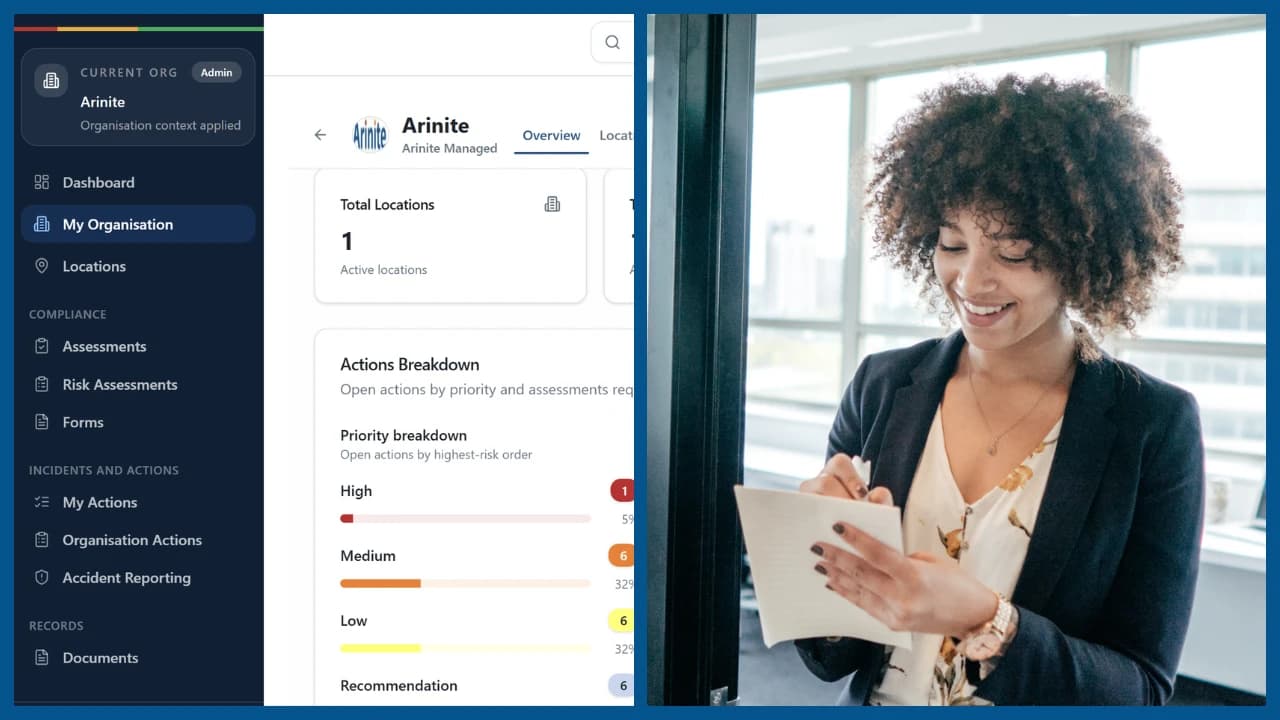
Arinite provides US compliance as part of our international health and safety service, combining UK-based programme management with US-based OSHA specialists. Coordinated by Chartered consultants.

1

US compliance partnership

Our US partners are qualified OSHA compliance professionals operating across federal OSHA and the major State Plans.

2

Hazard assessment and programme setup

OSHA-compliant hazard assessment of each US workplace, identification of applicable 29 CFR standards, and development of required written programmes.

3

OSHA 10 and OSHA 30 training

Delivered through authorised OSHA outreach trainers. On-site or online. Training records maintained in Arinite’s health and safety software platform.

4

Standards-required training

Hazard Communication at initial assignment. PPE training where applicable. Bloodborne Pathogens for healthcare. Emergency Action Plan training.

5

OSHA recordkeeping

Forms 300, 300A, and 301 maintained, with annual summary posting managed on the correct timescale.

6

Inspection support

Your US consultant attends OSHA inspections, manages conferences, and supports any informal conference or contest process.

7

State Plan compliance

Specific state compliance ensured including Cal/OSHA’s Injury and Illness Prevention Programme.

8

UK-based coordination

Your named Chartered consultant at Arinite UK manages the programme. Single UK point of contact for all international compliance activity.

9

Consolidated reporting

All US compliance activity maintained in Arinite’s health and safety software platform alongside UK and other international operations.

10

Workers’ compensation coordination

We coordinate with your US insurance broker to ensure OSHA compliance posture matches workers’ comp requirements.

11

Continuous maintenance

OSHA standards, State Plan requirements, and enforcement priorities evolve. We monitor changes and update your documentation.

PRICING

How Much Does US Health
and Safety Compliance Cost?

US compliance costs vary significantly based on several factors: number of US sites, number of US employees, state mix (especially whether California is in scope), industry sector, scope of training required, and whether ongoing maintenance or one-off setup is required.

Factors That Drive Cost

1

Number of US locations. Single office vs multi-state operations.

2

State Plan footprint. California operations add cost because Cal/OSHA is additional to federal OSHA.

3

Workforce size. Training delivery and recordkeeping scale with employee count.

4

Sector. Healthcare, hospitality, and retail face more prescriptive standards.

5

Training scope. OSHA 10, OSHA 30, and standards-required training stack.

6

Ongoing vs project. Initial setup is a one-time project; maintenance is ongoing.

Typical Engagement Types

1

Project-based: one-off US compliance establishment including hazard assessment, written programmes, initial training, and recordkeeping setup.

2

Ongoing retainer: US compliance maintained as part of a Done For You international package including annual review, training refresh, and inspection response.

3

Hybrid: initial project establishment followed by ongoing light-touch maintenance coordinated through your UK Arinite consultant.

Rather than publish generic rates, Arinite provides a tailored quote after a brief discovery call. A free international gap analysis call with one of our Chartered consultants will give you a clear estimate for your specific situation.

Get US Health and Safety Compliance Right

Opening US operations is often the compliance moment where UK businesses realise their European frameworks don’t transfer. Whether you’re setting up your first US office, scaling across multiple states, or dealing with an existing OSHA inspection, Arinite delivers locally qualified US compliance coordinated from the UK.

Book a free international gap analysis call. In 30 minutes, one of our Chartered consultants will review your US arrangements, identify the gaps that matter, and recommend the right approach.