Skip to content

HSE inspections up 47% - HSE carried out over 13,200 workplace inspections in 2024/25.

Legionella Specialists

Legionella:
Risk Assessment, Control, and Water Hygiene Compliance

ACOP L8 · HSG274 · COSHH Regulations · Water Safety Compliance

A guide to legionella risk assessment and water hygiene compliance for UK businesses. This page covers the Approved Code of Practice L8, HSG274, employer duties, water systems at risk, and how Arinite delivers legionella compliance across offices, multi-occupied buildings, care homes, and other premises.

1,500+ Businesses Protected
50+ Countries
95%+ Retention
IOSH Chartered
ACOP L8 Compliant
HSG274 Aligned
Get in Touch

Contact Arinite Today

Fill out the form below and our team will get back to you within 24 hours.

By submitting, you agree to our Privacy Policy and consent to Arinite contacting you.

LEGIONELLA

What Is Legionella?

Legionella is a group of bacteria (the best known species is Legionella pneumophila) that occur naturally in water environments. In most natural settings the concentration is low and does not cause human illness. The risk arises when legionella colonises a man-made water system under conditions that allow it to multiply, particularly temperatures between 20°C and 45°C, stagnation, biofilm, and sediment.

When contaminated water is aerosolised (broken into fine droplets and inhaled, for example from showers, taps, spa pools, or cooling towers), the bacteria can cause Legionnaires' disease, a serious form of pneumonia. Less severe infections include Pontiac fever and Lochgoilhead fever.

Most man-made water systems in commercial buildings are capable of supporting legionella if not properly managed. This is why UK employers, building owners, and dutyholders have specific legal duties to assess and control the risk.

LEGIONNAIRES' DISEASE

What Is
Legionnaires' Disease?

Legionnaires' disease is a form of pneumonia caused by inhaling water droplets containing legionella bacteria. Symptoms typically appear 2-10 days after exposure and include high fever, chills, muscle aches, headaches, confusion, chest pain, and persistent cough. The disease can be severe and is sometimes fatal, particularly in older people, smokers, and those with weakened immune systems.

Approximately 400-500 cases are reported in the UK each year, though the true figure is likely higher due to underreporting. Case fatality rates vary between 5% and 15% depending on the population affected and the speed of treatment.

Legionnaires' disease is notifiable under the Public Health (Control of Disease) Act 1984. Outbreaks in workplaces or public buildings frequently result in HSE investigation, enforcement action, and in serious cases prosecution of the responsible employer or dutyholder.

LEGAL FRAMEWORK

Legionella Legal Framework:
ACOP L8 and HSG274

Legionella control in the UK is governed by a combination of general health and safety law and specific guidance.

1

The Health and Safety at Work Act 1974

Places a general duty on every employer to ensure the health and safety of employees and anyone else affected by the work.

2

The Control of Substances Hazardous to Health Regulations 2002 (COSHH)

Apply to legionella as a biological agent, requiring assessment and control of exposure.

3

The Management of Health and Safety at Work Regulations 1999

Require employers to assess risks and implement suitable controls.

4

The Approved Code of Practice L8

Legionnaires' disease - The control of legionella bacteria in water systems sets out how employers and dutyholders should comply with the above. ACOP L8 has special legal status: following it is accepted as compliance with the underlying legal duties; departing from it requires equivalent or better control, with the burden on the dutyholder to demonstrate this.

5

The HSE Technical Guidance Document HSG274

Supports ACOP L8 with detailed practical guidance in three parts: HSG274 Part 1 (evaporative cooling systems), Part 2 (hot and cold water systems), and Part 3 (other risk systems including spa pools, sprinkler systems, and emergency showers).

DUTYHOLDER

Who Is the Dutyholder
for Legionella Control?

ACOP L8 uses the term 'dutyholder' to describe the person responsible for legionella control at a premises. In most cases the dutyholder is:

1

The employer

For workplaces where the employer has control of the premises and the water systems within them.

2

The building owner or landlord

For multi-occupied buildings where the owner controls the water systems serving the whole building, or for rented residential properties where the landlord has the statutory duty.

3

The self-employed person

For premises they control as part of a business undertaking.

The dutyholder must appoint a competent person (sometimes called the 'responsible person' for legionella) to take day-to-day responsibility for control. This can be an internal appointment or an external consultant. The legal duty stays with the dutyholder but the day-to-day management is delegated to the responsible person.

Landlords of residential properties have specific duties. Every residential landlord must assess the risk from legionella in water systems used by tenants and, where appropriate, implement control measures. For typical domestic systems the assessment is usually low-risk but still must be documented.

EMPLOYER DUTIES

Employer and Dutyholder Duties
for Legionella Control

Under ACOP L8, every dutyholder must:

1

Identify and assess the risk

Conduct a legionella risk assessment that considers every water system under the dutyholder's control, the conditions that could allow legionella to multiply, and the people who could be exposed.

2

Prepare a written control scheme

Document the specific measures in place to control identified risks. For higher-risk systems this is a detailed Written Scheme of Control; for lower-risk systems (such as many small office premises) it may be a simpler documented control plan.

3

Implement, manage, and monitor controls

Put the control measures into practice (for example temperature control, cleaning regimes, biocide treatment) and verify they are working through monitoring, inspection, and testing.

4

Keep records

Maintain records of the risk assessment, the control scheme, temperature monitoring, cleaning, testing, and any remedial actions. Records must be retained for at least five years.

5

Review the arrangements

Reassess the risk whenever circumstances change (new tenants, building work, equipment changes, outbreaks or near-misses) and at least every two years as good practice.

6

Notify authorities where required

Register cooling towers and evaporative condensers with the local authority under the Notification of Cooling Towers and Evaporative Condensers Regulations 1992.

WATER SYSTEMS

Water Systems at
Legionella Risk

Not every water system presents significant legionella risk. The highest-risk systems are those that combine stored water, temperature conditions that support bacterial growth, and a means of creating water droplets that can be inhaled.

1

Cooling Towers and Evaporative Condensers

Highest-risk systems because they generate large volumes of aerosol and often operate at temperatures that support legionella growth. Outbreaks from cooling towers have caused some of the most serious incidents in UK history. Statutory notification and intensive control regime required.

2

Hot and Cold Water Systems

The most common systems in UK buildings. Risk factors include stored cold water above 20°C, hot water below 50°C at the outlet, dead legs in pipework, and infrequently used outlets. Temperature control and regular flushing are the core defences.

3

Spa Pools and Hot Tubs

High risk because water temperatures are ideal for legionella growth and aerosol generation is inherent in their operation. Strict management regime required including biocide control, filtration, and routine testing.

4

Humidifiers and Air Washers

Often-overlooked source of aerosol generation, particularly in office HVAC systems. Must be included in the legionella risk assessment if present.

5

Emergency Showers and Eye Wash Stations

Often installed and rarely used, creating stagnation conditions. Require scheduled flushing to prevent legionella colonisation.

6

Sprinkler and Fire Hose Reel Systems

Normally closed systems but can present risk during testing, activation, or maintenance. Covered in HSG274 Part 3.

PREMISES TYPES

Legionella Risk by
Premises Type

Legionella risk and the control regime required vary significantly by premises type.

1

Office Legionella Compliance

Offices are typically lower-risk premises because most use mains-fed water with no storage, no cooling towers, and routine use of outlets. However, the legal duty to assess and document still applies. Multi-tenant office buildings, offices with occasional-use areas (showers, spare meeting rooms), and buildings with stored water systems require more detailed assessment.

2

Landlord Legionella Testing and Assessment

Residential landlords have a statutory duty to assess legionella risk in properties they let. For most domestic systems the risk is low but must be documented. Commercial landlords operating multi-occupied buildings have broader duties covering common water systems serving multiple tenants.

3

Care Home and Healthcare Legionella Control

High-risk premises due to vulnerable occupants (elderly, immunocompromised, hospital patients). Stringent ACOP L8 compliance is expected, often including routine legionella water testing, enhanced temperature monitoring, and detailed record-keeping.

4

Hotel and Hospitality Legionella Control

Large water systems, variable occupancy creating stagnation in unused areas, and guest showers make hotels higher-risk. Outbreaks in hotels have caused significant reputational and regulatory consequences.

5

Industrial and Manufacturing Sites

Cooling towers, evaporative condensers, and complex process water systems make industrial premises higher-risk and require more intensive control regimes under HSG274 Part 1.

TESTING & CONTROL

Legionella Testing, Monitoring,
and Control

Legionella control relies on a combination of risk assessment, physical controls, and monitoring. The specific activities depend on the water system type.

1

For hot and cold water systems

Temperature monitoring (cold below 20°C, hot above 50°C at the outlet), scheduled flushing of infrequently used outlets, cleaning and disinfection at specified intervals, and inspection of storage tanks.

2

For cooling towers

Continuous or automated biocide dosing, regular cleaning and disinfection, daily and weekly monitoring checks, and routine legionella water testing. Statutory notification under the 1992 Regulations.

3

For spa pools and hot tubs

Continuous filtration and disinfection, daily water quality monitoring, scheduled drain-down and deep clean, and routine legionella water testing.

Legionella water testing (sampling water for laboratory analysis) is one control activity among several. It is required routinely for cooling towers and spa pools but is not required routinely for most hot and cold water systems. Testing confirms that control measures are working; it does not replace them.

HOW WE HELP

How Arinite Delivers
Legionella Compliance

Arinite's Chartered health and safety consultants deliver legionella compliance as a standalone service or as part of an ongoing outsourced health and safety package. Our approach covers the full compliance cycle:

1

Legionella risk assessment

To ACOP L8 and HSG274 standards. Comprehensive assessment of every water system under your control, documented risk register, and prioritised action plan.

2

Control scheme preparation

Written schemes tailored to your premises and water systems, ready for day-to-day implementation.

3

Responsible person training and support

Arinite trains your internal responsible person or acts as the appointed competent person on your behalf.

4

Ongoing monitoring, review, and records

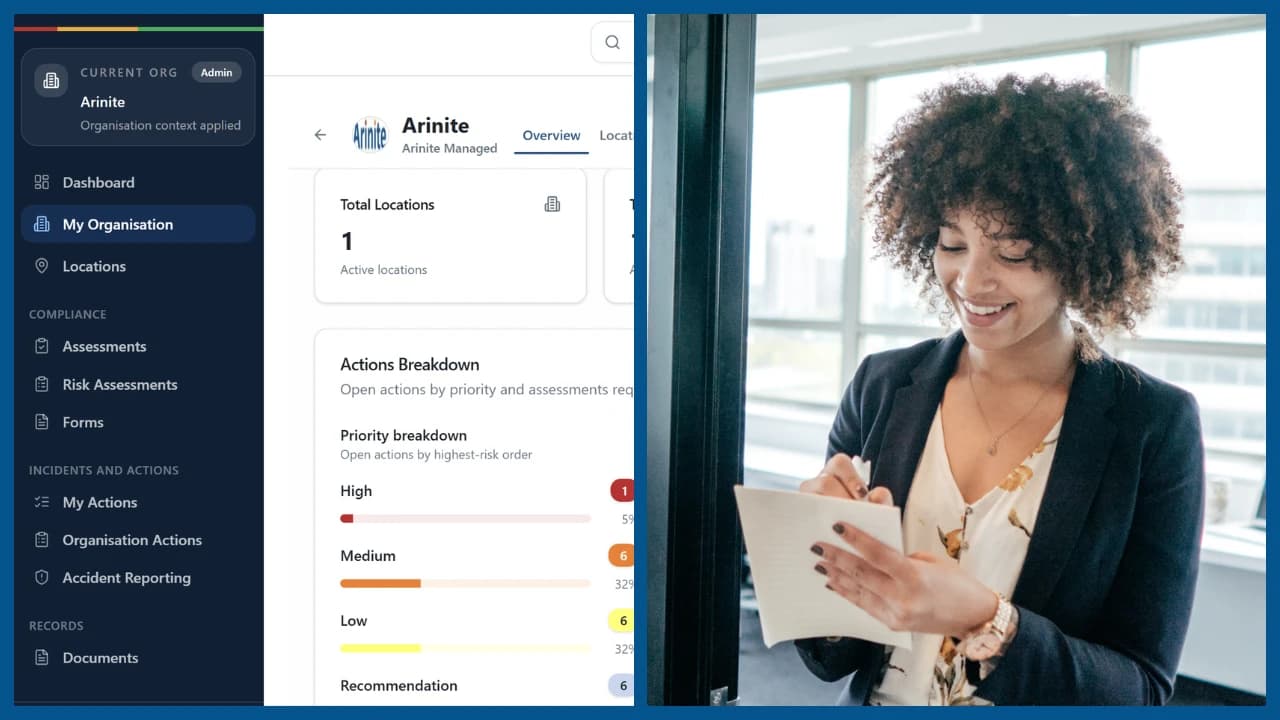
All legionella documentation maintained in Arinite's health and safety software platform, with automated reminders for monitoring, testing, and assessment review.

5

Water testing coordination

We arrange accredited laboratory testing when required and interpret the results for you.

6

Incident and outbreak response

Immediate support if a case of Legionnaires' disease is linked to your premises, including HSE liaison, investigation, and remedial action.

For businesses on Done For You or Done With You packages, legionella compliance is included in the service.

PRICING

How Much Does
Legionella Compliance Cost?

Costs depend on premises type, water system complexity, and the scope of services required. Every engagement is scoped and priced individually. Common shapes include:

£

Legionella risk assessment for a typical UK office

Single site, mains-fed water, no cooling towers: tailored quote.

£+

Legionella risk assessment for a larger or higher-risk premises

Care home, hotel, multi-occupied building, cooling tower present: bespoke quote based on complexity.

🧪

Water sampling and laboratory testing

Where required: priced per sample with UKAS-accredited laboratory analysis.

Ongoing legionella compliance

Monitoring, records, review for businesses on Arinite's Done For You or Done With You packages: included in the monthly fee.

For multi-site organisations, legionella risk assessments are scoped individually. Multi-site programmes are typically significantly more cost-efficient than commissioning site-by-site.

Get Your Legionella Compliance Right

A legionella failure in a UK workplace rarely stays minor. Cases of Legionnaires' disease linked to commercial premises routinely trigger HSE investigation, prosecution, and significant reputational damage.

Book a free gap analysis call. In 30 minutes, one of our Chartered consultants will review your current legionella arrangements, identify the gaps that matter, and recommend the right approach.