HSE inspections up 47% - HSE carried out over 13,200 workplace inspections in 2024/25.
Switzerland operates one of Europe's most distinctive workplace safety regimes: a federal legal foundation built on the Labour Act and the Accident Insurance Act, enforced not by a single regulator but by three parallel bodies — SUVA, SECO, and the Cantonal Labour Inspectorates — coordinated by the Federal Coordination Commission for Occupational Safety (EKAS/CFST). Under EKAS Directive 6508, every Swiss employer with "special hazards" must implement a documented MSST safety management system through certified occupational safety specialists. International employers expanding into Switzerland routinely underestimate the documentation depth, the multilingual obligations, and the cantonal variation. Arinite's Qualified consultants deliver the full Swiss compliance stack from federal alignment through EKAS 6508 / MSST implementation to cantonal inspectorate readiness.
In Switzerland, workplace health and safety is governed federally and enforced through a distinctive three-body system. There is no single national regulator equivalent to the UK's HSE or Singapore's MOM. Compliance is built from two integrated legal pillars and one operational directive:
Under the Federal Labour Act (German: Arbeitsgesetz, ArG; French: Loi sur le travail, LTr). Covers working time, rest periods, ergonomics, psychosocial protection, workplace conditions, ventilation, lighting, noise, and protection of particular categories of workers. Enforced primarily by SECO (State Secretariat for Economic Affairs) and the Cantonal Labour Inspectorates.
Under the Federal Accident Insurance Act (Unfallversicherungsgesetz, UVG; Loi sur l'assurance-accidents, LAA) and the Ordinance on Accident Prevention (Verordnung uber die Unfallverhutung, VUV; Ordonnance sur la prevention des accidents, OPA). Covers technical accident prevention, occupational disease prevention, machinery safety, hazardous substances, and mandatory accident insurance. Enforced primarily by SUVA (Swiss National Accident Insurance Fund) for employers with "special hazards" under Article 49 OPA, and by the Cantonal Inspectorates everywhere else.
The operational backbone for compliance. Requires every employer with identified special hazards to call on occupational safety specialists (MSST) — occupational physicians, hygienists, safety engineers, safety officers — and to implement a documented safety management system covering ten elements including risk assessment, training, emergency arrangements, and audit.
The three federal enforcement bodies are coordinated by EKAS / CFST (Federal Coordination Commission for Occupational Safety; German: Eidgenossische Koordinationskommission fur Arbeitssicherheit; French: Commission federale de coordination pour la securite au travail). EKAS issues directives (including the central Directive 6508), coordinates enforcement, and publishes operational tools.
For other European jurisdictions Arinite supports, see our country guides for the UK (HSE), Germany (DGUV), France (DUERP), Italy (RSPP), Spain (LPRL), the Netherlands (RI&E), Belgium (EDPBW), and Ireland (HSA).
Swiss workplace safety law is built on a small number of federal statutes supported by an extensive ordinance and directive layer. The framework reflects Switzerland's federal structure: federal law sets the substantive duties, the cantons carry much of the enforcement responsibility. See our health and safety legislation guide for cross-jurisdictional context.
The principal statute on health protection at work. Sets out duties on working time, daily and weekly rest periods, mandatory breaks, night and Sunday work, workplace layout, ventilation, lighting, ergonomics, noise, and protection of pregnant workers, young workers, and other particular categories.
Five accompanying ordinances operationalise the Labour Act. ArGV 3 / OLT 3 is the central health protection ordinance, covering ergonomics, workplace climate, psychosocial protection, and worker information. ArGV 4 / OLT 4 covers industrial enterprise approvals and subordination. ArGV 5 / OLT 5 covers young worker protection.
The principal statute on accident prevention and mandatory accident insurance. Establishes SUVA, the framework for occupational accident and occupational disease insurance, and the federal enforcement architecture. Employees of businesses with hazardous activities are compulsorily insured with SUVA (Article 66 UVG/LAA).
The operational ordinance under UVG/LAA. Covers technical accident prevention, machinery and equipment safety, hazardous substances, personal protective equipment, accident investigation, and accident reporting. Article 49 OPA lists the sectors and activities with "special hazards" that fall under direct SUVA enforcement.
Issued by EKAS / CFST under UVG/LAA and OPA/VUV. The detailed legal framework for the obligation on companies to use occupational safety specialists (MSST). In force since 2000. Establishes ten elements of a compliant safety management system. The practical compliance benchmark for any Swiss employer with identified special hazards.
Article 328 of the Code of Obligations places a general civil-law duty on every employer to protect the personality, health, and integrity of employees. Provides the civil-law route to damages claims for breach of health and safety duty, in parallel with the criminal and administrative routes under UVG/LAA and the Labour Act.
The Criminal Code can engage in cases of serious workplace harm: negligent bodily injury (Article 125) and negligent homicide (Article 117) are both available routes following workplace fatalities or serious injuries. Personal liability for managers and directors is a real exposure in serious cases.
SUVA issues sector-specific accident prevention recommendations and machinery safety guidelines. Cantons can issue additional implementing rules in their areas of competence. International employers often miss these layers when relying on federal documentation alone.
This is the Swiss-specific point that international employers most often get wrong. There is no single workplace safety regulator. Three federal bodies share enforcement responsibility along clear lines.
SUVA is simultaneously the national accident insurer (covering roughly half of Swiss employees compulsorily under Article 66 UVG/LAA) and an enforcement authority. SUVA enforces UVG/LAA and OPA/VUV directly in companies with "special hazards" under Article 49 OPA: construction, manufacturing, chemicals, certain machinery operations, woodworking, metalworking, transport, and other higher-hazard sectors. SUVA is also the market surveillance authority for machinery, lifts, personal protective equipment, and other work equipment used in business establishments.
Workplace inspections, technical examination of equipment, accident investigation, and increased premium loading for repeat or serious accident exposure. SUVA can require remedial action, escalate to administrative measures, and refer matters to criminal prosecution.
SECO is the federal authority for the Labour Act and its ordinances. SECO sets federal policy, issues guidance, and oversees the Cantonal Labour Inspectorates that carry out day-to-day enforcement of the Labour Act provisions on working time, rest periods, ergonomics, psychosocial protection, and workplace conditions.
SECO does not typically inspect individual workplaces directly. Instead, it sets the federal framework that the cantonal inspectorates apply. Where SECO does engage directly, it is usually on questions of regulatory interpretation, sector-wide issues, or coordination with the cantons.
Each canton operates its own Labour Inspectorate that enforces the Labour Act and ordinances within the canton, and that enforces UVG/LAA and OPA/VUV in any company not directly within SUVA's Article 49 OPA jurisdiction. For office-based and service-sector employers, the canton is usually the day-to-day regulator.
Practical enforcement intensity varies meaningfully between cantons. Zurich, Geneva, Vaud, Bern, and Basel-Stadt all operate active inspection regimes with somewhat different priorities and procedural styles. International employers with operations in multiple cantons should expect that compliance experience will not be uniform across sites.
EKAS is not itself an enforcement body. It coordinates the three enforcement bodies, issues binding directives (including the central Directive 6508 / MSST), and publishes operational tools for employers: hazard assessment checklists, sector-specific solutions, action plan templates, and machinery safety checklists. EKAS is, in practical terms, the body that defines what good looks like.
For practical purposes:
(construction, manufacturing, chemicals, certain industrial sectors): SUVA is the lead accident-prevention regulator, with the canton handling the Labour Act dimensions.
(offices, professional services, retail, hospitality, financial services): the Cantonal Labour Inspectorate is the day-to-day regulator on both Labour Act and accident-prevention dimensions, with SUVA still acting as accident insurer for those employers compulsorily insured with it.
EKAS Directive 6508, in force since 2000, is the operational backbone of Swiss occupational safety compliance. Every Swiss employer must understand whether it applies to them, and if so, how.
Directive 6508 applies wherever an employer has identified "special hazards" requiring the involvement of occupational safety specialists. Under Article 11a paragraphs 1 and 2 OPA/VUV, the employer has a statutory obligation to consult an occupational safety specialist where this is necessary for occupational health and safety, in particular where the employer does not have the internal expertise.
In practice, applicability follows the company's risk profile. The Directive provides criteria companies can use to determine whether they fall within scope. Construction, manufacturing, chemicals, healthcare, and parts of logistics and hospitality typically do. Office-based professional services typically do not, although certain activities (laboratory work, field activity, working at height during fit-outs) can bring them into scope.
EKAS 6508 defines ten elements that a compliant MSST safety management system must address. They are the de facto checklist any cantonal inspectorate or SUVA inspector will use to evaluate compliance:
Documented commitment from senior management, with defined safety objectives integrated into business planning.
Documented roles and responsibilities, including the appointed occupational safety specialist and the line management chain.
Initial induction and ongoing periodic training, role-specific competence development, and documented training records.
Written safe work procedures, operating instructions, and behavioural rules adapted to the workplace.
Systematic hazard mapping and documented risk assessment with prioritised controls, reviewed periodically and on change.
Action plans linking identified risks to specific controls, with owners, deadlines, and status tracking.
Documented emergency response, evacuation, first aid, and rescue organisation appropriate to the workplace.
Mechanisms for employee involvement in safety matters, including consultation on safety arrangements and the right to raise concerns.
Integration of Labour Act health protection requirements: ergonomics, psychosocial risk, workplace climate, breaks, and protection of particular worker categories.
Periodic internal audit of the safety management system, follow-up on findings, and continuous improvement.
Swiss employers have two main routes to implementing an MSST-compliant system:
Sector-level models validated by EKAS, providing a ready-made OHS manual, checklists, and collective training pathways. Available across many sectors and particularly useful for SMEs.
Tailored MSST systems for companies whose risk profile is not covered by a branch model or which require a customised approach. Implemented through certified MSST service providers.
Both routes require the involvement of qualified occupational safety specialists (occupational physicians, hygienists, safety engineers, or safety officers) at frequencies and depths proportionate to the company's risk profile.
Under the combined ArG/LTr, UVG/LAA, OPA/VUV, and EKAS 6508 framework, every Swiss employer must:
Conduct a documented hazard identification and risk assessment covering all work activities, reviewed periodically and on relevant change.
Determine whether EKAS Directive 6508 applies, and if so, implement an MSST-compliant safety management system through a branch solution or an individual solution.
Consult an occupational safety specialist where required under Article 11a OPA/VUV, in particular where the employer lacks the internal expertise to handle identified hazards.
Provide information and training to employees on workplace hazards, prevention measures, emergency procedures, and the role of the occupational safety specialist. Article 6 paragraph 2 OPA/VUV specifically requires employees to be informed about the tasks and functions of the occupational safety specialists working in the company.
Comply with the Federal Labour Act on working time, daily and weekly rest periods, breaks, night and Sunday work, with documentation as required by ArGV 1 / OLT 1.
Comply with ArGV 3 / OLT 3 on health protection: ergonomics, workplace climate, psychosocial protection, and protection of pregnant workers, young workers, and other particular categories.
Maintain mandatory accident insurance for all relevant employees. Employees of businesses with Article 49 OPA hazardous activities are compulsorily insured with SUVA. Other employees are insured through approved private accident insurers.
Report workplace accidents promptly. The employee must immediately notify the accident to the employer or the insurer in case of medical treatment or incapacity for work (Article 45 paragraph 1 UVG/LAA). The employer has a parallel notification obligation to the competent accident insurer (Article 45 paragraph 2 UVG/LAA). In case of death, entitled survivors are also obliged to report.
Provide appropriate personal protective equipment at no cost to the worker where engineering and administrative controls cannot adequately mitigate risk.
Ensure machinery and equipment compliance under OPA/VUV and the SUVA market surveillance regime, including periodic inspection of higher-risk equipment.
Maintain documentation in the languages relevant to the workforce. In Switzerland this typically means German, French, or Italian depending on the canton, often with English supplementing for international workforces.
Cooperate with SUVA, SECO, and Cantonal Inspectorate inspections, providing access to premises, records, and personnel as requested.
Comply with sector-specific SUVA recommendations and cantonal additional rules where applicable.
Failure to comply exposes the business to administrative measures (warnings, remedial orders, increased SUVA premiums, operational suspension), criminal sanctions under the Swiss Criminal Code, and civil liability under Article 328 of the Code of Obligations.
A compliant Swiss safety management programme is a documented system, not a single document. The minimum documentation set under EKAS 6508 includes:
A signed statement committing the organisation to occupational safety and health, aligned with the ten EKAS 6508 elements.
A documented inventory covering all work activities, reviewed periodically and on change.
Linking each identified risk to specific controls, owners, deadlines, and status.
Showing the appointed MSST specialist (where applicable) and the line management safety responsibilities.
For medium and higher-risk activities.
Mapping each role to required induction, periodic refresh, and role-specific training, with documented competence records.
Covering evacuation, first aid, rescue organisation, and emergency contact arrangements.
Demonstrating Article 6 paragraph 2 OPA/VUV compliance.
Documenting periodic review of the safety management system.
With notifications to the competent accident insurer under Article 45 UVG/LAA.
This should integrate with your wider health and safety policy at group level.
Swiss federal law applies uniformly across all employers, but the practical compliance profile varies materially by sector and by canton. Arinite supports clients across Switzerland in the sectors below.
Typically not within Article 49 OPA special hazards, so the Cantonal Labour Inspectorate is the day-to-day regulator. Lower physical risk but elevated focus on ArGV 3 / OLT 3 health protection: ergonomics for office and hybrid workers, psychosocial risk, workplace climate, and working time compliance. Particularly important in Zurich, Geneva, Lausanne, and Zug given the size of the tech and SaaS footprint.
Geneva and Zurich dominate. Cantonal Inspectorate-regulated. Office-based HSE risk profile combined with elevated focus on psychosocial risk, working time compliance, and harassment prevention. ArGV 3 / OLT 3 increasingly relevant to inspection priorities.
Long-hours environments and demanding client-facing pressure place psychosocial risk and working time compliance at the centre of inspection priorities. Cantonal Inspectorate-regulated for most office operations.
Basel dominates pharmaceuticals and chemicals. Direct SUVA enforcement under Article 49 OPA. Detailed expectations on hazardous substances, occupational hygiene, machinery safety, biological agents, and occupational medicine. Multi-language documentation common (German, French, English).
Direct SUVA enforcement under Article 49 OPA. Among Switzerland's most actively regulated sectors. EKAS 6508 / MSST expectations apply in full. Working at height, scaffolding, and construction equipment safety are central inspection priorities.
Direct SUVA enforcement. Detailed expectations on machinery safety (with SUVA acting as the market surveillance authority), hazardous substances, noise, vibration, and confined spaces. Sector-specific SUVA recommendations layered on top of OPA/VUV.
Direct SUVA enforcement in many activities. Biological agents, sharps, manual handling, shift work, psychosocial demand, and patient-facing aggression. EKAS 6508 expectations on emergency arrangements particularly demanding.
Cantonal Inspectorate-regulated. Focus on working time compliance (Sunday and night work), young worker protection (ArGV 5 / OLT 5), customer-facing aggression, and lone working. Watch and luxury retail particularly active in Geneva, Bern, and Zurich.
Direct SUVA enforcement for vehicle and warehousing activities. Working at height, racking, manual handling, vehicle-pedestrian interface, and Working Time Act compliance for drivers.
Arinite acts as your central health and safety partner across all of your jurisdictions. In Switzerland, our Qualified consultants deliver the federal compliance baseline, coordinate with certified Swiss MSST service providers where EKAS 6508 applies, and align with the canton you operate in. Delivered as part of our outsourced health and safety service. See our health and safety audit and training services.
Federal compliance audit against ArG/LTr, ArGV/OLT 1-5, UVG/LAA, OPA/VUV, and EKAS Directive 6508.
Structured assessment of whether your activities meet the threshold for MSST involvement under Article 11a OPA/VUV, and which route (branch solution or individual solution) is most appropriate.
Documented risk assessment meeting EKAS 6508 Element 5 expectations, reviewed periodically and on change, in the working language of the canton.
End-to-end implementation across the ten EKAS 6508 elements: policy, organisation, training, rules, risk assessment, action planning, emergency arrangements, employee participation, health protection, and internal audit.
Liaison with certified Swiss MSST service providers (occupational physicians, hygienists, safety engineers, safety officers), structured around your sector and risk profile.
Pre-inspection audit, documentation review in the relevant working language, and response to inspectorate findings or remedial orders.
For Article 49 OPA special-hazard activities: pre-engagement readiness, on-the-day support during SUVA visits, response to SUVA findings, and premium loading mitigation.
Process design and response readiness for the Article 45 UVG/LAA notification obligations, including coordination with the accident insurer.
Specific assessment and remediation work on ergonomics, workplace climate, psychosocial risk, and protection of particular worker categories.
Documentation prepared in German, French, Italian, or English as appropriate to the canton and the workforce.
For multi-country businesses, Arinite operates as a single compliance partner across Switzerland, the UK, the EU, and 50+ other jurisdictions, with consistent governance and a single set of records in our health and safety software platform.
For businesses on Arinite's Done For You or Done With You packages, Swiss compliance is included.
Swiss compliance cost varies meaningfully based on several factors. We do not publish generic rates because the inputs vary too widely to be useful in advance of a discovery call.
Companies with Article 49 OPA special hazards face materially deeper documentation, MSST specialist involvement, and audit expectations than office-based service businesses.
Single-site, single-office businesses carry less compliance scope than multi-site businesses spanning a production site, a head office, and field activities.
Single-canton operations are simpler than operations spanning Zurich, Geneva, Basel, Bern, Vaud, and Ticino, each with its own inspectorate and language profile.
Office-based services versus construction, pharmaceuticals, healthcare, or manufacturing carry materially different SUVA, SECO, and EKAS 6508 expectations.
Documentation in one of German, French, Italian, or English versus multilingual coverage across the workforce changes scope.
Employers already engaged with a certified MSST service provider need different support than employers starting from scratch.
Switzerland-only versus Switzerland-as-one-of-many jurisdictions changes the operating model.
One-off compliance baseline: EKAS 6508 applicability assessment, risk assessment, MSST system implementation, and initial training rollout.
Swiss compliance maintained as part of Done For You or Done With You monthly arrangements, including periodic risk assessment review, training, advisory, Cantonal Inspectorate readiness, and accident response.
SUVA inspector on site, Cantonal Inspectorate visit, accident investigation, or post-incident review. Scoped against urgency and complexity.
Initial project establishment followed by ongoing light-touch maintenance and advisory.
A free gap analysis call with one of our Qualified consultants will give you a clear estimate for your specific Swiss situation.
Swiss workplace safety enforcement is layered, multi-regulator, and quietly serious. The three-body system catches international employers out routinely. SUVA premium loading for repeat or serious accident exposure has real financial consequences. Cantonal Labour Inspectorates can require remedial action with material operational impact. EKAS 6508 expectations are detailed and audit-ready. Multilingual documentation in German, French, or Italian is non-negotiable in the relevant cantons.
Whether you are entering Switzerland for the first time, expanding from one canton to another, preparing for a SUVA visit, addressing a Cantonal Inspectorate remedial order, or coordinating Swiss compliance with operations in the UK and EU, Arinite's Qualified consultants support every stage.
Book a free gap analysis call. In 30 minutes, one of our Qualified consultants will review your current Swiss situation, identify what matters most, and recommend the right approach.
From Reactive Firefighting to Proactive Health & Safety Compliance
No formal HSE systems in place. Everything is reactive, waiting for something to go wrong. Documentation is missing or outdated.
This isn't just "non-compliant." It's criminally negligent. Directors face personal prosecution.
Basic HSE documentation is in place. Minimum legal requirements met. You can pass a basic audit.
Compliance is where most consultants get you, then leave. You're legal, but you're not optimised.
Systems run proactively, preventing problems before they occur. Compliance is distributed, not dependent on one person.
That's why 95%+ of clients renew year after year.

Robert Winsloe
Managing Director, Arinite
“We work with you to deliver peace of mind. We tailor our service provision to your business to provide proactive, pragmatic health and safety advice and that helps reduce costs by ensuring compliance with relevant health and safety legislation.”
Other Consultants
Get you to Stage 2 (Compliant) and disappear.
Arinite
Gets you to Stage 3 (Proactive) and keeps you there.
That's why we call it transformation, not just compliance.
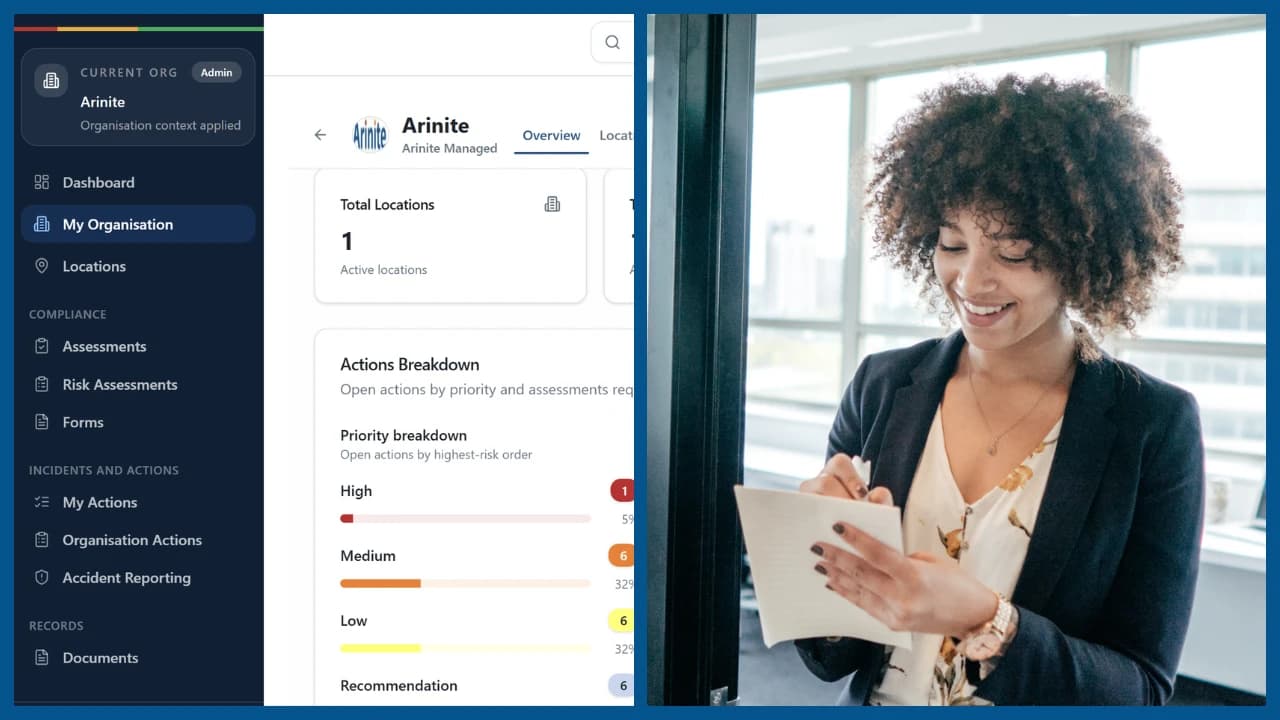
Compliance
Traditional consultancies audit, report and leave. You get a document and the job of implementing it.
Control
Software companies give you dashboards and workflows without the knowledge to use them.
Coverage
Global businesses need consultants who know compliance in every jurisdiction.
Arinite
We are not a consultancy that adds external software. We are not a software company that recommends consultants.
We are the place where those two things finally become one.
50+ Countries. Global Safety. Local Trust.
Headquartered in London, UK, with Qualified health and safety consultants in 50+ countries. Whether you need a health and safety audit in Manchester, a fire risk assessment in Birmingham, or outsourced workplace health and safety compliance in Singapore, we have consultants near you.
We're expanding globally

Operations Director, Arinite
I have been in the health and safety business for 35+ years. In that time, I have had one consistent experience across every sector and every country I have worked in.
Every business we speak to already knows, somewhere, that their workplace health and safety compliance has not kept pace with their growth. It is not ignorance. It is business. It is the assumption that because nothing has gone wrong yet, the gaps are probably manageable.
What stops most businesses from doing something about it is not the cost of outsourcing health and safety support. It is the fear of finding out how significant the gaps are.
The Free Gap Analysis Call exists for exactly that moment.
You get the full picture of your workplace health and safety position in 30 minutes.
“In 35+ years, I have not once had someone tell us they wished they had stayed in the dark.”
No video testimonials available at the moment.
Join 1,500+ organisations that trust Arinite as their health and safety consultants.
Common questions about SUVA, SECO, EKAS Directive 6508 (MSST), Cantonal Inspectorates, and Swiss employer obligations
Our Qualified health and safety consultants are here to help with any queries about workplace safety, compliance, or our services.
Download our comprehensive library of expert guides, checklists, and templates.
Browse LibraryHave a question or need expert advice? We're here to help.
Fill out the form below and our team will get back to you within 24 hours.
Headquarters
29 Throgmorton St
London EC2N 2AT