Skip to content

HSE inspections up 47% - HSE carried out over 13,200 workplace inspections in 2024/25.

Chartered Fire Safety Consultants

Fire Risk Assessment Services:
PAS 79 Compliant, London and UK

Expert fire risk assessments for offices, HMOs, blocks of flats, care homes, and commercial premises across London and the UK.

Compliant with the Regulatory Reform (Fire Safety) Order 2005, the Fire Safety Act 2021, and the Building Safety Act 2022. Free consultation.

1,500+ Businesses Protected
50+ Countries
95%+ Retention
PAS 79 Compliant
Fire Safety Act 2021
Chartered Consultants
London & Nationwide
Free Consultation
Get in Touch

Contact Arinite Today

Fill out the form below and our team will get back to you within 24 hours.

By submitting, you agree to our Privacy Policy and consent to Arinite contacting you.

UNDERSTANDING FIRE RISK

What Is a Fire Risk Assessment?

A fire risk assessment is a structured evaluation of your premises to identify fire hazards, assess who is at risk, evaluate existing controls, and determine what additional measures are needed. It is a legal requirement under the Regulatory Reform (Fire Safety) Order 2005 for virtually all non-domestic premises in England and Wales.

The purpose is not just to document hazards. It is to demonstrate that the responsible person has taken all reasonable steps to prevent fire and to protect people if a fire does occur. Fire and rescue authority inspectors assess the quality and sufficiency of this evidence during enforcement visits.

The Five Steps

1

Identify fire hazards (sources of ignition, fuel, and oxygen)

2

Identify people at risk (employees, visitors, residents, contractors, and anyone with impaired mobility or awareness)

3

Evaluate the risk and decide whether existing fire safety measures are adequate

4

Record findings and prepare an action plan

5

Review the assessment regularly or whenever circumstances change

LEGAL FRAMEWORK

Legal Requirements
Three Key Acts

Three pieces of legislation define fire safety obligations for premises in England and Wales.

Fire Safety Order

Regulatory Reform (Fire Safety) Order 2005

The primary legislation. It requires the "responsible person" for any non-domestic premises to carry out a suitable and sufficient assessment of fire risk and to implement appropriate fire precautions. The Order covers offices, shops, factories, warehouses, pubs, restaurants, hotels, hospitals, care homes, and the common areas of residential buildings.

Fire Safety Act

Fire Safety Act 2021

Clarified the scope of the Fire Safety Order following the Grenfell Tower inquiry. It confirmed that the Order applies to the structure, external walls (including cladding and balconies), and flat entrance doors of multi-occupied residential buildings. Assessments for blocks of flats and HMOs must now explicitly address these elements.

Building Safety Act

Building Safety Act 2022

Introduced additional requirements for "higher-risk buildings" (residential buildings at least 18 metres or seven storeys in height). Building owners and managers must register with the Building Safety Regulator, prepare a safety case, and demonstrate ongoing compliance.

For housing premises including HMOs and blocks of flats, assessments should follow BS 9792:2025, which replaced the previous PAS 79-2. For non-housing premises, PAS 79-1:2020 remains the relevant standard.

RESPONSIBLE PERSON

Who Is the Responsible Person?

The Fire Safety Order places duties on the "responsible person." In most cases, this is:

The employer (for workplaces)
The owner or managing agent (for commercial premises)
The landlord or management company (for residential common areas)

The responsible person must:

Ensure a suitable and sufficient assessment is carried out
Implement and maintain fire precautions
Put a fire safety management plan in place
Review the assessment whenever it may no longer be valid

If the responsible person does not have the competence to carry out or commission an adequate assessment, they must appoint someone who does. This is where fire safety consultants are typically engaged.

Failure to comply can result in:

Enforcement notices
Prohibition notices (immediate premises closure)
Prosecution with unlimited fines
Imprisonment in the most serious cases
ASSESSMENTS BY PREMISES TYPE

Assessments by
Premises Type

The hazards, the people at risk, and the controls inspectors expect vary significantly by building type. Arinite's fire safety consultants carry out assessments for all premises categories.

Office Fire Risk Assessment

Offices contain electrical equipment, server rooms, kitchenettes, paper storage, and increasingly, lithium-ion batteries in laptops and e-bikes. An office assessment must identify these hazards, assess means of escape (including for visitors and anyone with mobility impairments), evaluate fire detection and alarm systems, and confirm fire marshal arrangements are adequate for the occupancy level.

Fire Risk Assessment for HMOs and Blocks of Flats

Houses in multiple occupation and blocks of flats require assessments that address sleeping risk: residents may be asleep when a fire starts, may be unfamiliar with escape routes, or may have reduced mobility. Following the Fire Safety Act 2021, assessments must also cover external walls, cladding, and flat entrance doors. BS 9792:2025 is the current standard.

Care Home Fire Risk Assessment

Care homes present the highest level of sleeping risk because residents may have physical or cognitive impairments that prevent independent evacuation. Assessments must consider progressive horizontal evacuation, compartmentation and fire doors, night-time staffing levels, and the specific fire hazards in clinical and residential environments.

Fire Risk Assessment for Commercial and Retail Premises

Shops, restaurants, warehouses, factories, and commercial premises each present distinct fire hazards. Retail premises must account for customer evacuation and seasonal layout changes. Restaurants must address cooking equipment, extraction systems, and grease buildup. Warehouses must consider high-density stock as a fire load.

Fire Risk Assessment for Schools and Educational Buildings

Schools, colleges, and universities must assess fire risk across classrooms, laboratories, kitchens, assembly halls, sports facilities, and residential accommodation. The assessment must account for the presence of children and young people who may not respond to fire alarms as reliably as adults.

Arinite's assessments are always site-specific: a generic template applied across different premises types is not legally defensible.

WHAT INSPECTORS LOOK FOR

What Inspectors
Look For

Inspectors assess evidence, not intent. When an inspector visits your premises, they are looking for documented proof that you have:

Documented Proof Required

Identified fire hazards and assessed who is at risk
Adequate fire precautions (detection, alarm, escape routes, emergency lighting, fire doors, extinguishers) that are maintained
Staff who have received fire safety training including fire marshal or fire warden training
A documented emergency plan that has been practised through fire drills
Reviewed the assessment following any changes to premises, layout, occupancy, or use
Completed actions identified in the assessment within specified timescales

The most common enforcement trigger is not a fire. It is an assessment that is missing, out of date, or inadequate.

Enforcement Powers

Enforcement notice

requiring improvements within a specified period

Alterations notice

requiring notification before changes are made

Prohibition notice

closing the premises immediately where there is a serious risk to life

PAS 79 METHODOLOGY

PAS 79: The Standard
Our Assessments Follow

PAS 79-1:2020

Non-Housing Premises

PAS 79-1:2020 is the published document that provides guidance on how to carry out a fire risk assessment for non-housing premises. It is not a legal requirement to follow PAS 79, but it is recognised by fire and rescue authorities as the benchmark for a competent, systematic assessment. Following PAS 79 demonstrates that the assessment has been carried out by a competent person using a recognised methodology.

For housing premises (HMOs, blocks of flats, and sheltered housing), BS 9792:2025 has replaced the previous PAS 79-2:2020. This standard reflects the expanded scope of the Fire Safety Act 2021 and the specific requirements of sleeping accommodation.

Every assessment Arinite delivers follows the applicable standard. Our fire safety consultants are qualified assessors with experience applying both PAS 79-1 and BS 9792 across all premises types.

Not Sure Your Fire Risk Assessment Is Adequate? Find Out in 30 Minutes

Most businesses that search for a fire risk assessment template are trying to answer one question: are our current arrangements good enough?

A blank template cannot answer that. It gives you a structure, but no way to know whether what you write in it would satisfy an inspector. The gaps that lead to enforcement action are not gaps in documentation. They are gaps in judgement: hazards that were not identified because the person completing the assessment did not know to look for them.

On the call, the consultant will:

Review your current fire safety arrangements against a structured PAS 79 checklist
Identify which areas would not meet inspector expectations
Highlight specific compliance gaps that fire and rescue authorities are currently enforcing
Confirm whether your existing assessment (if you have one) meets PAS 79 standards

You leave the call knowing exactly where your fire safety compliance stands and what needs to happen next. No guesswork. No blank forms. No false sense of security.

If we cannot identify at least one compliance gap, we send you a £50 gift card. In 15+ years, we have never paid out.

FIRE RISK ASSESSMENT COST

How Much Does a Fire Risk
Assessment Cost?

The cost depends on the size, complexity, and type of premises. Every assessment is scoped and priced individually. Most engagements fall into one of these shapes:

Standard Office / Small Commercial

Single floor, straightforward layout

Tailored Quote

Larger Office / Multi-Floor Commercial

Retail units, multi-floor premises

Bespoke Quote

HMOs, Blocks of Flats, Residential

Varies by floors, units, and external wall assessment scope

Priced Individually

Care Homes, Hotels, Schools, Complex

Sleeping risk, specialist hazards, or large occupancy

Bespoke Quote

All assessments include:

On-site assessment
Written report following PAS 79-1 or BS 9792 methodology
Prioritised action plan with clear timescales
Follow-up consultation to discuss findings

The cost of not having an adequate assessment is significantly higher. Fire safety enforcement action can result in unlimited fines, prohibition notices that close your premises, and criminal prosecution of the responsible person.

COMPETENCE & QUALIFICATIONS

Who Can Carry Out
a Fire Risk Assessment?

The Fire Safety Order does not prescribe specific qualifications for the person carrying out the assessment. It requires that the assessment is "suitable and sufficient," which in practice means it must be carried out by someone with adequate training, experience, and knowledge of fire safety.

For simple premises with low fire risk, a competent internal employee may be able to carry out an adequate assessment using appropriate guidance. For more complex premises, sleeping accommodation, or any premises where enforcement action would have serious consequences, appointing a qualified fire safety consultant is the defensible approach.

When comparing fire risk assessment companies, look for:

Qualifications of the assessors (look for membership of the Institution of Fire Engineers, the Fire Protection Association, or equivalent professional bodies)
Whether the assessor has specific experience with your premises type
Whether the assessment follows a recognised methodology such as PAS 79

Led by 35 Years of Experience

Arinite's fire safety consultancy is led by William Robert Tucker, former Deputy Chief Fire Officer and Head of the Fire Service College's Fire Safety Division, with 35 years of fire safety experience. Our assessors hold relevant qualifications and have practical experience across all premises types.

Meet Our Team
COMPREHENSIVE COVERAGE

What Our Assessments
Cover

Every assessment Arinite delivers includes:

Thorough on-site inspection of the premises
Identification of all fire hazards including ignition sources, fuel sources, and structural factors
Assessment of means of escape including routes, signage, emergency lighting, and door hardware
Evaluation of fire detection and alarm systems
Review of firefighting equipment provision and maintenance
Assessment of compartmentation, fire doors, and passive fire protection
Review of emergency plan and fire drill records
Assessment of fire safety training records and fire marshal arrangements
Identification of people at particular risk (visitors, contractors, mobility or sensory impairments)
Written report following PAS 79-1 or BS 9792 methodology with prioritised action plan

For premises affected by the Fire Safety Act 2021, the assessment also covers external walls, cladding systems, and flat entrance doors.

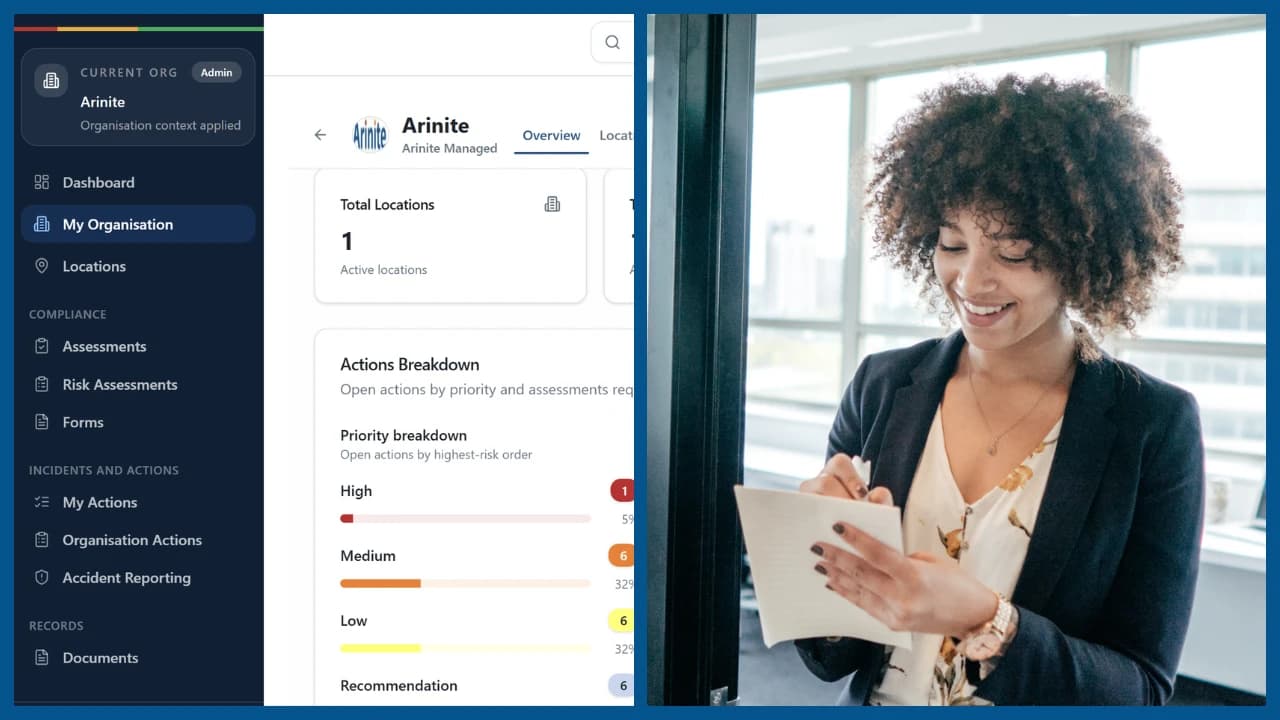
All findings are documented in Arinite's health and safety software, giving you a digital record that is accessible, auditable, and ready to present to inspectors.

Learn about our software
FIRE SAFETY TRAINING

Fire Marshal Training and Fire Safety Training

The Fire Safety Order requires the responsible person to ensure that employees receive adequate fire safety training. This includes general fire safety awareness for all staff, fire marshal (or fire warden) training for designated personnel, and refresher training at appropriate intervals.

Arinite provides:

Fire marshal training
Fire warden training
General fire safety awareness training
Training tailored to the specific fire hazards identified in your assessment
On-site or virtual delivery

For more details on our training courses, visit our health and safety training page.

View Training Courses
REVIEW & MAINTENANCE

How Often Should It
Be Reviewed?

There is no fixed statutory period for reviewing an assessment. The Fire Safety Order requires that the assessment is reviewed when there is reason to believe it is no longer valid, or when there has been a significant change to the premises.

A review is needed when:

The layout or use of the premises changes
The number or type of occupants changes significantly
Building works are carried out
New fire hazards are introduced (heating systems, cooking equipment, storage)
After a fire or fire-related incident
After a change in relevant legislation or guidance

Arinite recommends an annual review for most premises. For high-risk premises (sleeping accommodation, large public buildings, premises with complex fire systems), more frequent reviews may be appropriate.

Arinite's health and safety software includes automated review reminders so that assessments are never left to drift out of date.

LONDON & NATIONWIDE

Fire Risk Assessments in
London and Across the UK

Arinite is headquartered in London and provides assessments across the UK and in 50+ countries. Whether you need a single assessment for an office in the City of London, a programme covering a national retail portfolio, or assessments for international premises, our fire safety consultants deliver the same PAS 79 standard everywhere.

Coverage includes:

Rapid turnaround for London-based clients with assessors who know local fire and rescue authority expectations
Multi-site businesses get a single dashboard showing assessment status for every premises in your portfolio
London, the South East, Birmingham, Manchester, Leeds, Edinburgh, and all UK regions
International premises coordinated with locally qualified fire safety professionals

Looking for fire risk assessment services near you? Arinite's consultants cover London and all UK regions, plus 50+ countries worldwide.

Contact Us
Featured Resource

Free Fire Safety - Responsible Person Factsheet

Understand your legal obligations with our comprehensive Fire Safety Factsheet.