HSE inspections up 47% - HSE carried out over 13,200 workplace inspections in 2024/25.
When the Health and Safety Executive contacts your business, the clock starts. An inspector at your premises, an Improvement Notice in the post, a Fee for Intervention invoice, or a letter from an HSE investigator all demand a specific, considered response within short timeframes. Arinite’s Chartered health and safety consultants support UK businesses through every form of HSE engagement: routine inspections, Fee for Intervention appeals, Improvement Notice and Prohibition Notice response, post-incident investigation, and prosecution defence coordination.
The Health and Safety Executive (HSE) is Great Britain’s national regulator for workplace health and safety. Established under the Health and Safety at Work etc. Act 1974 (HSWA), HSE operates as a non-departmental public body sponsored by the Department for Work and Pensions.
HSE’s remit covers workplace safety regulation across England, Scotland, and Wales. In Northern Ireland, workplace safety is regulated by HSENI (Health and Safety Executive for Northern Ireland), a separate body operating under Northern Irish statute.
HSE shares enforcement responsibility with Local Authorities (LAs) under the Health and Safety (Enforcing Authority) Regulations 1998. HSE typically regulates higher-risk workplaces (construction, manufacturing, chemicals, extractives, agriculture, nuclear, healthcare). Local Authorities typically regulate lower-risk workplaces (retail, offices, hospitality, leisure, residential care). This split is a common source of confusion for UK businesses.
In the 12 months to August 2024, HSE achieved a 94% conviction rate across its prosecutions, with average fines of approximately £170,000 per case. Recent sentencing under the 2016 Sentencing Guidelines has produced individual fines exceeding £10 million for very large companies with serious breaches.
HSE operates under the Health and Safety at Work etc. Act 1974.
HSE inspectors have extensive statutory powers under Sections 19–28 of HSWA 1974. Full statutory framework in our health and safety legislation guide.
HSE inspectors may enter any premises where they reasonably believe it necessary for enforcement of health and safety law. No warrant is required in most cases. The inspector may enter at any reasonable time, or at any time where danger is suspected.
Inspectors may examine the workplace, take measurements, photographs, and samples, require documents to be produced (risk assessments, training records, accident books, maintenance records), require persons to provide information and answer questions, and require premises or items to be left undisturbed.
HSE inspectors can require any person who they reasonably believe can provide relevant information to answer questions. Statements given under Section 20 can potentially be used as evidence in subsequent criminal proceedings. What employees and managers say to inspectors matters.
HSE can issue Improvement Notices (Section 21), Prohibition Notices (Section 22), Crown Notices, Fee for Intervention charges (under the Health and Safety and Nuclear (Fees) Regulations 2022), and bring prosecution through the courts.
Under Section 40 HSWA 1974, the burden of proving that it was not reasonably practicable to do more than was actually done is on the defendant. This reverse burden makes H&S prosecutions harder to defend than many other regulatory prosecutions.
HSE prosecutions can be brought summarily (Magistrates’ Court) or on indictment (Crown Court). Since 2008, both courts have unlimited fining powers for H&S offences.
Most HSE inspections are unannounced. Understanding the process is the foundation of an effective response.
Programmed inspections under HSE’s sector-based plans and targeted campaigns
Incident-triggered investigation following RIDDOR reports of fatalities, major injuries, and dangerous occurrences
Complaint-driven inspections prompted by worker complaints or third-party concerns
Follow-up inspections verifying actions taken after previous inspections or notices
Inspector presents identification, confirms the purpose of the visit, and requests the person in control of the premises.
Inspector typically requests risk assessments, health and safety policy, training records, accident book, maintenance records, and documentation relevant to the inspection scope.
Physical inspection of the workplace, potentially with measurements, photographs, and observations of working practices.
Inspector may ask to speak with individual workers. Workers have no obligation to speak but many do. Employers have no right to insist on being present during worker interviews.
Inspector summarises findings, identifies any material breaches, and explains next steps. Outcomes range from verbal advice to formal enforcement notices to opening a formal investigation.
The single biggest mistake businesses make during HSE inspections is allowing the visit to proceed without a documented record of what was inspected, what was said, and what the inspector identified. Without your own contemporaneous record, any subsequent dispute becomes the inspector’s word against unclear recollection. A designated person should accompany the inspector, take detailed notes, and confirm findings at the closing discussion.
Fee for Intervention is HSE’s cost-recovery scheme, introduced in October 2012. Where inspectors identify a "material breach," the organisation is charged for the inspector’s time.
£188 per hour from 1 April 2026 (increased from £183 in April 2025 and £174 from April 2024). The rate adjusts annually.
Time on site during the initial inspection
Follow-up visits to verify abatement
Research and evidence review in the office
Preparation of reports and notices
Correspondence and telephone calls with the employer
Legal advice time where HSE’s in-house legal team is involved
Clear breaches of specific regulations with identifiable risk
Failure to have required documents (risk assessment, training records)
Observed unsafe working practices
Failure to act on previously identified issues
The employer raises objections with HSE directly. HSE reviews the material breach opinion, the time charged, and any procedural concerns.
If Stage 1 does not resolve the dispute, the employer escalates to an independent panel of experts who review the case and issue findings.
Beyond FFI and prosecution, HSE’s primary enforcement tools are two statutory notices under HSWA 1974.
Requires specified improvements within a specified period (minimum 21 days). Issued where the inspector believes a person is contravening, or has contravened in circumstances likely to continue or be repeated.
Prohibits a specified activity with immediate effect (or from a specified date). Issued where the inspector believes activities involve a risk of serious personal injury.
•Immediate: activity must cease at once
•Deferred: activity must cease from a specified date
Both notice types can be appealed to the Employment Tribunal within 21 days of service.
Improvement Notice appeal suspends the Notice until the Tribunal decides. Prohibition Notice appeal does NOT automatically suspend the effect.
The alleged contravention did not occur
The required remedial action is disproportionate or impracticable
The period for compliance is unreasonably short
Procedural defects in the Notice itself
The inspector’s opinion was not reasonably held
HSE publishes details of Improvement and Prohibition Notices on its online public register. The reputational consequences of a published Notice often exceed the immediate operational consequences.
Beyond routine inspection and notice-based enforcement, HSE conducts formal investigations and brings prosecutions for serious breaches.
Workplace fatalities
Major injuries under RIDDOR
Dangerous occurrences with potential for serious harm
Persistent or severe breaches identified during inspection
Reports from coroners, other regulators, or the public
Conducted under HSWA 1974. Attendance can be compelled. Answers can potentially be used in subsequent prosecution.
Conducted when HSE is investigating with prosecution in contemplation. Full criminal procedure protections including the right to legal representation and formal caution.
Culpability (high, medium, low, or very low) based on how the breach occurred
Harm (risk of serious harm, actual harm caused, number of people exposed)
Turnover band of the offending organisation (large, medium, small, micro)
In the 12 months to August 2024, HSE achieved a 94% conviction rate. Average fines approximately £170,000 per case. Fines exceeding £10 million have been imposed on very large organisations. Directors and managers can be prosecuted individually under Section 37 HSWA 1974.
The actions you take in the first 24–72 hours matter significantly.
Confirm identification. HSE inspectors carry warrant cards. Verify and record the inspector’s name and warrant number.
Escalate internally immediately. Notify the person responsible for H&S and senior management.
Designate an accompanying person. Someone with knowledge of operations and authority to respond to document requests.
Take contemporaneous notes. What was inspected, what was said, what was observed, what documents were requested.
Preserve evidence. If the inspector takes photographs or measurements, do the same from the same angles.
Do not speculate. If you don’t know the answer with certainty, say so. Do not guess.
Do not obstruct. You have a legal duty to cooperate with reasonable requests.
Request time for complex questions. For anything involving technical judgment or legal matters, respond in writing after consulting advisers.
Get closing summary in writing. Ask the inspector to summarise findings formally.
Which type: Improvement, Prohibition, or other
Which statutory provisions: specific regulations cited
The inspector’s reasoning: the stated basis for the opinion
The required action: what must be done
The period for compliance: the deadline
The appeal period: 21 days from service
Do not attempt to handle serious HSE engagement without specialist support. HSE’s procedural knowledge, legal resources, and technical depth are substantial. Businesses that engage support early achieve significantly better outcomes.
HSE inspection and enforcement priorities vary significantly by sector.
Typically Local Authority-regulated under the HSE/LA split. HSE engages in specific contexts: serious incidents, psychosocial risk complaints, whistleblower referrals, and large-scale operations. Growing HSE interest in psychological safety and stress in high-growth tech environments.
Typically LA-regulated. HSE engagement in major incidents, large office fit-outs (construction safety), and occasional thematic campaigns. Increasing attention to workplace psychological safety in trading and client-facing roles.
Typically LA-regulated for office operations. HSE engagement following incidents during client-site work, international travel safety, and occasional thematic campaigns.
Healthcare is directly HSE-regulated. Specific HSE priorities include sharps management, manual handling, violence prevention, infection control, and lone working. Care homes face additional attention on legionella, fire safety, resident handling, and staffing adequacy. Lone working in community healthcare.
Directly HSE-regulated. Major inspection focus. Priorities include machinery guarding, LOLER, PUWER, noise, vibration, COSHH compliance, working at height, and lifting operations.
Directly HSE-regulated under CDM 2015. One of HSE’s largest priority sectors. Focus on working at height (leading cause of construction fatalities), scaffolding, asbestos in refurbishment, and principal contractor/designer duties.
. Specific priorities include duty to manage asbestos (CAR 2012), legionella in water systems, and fire safety.
Typically LA-regulated. HSE engages in thematic campaigns (particularly violence and workplace aggression), major incidents, and specific hazards like legionella in large hospitality operations.
HSE engages significantly on school trips, practical subjects (science, D&T), sports, and premises safety. Enforcement sensitivity because education is publicly funded and high-profile.
Arinite’s Chartered health and safety consultants support UK businesses across the full range of HSE interaction. Delivered by Chartered consultants as part of outsourced health and safety. See our health and safety audit and training services.
Proactive inspection readiness reviews identifying likely HSE areas of focus, documentation gaps, and operational practices that attract enforcement attention.
Your named Chartered consultant attends on your behalf, accompanies the inspector, takes contemporaneous notes, and manages document examination and worker interview arrangements.
Reviewing FFI invoices, disputing material breach opinions through HSE’s internal review and the independent Disputes Panel, and advising on operational changes to prevent repeat FFI.
Assessing the notice, advising on compliance or appeal, preparing appeal documentation for the Employment Tribunal, and coordinating with legal advisers.
Initial scene preservation, RIDDOR reporting, internal investigation coordination, HSE liaison, witness support, and evidence management. Particularly valuable in the first 24–72 hours.
Managing document production, coordinating responses to information requests, advising on Section 20 and PACE interview arrangements, and liaising between HSE, your organisation, and your legal advisers.
Working alongside specialist H&S defence lawyers. Arinite does not provide legal representation, but our technical expertise supports the legal defence team.
The most effective HSE engagement strategy is preventing material breach in the first place. Our retainer packages maintain the compliance system that reduces HSE risk exposure.
HSE publishes inspection priorities, thematic campaigns, and enforcement focuses periodically. Our clients receive sector-relevant regulatory intelligence.
Specific training for managers and directors on what to expect during HSE engagement, how to respond, and how to avoid common errors.
Arinite is not a replacement for specialist H&S defence lawyers in serious prosecution cases. What Arinite provides is the technical H&S expertise, ongoing compliance foundation, and HSE engagement management that sits alongside legal representation.
Costs vary significantly based on the nature of the engagement.
Urgency. Reactive HSE engagement (inspector on site, notice received) carries different pricing from proactive preparation.
Scale of engagement. A single FFI invoice review is different from multi-month prosecution defence support.
Technical complexity. Standard office/retail situations are more straightforward than complex manufacturing, construction, or healthcare cases.
Sector risk profile. Construction, manufacturing, and healthcare require more specialist input.
Integration with ongoing services. Businesses on a Done For You or Done With You retainer have HSE engagement included in scope for most situations.
Inspection readiness review (proactive). Scoped against business size and sector.
Reactive inspection attendance and support. Scoped against the immediate situation and anticipated follow-up.
FFI appeal and dispute. Scoped against the size of the invoice and complexity of the material breach finding.
Notice response and appeal. Scoped against the complexity and whether Employment Tribunal proceedings are anticipated.
Investigation support. Typically ongoing engagement across weeks or months.
Prosecution defence support. Typically working alongside legal counsel over months.
Ongoing retainer. HSE engagement included within Done For You and Done With You packages.
Rather than publish generic rates, Arinite provides a tailored quote after a brief discovery call. A free gap analysis call with one of our Chartered consultants will give you a clear estimate.
HSE engagement ranges from a routine inspection to a fatal incident investigation to a multi-year prosecution. The common thread is that businesses facing HSE engagement achieve significantly better outcomes with experienced specialist support.
Whether you’re preparing for a likely HSE inspection, reviewing a recent FFI invoice, considering an Improvement Notice appeal, managing a post-incident investigation, or coordinating with legal counsel on prosecution defence, Arinite’s Chartered consultants support every stage.
Book a free gap analysis call. In 30 minutes, one of our Chartered consultants will review your current situation, identify what matters most, and recommend the right approach.
From Reactive Firefighting to Proactive Health & Safety Compliance
No formal HSE systems in place. Everything is reactive, waiting for something to go wrong. Documentation is missing or outdated.
This isn't just "non-compliant." It's criminally negligent. Directors face personal prosecution.
Basic HSE documentation is in place. Minimum legal requirements met. You can pass a basic audit.
Compliance is where most consultants get you, then leave. You're legal, but you're not optimised.
Systems run proactively, preventing problems before they occur. Compliance is distributed, not dependent on one person.
That's why 95%+ of clients renew year after year.

Robert Winsloe
Managing Director, Arinite
“We work with you to deliver peace of mind. We tailor our service provision to your business to provide proactive, pragmatic health and safety advice and that helps reduce costs by ensuring compliance with relevant health and safety legislation.”
Other Consultants
Get you to Stage 2 (Compliant) and disappear.
Arinite
Gets you to Stage 3 (Proactive) and keeps you there.
That's why we call it transformation, not just compliance.
Compliance
Traditional consultancies audit, report and leave. You get a document and the job of implementing it.
Control
Software companies give you dashboards and workflows without the knowledge to use them.
Coverage
Global businesses need consultants who know compliance in every jurisdiction.
Arinite
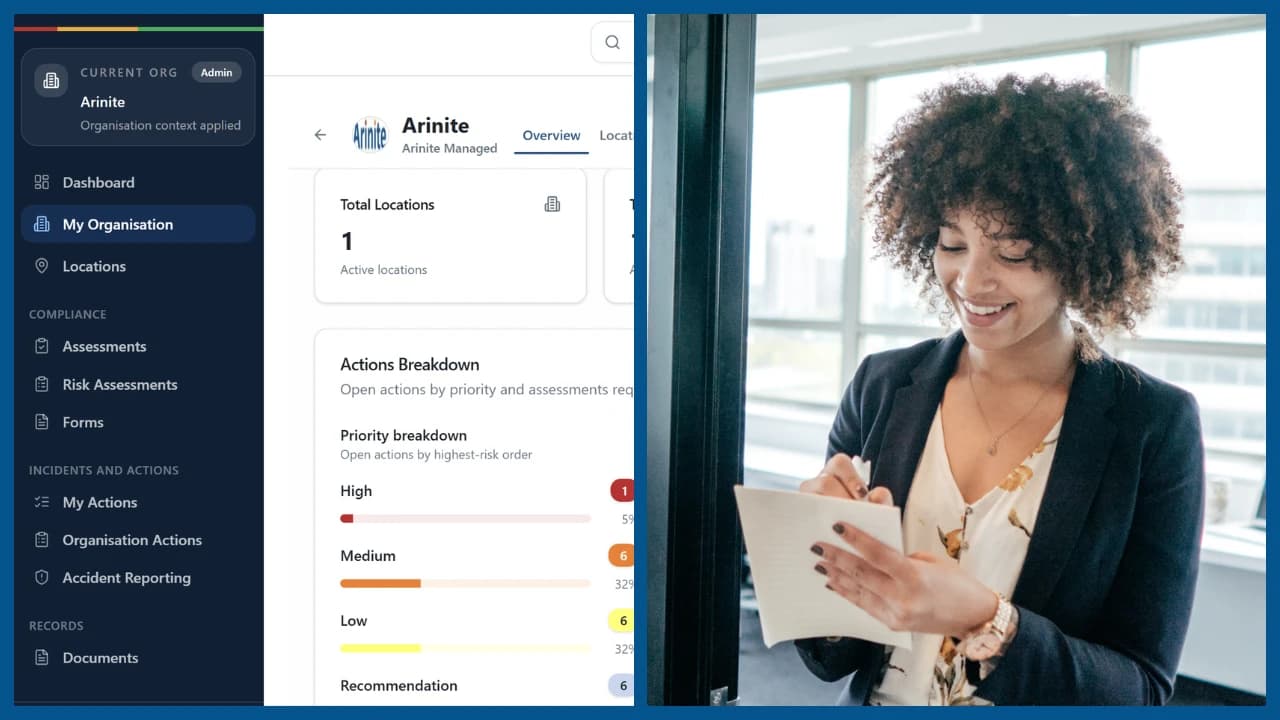
We are not a consultancy that adds external software. We are not a software company that recommends consultants.
We are the place where those two things finally become one.
50+ Countries. Global Safety. Local Trust.
Headquartered in London, UK, with Chartered health and safety consultants in 50+ countries. Whether you need a health and safety audit in Manchester, a fire risk assessment in Birmingham, or outsourced workplace health and safety compliance in Singapore, we have consultants near you.
We're expanding globally

Operations Director, Arinite
I have been in the health and safety business for 35+ years. In that time, I have had one consistent experience across every sector and every country I have worked in.
Every business we speak to already knows, somewhere, that their workplace health and safety compliance has not kept pace with their growth. It is not ignorance. It is busyness. It is the assumption that because nothing has gone wrong yet, the gaps are probably manageable.
What stops most businesses from doing something about it is not the cost of outsourcing health and safety support. It is the fear of finding out how significant the gaps are.
The Free Gap Analysis Call exists for exactly that moment.
You get the full picture of your workplace health and safety position in 30 minutes.
“In 35+ years, I have not once had someone tell us they wished they had stayed in the dark.”
No video testimonials available at the moment.
Join 1,500+ organisations that trust Arinite as their health and safety consultants.
Common questions about HSE inspections, Fee for Intervention, enforcement notices, and investigation support
Our IOSH Chartered health and safety consultants are here to help with any queries about workplace safety, compliance, or our services.
Download our comprehensive library of expert guides, checklists, and templates.
Browse LibraryHave a question or need expert advice? We're here to help.
Fill out the form below and our team will get back to you within 24 hours.
Headquarters
29 Throgmorton St
London EC2N 2AT