Fire Extinguisher Colours: The 5 Bands, What Each Fights, and the One Table That Sorts It
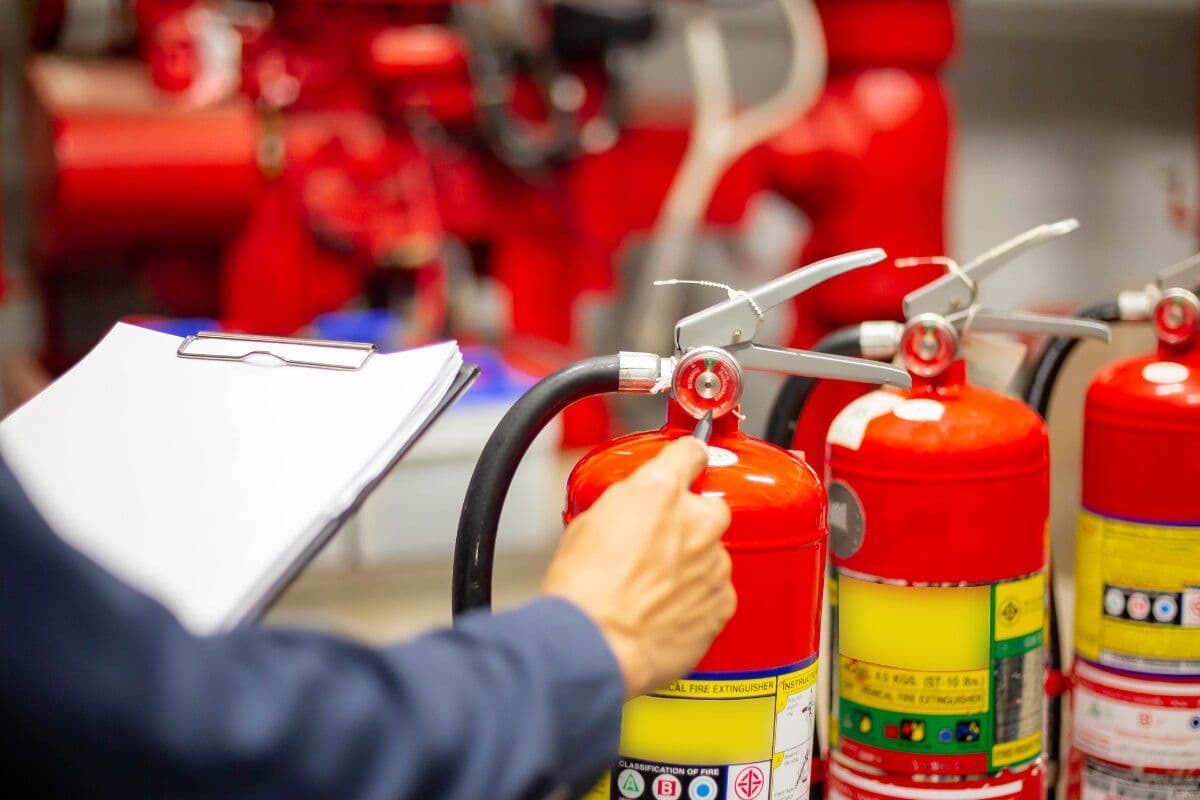
Every fire extinguisher in a UK workplace is red. The information is in the band: a coloured label near the top that tells you, in the seconds when it matters, what is inside and what it can safely fight. Five bands cover the standard types, red for water, cream for foam, black for CO2, blue for dry powder and yellow for wet chemical, and knowing them is not trivia, because the band answers the question that kills people when answered wrongly: can I use this on that fire?
This guide sorts the system properly: the classes of fire first, because the bands only make sense against them, then each band in turn, what it fights, where it must never be used, then the master table, and finally the employer layer, because which extinguishers your premises need is not a shopping decision but an output of your fire risk assessment, and the government's workplace fire safety responsibilities sit behind all of it.
First, the classes of fire
Extinguishers are rated against classes of fire, and the classes are the key that unlocks the colours. Class A is ordinary combustibles: paper, wood, textiles. Class B is flammable liquids: petrol, solvents, paints. Class C is flammable gases. Class D is combustible metals, a specialist industrial concern. Class F is cooking oils and fats, the deep fat fryer class. And electrical fires, sometimes informally called class E, are not formally a class at all, electricity is a cause rather than a fuel, but they impose the rule that matters most: nothing water-based near live electrics.
Hold those in mind and every band below reads instantly.
Red band: water
The oldest and simplest type. Water extinguishers fight class A fires only, the paper, wood and fabric fires of ordinary rooms, by cooling the fuel below ignition. Where you will meet them: offices, corridors, storage areas, anywhere the fuel is ordinary combustibles.
Where they must never be used: flammable liquids, which water spreads rather than smothers, cooking oils, where water causes a violent eruption of burning fat, and anything electrical, where the water stream becomes a conductor back to the person holding it. The red band is the most common and the most misused, which is exactly why it comes first.
Cream band: foam
Need Expert H&S Guidance?
Our qualified consultants can help you implement the right health & safety measures for your business.
Foam extinguishers fight class A and class B fires: the ordinary combustibles plus flammable liquids, which the foam blankets and seals against reignition. Where you will meet them: workplaces holding solvents, paints, fuels and similar liquids alongside ordinary combustibles, which is many workplaces.
Where caution applies: foam is water-based, so live electrical equipment remains off-limits, and foam is not the answer to a fat fryer. The cream band buys versatility across the two commonest classes, which is why it often stands beside the red one.
Black band: CO2
Carbon dioxide extinguishers fight class B fires and, crucially, fires involving live electrical equipment, smothering the fire with an inert gas that leaves no residue and conducts nothing. Where you will meet them: beside server rooms, electrical cupboards, plant rooms and anywhere powered equipment concentrates, which makes the black band the office's second essential.
The cautions are physical: the discharge horn gets intensely cold, grip the handle only; the gas displaces air, so ventilate after use in confined spaces; and CO2 offers little hold on class A fires, where embers can reignite once the gas disperses.
Blue band: dry powder
Dry powder is the multi-tool: effective across class A, B and C fires, the only standard type rated for flammable gases, and usable on electrical fires. Specialist powder variants also exist for class D metal fires. Where you will meet it: vehicles, plant areas, sites handling gases, and mixed-risk environments.
Why it is not simply everywhere: powder deployed indoors fills the space with a choking, vision-killing cloud, contaminates everything it touches, and can make escape harder, which is why guidance steers powder away from enclosed offices and public interiors. The blue band's breadth comes at a cost the confined room pays.
Yellow band: wet chemical
The specialist of the five. Wet chemical extinguishers exist for class F fires, cooking oils and fats, which they fight by reacting with the burning oil to form a sealing, cooling layer, the only agent that reliably ends a deep fat fryer fire. Most also handle class A. Where you will meet them: commercial kitchens, and any premises with catering, from the hotel to the office with a canteen.
The rule the yellow band exists to enforce: no other standard extinguisher, not water, not foam, not CO2, belongs on a fat fryer fire, and a kitchen without wet chemical cover is a kitchen whose fire plan has a hole exactly where its likeliest fire starts.
The master table
| Band | Type | Fights | Never use on |
|---|---|---|---|
| Red | Water | Class A (paper, wood, textiles) | Liquids, cooking oils, anything electrical |
| Cream | Foam | Class A and B (plus liquids) | Live electrics, cooking oils |
| Black | CO2 | Class B and live electrical equipment | Poor on class A embers; care in confined spaces |
| Blue | Dry powder | Class A, B, C and electrical (specialist: D) | Enclosed spaces, unless no alternative |
| Yellow | Wet chemical | Class F (cooking oils), usually class A | Not the tool for gas or electrical fires |
Print-worthy, but with the caveat the next section explains: the table tells you what each band does; it does not tell your premises which bands they need.
The employer layer: what your premises actually need
Which extinguishers, how many, and where they hang is determined by your fire risk assessment, the legally required review of your premises' fuels, ignition sources, people and escape routes, and the government's fire risk assessment guidance for offices and shops shows the shape of that thinking. The assessment is what notices that your office needs red or cream plus black by the server room, that the canteen needs yellow, and that the loading area's gas cylinders change the answer entirely.
Around the choice sit the duties that keep it real: extinguishers sited visibly on escape routes and by specific risks, commissioned and serviced by a competent person on the annual cycle the standards expect, and people trained in the only judgement that outranks every band, when to fight and when to leave. Extinguishers exist for small, early fires on your way out; the training that says "drop it and go" is as much a part of fire safety as the kit on the wall. All of it, the assessment, the servicing records, the training log, is exactly what a health and safety audit checks, and exactly what fails quietly when nobody owns it.
At scale, and across borders
One building's extinguisher estate is a checklist. Fifty buildings' worth, assessed, serviced on cycle, training current, evidence ready, is a system, and it is where consultants and software hold it together: qualified health and safety consultants making the assessment judgements and the platform tracking every unit, service date and training record across the estate. Internationally, the colour conventions and standards vary while the logic holds, matching agent to fuel, which is the kind of local-detail-global-standard problem international health and safety consultants exist for, aligned with frameworks such as ISO 45001.
Where Arinite fits
Arinite has spent 15+ years making sure the right equipment hangs in the right places for the right reasons, with the paperwork to prove it. We support 1,500+ businesses across 50+ countries and have helped protect 100,000+ employees, with a 95% client retention rate. As global health and safety consultants, we take fire safety from the colour bands to the complete system: assessment, provision, servicing and training, across every site you operate.
If the master table made you glance mentally at your own walls, follow the instinct. Our free gap analysis reviews your arrangements, fire safety included, and tells you plainly where you stand. Book your free gap analysis and make sure the band on the wall matches the risk in the room.
Written by
Arinite Health & Safety Consultants
Health & Safety Expert at Arinite