Emergency Lighting: 9 Things the Annual Test Does Not Tell You
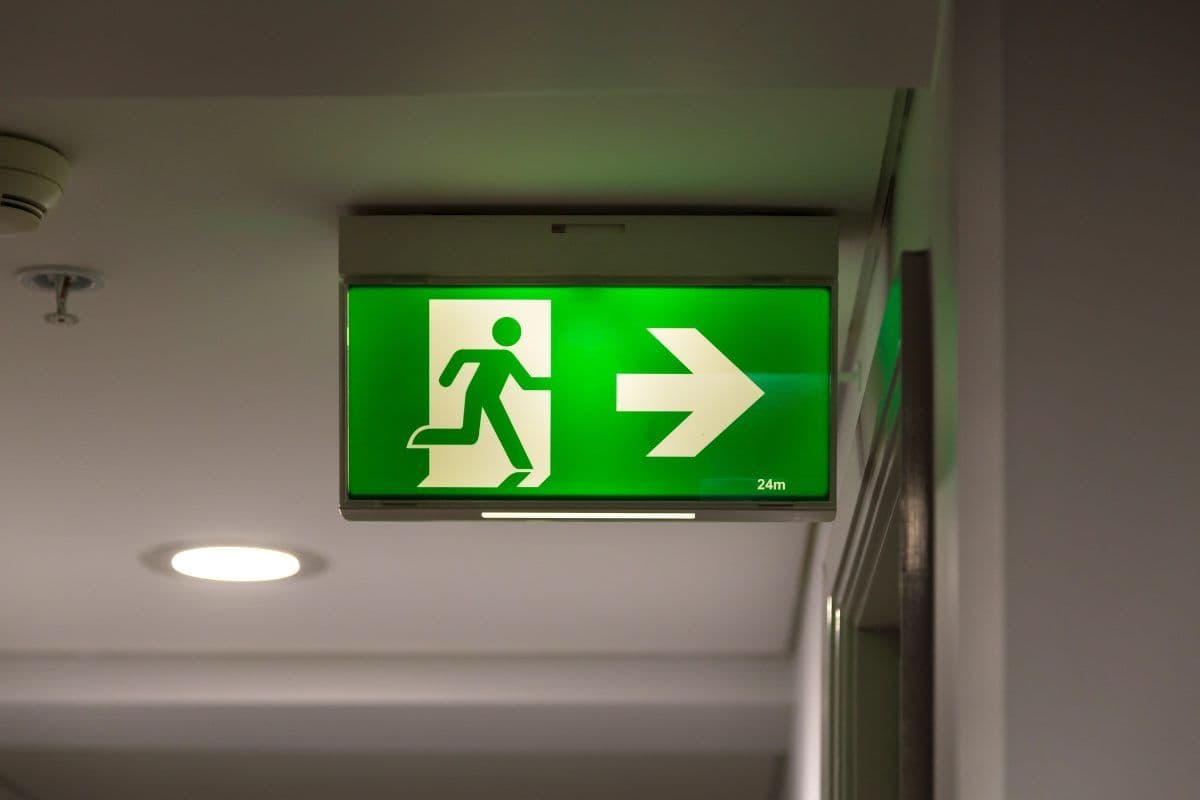
A contractor attends once a month, flicks a key switch, walks the floors and leaves. Once a year they come back, drop the supply for three hours and issue a certificate. Somebody files it. Nobody reads it.
On that basis most organisations believe emergency lighting is handled, and narrowly it is. The test proves the luminaires illuminate when the power fails and the batteries hold their charge for the rated duration.
What it does not prove is that the lighting is in the right places, at the right intensity, for the building you now occupy. Testing verifies the system you have and is silent on the system you need, and the gap widens every time somebody puts up a partition.
Here are nine things a clean certificate does not tell you, and the two duties that decide whether any of it is adequate.
The two duties, and why most guidance cites only one
Supplier pages almost always cite the fire regime alone. There are two.
Under article 14 of the Regulatory Reform (Fire Safety) Order 2005, where necessary to safeguard relevant persons, emergency routes and exits that require illumination must be provided with emergency lighting of adequate intensity in case the normal lighting fails. The same article requires routes to lead as directly as possible to a place of safety, and to be indicated by signs.
Separately, regulation 8 of the Workplace (Health, Safety and Welfare) Regulations 1992 requires suitable and sufficient lighting in every workplace and then adds its own emergency limb: suitable and sufficient emergency lighting must be provided in any room where people at work are specially exposed to danger if the artificial lighting fails.
Those cover different things. Article 14 is about getting out. Regulation 8(3) is about rooms where the failure of light is itself the hazard, which in our sectors means plant rooms, switch rooms, server halls, laboratories, workshops and anywhere a person could be hurt by being suddenly unable to see what they are doing. A system designed purely around escape routes satisfies one duty and not the other.
Article 17 then requires the responsible person to keep the premises and the equipment provided under the Order subject to a suitable system of maintenance, in efficient working order and good repair. That is where the testing regime comes from, and the regime is set out in the British Standard for emergency lighting, BS 5266-1: a short monthly function test, and an annual test for the full rated duration. The FPA and BAFE both set out the practice.
Now the nine.
1. Whether the coverage still matches the layout
The big one, and the reason this article exists.
A test checks the luminaires that are installed. It cannot know that you have since added a partition wall creating an internal corridor with no emergency luminaire, converted a meeting room into a store, moved a tea point, or turned an open floor into a maze of booths. Every one of those changes the escape geometry, and none of them triggers a test failure.
The practical rule is that any change to the internal layout is a change to the emergency lighting design, and a design question cannot be answered by a test. It is answered by looking at the floor with the drawing in hand.
2. Whether the duration is right for your building
Need Expert H&S Guidance?
Our qualified consultants can help you implement the right health & safety measures for your business.
A three-hour test proves three hours of battery. It does not tell you whether three hours is the right figure, or whether one hour would do, or whether somebody specified one hour in a building that needs three.
Duration depends on how the building is used and how long evacuation and any subsequent occupation might take, including whether people may need to remain in or re-enter the building. Premises with sleeping accommodation, which includes a university hall or a hotel-style campus facility, sit in a different place from an office that empties in four minutes. The certificate records what the system did, not what the building requires.
3. Whether the illuminance on the route is actually adequate
A function test is binary. The lamp lights or it does not.
Adequacy is not binary. It is a level of illuminance measured along the centre line of the escape route, in open areas and at higher levels in high-risk task areas, and it degrades over time as lamps age, diffusers yellow and dirt accumulates. A luminaire can pass every monthly test for a decade while delivering materially less light than it did when commissioned.
This is why a periodic design verification, rather than only a function test, is the thing that answers the article 14 question about adequate intensity.
4. Whether the high-risk rooms are covered at all
Back to regulation 8(3). Testing covers the luminaires on the system. If a room where people are specially exposed to danger never had a luminaire, there is nothing to test and no failure to report.
The pattern we find most often is a well-lit escape route and an unlit plant room, comms room or lab prep area, because the original design was drawn against the fire strategy and nobody revisited it against the work being done in those spaces.
5. Whether the route to the place of safety is lit
Article 14 requires routes and exits to lead as directly as possible to a place of safety, which is not the same as to the door.
An assembly point across an unlit car park, down an external stair, or along a path behind the building is part of the escape route in practice. External emergency lighting is frequently absent, and a winter evacuation at six in the evening is the moment that becomes obvious. Our note on fire exits and escape routes covers the wider set of requirements that attach to the route itself.
6. Whether the test left you unprotected
An uncomfortable one, and a genuine finding.
After a full-duration discharge, batteries need to recharge, typically for up to 24 hours. During that window the system cannot deliver its rated duration. If the annual test runs on a Friday afternoon and the building is occupied on Saturday for a deadline, the organisation has spent that period with degraded protection and no record of having thought about it.
The fix is scheduling rather than engineering. Test when the building is least occupied, and know that the recharge period is part of the test.
7. Whether anybody read the certificate
The commonest failure of all, and it is administrative.
A certificate frequently lists defects: three luminaires failed, two did not achieve duration, one is obscured. The document is then filed as evidence of compliance when it is actually a list of open actions. We have seen the same four luminaires recorded as failed on three consecutive annual certificates, which is a worse position than having no certificate, because it evidences knowledge.
Whoever receives the certificate needs to be someone who owns actions, not someone who owns a filing system. Our note on fire safety testing deals with the wider question of who signs these off.
8. Whether the landlord's system covers your demise
For anybody in a multi-let building, this is the question that decides the previous eight.
Article 17 anticipates it. Where premises form part of a building, the responsible person may make arrangements with the occupiers of other premises to meet the maintenance requirement, and those occupiers must cooperate. Where the occupier is not also the owner, the duty to cooperate extends to the owner.
So the law expects an arrangement. What it does not do is presume one exists. The common position is that the landlord tests the common parts and the core, the tenant has installed partitions and luminaires inside its own demise, and nobody has established which system the demise luminaires belong to or who tests them. The answer is usually in the lease, expressed in terms that never mention lighting.
9. Whether the logbook would survive a question
Finally, the record. A suitable system of maintenance implies a record of it, and the useful test is not whether a logbook exists but whether it can answer a specific question: show me the monthly test for March, for this floor, and the actions arising.
An estate of fifteen buildings with monthly and annual tests generates a great deal of recurring evidence, which is where health and safety consultants and software are worth more in combination than either alone. A spreadsheet maintained by whoever last cared about it does not survive a facilities restructure, and emergency lighting is a system whose whole purpose is to work on the one day nobody planned for.
The nine, and what answers each
| What the test misses | What answers it |
|---|---|
| Coverage versus current layout | A design review after any layout change, drawing in hand |
| Whether the duration is correct | A decision recorded against how the building is used |
| Actual illuminance on the route | Periodic design verification, not a function test |
| High-risk rooms with no luminaire | Regulation 8(3) applied to the work, not the fire strategy |
| The unlit route to the assembly point | Walking the full route to the place of safety, after dark |
| Recharge period after the annual test | Scheduling the test when the building is empty |
| Defects nobody actioned | A named owner who closes actions, not files certificates |
| The multi-let boundary | An arrangement under article 17, written down |
| Whether the record answers a question | One register, per building, per floor, with actions |
Rows one and eight account for most of what we find. Both are invisible to testing, and both are cheap to resolve once somebody asks. Periodic health and safety audits should test row seven directly, by taking the last certificate and asking what happened to each defect on it, and a fire risk assessment is where rows one to five properly belong. Emergency lighting also sits alongside the rest of the recurring checks in our note on statutory building checks.
How this travels, and the part that does not
For multi-country groups there is an unusual split here. The technical standard largely harmonises and the verification regime does not.
Across the EEA, the performance requirements for emergency escape lighting sit in a European standard, so the concepts a UK engineer uses, illuminance on the centre line of the route, levels for open areas and higher levels for high-risk task areas, are recognisable to a colleague in Madrid or Warsaw. A group can therefore hold one technical specification.
What does not transfer is who checks it and how often. Several countries attach periodic inspection of defined installations to approved or accredited bodies rather than a contractor of the operator's choosing, and the interval, competence category and certificate format are set locally. Germany treats certain installations as requiring an approved body; France runs periodic verification through approved organisations. So the drawing can be a group document while the certificate must be a local one.
The pattern that works holds across every technical area: one specification and one register, with the local inspection body, interval and signatory category attached per site. A group standard naming a UK test regime and a British Standard, applied unchanged to a Polish or Spanish building, produces a compliant system with the wrong paperwork.
Where Arinite fits
Arinite has spent 15+ years finding the gap between a building's compliance file and its actual condition, and emergency lighting is the clearest example we see, because the file is usually complete and the coverage usually is not. We support 1,500+ businesses in 50+ countries and protect 100,000+ employees, with 95%+ client retention. Our health and safety consultants work extensively with offices, legal, education and property and real estate clients, where the multi-let boundary question is live in most buildings we assess.
For multi-country estates, our global health and safety consultants apply the local inspection regime rather than exporting the British one, and our international health and safety consultants can tell you which buildings need an approved inspection body rather than a contractor.
Do one thing this week. Take your last emergency lighting certificate, find the defects listed on it, and ask what happened to each. Then book a free gap analysis and we will tell you in one call whether your lighting is compliant or merely tested.
Related Articles
Written by
Arinite Health & Safety Consultants
Health & Safety Expert at Arinite