Event Risk Assessment: 15 Decisions from Booking to De-Rig

Your firm runs a client conference for 400 people. Your university holds graduation in a marquee. Your software business puts on a user summit with a stage, a rig and a drinks reception. None of these organisations is in the events business, and in each case the safety thinking starts about three weeks out when somebody asks whether a risk assessment exists.
By then most of the decisions that matter have already been made. The venue is booked, the layout is drawn, the contractors are appointed and the capacity has been announced. An event risk assessment written after those commitments documents a plan rather than shaping one.
So this is organised by the clock rather than by hazard. Fifteen decisions, in the order they arise, from the day you book to the night the rig comes down.
Phase one: before you commit
1. Who is the organiser, in law? Section 3 of the Health and Safety at Work etc. Act 1974 requires an employer to conduct its undertaking so that persons not in its employment are not exposed to risk. Running an event is conducting your undertaking, and attendees are those persons. Settle in writing whether your organisation, the venue or an event agency is the organiser before anything is signed, because all three will later assume it was one of the others.
2. What does the venue's existing documentation already cover? A licensed venue has a premises licence with conditions, a fire risk assessment and an evacuation strategy built around its normal use. Ask for all three at the enquiry stage. What they cover is work you do not need to repeat; what they do not cover is your scope, and the gap is usually anything that changes the layout.
3. What capacity are you actually allowed? Capacity is set by the licence and by the escape route provision, not by how many chairs fit. The Licensing Act 2003 regime governs licensable activities, and announcing a number before you have confirmed it against the licence is the commonest way an event ends up oversubscribed and under-provisioned.
4. Does the event engage the new terrorism legislation? The Terrorism (Protection of Premises) Act 2025 creates public protection requirements for qualifying premises and qualifying events, with persons responsible identified and a compliance regime behind it. Establish early whether your event qualifies and who the responsible person is, because the answer shapes security, screening and the plan rather than being bolted on later.
Phase two: planning the event
5. Does the layout invalidate the venue's fire strategy? This is the single most common failure. Article 9 of the Regulatory Reform (Fire Safety) Order 2005 requires a fire risk assessment, and article 14 governs emergency routes and exits. A stage across a fire exit, a sponsor stand in a corridor, cabling across an escape route or seating in rows where the venue assessed standing all change the assessment the venue gave you. Produce an event-specific assessment that references theirs rather than replacing it.
6. How will people move, and where will they queue? Entry, registration, breaks, lunch and egress all create pinch points, and the hazard is the crowd rather than the venue. A single registration desk for 400 arrivals in twenty minutes produces a queue that blocks something. The HSE's event safety material and the industry's Purple Guide are the right references for crowd planning at scale.
7. Who is doing the build, and under whose control? Rigging, staging, lighting, AV, marquees and exhibition stands are contractor activities carried out in your venue on your behalf. Regulation 3 of the Management of Health and Safety at Work Regulations 1999 requires a suitable and sufficient assessment, and for the build phase that means seeing the contractors' method statements rather than collecting their insurance certificates.
8. What is the temporary power arrangement? Generators, distribution boards, cable runs and anything suspended above people. Temporary electrical installations for events have their own inspection expectations, and the person who signs them off should be named before the build rather than found during it.
9. What are the catering and allergen arrangements? If food is served, allergen information duties apply, and the Food Standards Agency's allergen guidance sets out what caterers must provide. Where alcohol is served by your organisation, you have also created a foreseeable risk that belongs in the assessment rather than in the social committee's notes.
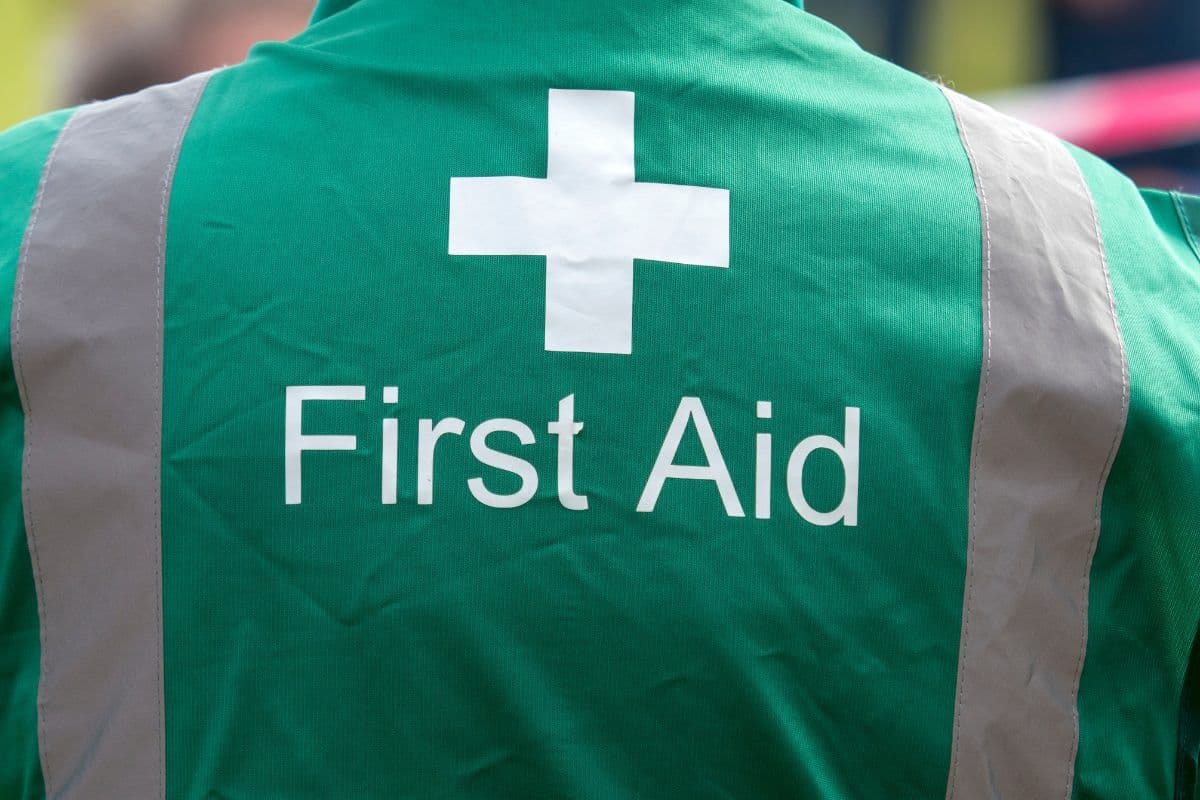
10. What medical and first aid provision does the event need? Not the office complement. Event provision scales with attendance, duration, demographic, alcohol and distance from emergency services, and for a large or outdoor event it usually means a contracted medical provider rather than a volunteer first aider.
11. How will disabled attendees evacuate? Personal emergency evacuation planning does not stop at employees. If someone needs assistance to leave a building, the plan has to exist before they arrive, which means asking at registration and resourcing the answer. Refuge points, evacuation lifts and trained assistance all need to be in the plan rather than improvised.
12. What happens if the weather turns? For anything outdoors or in a temporary structure, wind loading, lightning and heat are the governing risks, and a marquee has a published wind rating that somebody has to monitor. Set the trigger points and the person who owns the decision in advance.
Phase three: on the day and after
Need Expert H&S Guidance?
Our qualified consultants can help you implement the right health & safety measures for your business.
13. Who can stop the event, and how is that communicated? The most important sentence in any event plan. One named role, with authority to halt proceedings, contactable throughout, with a defined way of reaching stewards, the venue and the medical provider. Events that go wrong usually had someone who noticed and nobody who could act.
14. How are incidents recorded and reported? Your reporting route is built for employees and this event is mostly attendees. Decide before the doors open who records an incident, where it goes, which incidents are legally reportable and who notifies insurers. A delegate injury discovered through an insurance claim three weeks later is a bad start to a defence.
15. Who supervises the de-rig? The forgotten phase and statistically the riskiest. The audience has gone, the crew are tired, it is late, the lighting is reduced, work is at height and the client is no longer present. Most event injuries happen during build and breakdown rather than during the event, and de-rig is where supervision is thinnest. Name a supervisor for it specifically.
The timeline on one page
| Phase | Decision | What goes wrong |
|---|---|---|
| Before committing | Organiser identified in writing | Venue, agency and client each assume another |
| Before committing | Venue licence, FRA and strategy obtained | Requested three weeks out |
| Before committing | Capacity confirmed against the licence | Number announced before it is checked |
| Before committing | Terrorism legislation position established | Treated as a security add-on |
| Planning | Event-specific fire assessment | Stage or stand blocks an exit |
| Planning | Crowd flow and queuing | One desk, 400 arrivals, twenty minutes |
| Planning | Build contractors and method statements | Insurance certificates collected instead |
| Planning | Temporary power signed off | Nobody named until the build |
| Planning | Catering and allergens | Left with the caterer entirely |
| Planning | Medical provision scaled to the event | Office first aider assumed sufficient |
| Planning | Evacuation of disabled attendees | Nobody asked at registration |
| Planning | Weather triggers and decision owner | No wind limit, no decision maker |
| On the day | Named authority to stop | Someone notices, nobody can act |
| On the day | Incident recording and insurer notification | Found out via a claim |
| After | De-rig supervision | Thinnest supervision, highest risk |
Score your last event against the fifteen. Most organisations manage the planning rows and miss the four at either end, which is where both the legal exposure and the actual injuries sit.
Running events in more than one country
Groups that hold the same conference in London, Frankfurt and Singapore cannot run one event safety plan, because assembly and public-event rules are among the most locally prescribed in occupational safety.
In Germany, venues used for public assembly fall under state assembly places ordinances, which prescribe capacities, exit provision and, above certain sizes, the appointment of named technical and safety roles for the event itself. That is a personnel requirement rather than a documentation one, and it has no UK equivalent. France distinguishes buildings receiving the public with categories that drive periodic verification and staffing. Across the EEA the general duties sit on the EU Framework Directive 89/391/EEC, but event-specific rules come from national and local instruments, and in many jurisdictions from the municipality.
The workable pattern is one methodology with a local annex per city: the same fifteen decisions, answered against local requirements, with the local permit, capacity and appointed-role position recorded. Holding that in one place rather than in each organiser's inbox is where health and safety consultants and software are worth more in combination than either alone, particularly for an organisation running twenty events a year across eight countries. Periodic health and safety audits should sample completed events rather than only reviewing the template, because the template is rarely the problem.
Where Arinite fits
Arinite has spent 15+ years supporting organisations that run significant events without being event companies. We support 1,500+ businesses in 50+ countries and protect 100,000+ employees, with 95%+ client retention. Our health and safety consultants work extensively with education, legal, insurance and hospitality clients, so we see both sides of the venue and organiser split.
For international programmes, our global health and safety consultants establish the local permit and appointed-role requirements before a city is booked, and our international health and safety consultants can tell you which of your planned venues carries obligations your UK template does not cover. Where the event is in your own building, it sits on top of your existing fire safety arrangements rather than beside them.
Take the fifteen rows to your next event and find the four nobody owns. Then book a free gap analysis and we will tell you in one call where your plan stops.
Related Articles
Written by
Arinite Health & Safety Consultants
Health & Safety Expert at Arinite