HSE inspections up 47% - HSE carried out over 13,200 workplace inspections in 2024/25.
Hospitality sits at the intersection of multiple compliance regimes: workplace health and safety under HSWA 1974 and MHSWR 1999, food safety under the Food Safety Act 1990 and Food Hygiene Regulations 2006, fire safety under the RRO 2005, and customer-facing duty under the Worker Protection Act 2023. Kitchens carry higher physical risk than most office sectors: burns, scalds, knife injuries, slips, manual handling, and elevated COSHH exposure to cleaning chemicals. Arinite delivers the full hospitality compliance stack through Qualified consultants and integrated compliance software, working alongside your food safety advisor.
Hospitality and catering covers restaurants, cafes, pubs, bars, contract caterers, dark kitchens, hotel F&B operations, event catering, and quick-service restaurants. The compliance profile is shared across all of them: a kitchen with hot work, knives, slips, and chemicals; a customer area with fire safety and public access; back-of-house with manual handling and delivery operations; and a workforce often including young workers, agency staff, and shift workers.
Local Authority Environmental Health Officers are the primary inspectors, enforcing both food safety and workplace health and safety. The Local Authority can issue Improvement Notices, Prohibition Notices, and prosecutions in exactly the same way as HSE.
Arinite provides Qualified consultants and compliance software to hospitality operators across the UK and 50+ countries.
A single risk assessment covers the venue but does not address kitchen activities task-by-task. The most common gap across the sector.
Particularly when cooking method, oil volumes, or kitchen layout changes.
Deliveries, kegs, stock movement, and dish-out handling carried out without TILE assessment.
Wet floor signs deployed after spills but no proactive programme around drainage, floor surface, and footwear.
Customer-facing aggression in bars, late-night venues, and quick-service restaurants treated as a security issue, not a statutory psychosocial risk.
Under-18 staff working in kitchens, bars, and front of house without specific risk assessment under MHSWR Regulation 19.
Food safety advisor maintains HACCP; no integration with the wider workplace health and safety management system.
Burns, scalds, and minor cuts not recorded as standard, leaving the business unable to spot patterns or comply with RIDDOR.
The kitchen is the highest-density risk environment in hospitality. A compliant kitchen risk assessment addresses each activity discretely:
Open flames, fryers, ovens, grills, salamanders. Burn and scald risk, gas safety, fire risk.
Preparation, butchery, service. Cut injuries, glove use, training.
Wet floors, oil contamination, food spills, drainage, footwear.
Deliveries, stock movement, pot and pan handling, waste management.
Caustic and acidic cleaners, oven cleaners, sanitisers. Storage, dispensing, PPE.
Mixers, slicers, meat grinders, dough machines. PUWER assessment, guarding, training.
Cold injury, manual handling in cold environments, gas leaks.
Filtration, transport, disposal, fire risk.
Machine-specific PUWER assessments for slicers, mixers, and grinders. COSHH inventory for cleaning chemicals. Hot work and gas safety assessment. Manual handling task assessments. Knife safety procedure. Slip and trip inspection log. Burn and scald first aid arrangements.
Hospitality fire risk is elevated by the combination of public access, cooking activities, electrical loads, and the presence of fuel (linen, paper, alcohol, cooking oils, packaging). The Regulatory Reform (Fire Safety) Order 2005 requires a documented fire risk assessment for every non-domestic premises. See our fire risk assessment service.
Public access and evacuation of customers including those who are intoxicated, mobility-impaired, or unfamiliar with the premises.
Kitchen fire suppression systems (ANSUL, Amerex, or equivalent), their inspection schedule, and integration with the fire alarm.
Extraction canopy cleaning schedule and grease accumulation.
Gas safety: commercial gas certification, ventilation, isolation.
Cellar and back-of-house fire risk including alcohol storage.
Late-night operation considerations: drunk patrons, locked-in fire exits, lone closing staff.
Outdoor area fire risk: heaters, smoking areas, marquees.
The Fire Safety Order requires review whenever there is reason to suspect the assessment is no longer valid. For hospitality, that includes refits, menu changes affecting cooking method, occupancy capacity changes, and following any fire or near-miss incident.
Food safety and workplace health and safety are legally distinct regimes but operationally overlap. The Food Safety Act 1990 and the Food Hygiene Regulations 2006 require a HACCP-based food safety management system. The HSWA 1974 and MHSWR 1999 require workplace risk assessment. Each is enforced by Local Authority Environmental Health Officers.
Arinite does not deliver HACCP food safety advisory directly. We work alongside your food safety advisor (whether in-house or external) and ensure that:
The two systems use compatible documentation and avoid contradictory instructions to staff.
Cleaning chemicals appear correctly in both the HACCP system and the COSHH inventory.
Workplace risk assessment for the kitchen integrates with the HACCP procedures.
Training records cover both food safety and workplace health and safety.
Incident reporting captures both food safety incidents (allergens, contamination) and workplace incidents (burns, cuts, slips).
Documented MHSWR Regulation 3 risk assessment covering kitchen, front of house, back of house, and cellar activities.
Documented fire risk assessment under the RRO 2005, reviewed on change.
HACCP food safety management system under the Food Hygiene Regulations 2006 (delivered through your food safety advisor).
Documented manual handling assessment under the Manual Handling Operations Regulations 1992.
COSHH inventory and assessment for cleaning chemicals and other hazardous substances.
PUWER assessments for kitchen machinery.
Violence at work risk assessment for customer-facing roles.
Worker Protection Act 2023 reasonable steps documentation.
Specific risk assessment for young workers and new and expectant mothers.
Competent person under MHSWR Regulation 7.
Written health and safety policy.
RIDDOR reporting arrangements.
General duties; Section 37 director liability.
Risk assessment, competent person, training, young workers, new and expectant mothers.
Fire risk assessment.
HACCP food safety.
Temperature, ventilation, lighting, space, sanitation.
Manual handling assessment and controls.
Cleaning chemicals.
Kitchen machinery.
Commercial gas.
Sexual harassment prevention including by third parties.
Mandatory reporting of specified workplace injuries, diseases, and dangerous occurrences.
Intersects with workplace safety in licensed premises.
Site-specific risk assessment covering kitchen, front of house, back of house, cellar, and outdoor areas.
Activity-by-activity assessment of hot work, knives, slips, manual handling, machinery, and chemicals.
PAS 79:2020 fire risk assessments for hospitality premises.
Task-specific assessments and training for goods-in, kitchen, and service activities.
Inventory and assessment of cleaning chemicals and other hazardous substances.
Machine-by-machine assessments for slicers, mixers, grinders, fryers, and other kitchen machinery.
Risk assessment and training for late-night, customer-facing, and lone working roles.
Centralised documentation across estates of restaurants, pubs, or hotels.
See our health and safety policy, health and safety audit, and competent person services.
Centralised platform configured for multi-site hospitality operations.
For all kitchen staff joining the operation.
For goods-in, kitchen, and service activities.
For all staff using cleaning chemicals.
And fire warden training.
Including burn and scald management.
For customer-facing and late-night roles.
Including customer-on-staff scenarios.
For managers supervising under-18s.
For kitchen and butchery staff.
See our health and safety training service.
The following is an illustrative example of how Arinite engagement typically runs for a hospitality operator.
A growing restaurant group with 12 sites across London and the South East and 380 employees approaches Arinite after a kitchen fire at one of their venues caused significant damage but no injuries. The insurer flagged compliance documentation as a renewal condition. The group operates with a head-office H&S manager but no Qualified competent person and inconsistent site-level documentation.
In month one, we deliver: a refreshed health and safety policy signed by the operations director, a current MHSWR Regulation 3 risk assessment covering kitchen, front-of-house, head office, and delivery activities, a competent person appointment, and a centralised compliance programme architecture through Arinite's software platform.
In month two: we deliver site-specific kitchen risk assessments and PAS 79:2020 fire risk assessments for all 12 sites with specific attention to kitchen fire suppression systems and Ansul system inspection records, food safety integration with HACCP, manual handling and slips assessments for each site, and Worker Protection Act 2023 reasonable steps covering customer-on-staff harassment.
In month three: we deliver fire warden training for each site, kitchen safety training for chefs and kitchen porters, mental health awareness for general managers, and hand over to ongoing competent person retainer with rolling site inspection programme.
The insurer accepts the documentation set. The competent person retainer continues with monthly site inspections.
Five practical reasons hospitality operators appoint Arinite as their outsourced competent person:
Documented kitchen risk assessment, fire suppression coordination, manual handling, and food safety integration.
Centralised compliance for restaurant and hospitality groups through Arinite's software platform.
The integrated documentation pack satisfies typical commercial insurance renewal compliance reviews.
Specifically configured for customer-on-staff harassment in venue-based environments.
MHSWR Regulation 7 requires competent advice.
If you operate adjacent to hospitality, you may also find these sector pages relevant:
Book a free gap analysis call with one of our Qualified health and safety consultants to assess your current arrangements, identify the compliance gaps that matter most for your operation, and get a clear recommendation and indicative cost.
From Reactive Firefighting to Proactive Health & Safety Compliance
No formal HSE systems in place. Everything is reactive, waiting for something to go wrong. Documentation is missing or outdated.
This isn't just "non-compliant." It's criminally negligent. Directors face personal prosecution.
Basic HSE documentation is in place. Minimum legal requirements met. You can pass a basic audit.
Compliance is where most consultants get you, then leave. You're legal, but you're not optimised.
Systems run proactively, preventing problems before they occur. Compliance is distributed, not dependent on one person.
That's why 95%+ of clients renew year after year.

Robert Winsloe
Managing Director, Arinite
“We work with you to deliver peace of mind. We tailor our service provision to your business to provide proactive, pragmatic health and safety advice and that helps reduce costs by ensuring compliance with relevant health and safety legislation.”
Other Consultants
Get you to Stage 2 (Compliant) and disappear.
Arinite
Gets you to Stage 3 (Proactive) and keeps you there.
That's why we call it transformation, not just compliance.
Compliance
Traditional consultancies audit, report and leave. You get a document and the job of implementing it.
Control
Software companies give you dashboards and workflows without the knowledge to use them.
Coverage
Global businesses need consultants who know compliance in every jurisdiction.
Arinite
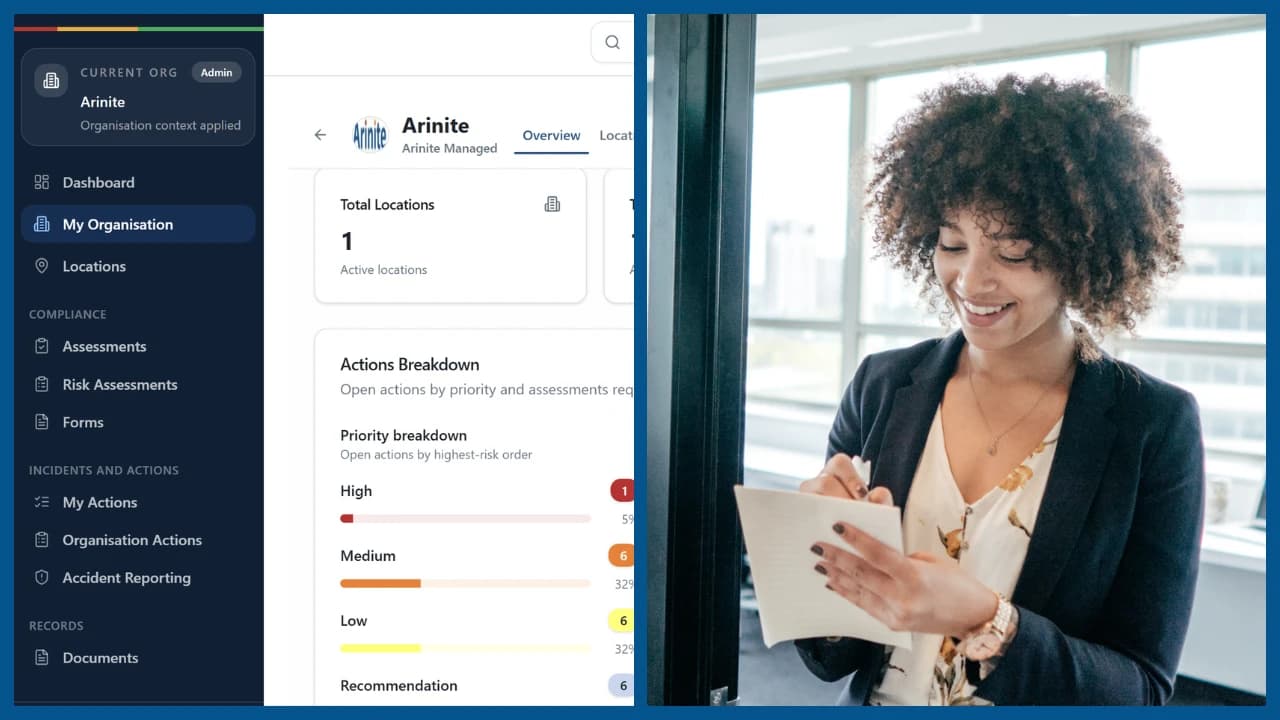
We are not a consultancy that adds external software. We are not a software company that recommends consultants.
We are the place where those two things finally become one.
50+ Countries. Global Safety. Local Trust.
Headquartered in London, UK, with Qualified health and safety consultants in 50+ countries. Whether you need a health and safety audit in Manchester, a fire risk assessment in Birmingham, or outsourced workplace health and safety compliance in Singapore, we have consultants near you.
We're expanding globally

Operations Director, Arinite
I have been in the health and safety business for 35+ years. In that time, I have had one consistent experience across every sector and every country I have worked in.
Every business we speak to already knows, somewhere, that their workplace health and safety compliance has not kept pace with their growth. It is not ignorance. It is business. It is the assumption that because nothing has gone wrong yet, the gaps are probably manageable.
What stops most businesses from doing something about it is not the cost of outsourcing health and safety support. It is the fear of finding out how significant the gaps are.
The Free Gap Analysis Call exists for exactly that moment.
You get the full picture of your workplace health and safety position in 30 minutes.
“In 35+ years, I have not once had someone tell us they wished they had stayed in the dark.”
No video testimonials available at the moment.
Join 1,500+ organisations that trust Arinite as their health and safety consultants.
Common questions about kitchen risk, fire safety, HACCP integration, violence at work, young workers, and Worker Protection Act 2023 duties
Our Qualified health and safety consultants are here to help with any queries about workplace safety, compliance, or our services.
Download our comprehensive library of expert guides, checklists, and templates.
Browse LibraryHave a question or need expert advice? We're here to help.
Fill out the form below and our team will get back to you within 24 hours.
Headquarters
29 Throgmorton St
London EC2N 2AT