HSE inspections up 47% - HSE carried out over 13,200 workplace inspections in 2024/25.
Insurance is the one sector where workplace H&S failure carries an additional layer of reputational risk: the firm sells confidence in risk management. Underwriters, brokers, claims handlers, loss adjusters, surveyors, and MGAs all carry the same statutory duties under HSWA 1974, MHSWR 1999, DSE Regulations 1992, and the RRO 2005 as any other employer. Three sector-specific layers separate insurance from a generic office sector: loss adjusters, surveyors, and field claims handlers attend client and site visits with documented elevated risk, the Lloyd's market and London market trading floors carry trading-floor DSE risk, and the FCA's increasing focus on culture, conduct, and non-financial misconduct creates regulatory weight on workplace H&S documentation. Arinite delivers the full insurance compliance stack.
The insurance sector encompasses Lloyd's market underwriters, syndicates, and managing agents, MGAs, retail and wholesale brokers, run-off and legacy specialists, claims handling firms, loss adjusters and surveyors, reinsurance brokers, parametric and insurtech operators, and the in-house insurance functions of larger employers. The compliance profile is predominantly office-based but spans several distinct working patterns: London market trading floors, branch-based broker offices, hybrid claims handling, field-based loss adjusting and surveying, and global delegated authority arrangements.
Each pattern carries its own risk assessment scope, and the field-based pattern in particular is routinely under-managed.
Arinite provides Qualified consultants and compliance software to insurance firms across the UK and 50+ countries.
These are the insurance sector health and safety failures Arinite's Qualified consultants find most frequently.
Risk assessment covers the office but not field activities, lone working at site visits, or driving at work. The single most common gap in field-active insurance firms.
Particularly common in London market trading, catastrophe response, and claims-surge environments where the demand profile is documented as significantly elevated.
Pre-pandemic DSE programme not updated.
Loss adjusters and surveyors driving extensively on company business without documented driving-at-work risk assessment or grey fleet arrangements.
Harassment policy exists but no specific Worker Protection Act risk assessment, no documented reasonable steps, no third-party harassment provisions for clients, brokers, and counterparties.
Many insurance firms are tenants in multi-tenant City buildings. Risk assessment covers demised premises but not common areas, fire alarm coordination, or evacuation of vulnerable visitors.
Incidents not recorded because they are seen as "not relevant" to an insurance firm, leaving the business unable to comply with RIDDOR or demonstrate proactive management.
Workplace H&S documentation not joined up with the FCA conduct, culture, and non-financial misconduct framework.
Loss adjusters, surveyors, and field claims handlers attend client premises and incident sites as part of their normal work. Each visit carries its own compliance footprint and the cumulative exposure can be material.
Loss adjuster and surveyor visits include some of the highest-risk environments encountered by any insurance employee:
Structural instability, asbestos disturbance, residual hot spots, contaminated debris.
Electrical hazards, biological contamination, structural concerns.
Manufacturing risks, working at height, confined space hazards.
Permit-to-work requirements, principal contractor coordination, PPE.
Lone working in private homes, sometimes with distressed claimants.
Police coordination, restricted access.
A compliant field worker risk assessment for loss adjusters and surveyors covers:
Including review of the site type, any known hazards, and the claimant context.
Including check-in and check-out protocols.
Alarm-fitted apps and dedicated lone worker devices for higher-risk visits.
Including hard hats, hi-vis, steel toe-cap footwear, RPE for fire-damaged sites, and gloves for contaminated environments.
Given the high probability of disturbing asbestos at older fire and flood damaged premises.
Including de-escalation for visits involving distressed claimants.
For remote and adverse weather visits.
For higher-risk visits with occupational health support where required.
Where loss adjusters or surveyors attend sites where work activity is in progress, they may need to engage with the host's permit-to-work system before entering specific work areas. The insurance employer remains primarily responsible for the safety of its employees regardless of the host's site rules.
Underwriting, broking, and claims handling are intensive screen work. London market trading floors carry sector-specific DSE risk similar to investment banking trading floors.
Common in London market underwriting and structuring roles.
Specific physical workspace at the boxes carries its own ergonomic considerations.
High-volume desk work with prolonged sedentary periods.
Loss adjusters and surveyors using laptops, tablets, and mobile devices on the road and at site visits.
Asset management, compliance, operations, and broking staff working hybrid or remote.
Sector-specific DSE assessment template for trading and front-office environments.
Standard DSE assessment for office and back-office roles.
Mobile DSE assessment for field workers covering laptop ergonomics, vehicle-based working, and short-period site working.
Home assessment for hybrid workers.
Software-managed renewal cycles.
Loss adjusters, surveyors, and field claims handlers driving on company business are in scope under the employer's general duty of care under HSWA 1974. HSE guidance on managing work-related road risk applies. This is the single most commonly under-managed risk for insurance firms with field staff.
A compliant driving-at-work programme for insurance field staff covers:
Licence checks, endorsement reviews, eyesight standards, and driver assessment for high-mileage drivers.
Whether company fleet, leased, or grey fleet (employee's own vehicle used for company business).
Including MOT verification, insurance verification (specifically that the policy covers business use), and vehicle condition.
Route assessment, weather contingency, fatigue management for long journeys, overnight stops where appropriate.
Specifically prohibiting handheld use while driving.
Working hours including driving time, break protocols, and refusal-to-drive arrangements.
What to do in the event of any vehicle incident on company business.
That business use is covered.
The grey fleet is the most commonly under-managed element. Employees using their own vehicles for company business must:
Hold valid licence, MOT, insurance with business use cover, and roadworthy vehicle.
Be subject to the same driving-at-work risk assessment as company fleet drivers.
Have documented evidence of the above on file with the employer.
Stress, burnout, and elevated psychosocial demand are documented across insurance, particularly in London market trading, catastrophe response, claims surge events, and demanding production environments. Under MHSWR Regulation 3, psychosocial factors are a statutory risk assessment category. The HSE Management Standards and ISO 45003:2021 set the framework.
The FCA has signalled regulatory interest in psychological safety, culture, and non-financial misconduct as part of broader conduct expectations, with workplace H&S documentation directly relevant to the firm's regulatory positioning.
Every insurance employer must:
Conduct a documented risk assessment under MHSWR Regulation 3 covering office, hybrid, home, and field activities.
Conduct DSE assessments for every habitual screen user including trading floor, office, mobile, and home workers.
Operate a documented field worker risk assessment for loss adjusters, surveyors, and field claims handlers.
Operate a documented driving-at-work programme for any employee driving on company business, including grey fleet.
Operate a documented lone working programme for field staff.
Maintain a documented psychosocial risk assessment.
Document Worker Protection Act 2023 reasonable steps including client and counterparty harassment.
Maintain a documented fire risk assessment for each premises.
Appoint one or more competent persons under MHSWR Regulation 7.
Maintain a written health and safety policy.
Report specified injuries, diseases, and dangerous occurrences under RIDDOR.
Maintain reasonable adjustments processes under the Equality Act 2010.
General duties; Section 37 director liability.
Risk assessment, competent person, training, and worker information for every employer.
DSE assessment for every habitual screen user including trading floor, office, mobile, and home workers.
Documented fire risk assessment for every non-domestic premises.
Minimum standards for temperature, ventilation, lighting, space, sanitation, and welfare facilities.
Loss adjuster site visits, particularly to older fire and flood damaged premises.
Preventative duty on sexual harassment in force from 26 October 2024, including third-party harassment from clients, brokers, and counterparties.
Reasonable adjustments duty for workers with disabilities, including mental health conditions.
Mandatory reporting of specified workplace injuries, diseases, and dangerous occurrences to HSE.
Insofar as they engage with culture and conduct, with workplace H&S documentation relevant to the firm’s regulatory positioning.
Office, hybrid, home, and field activity risk assessment.
For loss adjusters, surveyors, and field claims handlers.
For company fleet and grey fleet drivers.
Including lone worker safety device deployment for field staff.
For trading floor, office, mobile, and home staff.
HSE Management Standards-aligned psychosocial risk assessment.
Risk assessment, policy, training, and documented reasonable steps.
For loss adjusters and surveyors attending older damaged premises.
PAS 79:2020 fire risk assessments for offices.
External Qualified competent person on a retainer basis, with policy and audit support.
Centralised platform for risk assessments, DSE, training, incidents, and audits across the firm.
For all employees, covering posture, workstation setup, breaks, eyesight tests, and reporting discomfort.
On Section 37 duties, MHSWR Regulation 7 competent person, and director-level H&S responsibilities.
For all employees with deeper line manager training.
On harassment prevention and bystander intervention.
For field staff including grey fleet drivers.
For loss adjusters, surveyors, and field claims handlers.
For loss adjusters and surveyors attending older damaged premises under the Control of Asbestos Regulations 2012.
Fire safety induction, fire warden, and first aid at work training.
For staff visiting distressed claimants.
The following is an illustrative example of how Arinite engagement typically runs for an insurance firm.
A specialist loss adjusting firm with 90 employees, head office in London, and a UK-wide field force approaches Arinite after a near-miss at a fire-damaged industrial site. The field worker reported structural concerns mid-visit and withdrew. The firm has a basic H&S policy but no field worker risk assessment, no driving-at-work documentation, and no lone working programme.
Arinite's free gap analysis call identifies the priority gaps. We agree a 90-day remediation programme. In month one, we deliver: a refreshed health and safety policy signed by the managing director, a current MHSWR Regulation 3 risk assessment covering office, hybrid, home, and field activities, a competent person appointment, and DSE self-declarations to all 90 employees including a mobile DSE assessment for field staff.
In month two: we deliver a fire risk assessment for the London office, a driving-at-work risk assessment including grey fleet provisions, a lone working programme with deployment of lone worker safety devices for field staff, and asbestos awareness training for all loss adjusters given the high probability of asbestos exposure at older fire and flood damaged premises.
In month three: we deliver psychosocial risk assessment, document Worker Protection Act 2023 reasonable steps, train field managers on supporting field staff after higher-risk visits, and hand over to ongoing competent person retainer with quarterly reviews.
The firm now operates a field worker safety programme that satisfies HSWA 1974 Sections 2 and 3 for its loss adjusters and surveyors. The competent person retainer continues.
Five practical reasons insurance firms appoint Arinite as their outsourced competent person:
We cover the loss adjuster and surveyor risk profile specifically, including site visit risk, lone working, driving at work, and asbestos awareness.
Our workplace H&S evidence base integrates with FCA culture, conduct, and non-financial misconduct expectations.
Sector-specific DSE assessment for box trading and underwriting environments.
For international and Lloyd's market firms operating globally, Arinite coordinates UK employer duty with local law across 50+ countries.
MHSWR Regulation 7 requires competent advice.
If you operate adjacent to insurance, you may also find these sector pages relevant:
Book a free gap analysis call with one of our Qualified health and safety consultants. In 30 minutes, we will assess your current arrangements, identify the compliance gaps that matter most including field worker and driving-at-work risk, and give you a clear recommendation and indicative cost.
From Reactive Firefighting to Proactive Health & Safety Compliance
No formal HSE systems in place. Everything is reactive, waiting for something to go wrong. Documentation is missing or outdated.
This isn't just "non-compliant." It's criminally negligent. Directors face personal prosecution.
Basic HSE documentation is in place. Minimum legal requirements met. You can pass a basic audit.
Compliance is where most consultants get you, then leave. You're legal, but you're not optimised.
Systems run proactively, preventing problems before they occur. Compliance is distributed, not dependent on one person.
That's why 95%+ of clients renew year after year.

Robert Winsloe
Managing Director, Arinite
“We work with you to deliver peace of mind. We tailor our service provision to your business to provide proactive, pragmatic health and safety advice and that helps reduce costs by ensuring compliance with relevant health and safety legislation.”
Other Consultants
Get you to Stage 2 (Compliant) and disappear.
Arinite
Gets you to Stage 3 (Proactive) and keeps you there.
That's why we call it transformation, not just compliance.
Compliance
Traditional consultancies audit, report and leave. You get a document and the job of implementing it.
Control
Software companies give you dashboards and workflows without the knowledge to use them.
Coverage
Global businesses need consultants who know compliance in every jurisdiction.
Arinite
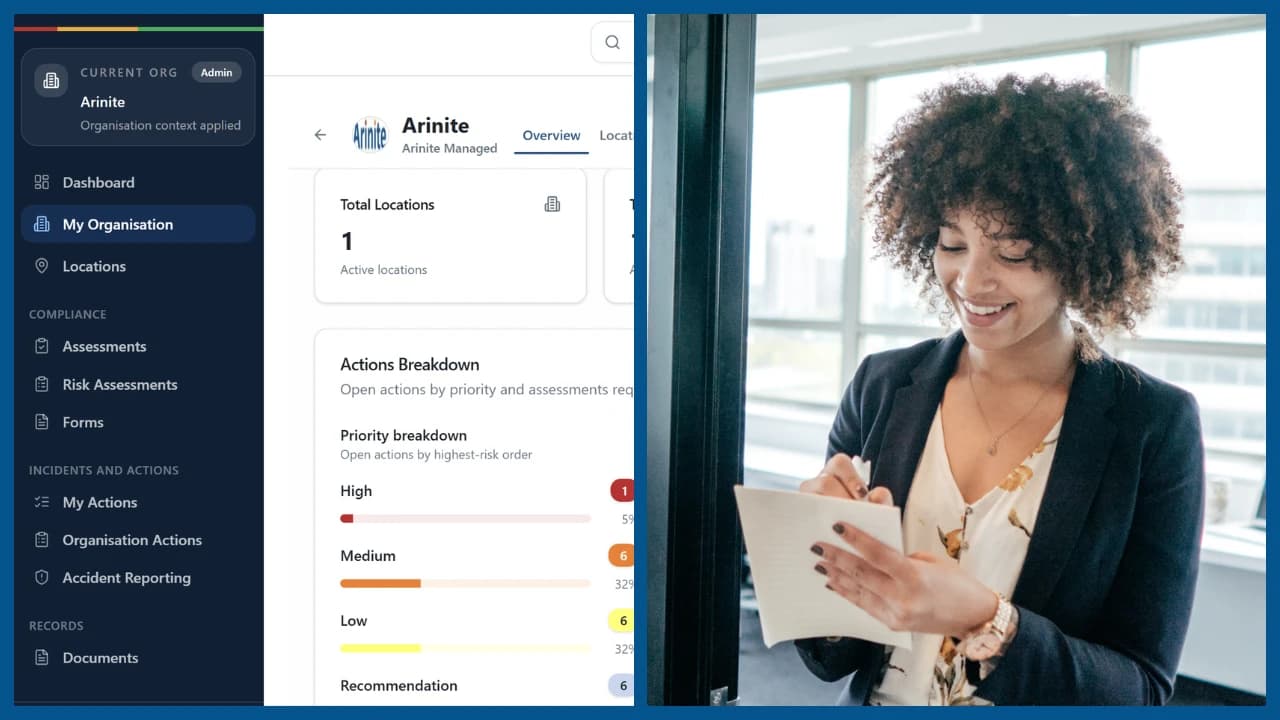
We are not a consultancy that adds external software. We are not a software company that recommends consultants.
We are the place where those two things finally become one.
50+ Countries. Global Safety. Local Trust.
Headquartered in London, UK, with Qualified health and safety consultants in 50+ countries. Whether you need a health and safety audit in Manchester, a fire risk assessment in Birmingham, or outsourced workplace health and safety compliance in Singapore, we have consultants near you.
We're expanding globally

Operations Director, Arinite
I have been in the health and safety business for 35+ years. In that time, I have had one consistent experience across every sector and every country I have worked in.
Every business we speak to already knows, somewhere, that their workplace health and safety compliance has not kept pace with their growth. It is not ignorance. It is business. It is the assumption that because nothing has gone wrong yet, the gaps are probably manageable.
What stops most businesses from doing something about it is not the cost of outsourcing health and safety support. It is the fear of finding out how significant the gaps are.
The Free Gap Analysis Call exists for exactly that moment.
You get the full picture of your workplace health and safety position in 30 minutes.
“In 35+ years, I have not once had someone tell us they wished they had stayed in the dark.”
No video testimonials available at the moment.
Join 1,500+ organisations that trust Arinite as their health and safety consultants.
Common questions about field worker safety, driving at work, DSE, psychosocial risk, and insurance sector compliance
Our Qualified health and safety consultants are here to help with any queries about workplace safety, compliance, or our services.
Download our comprehensive library of expert guides, checklists, and templates.
Browse LibraryHave a question or need expert advice? We're here to help.
Fill out the form below and our team will get back to you within 24 hours.
Headquarters
29 Throgmorton St
London EC2N 2AT