Contractors in Your Office: 7 Duties You Keep
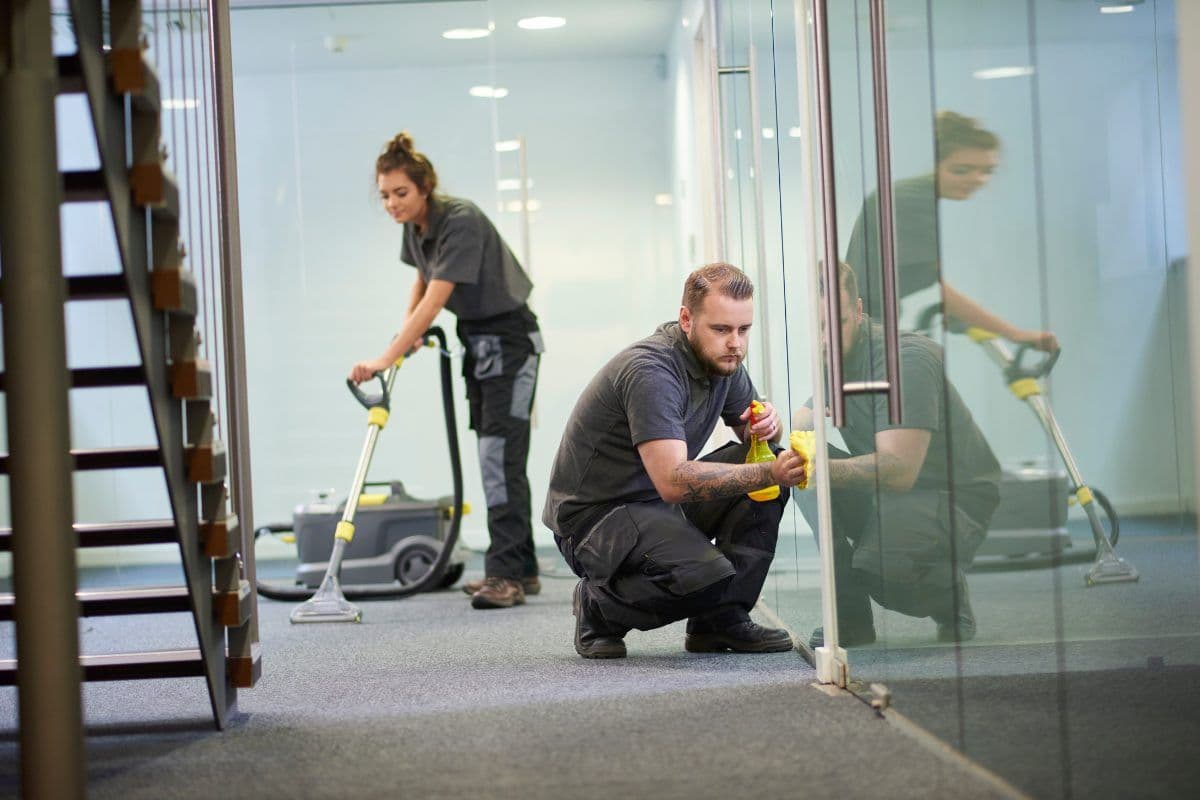
Your organisation employs no cleaners, no security officers, no electricians and no air conditioning engineers. All of them are in the building regularly, none of them is on your payroll, and the arrangement works because nobody thinks about it.
That is precisely the problem. Where an office incident involves someone who is not an employee, the first question asked is who was responsible for what, and the usual answer is that nobody wrote it down. The duties are neither onerous nor obscure. They are simply invisible until they matter.
This is the mirror image of sending your own people to work at a client site. Seven duties stay with you when other people's workers come to you.
1. You owe duties to people you do not employ
The foundation. Section 3 of the Health and Safety at Work etc. Act 1974 requires every employer to conduct its undertaking so as to ensure, so far as reasonably practicable, that persons not in its employment who may be affected are not exposed to risks. Section 4 adds a duty on those in control of premises made available as a place of work for people who are not their employees.
So the cleaner working your floor at seven in the evening is owed a duty by you, by the cleaning company, and potentially by the building operator. Concurrent duties again, not transferred ones, and the contract between you and the provider allocates commercial risk without altering any of it.
2. Selection is a safety decision, not only a procurement one
The point at which most exposure is created or avoided, and it happens before anyone arrives.
Proportionate checks at selection: does the provider have arrangements appropriate to the work, are the individuals competent for what they will actually do, and is there insurance in place. For higher-risk activity such as electrical work, working at height to change lighting, or anything involving building systems, the checks should be correspondingly firmer. HSE's framework for managing health and safety sets out the general approach.
The failure mode is familiar: the provider was selected on price and availability by someone who was never asked to consider anything else, and the safety question was never part of the specification.
3. You must tell them what they cannot know
Need Expert H&S Guidance?
Our qualified consultants can help you implement the right health & safety measures for your business.
Regulation 12 of the Management of Health and Safety at Work Regulations 1999 requires you to provide employers of visiting workers with comprehensible information on the risks and on the emergency procedures. Regulation 11 requires employers sharing a workplace to co-operate and co-ordinate.
In an office the information that matters is unglamorous: what the evacuation procedure is and where the assembly point is, particularly for people working outside normal hours when the floor is empty; where the electrical isolation points are; what areas are restricted; who to contact when something is wrong; and anything unusual about the building.
An induction of ten minutes, recorded, covers almost all of it. The absence of that ten minutes is what turns a minor event into a dispute about who knew what.
4. The asbestos register, before anyone drills a wall
The single most consequential item on this list for anyone occupying an older building, and the one most often missed because it sits with property rather than with health and safety.
Regulation 4 of the Control of Asbestos Regulations 2012 imposes a duty to manage asbestos in non-domestic premises, which includes providing information about its location and condition to anyone liable to disturb it.
Offices in buildings constructed or refurbished before 2000 may contain asbestos-containing materials in ceiling voids, floor tiles, partition cores and around service risers. A maintenance contractor mounting a screen, running a cable or fitting a new socket may disturb them without knowing. Whether the duty holder is you or your landlord depends on the lease and the arrangement, but the practical requirement is the same: whoever is about to make a hole in the fabric must be given the information first.
5. Building systems have their own regimes
Three that recur in ordinary offices, none of which involves construction work.
Water systems: where there are cooling towers, infrequently used outlets or stored hot and cold water, the legionella risk requires assessment and a monitoring regime, and contractors servicing those systems form part of it. HSE publishes guidance on Legionnaires' disease.
Electrical work: the Electricity at Work Regulations 1989 framework applies to whoever performs it, and competence is a legal question rather than a commercial one.
Fire systems: alarm and detection maintenance intersects with your own fire risk assessment, and a system impaired during maintenance changes your evacuation position for the duration.
6. Out of hours is where the real risk sits
Cleaning, maintenance and security overwhelmingly happen when your people are not there, which removes most of the informal controls you rely on without anyone deciding to remove them.
A lone cleaner on an empty floor at ten in the evening has no colleague to notice a problem. Whether the alarm system is in night mode, whether the person can raise an alarm and reach an exit, and whether anyone would know if they did not leave, are all worth establishing once rather than assuming. So is whether the provider's own lone working arrangements are real or theoretical.
7. Their incidents are still your information
Something happens to a contractor's employee on your floor. Their employer makes any statutory report, since reportability follows the employment relationship. That does not mean the event is none of your business.
If a lighting contractor's engineer falls from a ladder in your office, the cause may be a condition in your premises, and you need to know for your own risk assessment regardless of who reports it. Agree in advance that incidents involving provider staff on your premises are notified to you, and record them alongside your own. Patterns only become visible when the data sits in one place, which is where health and safety consultants and software are worth more in combination than either alone.
The seven, in practice
| Duty | Minimum that satisfies it | |---|---| | Duties to non-employees | Recognised in your arrangements, not assumed away by contract | | Selection | Proportionate competence, arrangements and insurance checks before appointment | | Information | Short recorded induction covering evacuation, isolation, restrictions, contacts | | Asbestos | Register available and provided before any work disturbing the fabric | | Building systems | Water, electrical and fire regimes identified and providers verified | | Out of hours | Lone working arrangements confirmed, alarm and exit route usable | | Incidents | Notification agreed, recorded in your register |
None of this requires a permit system or a contractor management platform for an office of ordinary size. It requires somebody to have thought about it once and written down half a page.
For multi-country groups
Two complications when the same providers, or the same categories of provider, appear across several countries.
The duty structures differ. Australia's regime places duties on a person conducting a business or undertaking rather than on an employer, which captures these relationships more broadly and requires duty holders to consult, co-operate and co-ordinate. Across Europe, shared workplace co-operation duties derive from the same EU Framework Directive 89/391/EEC but were implemented with different documentation in each state.
And the local arrangement is usually invisible from the centre. Facilities and office management are typically local decisions, so a group can have twelve providers across six countries with no consolidated view of who checked what. Periodic health and safety audits are the practical way to find out, because this is not a question a group policy can answer.
Where Arinite fits
Arinite works with organisations whose offices depend on providers they do not employ, which is essentially all of them. We support 1,500+ businesses across 50+ countries and protect 100,000+ employees, with 95%+ client retention over 15+ years. Our health and safety consultants work extensively with legal, finance and banking and professional services organisations, and we build arrangements proportionate to an office rather than imported from heavy industry.
Where offices span several countries, our global health and safety consultants establish what each jurisdiction requires of you as occupier, and our international health and safety consultants keep that current as providers change. If you could not currently say who checked your cleaning contractor, a free gap analysis will show you what else is unrecorded.
Related Articles
Written by
Arinite Health & Safety Consultants
Health & Safety Expert at Arinite