PUWER in the Office: 12 Items It Covers and the Duty Each One Triggers
Ask a facilities manager in a law firm whether PUWER applies to them and the answer is usually no. Ask an insurance broker, a software business or a university professional services team and you get the same answer. The regulations are understood to be about machinery, and machinery is understood to happen in a factory.
That is the most expensive misreading in office compliance, because the Provision and Use of Work Equipment Regulations 1998 are not scoped by industry. They are scoped by the definition of work equipment, and that definition is extremely wide. Any machinery, appliance, apparatus, tool or installation provided for use or used by an employee at work falls inside it. The HSE's own PUWER overview is explicit that the duty attaches to the employer who provides or allows the use, whatever the sector.
An ordinary office floor contains at least a dozen qualifying items. Below is the list, with the duty each one triggers. Count the ones you hold inspection or training records for.
1. The powered sit-stand desk
A height-adjustable desk with a motor is work equipment. Regulation 4 of PUWER requires equipment to be suitable for the purpose and conditions of use, and regulation 5 requires it to be maintained in efficient working order and good repair. Powered desks have pinch points, trap cables, and fail in the down direction. Most offices have hundreds of them and no maintenance schedule for any of them.
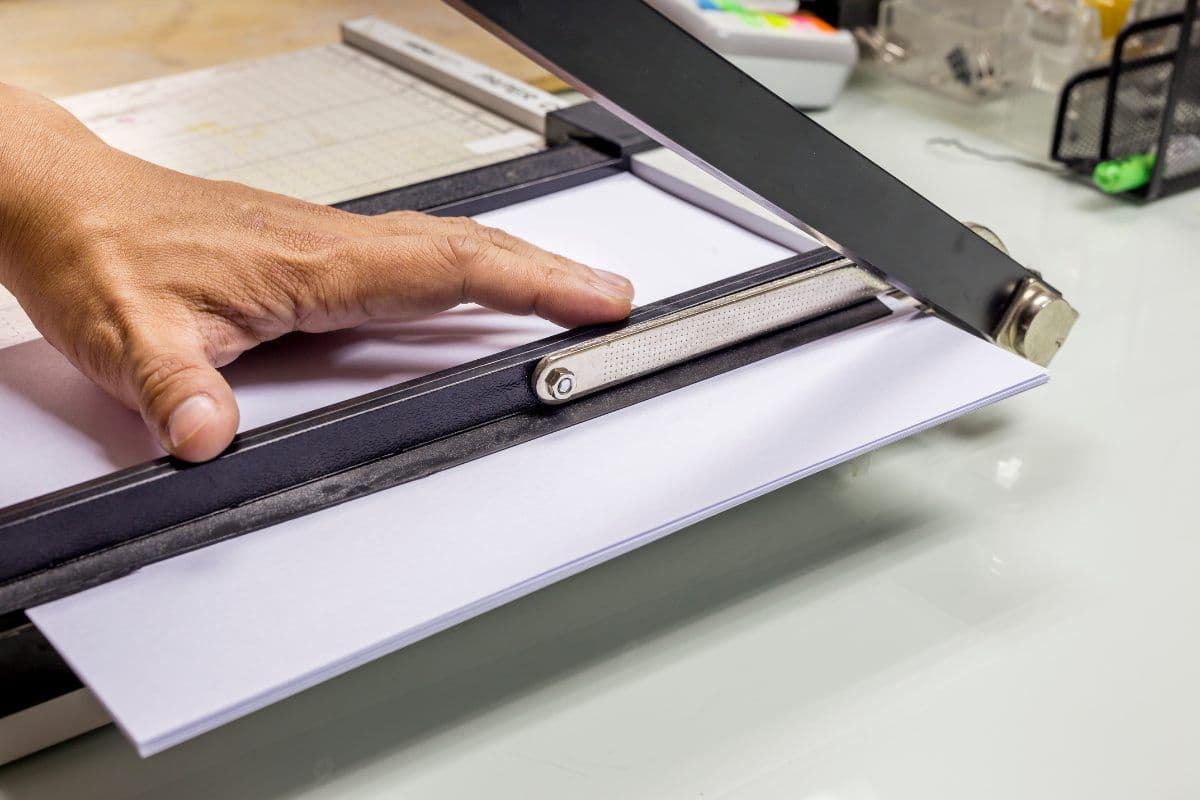
2. The paper guillotine
The clearest case on the floor and the one most often missed. Regulation 11 requires measures to prevent access to dangerous parts of machinery, in a specified hierarchy starting with fixed guarding. A guillotine with a missing finger guard in a print room is a textbook regulation 11 contravention sitting in plain sight next to the stationery.
3. The shredder and the laminator
Need Expert H&S Guidance?
Our qualified consultants can help you implement the right health & safety measures for your business.
Both combine a dangerous part with a feed that invites a hand. Cross-cut shredders in particular are involved in injuries every year, usually when someone clears a jam without isolating the machine. Regulation 9 requires adequate information, instruction and training for users, and "everyone knows how a shredder works" is not training. Nor is it a defence.
4. The coffee machine and the boiling water tap
Appliances are expressly inside the definition. The duties here are suitability and maintenance: a descaling regime, a scald risk that has been assessed, and a route for reporting a fault that does not involve a note taped to the front. Bean-to-cup machines with steam wands and under-counter boilers are the two that generate actual injuries in professional offices.
5. The passenger lift or platform lift
Your lift is work equipment and attracts PUWER alongside the lifting operations regime. Regulation 6 requires inspection at suitable intervals by a competent person where safety depends on installation conditions, with records kept. Tenants routinely assume the landlord holds this. Sometimes the landlord does. The point is that somebody has to be able to produce the record on request, and a lease is not a record.
6. The step ladder in the stationery cupboard
Access equipment is work equipment. It needs to be suitable for the task, inspected, and used by someone trained, and that sits alongside the separate duties on working at height. The failure mode is universal: a ladder nobody owns, nobody inspects, and everybody uses to change a bulb or reach archive boxes.
7. Server racks, UPS units and battery cabinets
For software, AI and data businesses this is where PUWER gets serious. Regulation 20 requires equipment to be stabilised by clamping or otherwise where necessary for safety, and regulation 19 requires suitable means to isolate equipment from every source of energy. A rack on castors with rails extended, a UPS with no documented isolation point and a battery cabinet with no stored-energy procedure are three separate findings in one room.
8. The AV and conference rig
Motorised screens, ceiling-mounted projectors, video walls and automated blinds are all installations provided for use at work. Suspended equipment raises stability and inspection duties, and the records usually sit with whoever installed it rather than with the occupier. Boardroom and auditorium kit in professional firms and education settings is frequently the oldest unmanaged equipment in the building.
9. Cleaning machinery
Floor scrubbers, polishers and increasingly autonomous vacuums are work equipment, and here the awkward question is whose. If your cleaning contractor brings the machine, the duty does not vanish. You still control the premises, and you still allow the use. Regulations 14 to 18 deal with controls, stop controls and emergency stops, and an autonomous cleaner operating in a corridor used by the public raises exactly those questions.
10. The electric pallet truck or post room tug
Any office with a mail room, a records store or a basement goods area probably has one. These are mobile work equipment and attract the additional duties in Part III of the Regulations, including requirements around carrying passengers, roll-over and overturning. A powered truck driven by an untrained post room assistant is both the most common and the most serious finding in this category.
11. Powered monitor arms and docking hardware
Minor equipment, but it illustrates how the duties interact. The equipment is supplied by you, used at work, and sits directly within the display screen assessment. Regulation 23 requires equipment to be marked with appropriate health and safety markings where necessary, which matters for load limits on arms and mounts. Overloaded monitor mounts fail downwards onto a seated person.
12. Equipment nobody bought
The scope point that catches everyone. PUWER applies to equipment provided for use or used by an employee at work, which reaches further than the asset register. The personal desk fan from home, the space heater someone brought in during a cold snap, the contractor's drill used on your floor, the personal power bank charging under a desk. You did not buy any of it, and you are the one allowing its use. An asset register that only contains purchased items is not an inventory of your PUWER duties.
The duty behind each item
| Item | Primary duty | What is usually missing |
|---|---|---|
| Powered desks | Suitability and maintenance | Any maintenance schedule at all |
| Guillotine, shredder, laminator | Guarding of dangerous parts, user training | Guards reinstated after a jam. Recorded training |
| Coffee machines and boiling taps | Suitability, maintenance, scald assessment | Fault reporting route. Descaling records |
| Lift and platform lift | Inspection by a competent person, records | A record the occupier can actually produce |
| Ladders and access equipment | Suitability, inspection, trained user | An owner for the equipment |
| Racks, UPS, battery cabinets | Stability and isolation from energy sources | Documented isolation and stored-energy procedure |
| AV and suspended kit | Stability, inspection at suitable intervals | Handover records from the installer |
| Cleaning machinery | Controls and emergency stops, training | Clarity on duties where the contractor owns the machine |
| Mobile equipment | Part III mobile duties, trained operator | Operator training in a non-industrial setting |
| Employee and contractor equipment | Scope of the Regulations themselves | Any awareness that it is in scope |
If you can produce records against four or fewer rows, the gap is not an equipment problem. It is that nobody has treated the office as a place where PUWER applies.
Where the duty is the same abroad, and where it is not
PUWER implements the European Use of Work Equipment Directive 2009/104/EC, so a recognisable equivalent exists across the EEA. In Germany the duties sit in the Betriebssicherheitsverordnung, with prescribed inspection regimes and a stronger emphasis on the competence of whoever carries them out. Most member states similarly specify who may inspect, which the UK leaves to the broader test of competence. A group that satisfies PUWER has usually done the substantive work for Europe but not the documentary work.
Two divergences matter commercially. The first is procurement: since the UK and EU marking regimes separated, a group buying centrally needs to know whether a machine carries the right marking for the country it lands in. Government guidance on the UKCA marking and the Supply of Machinery (Safety) Regulations 2008 set the UK position. One model for twelve offices is efficient until two are the wrong side of a marking boundary.
The second is the United States, which has no single PUWER equivalent. Duties are distributed across specific standards plus the general duty clause, so a US entity inside a UK-led group will have no document resembling a PUWER assessment and may still be compliant locally. The error runs both ways: UK teams read the absence as a gap, US teams read the UK requirement as bureaucracy.
How to close this in one pass
Start with an inventory rather than a policy. Walk the floor, list everything that meets the definition including the items nobody bought, then attach the duty, the owner and the review interval to each line. That register is the deliverable, and it is where health and safety consultants and software are worth considerably more together than separately, because an equipment register with owners, inspection dates and an evidence trail is exactly the artefact an inspector, an insurer or a client auditor asks for first.
Then test it. Periodic health and safety audits should pick items off the register at random and ask for the record, which is a far better measure of whether the system works than reading the policy that describes it.
Where Arinite fits
Arinite has spent 15+ years applying industrial regulations correctly to non-industrial workplaces, which is a different skill from applying them to factories. We support 1,500+ businesses in 50+ countries and protect 100,000+ employees, with 95%+ client retention. Our health and safety consultants work extensively with legal, insurance, IT and software and education clients, where the server room and the boardroom rig are the two findings we see most often.
For multi-country groups, our global health and safety consultants align one equipment register across jurisdictions while meeting the local inspection and competence rules, and our international health and safety consultants can tell you which of your sites needs a prescribed inspector rather than a competent person.
Walk your floor against the twelve items above. Then book a free gap analysis and we will tell you in one call how much of your equipment is currently unmanaged.
Related Articles
Written by
Arinite Health & Safety Consultants
Health & Safety Expert at Arinite