Near Miss Reporting: 9 Office Examples Most Teams Never Log
In 2024/25, 680,000 working people in Great Britain said they had been injured at work, according to the Labour Force Survey. Employers reported 59,219 injuries under RIDDOR in the same year (HSE statistics). The two figures measure different things, but the gap tells a familiar story: most of what happens at work never reaches a report. Near misses, where nobody is hurt at all, are reported even less.
That is a problem, because a near miss is the cheapest lesson your organisation will ever get. Nobody is injured, nobody is off sick, nobody is claiming. You get the warning for free. Ignore it, and the next time the same thing happens the outcome may be very different.
In offices, tech companies, law firms, insurers and education settings, near misses are especially easy to dismiss. People think of them as a factory or warehouse concept. So here are nine near miss examples drawn from the kinds of workplaces Arinite supports every day, with what each one nearly was and what a good report should trigger.
---
What Counts as a Near Miss?
HSE's guide to investigating accidents and incidents, HSG245, describes a near miss as an event that does not cause harm but has the potential to cause injury or ill health. ISO 45001 takes the same view: an incident where no injury or ill health occurs is still an incident, and clause 10.2 expects it to be reported, investigated and acted on. See our ISO 45001 support for how that fits into a management system.
If you need the full background, our pillar guide explains what a near miss is in health and safety, and accident or incident: the 5 terms that decide what you report untangles the vocabulary.
---
9 Near Miss Examples From Real Workplaces
Example 1: The Trailing Cable Across the Hot-Desk Walkway
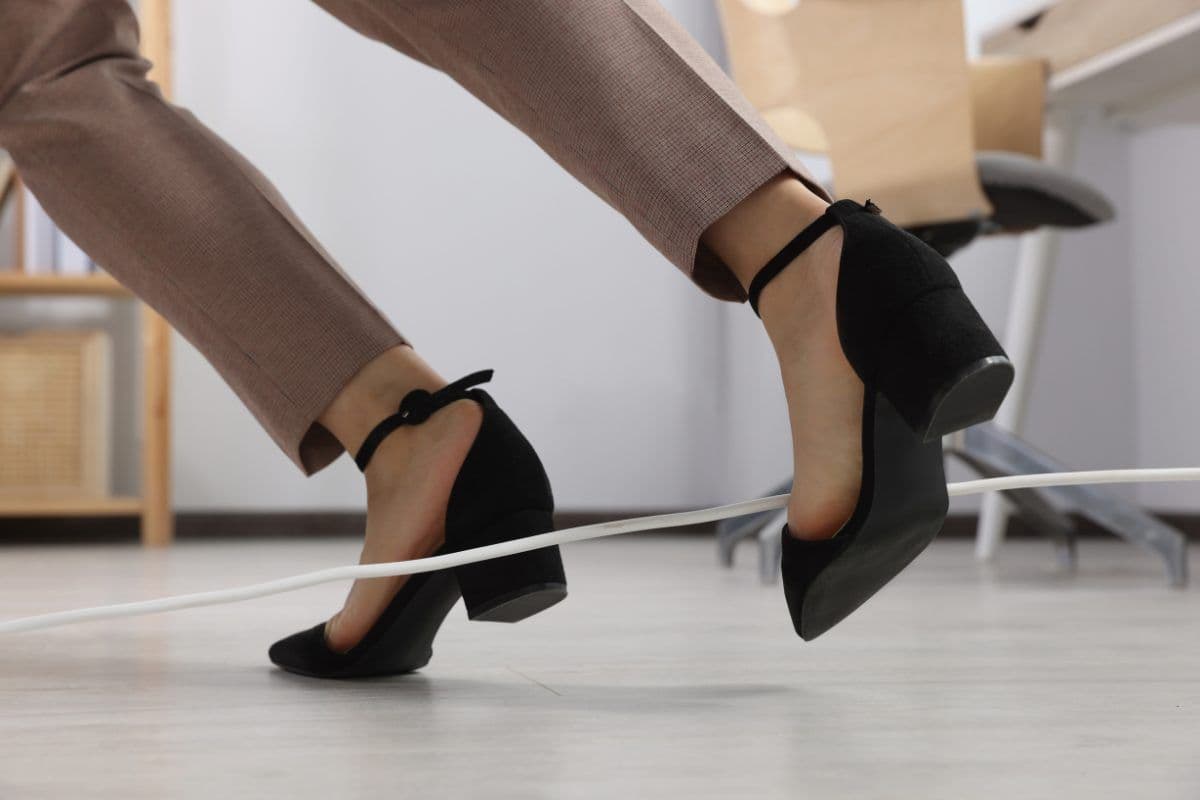
What happened: a monitor cable stretched across a walkway between hot desks. A colleague carrying coffee caught a foot on it and recovered their balance.
What it nearly was: a fall, possibly onto a desk edge, plus a scald.
What the report should trigger: a check of cable management across every hot-desk bank, not just the one desk. In hybrid offices, nobody owns a shared desk, so nobody notices.
Who it matters to: offices of every size, especially after a move to hot-desking.
Example 2: The Kitchen Boiling Water Tap
What happened: an instant boiling water tap was knocked while someone rinsed a mug beneath it. Water splashed onto the counter, missing their hand.
What it nearly was: a serious scald.
What the report should trigger: a review of tap position, child-lock or safety handle settings, and signage. One report usually reveals several people who have had the same experience and said nothing.
Who it matters to: every office kitchen, and any education setting where students share staff facilities.
Example 3: The Overheating UPS in the Server Room
What happened: an engineer noticed a burning smell and a warm battery cabinet on an uninterruptible power supply. It was shut down before anything ignited.
What it nearly was: an electrical fire. If a fire caused by an electrical short circuit or overload stops the plant for more than 24 hours, or creates a significant risk of death, it becomes a reportable dangerous occurrence under RIDDOR.
What the report should trigger: inspection of battery systems across all sites, a review of maintenance contracts, and an update to the fire risk assessment.
Who it matters to: AI and data businesses and software companies with on-premises server rooms or lab equipment.
Example 4: The Lift That Dropped Between Floors
What happened: a passenger lift jolted and stopped between floors with four people inside. Nobody was hurt and the engineer released them within the hour.
What it nearly was: depending on the cause, a dangerous occurrence. Under RIDDOR, the collapse or failure of any load-bearing part of lifting equipment is reportable even when nobody is injured. HSE's dangerous occurrences guidance explains the categories.
What the report should trigger: an immediate request to the landlord or lift contractor for the cause, confirmation of whether a RIDDOR report is needed, and a record on your own system even if the landlord reports it.
Who it matters to: any tenant in a multi-storey building, which covers most legal and insurance offices in city centres.
Example 5: The Fire Exit Behind the Archive Boxes
What happened: during a fire drill, a fire warden found an escape route partly blocked by archive boxes delivered the day before.
What it nearly was: a delayed evacuation in a real fire.
What the report should trigger: a storage rule, a delivery procedure, and a review of whether your fire risk assessment still reflects how space is actually used.
Who it matters to: law firms with paper archives, and any office where storage space is under pressure.
Example 6: The Display Screen on the Wobbling Trolley
What happened: a large display screen on a mobile trolley tipped as it was pushed over a door threshold in a classroom. A teacher caught it.
What it nearly was: a crush injury to a child or member of staff.
What the report should trigger: a check of every mobile screen trolley across the site, and a look at how equipment is moved between rooms.
Who it matters to: schools, colleges and universities. See our education sector page.
Example 7: The Caller Who Made a Threat
What happened: a claims handler took a call from a distressed customer who said they knew where the office was and would "come down and sort this out". Nobody arrived.
What it nearly was: workplace violence, and certainly a source of lasting stress for the handler.
What the report should trigger: escalation under your violence and aggression procedure, a check of reception and access controls, and support for the employee. Threats are near misses too. Our post on abuse through a screen covers the duties owed to support teams.
Who it matters to: insurers, contact centres, and client-facing professional services.
Example 8: The Lone Worker Locked in the Stairwell
What happened: a developer working late took the stairs after the building's out-of-hours mode activated. Their access fob would not open the stairwell door at ground level, and their phone had no signal. Security found them 40 minutes later.
What it nearly was: a medical emergency with nobody aware of where they were.
What the report should trigger: a review of out-of-hours access, a check-in system for lone workers, and a conversation with the landlord about stairwell exits. See lone working policy: the 7 sections every policy needs.
Who it matters to: tech and AI teams with late working cultures.
Example 9: The Scorched Extension Lead at Home
What happened: a home worker noticed a scorch mark on a daisy-chained extension lead running a laptop, two monitors and a heater.
What it nearly was: a house fire.
What the report should trigger: guidance for all home workers on safe electrical set-ups, and a prompt in your home working assessment. Your duties do not stop at the office door, as our post on work-from-anywhere policies explains.
Who it matters to: every hybrid and remote workforce.
---
Why These Near Misses Go Unreported
Need Expert H&S Guidance?
Our qualified consultants can help you implement the right health & safety measures for your business.
Most organisations do not have a near miss problem. They have a reporting problem. The same four barriers come up again and again:
People do not recognise it as a near miss. If staff think the concept only applies to warehouses and factories, they will not report a wobbling trolley or a blocked exit. Examples like the nine above fix that faster than any definition.
Reporting takes too long. If a near miss form is a three-page document on a shared drive, nobody will fill it in for a cable across a walkway. Reporting needs to take a minute, from a phone.
Nothing happens afterwards. When people report and hear nothing, they stop reporting. Closing the loop matters more than the form itself.
People fear blame. If a report might reflect badly on the reporter or a colleague, it will not be made. Our article on why half of workers avoid incident reporting looks at this in depth, and safety culture: 8 things you can actually measure shows how to track whether it is improving.
---
What a Good Near Miss Report Captures
A near miss report does not need to be long. It needs to be quick to complete and useful to act on.
| Field | Why it matters |
|---|---|
| What happened | A short description in the reporter's own words |
| Where and when | So patterns by location and time can be spotted |
| What it nearly was | Forces a realistic view of the potential outcome |
| Immediate action taken | Shows the hazard was controlled straight away |
| Suggested fix | The reporter often knows the best answer |
| Owner and closure date | Turns a report into an action that gets done |
Near miss reporting software makes this practical across many sites and countries. Reports come in from phones, go straight to the right owner, and feed trends that board reports can use. Our guide to incident management software: 6 features every global business needs sets out what to look for, and health and safety board reporting explains how near miss data belongs in the board pack.
---
Near Miss Reporting Across Jurisdictions
Most near misses do not need to be reported to a regulator. But in several countries, certain near misses do, and the categories and deadlines differ.
| Jurisdiction | Must some near misses be reported to the regulator? | Where to start |
|---|---|---|
| United Kingdom | Yes, if they are dangerous occurrences listed in RIDDOR Schedule 2 | RIDDOR |
| Ireland | Yes, specified dangerous occurrences are reportable to the HSA | HSA reporting guidance |
| Australia | Yes, "dangerous incidents" are notifiable under the model WHS laws | Australia WHS |
| United States | Generally no federal requirement, though OSHA encourages near miss reporting in its safety management guidance | United States |
| ISO 45001 (any country) | Not to a regulator, but incidents including near misses must be managed under clause 10.2 | Your internal incident procedure |
For the timing of reports that are required, see when the clock starts: 12 reporting deadlines across jurisdictions.
---
How Arinite Helps You Turn Near Misses Into Fewer Incidents
Arinite has supported 1,500+ businesses across 50+ countries for 15+ years, protecting 100,000+ employees, with 95%+ client retention. Our qualified consultants and our software work together, so near misses are easy to report and quick to fix.
- Done For You: our health and safety consultants investigate significant near misses, identify root causes, and check that actions were completed through regular health and safety audits.
- Done With You: we design your reporting process, train managers to respond well, and set up trend reviews with your team.
- DIY: your people report near misses from any device on our health and safety consultants and software platform, with automatic routing, reminders and dashboards.
For groups operating in several countries, our international health and safety consultants make sure the right near misses reach the right regulator in each jurisdiction. Our global health and safety consultants keep reporting consistent across every site, so a near miss in Dublin teaches the same lesson in Dallas and Delhi.
---
Frequently Asked Questions
What is an example of a near miss in an office?
Common office near misses include tripping over a trailing cable, a scald risk from a boiling water tap, a blocked fire exit discovered during a drill, a lift stopping suddenly between floors, and an overheating piece of electrical equipment that is switched off before it catches fire.
Do near misses need to be reported to HSE?
Most do not. However, some near misses are dangerous occurrences under RIDDOR and must be reported even when nobody is injured. Examples include the failure of a load-bearing part of lifting equipment, such as a passenger lift, and certain electrical fires.
Why is near miss reporting important?
Near misses show you where an accident is likely to happen before anyone is hurt. Reporting them lets you fix hazards early, spot patterns across sites, and demonstrate to inspectors, insurers and auditors that your system works.
What should a near miss form include?
What happened, where and when, what the outcome could have been, any immediate action taken, a suggested fix, and an owner with a closure date. Keep it short enough to complete in a minute.
Is near miss reporting software worth it for office-based businesses?
For a single small office, a simple form may be enough. For businesses with multiple sites, hybrid workers or offices in several countries, software makes reporting faster, routes reports to the right person, and turns individual reports into trends you can act on.
---
Find Out What Your Near Misses Are Telling You
If your organisation logged fewer than a handful of near misses last year, it is almost certainly not because nothing happened. Book a free gap analysis with Arinite and we will review your reporting process, culture and data, in the UK and internationally, and show you how to turn near misses into fewer incidents.
Written by
Arinite Health & Safety Consultants
Health & Safety Expert at Arinite