Archive and Storage Rooms: 5 Risks Nobody Assesses
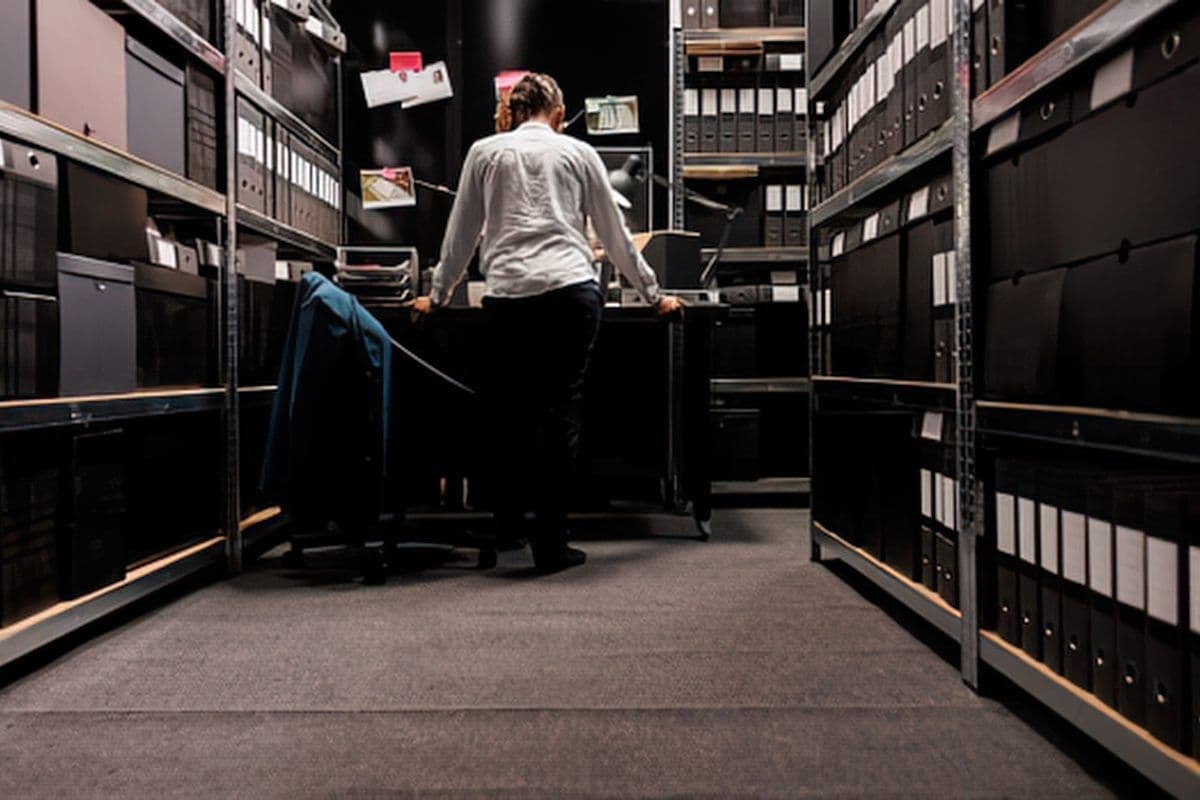
Everyone was going paperless. Law firms, insurers, accountancy practices and banks all reduced their filing, digitised their records, and kept the room.
Then the room filled up again. Deeds and wills that cannot sensibly be destroyed, matter files under retention obligations, regulatory records, historic client papers inherited through mergers, and the boxes that arrived when the last office closed. In most professional firms the archive is now denser than it was when the building was designed, and it is the one room that has never appeared in a risk assessment.
Five risks. The first is structural and almost nobody has checked it.
1. Floor loading, which is a number somebody once specified
The risk that is invisible until it is not.
Office floors are designed to a loading capacity, expressed as weight per square metre, and general office areas are specified for people, desks and light furniture. Dense paper storage is heavier than almost anything else a commercial building routinely holds. Archive boxes stacked on mobile shelving over a small footprint concentrate that weight considerably.
Buildings designed with a dedicated storage or filing area will have a higher specified capacity for that zone. The problem arises when the archive migrated: a meeting room converted to storage, a corner of a general office filled with racking, or a mezzanine that seemed like spare space.
The question to ask your landlord or building manager is what the floor loading capacity is for the specific area you are using for storage, and whether the current arrangement was ever assessed against it. Most organisations have never asked. This is not an alarmist point: it is a check that costs one email and closes an exposure nobody can otherwise quantify.
2. Racking and shelving that nobody inspects
The equipment risk, and the archive is usually where the oldest equipment in the building lives.
Storage racking and shelving is work equipment. Regulation 5 of the Provision and Use of Work Equipment Regulations 1998 requires work equipment to be maintained in an efficient state, in efficient working order and in good repair. That covers the shelving as much as it covers anything else.
What to look for is unglamorous: uprights out of plumb, damaged or bent members, missing bracing or fixings, units not secured to the wall where they should be, loading beyond the manufacturer's stated capacity, and mobile shelving whose tracks or locking mechanisms no longer operate correctly.
Mobile roller racking deserves specific attention, because the failure mode involves a person between two bays that can be moved. Safety locks, aisle-occupied indicators and a rule that nobody moves a bay without checking are the controls, and in an archive used infrequently by people who have not been briefed, none of that is intuitive.
3. Getting things down, and up
Need Expert H&S Guidance?
Our qualified consultants can help you implement the right health & safety measures for your business.
Manual handling and access, which are separate duties that combine here in a specific way.
Archive work involves boxes of paper, which are heavier than they look, retrieved from heights, in a confined aisle, often by someone who does this twice a year. Regulation 4 of the Manual Handling Operations Regulations 1992 requires the employer to avoid hazardous manual handling so far as reasonably practicable, and where it cannot be avoided, to assess it and reduce the risk. HSE's guidance on musculoskeletal disorders and manual handling covers the assessment.
The access half is where injuries actually occur. Retrieval from a top shelf using a wheeled office chair, a stack of boxes or the bottom shelf as a step is common, is entirely predictable, and is what happens when no suitable step is provided in the room. A kick stool costs very little and its absence is the proximate cause of a substantial share of office falls.
The practical controls are equally simple: heavy items at waist height, a suitable step or platform stored in the room rather than borrowed from elsewhere, and a stated position that nobody climbs the racking.
4. Fire load, which the fire risk assessment may predate
The risk with the widest consequence, and the one most likely to have changed since anyone looked.
Paper is fuel. A room densely packed with archive boxes represents a significant fire load concentrated in one compartment, and the fire strategy for your building was written on the basis of what that space contained at the time.
Article 9 of the Regulatory Reform (Fire Safety) Order 2005 requires the risk assessment to be reviewed where it is no longer valid or where there has been a significant change. Converting a room to dense paper storage is a significant change, as is doubling what an existing archive holds.
Three specific questions follow. Does detection and, where fitted, suppression cover the room adequately for its current contents. Is the room's compartmentation intact, particularly if cabling or services were run through walls or ceilings when it was converted. And, most commonly missed, has storage crept into corridors, lobbies or stairwells, because storage in an escape route is both a fire load and an obstruction.
5. The room itself, and who goes in alone
The environmental and organisational risks, which travel together because the archive is a room nobody occupies.
Lighting in storage rooms is frequently poor and often on a short timer, which produces someone carrying a box down an aisle in the dark. Ventilation is usually minimal, and older archives can have genuine air quality issues from dust and, in basements or buildings with a history of water ingress, from mould. Regulation 12 of the Workplace Regulations addresses the condition of floors and traffic routes, and an aisle used as overflow storage is a traffic route obstructed.
Then there is the person. Archive retrieval happens alone, often out of hours, sometimes in a basement where a phone does not work, in a room others have no reason to enter. That is a lone working scenario, and HSE publishes guidance on lone working. The controls are the familiar ones: knowing somebody is in there, a means of raising an alarm that functions in that location, and a stated position on what should not be done alone.
Five questions to ask this week
| Risk | Question | Usual answer |
|---|---|---|
| Floor loading | What is the capacity for that area, and was this assessed? | Nobody has asked |
| Racking | When was the shelving last inspected? | Never |
| Retrieval | Is there a suitable step stored in the room? | People use a chair |
| Fire load | Has the fire risk assessment been reviewed since the room filled? | No |
| The room | Lighting, air, and who knows someone is in there? | Not considered |
Every one of these is answerable without a survey and most are fixable within a small budget. The archive is a rare case where the gap between current state and adequate is genuinely small, and where the reason nothing has been done is simply that nobody owns the room.
For multi-site and international groups
Two points.
Archives accumulate at closure. When a group consolidates offices, the paper does not disappear; it moves to whichever remaining site had space, usually without anyone assessing the receiving room. A group that has rationalised its estate in the past few years very likely has one office carrying considerably more storage than it was designed for.
And retention obligations differ by country, so the volume differs too. Several jurisdictions in this series require records to be held for decades: occupational health surveillance records under the British COSHH regime, and successive versions of the French risk assessment document for forty years. Those obligations produce physical or digital archives that outlast the arrangements holding them, which is a records governance question as much as a safety one.
Holding assessments and actions for every site in one register is where health and safety consultants and software are worth more together than either alone, and periodic health and safety audits are usually how a storage room gets looked at for the first time.
Where Arinite fits
Arinite assesses the rooms that fall outside everyone's remit, which in a professional firm is reliably where the physical risks concentrate. We support 1,500+ businesses across 50+ countries and protect 100,000+ employees, with 95%+ client retention over 15+ years. Our health and safety consultants work extensively with legal, insurance and professional services organisations, all of which hold more paper than they expect to.
Where offices span several countries, our global health and safety consultants establish what each jurisdiction requires, and our international health and safety consultants keep that current as estates consolidate.
If your archive doubled when another office closed and nobody revisited the fire risk assessment, a free gap analysis will tell you what else moved with the boxes.
Related Articles
Written by
Arinite Health & Safety Consultants
Health & Safety Expert at Arinite