HSE inspections up 47% - HSE carried out over 13,200 workplace inspections in 2024/25.
Healthcare is directly HSE-regulated and one of HSE's priority sectors every year. Care homes face the additional layer of CQC inspection where workplace safety, infection control, manual handling, and staffing adequacy intersect directly with regulated activity ratings. The compliance load spans elevated biological agent exposure, sharps injury risk, patient manual handling, lone working in community settings, and intensive psychosocial demand on the workforce. Arinite delivers the full healthcare compliance stack through Qualified consultants and integrated compliance software.
Healthcare covers a wide range of operations: NHS trusts, private hospitals, GP surgeries, dental practices, mental health and substance misuse services, residential and nursing care homes, domiciliary and community care, hospices, ambulance services, and clinical laboratories. The compliance profile shares common threads: biological agents under COSHH and the Control of Substances Hazardous to Health Regulations, sharps injury risk under the Health and Safety (Sharp Instruments in Healthcare) Regulations 2013, patient handling under the Manual Handling Operations Regulations 1992, infection control under HSE and Public Health England guidance, and lone working under HSE general duties for community-based staff.
Workplace health and safety in CQC-regulated care services overlaps directly with the CQC fundamental standards. Failures in workplace H&S routinely contribute to CQC ratings of Requires Improvement or Inadequate.
Arinite provides Qualified consultants and compliance software to healthcare and care providers across the UK and 50+ countries.
The Health and Safety (Sharp Instruments in Healthcare) Regulations 2013 require specific assessment of every clinical activity involving sharps. Most providers have only generic clinical risk assessments.
Patient-specific moving and handling plans missing, generic care plans used instead. The single most common care home compliance gap.
IPC lead identified but programme documentation, audit cycle, and training records do not stand up to CQC inspection.
Clinical chemicals captured; cleaning chemicals, laundry chemicals, and laboratory reagents missing.
Community nurses, district nurses, domiciliary carers, and CPNs working alone in patient homes without documented lone working risk assessment.
Generic assessment not updated to reflect changing resident profile (increased dependency, dementia, mobility loss).
Compassion fatigue, secondary traumatic stress, and moral injury well documented but rarely captured in workplace risk assessment.
Patient-on-staff aggression and harassment treated as a clinical or HR issue, not as a statutory workplace H&S category.
The Health and Safety (Sharp Instruments in Healthcare) Regulations 2013 require employers in the healthcare sector to:
Avoid the unnecessary use of sharps.
Use safer sharps (sharps incorporating engineered controls) where reasonably practicable.
Prevent the recapping of needles.
Place secure containers and instructions for safe disposal of sharps close to the work area.
Provide information and training to employees.
Investigate and act upon any sharps injury.
Each clinical activity involving sharps requires assessment under the Sharps Regulations. Documentation should cover the activity, the sharps used, whether safer sharps are in use, the disposal arrangements, training records, and any sharps injuries with investigation findings.
Every sharps injury requires immediate first aid, source patient testing where consented, recipient testing, post-exposure prophylaxis decision-making, RIDDOR reporting where the injury results from contact with a needle infected with a blood-borne virus, and root cause investigation.
Infection Prevention and Control (IPC) sits at the intersection of workplace H&S (COSHH 2002 Schedule 3 biological agents), CQC regulated activity standards, and public health duty. A compliant IPC programme covers:
Documented IPC policy aligned with national IPC manual standards.
Appointed IPC lead with documented competence.
Standard precautions training for all clinical staff.
Transmission-based precautions for specific organisms.
Hand hygiene programme with audit cycle.
Personal protective equipment programme including RPE face fit testing where required.
Outbreak management plan.
Cleaning and decontamination arrangements.
Sharps and clinical waste arrangements.
Vaccination programme for staff.
Documented surveillance and reporting.
The Manual Handling Operations Regulations 1992 apply with particular force in healthcare. HSE's specific guidance on moving and handling in healthcare is HSG225 (Handling Home Care).
Generic "moving and handling" risk assessments do not satisfy the duty. Every patient or resident requiring assistance must have a patient-specific moving and handling plan covering:
Patient capability and cooperation.
Equipment to be used (hoists, slide sheets, transfer boards).
Number of staff required.
Specific techniques.
Review trigger points (significant change in condition).
LOLER 1998 applies to patient lifting equipment. Hoists, ceiling tracks, and stand-aids require thorough examination every six months. See our manual handling page.
Community nurses, district nurses, domiciliary carers, and community psychiatric nurses spend significant time alone in patient homes, including patients with mental health conditions, substance misuse issues, or aggressive behaviour. Documented lone working risk assessment covers:
Pre-visit risk assessment by patient.
Check-in and check-out arrangements with a designated supervisor.
Lone worker safety device deployment (alarm devices, monitored apps).
Visit planning to avoid late or high-risk visits where possible.
Post-incident support and risk reassessment.
Training on de-escalation and safe withdrawal.
Care homes regulated by CQC carry the workplace H&S duties of any employer plus the CQC fundamental standards. The two overlap significantly. CQC inspections routinely cite workplace H&S failures as evidence of breach of the fundamental standards on safe care and treatment, premises and equipment, and good governance.
Resident-specific moving and handling plans.
Dementia-specific risk: wandering, falls, behavioural symptoms, environmental adaptation.
Falls prevention programme.
Pressure ulcer prevention.
Medication management.
Mealtime risk: choking, allergens, scalding from hot food and drinks.
Bathing and showering safety.
Bed rail and bedside risk.
Fire safety for residents with mobility limitations and PEEPs.
Hot surface and bath water temperature controls.
CQC inspectors expect to see workplace H&S documentation integrated with the wider quality and safety management system. Arinite ensures the workplace H&S documentation set aligns with CQC expectations.
Care homes carry one of the highest fire risk profiles of any non-domestic premises in UK law because of sleeping residents with reduced mobility and cognitive impairment. PAS 79-2:2020 is the recognised methodology. See our fire risk assessment service.
Sleeping residents with mobility, cognitive, and sensory impairments.
Personal emergency evacuation plans (PEEPs) for every resident.
Compartmentation and progressive horizontal evacuation strategy.
Fire door integrity and self-closing discipline.
Sprinkler systems where installed.
Mattress and furniture fire performance.
Smoking arrangements where permitted.
Night-staffing ratios and evacuation capability.
Documented MHSWR Regulation 3 risk assessment covering all clinical and non-clinical activities.
Sharps risk assessment under the Health and Safety (Sharp Instruments in Healthcare) Regulations 2013.
Documented Infection Prevention and Control programme.
Patient-specific moving and handling plans under the Manual Handling Operations Regulations 1992.
LOLER thorough examination for patient lifting equipment.
COSHH inventory covering clinical, cleaning, laundry, and laboratory chemicals.
Lone working risk assessment for community-based staff.
Site-specific fire risk assessment under the RRO 2005, delivered to PAS 79-2:2020 for sleeping accommodation.
Psychosocial risk assessment covering compassion fatigue, secondary traumatic stress, and patient aggression.
Worker Protection Act 2023 reasonable steps including patient-on-staff harassment.
Competent person under MHSWR Regulation 7.
Written health and safety policy.
RIDDOR reporting including blood-borne virus exposure.
General duties; Section 37 director liability.
Risk assessment, competent person, and worker information duties.
Specific employer duties on sharps, including safer sharps, recapping prohibition, and injury investigation.
Including Schedule 3 biological agents.
With HSG225 for home care.
For patient lifting equipment.
With PAS 79-2:2020 for sleeping accommodation.
On legionella control.
For older healthcare estates.
Fundamental standards.
Mandatory reporting of specified workplace injuries, diseases, and dangerous occurrences to HSE.
Preventative duty on sexual harassment, including by third parties.
Reasonable adjustments duty including for staff and service users.
Clinical and non-clinical risk assessment across the service.
Activity-by-activity sharps assessment under the 2013 Regulations.
IPC programme review, audit cycle design, training, and outbreak response.
Patient-specific moving and handling plans, equipment LOLER coordination, and training.
Risk assessment, lone worker device deployment, and training.
Care home-specific risk assessment integrated with CQC fundamental standards.
PAS 79-2:2020 fire risk assessments for care homes and sleeping accommodation.
See our legionella and asbestos pages.
Compassion fatigue, secondary traumatic stress, and staff wellbeing programmes.
See our health and safety policy, health and safety audit, and competent person services.
Centralised platform. See our health and safety software.
For all clinical and non-clinical staff joining the service.
For all staff handling sharps.
For all clinical staff with refresher cycles.
Including hoist and equipment use.
For community-based and domiciliary staff.
With PEEP-specific scenarios for care home settings.
Including clinical first aid and BLS for designated staff.
With deeper line manager training.
For staff exposed to patient or service-user aggression.
Including patient-on-staff scenarios.
See our health and safety training service.
The following is an illustrative example of how Arinite engagement typically runs for a healthcare provider.
A private domiciliary care and care home operator with 6 care homes and 320 staff approaches Arinite ahead of a CQC inspection. The operator holds basic H&S documentation but lacks current moving and handling assessments, has gaps in sharps injury prevention documentation under the Health and Safety (Sharp Instruments in Healthcare) Regulations 2013, and no documented psychosocial risk assessment despite documented staff stress and turnover issues.
In month one, we deliver: a refreshed health and safety policy signed by the registered manager and managing director, a current MHSWR Regulation 3 risk assessment covering care home, domiciliary care, head office, and lone worker activities, a competent person appointment, and a centralised compliance programme architecture.
In month two: we deliver site-specific risk assessments and PAS 79:2020 fire risk assessments for the 6 care homes with sleeping accommodation provisions, moving and handling assessments under MHOR 1992 for each resident type, sharps injury prevention documentation under the Sharps Regulations 2013, COSHH assessments for cleaning and clinical substances, and infection prevention and control documentation.
In month three: we deliver violence and aggression assessment for domiciliary lone workers, lone working programme including check-in arrangements, psychosocial risk assessment using HSE Stress Indicator Tool, Worker Protection Act 2023 reasonable steps documentation, and hand over to ongoing competent person retainer.
The CQC inspection passes with no H&S concerns. The competent person retainer continues with monthly site inspections.
Five practical reasons healthcare providers appoint Arinite as their outsourced competent person:
Moving and handling, sharps, COSHH, IPC, and clinical activity risk integrated with workplace H&S.
The integrated documentation pack satisfies CQC inspection workplace H&S evidence requirements.
Centralised compliance for care home groups and domiciliary providers through Arinite's software platform.
Documented lone working programme including lone worker safety device deployment for domiciliary care staff.
MHSWR Regulation 7 requires competent advice.
If you operate adjacent to healthcare, you may also find these sector pages relevant:
Book a free gap analysis call with one of our Qualified health and safety consultants to assess your current arrangements, identify the compliance gaps that matter most for your CQC and HSE positioning, and get a clear recommendation and indicative cost.
From Reactive Firefighting to Proactive Health & Safety Compliance
No formal HSE systems in place. Everything is reactive, waiting for something to go wrong. Documentation is missing or outdated.
This isn't just "non-compliant." It's criminally negligent. Directors face personal prosecution.
Basic HSE documentation is in place. Minimum legal requirements met. You can pass a basic audit.
Compliance is where most consultants get you, then leave. You're legal, but you're not optimised.
Systems run proactively, preventing problems before they occur. Compliance is distributed, not dependent on one person.
That's why 95%+ of clients renew year after year.

Robert Winsloe
Managing Director, Arinite
“We work with you to deliver peace of mind. We tailor our service provision to your business to provide proactive, pragmatic health and safety advice and that helps reduce costs by ensuring compliance with relevant health and safety legislation.”
Other Consultants
Get you to Stage 2 (Compliant) and disappear.
Arinite
Gets you to Stage 3 (Proactive) and keeps you there.
That's why we call it transformation, not just compliance.
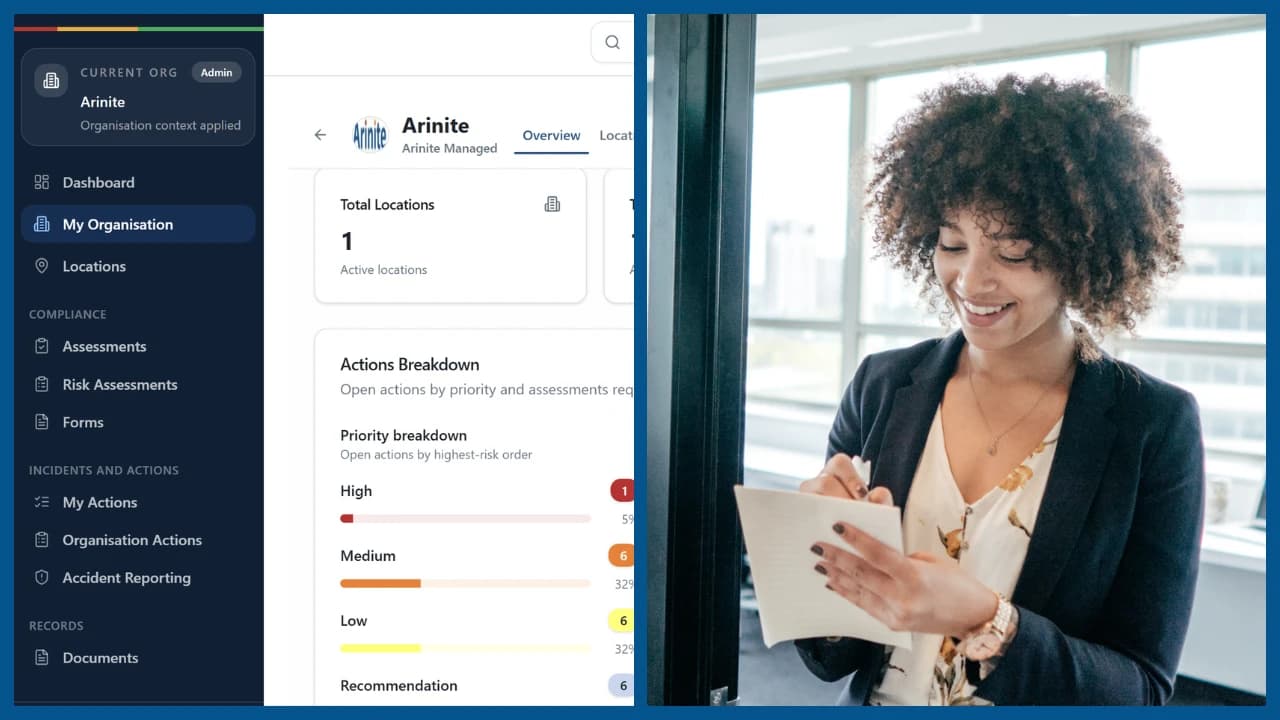
Compliance
Traditional consultancies audit, report and leave. You get a document and the job of implementing it.
Control
Software companies give you dashboards and workflows without the knowledge to use them.
Coverage
Global businesses need consultants who know compliance in every jurisdiction.
Arinite
We are not a consultancy that adds external software. We are not a software company that recommends consultants.
We are the place where those two things finally become one.
50+ Countries. Global Safety. Local Trust.
Headquartered in London, UK, with Qualified health and safety consultants in 50+ countries. Whether you need a health and safety audit in Manchester, a fire risk assessment in Birmingham, or outsourced workplace health and safety compliance in Singapore, we have consultants near you.
We're expanding globally

Operations Director, Arinite
I have been in the health and safety business for 35+ years. In that time, I have had one consistent experience across every sector and every country I have worked in.
Every business we speak to already knows, somewhere, that their workplace health and safety compliance has not kept pace with their growth. It is not ignorance. It is business. It is the assumption that because nothing has gone wrong yet, the gaps are probably manageable.
What stops most businesses from doing something about it is not the cost of outsourcing health and safety support. It is the fear of finding out how significant the gaps are.
The Free Gap Analysis Call exists for exactly that moment.
You get the full picture of your workplace health and safety position in 30 minutes.
“In 35+ years, I have not once had someone tell us they wished they had stayed in the dark.”
No video testimonials available at the moment.
Join 1,500+ organisations that trust Arinite as their health and safety consultants.
Common questions about CQC compliance, sharps, infection control, moving and handling, lone working, and clinical risk
Our Qualified health and safety consultants are here to help with any queries about workplace safety, compliance, or our services.
Download our comprehensive library of expert guides, checklists, and templates.
Browse LibraryHave a question or need expert advice? We're here to help.
Fill out the form below and our team will get back to you within 24 hours.
Headquarters
29 Throgmorton St
London EC2N 2AT