Safety Signs: 8 Things the Regulations Actually Require
Search for safety signs and you will mostly find people selling them. That is reasonable, and it produces a particular understanding of the subject: that compliance is a purchasing exercise, and that more signs means safer.
The Health and Safety (Safety Signs and Signals) Regulations 1996 take a different view. Signs are what you provide when the risk cannot be avoided or adequately controlled by other means, and an office covered in signage is usually an office that has substituted notices for control.
Eight things the Regulations actually require.
1. A sign is a last resort, not a control measure
The provision that reframes everything.
Regulation 4 requires the employer to provide and maintain a safety sign where there is a risk to health and safety that has not been avoided or controlled by other means, provided the sign can help reduce that risk.
Read the sequence. Avoid the risk first. Control it by other means second. A sign comes third, and only where it will actually help.
An organisation that responds to a hazard by ordering a sign has usually skipped the first two steps, and the sign does not discharge the duty. This is the same hierarchy that runs through every other assessment your organisation makes.
2. There are defined categories, and they mean specific things
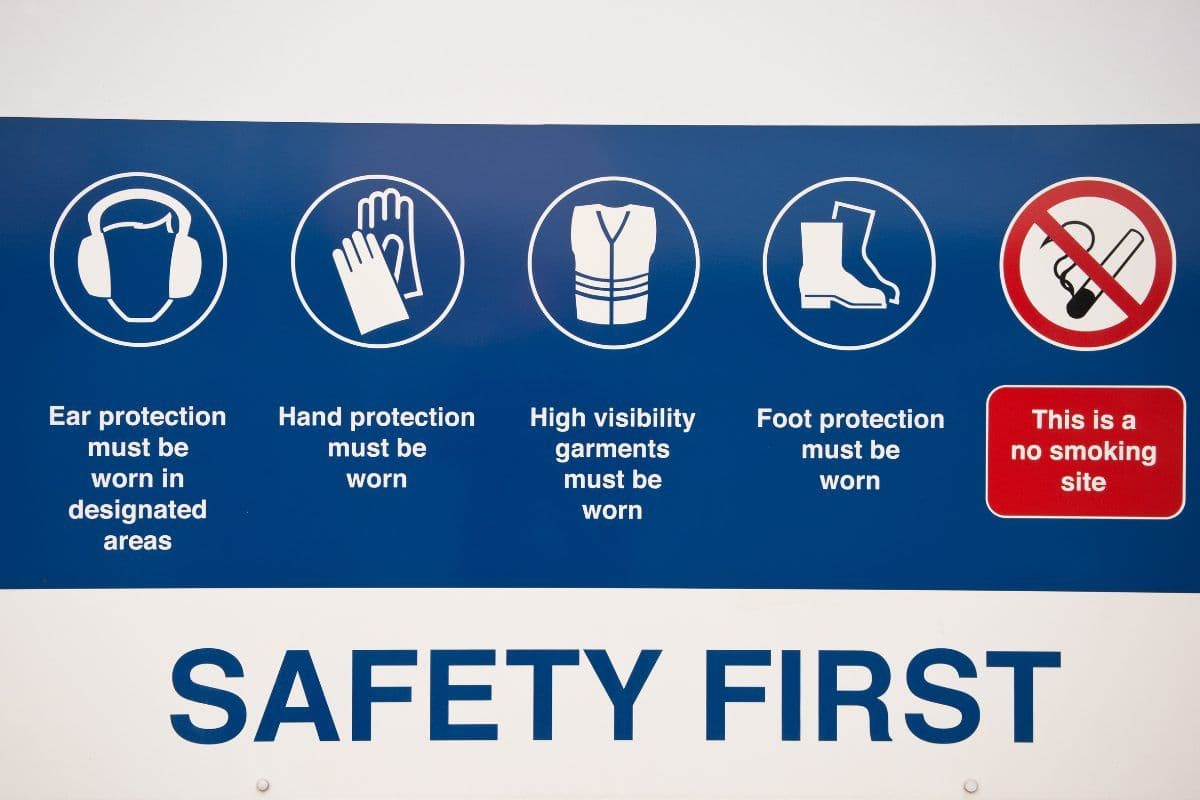
The Regulations and their schedules set out the system, and the categories carry meaning through shape and colour rather than through text alone.
Prohibition. Round, red border with a diagonal bar. Something must not be done.
Warning. Triangular, yellow with a black border. Be careful, there is a hazard.
Mandatory. Round and blue. Something must be done, typically wearing or using something.
Emergency escape and first aid. Rectangular or square, green. Where to go and where things are.
Firefighting. Rectangular or square, red. Where the equipment is.
The practical point is consistency. A sign that uses the wrong shape or colour for its purpose is harder to interpret quickly, which is when signs matter most. The full scheme is in the Regulations and their schedules.
3. Signs are not only signs
Need Expert H&S Guidance?
Our qualified consultants can help you implement the right health & safety measures for your business.
An aspect frequently missed.
The Regulations cover signals as well as signs, including illuminated signs, acoustic signals, verbal communication and hand signals. In an office context the relevant ones are illuminated emergency escape signage and the alarm itself.
That matters for maintenance. An emergency escape sign that depends on illumination is a sign that fails when its supply does, which is why emergency lighting testing and escape signage belong in the same conversation.
4. Information, instruction and training are required
Regulation 5 requires the employer to ensure that employees receive suitable and sufficient information, instruction and training regarding the measures to be taken in connection with safety signs.
A sign nobody has explained is a sign people will interpret, and interpretation varies. Most office populations can identify a fire exit sign and considerably fewer can say what a specific prohibition or mandatory sign in their building actually requires of them.
This does not need a course. It needs the signs to appear in induction alongside the arrangements they relate to.
5. Over-signing degrades the signs that matter
The failure that is genuinely common in professional offices, and it is a safety problem rather than an aesthetic one.
Where every surface carries a notice, people stop reading any of them. That is well understood in human factors terms and it is visible in most buildings: laminated signs about mugs, printers, meeting room etiquette and coffee machines competing for attention with the fire exit signage.
The discipline is to distinguish safety signage from housekeeping notices, keep them physically separate, and remove signs whose underlying reason has gone. A sign warning about a step that was removed in the last fit-out teaches people that the signs are not current.
6. Fire signage sits under a second regime as well
Worth knowing because organisations often treat it as one subject.
Article 14 of the Regulatory Reform (Fire Safety) Order 2005 addresses emergency routes and exits, including requirements relating to their marking, and other provisions of the Order deal with firefighting equipment being indicated by signs.
So fire exit and firefighting signage is required both by the signs Regulations and by the fire regime, and it needs to be consistent with your fire risk assessment rather than decided independently by whoever ordered it.
7. Maintenance, legibility and position
Signs are provided and maintained, which imposes an ongoing obligation.
Four practical failures recur. Signs obscured by furniture, storage or a plant that has grown. Signs faded by sunlight to the point of illegibility. Signs left in place after the layout changed, pointing at a route that no longer exists. And signs positioned too high, too low or around a corner from the decision point they relate to.
A walk round with the fire risk assessment in hand finds all four in about twenty minutes.
8. Comprehensibility, in the workforce you actually have
The final requirement, and it connects to the wider information duty.
The category system exists precisely so that meaning does not depend on reading English. That is an advantage where a workforce includes people with different first languages, and it is undermined the moment a sign relies on a block of text.
Where an office has a multilingual workforce, contractors from various backgrounds and visitors, the test is whether somebody who does not read English well could act correctly on the signage. Pictograms and consistent colour do that work; a laminated paragraph does not.
The eight, in short
| Requirement | Common position | What is needed |
|---|---|---|
| Last resort | Sign ordered as the response | Avoid, then control, then sign |
| Categories | Chosen by appearance | Shape and colour matched to purpose |
| Signals too | Signs only | Illuminated signage and alarms included |
| Training | Assumed obvious | Signs covered in induction |
| Over-signing | More is safer | Safety signage separated from notices |
| Fire regime | One subject | Consistent with the fire risk assessment |
| Maintenance | Fit and forget | Obscured, faded, obsolete, misplaced |
| Comprehensibility | English text | Pictograms and colour carry the meaning |
Rows one and five are the two that matter most, and they point the same way. Signs work when there are few of them, they are current, and they are the residue after the real controls have been applied.
For international offices
Two considerations, and the first is unusually favourable.
The visual system travels well. The shape and colour conventions in the British Regulations derive from European requirements and align closely with the international standard for graphical symbols and safety signs used across many markets. That makes signage one of the few pieces of safety infrastructure a group can broadly standardise, which is the opposite of the position with almost every document covered in this series.
The text and the legal specifics do not. Language requirements differ, several jurisdictions require safety instructions in a particular language, and Saudi Arabia and Kuwait both require safety instructions displayed in Arabic. Fire signage requirements and the associated inspection regimes are national.
So a group standard specifying pictograms and layout will transfer, while the text, the language and the fire documentation behind it will not. Holding each site's position in one register is where health and safety consultants and software are worth more together than either alone, and periodic health and safety audits find obsolete signage more reliably than anything else.
Where Arinite fits
Arinite treats signage as the output of an assessment rather than as a purchase, which usually means fewer signs and better ones. We support 1,500+ businesses across 50+ countries and protect 100,000+ employees, with 95%+ client retention over 15+ years. Our health and safety consultants work extensively with legal, finance and banking and IT and software organisations, and our fire risk assessment work covers escape and firefighting signage as part of the strategy rather than separately.
Where offices span several countries, our global health and safety consultants establish what each jurisdiction requires of language and fire signage, and our international health and safety consultants keep that current.
If your office has a sign warning about something that was removed in the last refurbishment, a free gap analysis will find what else is no longer describing the building.
Related Articles
Written by
Arinite Health & Safety Consultants
Health & Safety Expert at Arinite