HSE inspections up 47% - HSE carried out over 13,200 workplace inspections in 2024/25.
Marketing agencies, creative shops, PR firms, advertising agencies, and digital production businesses look like office-based professional services on the surface and they are. But the project-based tail (events, shoots, activations, experiential, production) layers in genuine elevated-risk activity, the pitch-driven culture creates documented psychosocial demand well above the cross-sector average, and the Worker Protection Act 2023 reasonable steps now sit directly on the agenda for an industry where third-party harassment (clients, talent, contractors) is a real exposure. Arinite delivers the compliance stack that covers studio and field, configured for the realities of agency operations.
Marketing and agencies covers a wide range of operations: integrated advertising agencies, creative and design studios, PR and communications firms, digital and content marketing agencies, social media agencies, event and experiential agencies, media buying agencies, video and film production businesses, brand and packaging design studios, and in-house creative functions within larger employers. The compliance profile shares common threads:
A hybrid creative workforce working across studio, home, and client offices. A project-based tail of events, shoots, activations, and experiential builds where the agency carries duty as employer, often as contractor under client procurement terms, and sometimes as designer or principal designer under CDM 2015 for activations that include construction work. A pitch-driven culture with deadline cycles that create documented psychosocial demand, and a workforce demographic skewed young, often with high vulnerability to overwork and mental health pressure. And an industry post-MeToo where Worker Protection Act 2023 reasonable steps documentation is increasingly a procurement condition from major brand clients.
Arinite provides Qualified consultants and compliance software to marketing and creative agencies across the UK and 50+ countries.
These are the marketing agency health and safety failures Arinite's Qualified consultants find most frequently. Each one is a real exposure to HSE enforcement, civil claims, client procurement failure, and director liability under Section 37 HSWA 1974.
Universal across the sector. The single most common gap.
Activations, launches, brand events, and shoots run without documented risk assessments or method statements. The most common gap in project-active agencies.
EAP, Headspace, four-day-week experiments in place; no documented psychosocial risk assessment. Pitch cycles, deadline density, and client volatility are recognised statutory psychosocial demand factors.
Particularly significant in agency contexts given the prevalence of client entertainment, talent interactions, freelancer relationships, and travel.
Particularly common in independent agencies and growth-stage shops.
Where activation builds involve construction work (staging, scaffolding, structural builds), the agency or its production partner may carry designer or principal designer duties, often without realising.
Studios change locations frequently, often to bespoke creative spaces. Risk assessments often do not follow.
The agency engages large numbers of freelance creatives, production crew, and talent without consistent H&S coordination.
For agencies running events, activations, and experiential work, the project-based risk profile is materially elevated above the studio. Each event or activation requires its own documented risk assessment and method statement (RAMS) under MHSWR Regulation 3 and the wider regulatory framework.
Building familiarisation, fire safety arrangements, emergency procedures, access and egress, structural integrity.
Where staging, scaffolding, structures, lighting rigs, or set builds are involved, the build phase carries the highest risk in the entire activation.
Public attendance numbers, queue management, capacity limits, security arrangements.
Temporary electrical installations, generators, lighting rigs, audio, special effects.
Stage, marquees, temporary demountable structures, signage, branding installations.
Hot work permits, pyrotechnic licensing, smoke machine fire alarm interactions.
Catering food safety, alcohol service, allergen management.
Working hours, breaks, welfare facilities, accommodation.
For outdoor events.
First aid, medical cover, evacuation plan, incident response.
The Construction (Design and Management) Regulations 2015 apply to construction work, which includes the build of staging, scaffolding, structural elements, and bespoke installations on activations. Where CDM applies:
The client (typically the agency or the end brand) carries client duties under CDM 2015 Regulation 4.
A principal designer must be appointed where there is more than one contractor, with duties under Regulations 11 and 12.
A principal contractor must be appointed in the same circumstances, with duties under Regulations 13 and 14.
Designer duties apply to anyone preparing or modifying a design, including set designers and production designers, under Regulation 9.
Pre-construction information and the construction phase plan must be prepared and maintained.
Most agencies discharge CDM duties through their production partners but the agency carries residual client-side responsibility. Arinite supports CDM 2015 capability planning, partner selection, and ongoing compliance.
Photo and video shoots, in studio or on location, carry distinct risk patterns:
Lighting rigs, set builds, camera platforms, and crane work all involve working at height. The Work at Height Regulations 2005 apply.
Lighting, electrical effects, generators, and temporary mains all require documented competent person installation and isolation procedures under the Electricity at Work Regulations 1989.
Kit transport, set construction, equipment movement on location, and load-in / load-out activities all involve significant manual handling. Task-specific assessment under the Manual Handling Operations Regulations 1992.
Pre-production scouting, location reconnaissance, and post-production wrap-up activities often involve lone working in unfamiliar environments.
Shoot duration, break management, welfare facilities, mental health support, and (for shoots involving children) Child Performance Licences and chaperone arrangements.
Remote locations, urban locations, water, height, weather, and any specific environmental risks at the chosen shoot location.
Filming permits, road closure notices, location owner permissions, and where applicable Civil Aviation Authority approval for drone work.
The agency business model creates documented elevated psychosocial demand: pitch cycles concentrating workload, client volatility creating unpredictable spikes, deadline-driven culture with extended working hours, and a young workforce demographic with higher vulnerability to mental health issues. Under MHSWR Regulation 3, psychosocial factors are a statutory risk assessment category. The HSE Management Standards and ISO 45003:2021 set the framework. See our stress and mental health at work page.
Pitch cycles, deadline density, client volatility, workload distribution across creative teams.
Creative autonomy, ability to push back on unreasonable timelines, account team workload management.
Senior creative supervision, mentoring, sponsorship, and feedback culture, particularly for junior creatives.
Bullying, harassment, and client behaviour. Worker Protection Act 2023 specifically addresses third-party harassment (clients, talent, contractors).
Role clarity for creatives working across multiple accounts and disciplines.
Mergers, network restructures, account wins and losses, client moves.
The Worker Protection Act 2023, in force from 26 October 2024, places specific weight on prevention of sexual harassment by third parties. For agencies, the high-risk third-party touchpoints include client entertainment, talent interactions, freelancer and contractor relationships, on-shoot crew interactions, and conference and award travel. Documented risk assessment, policy, training, and reasonable steps are required.
Every marketing and creative agency must:
Conduct a documented risk assessment under MHSWR Regulation 3 covering studio, home, hybrid, client-site, event, and shoot activities.
Conduct DSE assessments for every habitual screen user under the Display Screen Equipment Regulations 1992.
Maintain a documented psychosocial risk assessment.
Document Worker Protection Act 2023 reasonable steps including third-party harassment.
Maintain a documented fire risk assessment for every occupied premises.
Produce a risk assessment and method statement (RAMS) for every event, activation, and shoot.
Comply with CDM 2015 duties where activation builds involve construction work.
Operate Work at Height Regulations 2005 and Electricity at Work Regulations 1989 compliance for shoot and event activities.
Appoint one or more competent persons under MHSWR Regulation 7. See our competent person service.
Maintain a written health and safety policy signed by a director.
Operate freelancer and contractor coordination arrangements.
Report specified injuries, diseases, and dangerous occurrences under RIDDOR.
General duties; Section 37 director liability.
Risk assessment, competent person, training, and worker information duties.
DSE assessment for habitual screen users including home and hybrid workers.
Documented fire risk assessment for every non-domestic premises.
Minimum welfare standards for occupied premises.
Preventative duty on sexual harassment, including by third parties.
Reasonable adjustments duty for workers with disabilities.
For activations involving construction work.
For shoots, event builds, and rigging.
For temporary electrical installations.
Task-specific assessment of significant manual handling activities.
Mandatory reporting of specified workplace injuries, diseases, and dangerous occurrences.
For events including alcohol, public entertainment, and temporary structures.
Delivered as part of our outsourced health and safety service.
Studio, home, hybrid, client-site, event, and shoot activity risk assessment.
Event-specific RAMS for activations, launches, brand events, and experiential work.
Shoot-specific RAMS for studio and location photo and video productions.
CDM duty review, partner selection, and ongoing compliance for activations involving construction work.
For studio, hybrid, and home-based staff.
HSE Management Standards-aligned psychosocial risk assessment.
Risk assessment, policy, training, and documented reasonable steps including third-party harassment.
PAS 79:2020 fire risk assessments for studios and offices.
Supplier compliance pack production and audit-day support.
See our health and safety policy, health and safety audit, and competent person services.
See our health and safety software.
For all employees.
On H&S duties.
With deeper line manager training, given sector-elevated psychosocial demand.
Including third-party scenarios.
For project teams.
For production and creative leadership.
For shoot and event crew.
Appropriate to the studio and premises.
For designated first aiders.
See our health and safety training service.
The following is an illustrative example of how Arinite engagement typically runs for a marketing agency, drawn from common patterns across our agency client base.
An independent integrated agency with 120 employees and an active events and experiential practice approaches Arinite after a major brand client adds workplace H&S and Worker Protection Act 2023 documentation to their supplier compliance review. The agency holds a basic H&S policy but no current risk assessment, no DSE programme, and event RAMS produced on a per-project basis without consistency.
Arinite's free gap analysis call identifies the priority gaps. We agree a 90-day remediation programme. In month one, we deliver: a refreshed health and safety policy signed by the managing director, a current MHSWR Regulation 3 risk assessment covering studio, home, hybrid, client-site, event, and shoot activities, a competent person appointment, and DSE self-declarations to all 120 employees through our software platform.
In month two: we deliver a fire risk assessment for the studio, run the psychosocial risk assessment using HSE Stress Indicator Tool, document Worker Protection Act 2023 reasonable steps with specific provisions for third-party harassment, and produce standardised event and shoot RAMS templates that the production team can deploy consistently across projects.
In month three: we deliver CDM 2015 awareness training to the production team, train senior leadership on their Section 37 duties, hand over to ongoing competent person retainer with quarterly reviews, and complete the brand client supplier compliance pack.
The client compliance review passes. The competent person retainer continues. The agency now deploys standardised RAMS on every event and shoot, with the production team supported by the Qualified competent person on a retainer basis.
Five practical reasons agencies appoint Arinite as their outsourced competent person:
We cover both the studio H&S documentation set and the project-based event, activation, and shoot RAMS.
The integrated documentation pack satisfies the workplace H&S sections of major brand client supplier compliance reviews.
Production teams deploy consistent risk assessments and method statements across events and shoots without rebuilding from scratch each time.
Particularly relevant in agency contexts, with documented reasonable steps covering client, talent, freelancer, and conference touchpoints.
MHSWR Regulation 7 requires competent advice.
If you operate adjacent to marketing and creative agencies, you may also find these sector pages relevant:
Book a free gap analysis call with one of our Qualified health and safety consultants. In 30 minutes, we will assess your current arrangements, identify the compliance gaps that matter most for your brand client procurement cycle, and give you a clear recommendation and indicative cost.
From Reactive Firefighting to Proactive Health & Safety Compliance
No formal HSE systems in place. Everything is reactive, waiting for something to go wrong. Documentation is missing or outdated.
This isn't just "non-compliant." It's criminally negligent. Directors face personal prosecution.
Basic HSE documentation is in place. Minimum legal requirements met. You can pass a basic audit.
Compliance is where most consultants get you, then leave. You're legal, but you're not optimised.
Systems run proactively, preventing problems before they occur. Compliance is distributed, not dependent on one person.
That's why 95%+ of clients renew year after year.

Robert Winsloe
Managing Director, Arinite
“We work with you to deliver peace of mind. We tailor our service provision to your business to provide proactive, pragmatic health and safety advice and that helps reduce costs by ensuring compliance with relevant health and safety legislation.”
Other Consultants
Get you to Stage 2 (Compliant) and disappear.
Arinite
Gets you to Stage 3 (Proactive) and keeps you there.
That's why we call it transformation, not just compliance.
Compliance
Traditional consultancies audit, report and leave. You get a document and the job of implementing it.
Control
Software companies give you dashboards and workflows without the knowledge to use them.
Coverage
Global businesses need consultants who know compliance in every jurisdiction.
Arinite
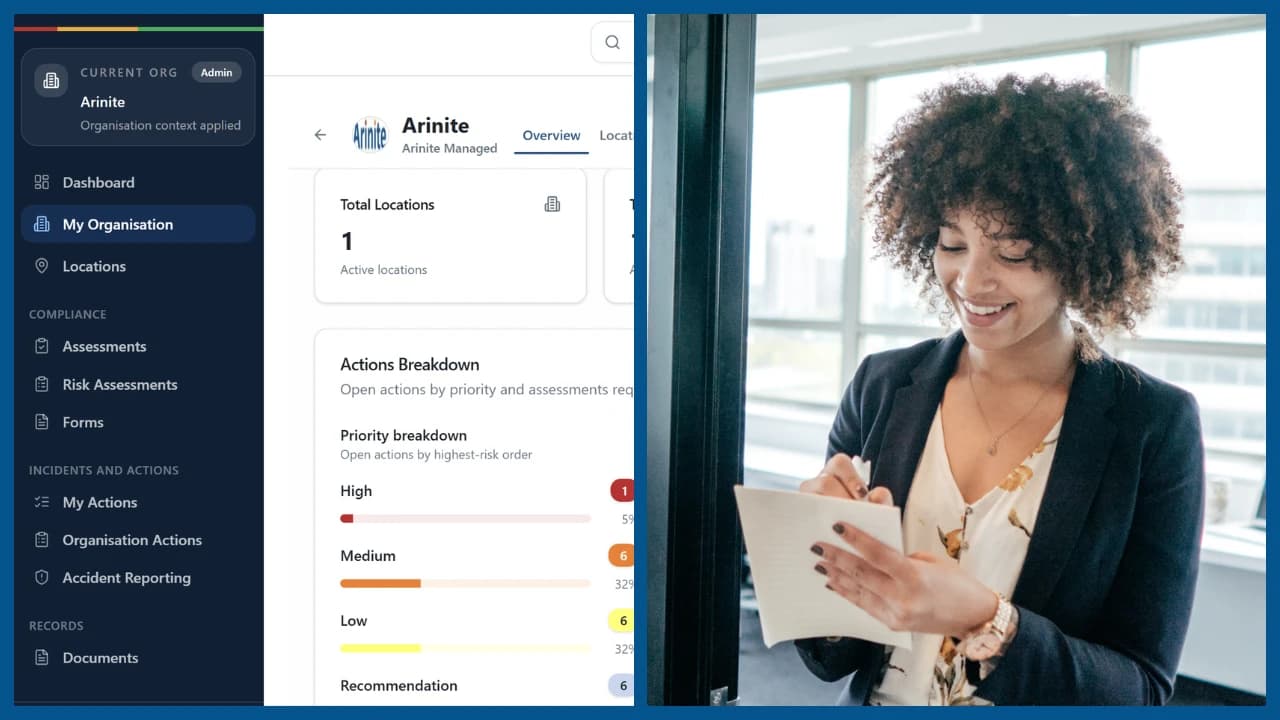
We are not a consultancy that adds external software. We are not a software company that recommends consultants.
We are the place where those two things finally become one.
50+ Countries. Global Safety. Local Trust.
Headquartered in London, UK, with Qualified health and safety consultants in 50+ countries. Whether you need a health and safety audit in Manchester, a fire risk assessment in Birmingham, or outsourced workplace health and safety compliance in Singapore, we have consultants near you.
We're expanding globally

Operations Director, Arinite
I have been in the health and safety business for 35+ years. In that time, I have had one consistent experience across every sector and every country I have worked in.
Every business we speak to already knows, somewhere, that their workplace health and safety compliance has not kept pace with their growth. It is not ignorance. It is business. It is the assumption that because nothing has gone wrong yet, the gaps are probably manageable.
What stops most businesses from doing something about it is not the cost of outsourcing health and safety support. It is the fear of finding out how significant the gaps are.
The Free Gap Analysis Call exists for exactly that moment.
You get the full picture of your workplace health and safety position in 30 minutes.
“In 35+ years, I have not once had someone tell us they wished they had stayed in the dark.”
No video testimonials available at the moment.
Join 1,500+ organisations that trust Arinite as their health and safety consultants.
Common questions about events, shoots, psychosocial risk, CDM 2015, and agency compliance
Our Qualified health and safety consultants are here to help with any queries about workplace safety, compliance, or our services.
Download our comprehensive library of expert guides, checklists, and templates.
Browse LibraryHave a question or need expert advice? We're here to help.
Fill out the form below and our team will get back to you within 24 hours.
Headquarters
29 Throgmorton St
London EC2N 2AT