Trading Floor Health and Safety: 8 Risks Office Assessments Miss
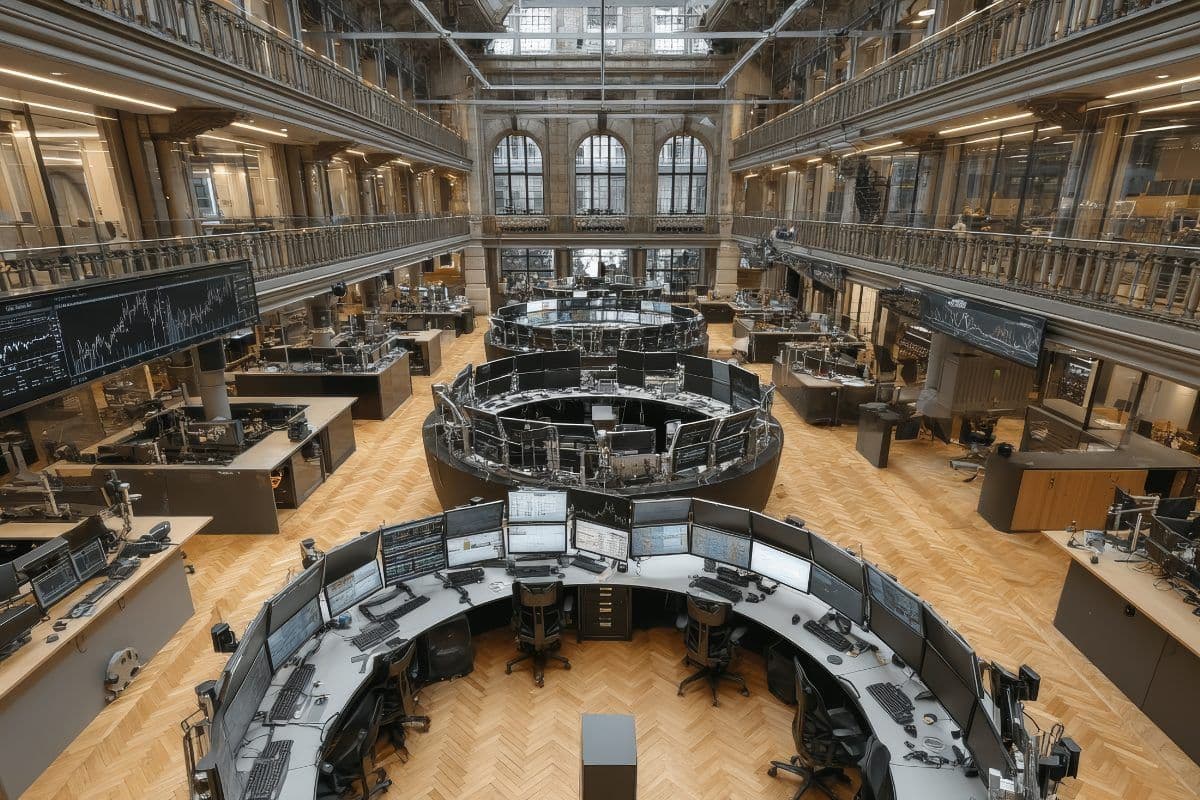
A dealing room looks like an office and does not behave like one. The desks are closer together, the screens outnumber the people four to one, the ambient noise is continuous, nobody leaves at a predictable hour, and the intensity arrives in waves that everyone can see coming and nobody can move.
Standard office risk assessments are written for a floor where people sit at a desk, use a screen, take a lunch break and go home. Applied to a trading floor, they produce a document that is accurate about the carpet and silent about everything that actually affects the people on it.
Eight risks that a general assessment misses. Most apply equally to a dealing desk, a market operations floor, a trading technology team and a 24-hour support function.
1. Multi-screen workstations are a different assessment
The display screen equipment framework applies to users regardless of how many screens they have, but a four or six screen setup raises questions a single-monitor assessment never asks.
Where the primary screen sits, how far the peripheral screens are from the centre line, how often the neck rotates to reach them, and whether the desk depth accommodates the arrangement at all. Continuous rotation to a screen positioned forty-five degrees off centre for eight hours is a different exposure from occasional glances. HSE's guidance on display screen equipment sets out what the assessment covers, and the DSE assessment needs to address the actual configuration rather than a generic workstation.
Eye and eyesight tests are part of the duty too. Under the display screen equipment regulations, users are entitled to appropriate tests on request, and HSE explains the eye test entitlement. Take-up on trading floors is frequently low, which is not evidence that the duty is discharged.
2. Nobody leaves the desk
The behaviour that makes everything else worse.
The display screen regulations require the employer to plan activities so that daily work at a screen is periodically interrupted by breaks or changes of activity, and regulation 4 of those regulations addresses the daily work routine of users specifically. On a dealing floor the natural interruptions that office workers get, walking to a meeting room, going to a printer, taking a call standing up, are largely absent, and lunch is eaten at the desk during an open market.
The realistic control is not a break policy that nobody follows. It is designing the desk and the coverage arrangements so that leaving is possible: someone to hand over to, a norm that permits it, and equipment that supports posture change including sit-stand where feasible.
3. The workload peaks are foreseeable, which makes them assessable
Need Expert H&S Guidance?
Our qualified consultants can help you implement the right health & safety measures for your business.
Stress is a hazard to be assessed, and the HSE Management Standards identify demands, control, support, relationships, role and change as the six areas to address.
The distinguishing feature of financial floors is that the peaks are known in advance. Market opens and closes, month and quarter end, index rebalancing, results season, central bank announcements, and settlement cycles are all in the calendar. A hazard that recurs on a published schedule is the easiest kind to assess and the hardest to claim was unforeseeable.
This is the single most consequential gap on most trading floor assessments, because the physical environment is usually well managed and the organisational one is usually not assessed at all.
4. Working time, and what counts as a rest break
Extended hours are normal in the sector and the framework still applies.
The Working Time Regulations 1998 set entitlements including a rest break where daily working time exceeds six hours, and daily rest between working days. Certain roles fall within specific exceptions and some workers opt out of the weekly limit, but an opt-out addresses the average weekly hours and does not dispose of every other entitlement.
The practical question is whether the arrangements are documented and whether the records exist. Firms are generally confident about the opt-out paperwork and considerably less confident about anything else.
5. Night and early shifts have their own regime
Where the floor covers Asian or American hours from a European base, or runs a follow-the-sun support model, night working provisions engage.
Night workers are subject to limits on normal hours and to an entitlement to a free health assessment, and the arrangements around this are frequently informal in financial firms because the people involved are senior and salaried. Seniority does not remove the entitlement. HSE's guidance on fatigue sets out why shift patterns matter physiologically rather than merely as a scheduling preference.
Shift design is the control that actually works: direction of rotation, speed of rotation, the length of runs of nights, and recovery time after them.
6. Ambient noise is an environmental problem, not a hearing one
Trading floors are loud, and the risk is usually mischaracterised in both directions.
The levels are typically nowhere near those requiring hearing protection under the noise regulations framework, so firms conclude there is no issue. But continuous ambient noise at levels well below the action values still degrades concentration, increases cognitive load and interferes with communication, and communication failures on a dealing desk have consequences beyond health and safety.
Where headsets are used continuously, the relevant questions are volume management, hygiene and fit rather than exposure limits. Where they are not, the design questions are absorption, screening and layout.
7. Density changes the evacuation arithmetic
Dealing floors are among the densest occupied spaces in commercial offices, and a fire strategy calculated on a general office occupancy figure may not reflect them.
Three things are worth checking specifically. Whether the floor's actual occupancy matches the assumption in the building's fire risk assessment. Whether escape routes remain clear given desk layouts that have evolved incrementally since the fit-out. And whether personal emergency evacuation plans work in a dense environment where the designated assistant may be mid-transaction.
There is also a cultural obstacle unique to these floors, which is a reluctance to evacuate during market hours. That is a real phenomenon and it needs addressing explicitly rather than being left to the moment.
8. The same floor exists in other countries, under other rules
For a bank or asset manager with dealing operations in more than one location, the arrangements do not port.
A German entity requires a documented Gefährdungsbeurteilung with psychosocial load assessed as a statutory component, and a works council with co-determination rights over arrangements affecting health and safety. A French entity requires a DUERP that includes psychosocial risk, mandatory since 2021. A Swedish entity is subject to direct regulation of workload and working hours as organisational working environment matters.
A group standard describing what a good dealing floor looks like is useful. It does not satisfy any of those requirements on its own.
What a trading floor assessment should cover
| Area | The specific question | Typical finding | |---|---|---| | Multi-screen DSE | Is the actual configuration assessed, not a generic desk? | Generic assessment, real setup unexamined | | Breaks | Is leaving the desk actually possible? | Policy exists, coverage does not | | Workload peaks | Are scheduled peaks assessed as a hazard? | Not assessed at all | | Working time | Are arrangements documented and records kept? | Opt-outs filed, nothing else | | Night and early shifts | Are health assessments offered and shifts designed? | Informal because staff are senior | | Noise | Is ambient noise treated as a design issue? | Dismissed because below action values | | Evacuation | Does the strategy match actual density and layout? | Based on general office occupancy | | Other countries | Does each entity meet its own national test? | Group standard translated |
Rows three and eight are where most of the exposure sits, and neither is visible in a physical walkthrough. That is precisely why they survive assessments that look thorough.
Where Arinite fits
Arinite assesses the environments financial organisations actually operate, including floors where a standard office template produces a document nobody recognises. We support 1,500+ businesses across 50+ countries and protect 100,000+ employees, with 95%+ client retention over 15+ years. Our health and safety consultants work extensively with finance and banking and insurance organisations, and periodic health and safety audits test the organisational arrangements as well as the physical ones.
Where dealing operations span several countries, our global health and safety consultants ensure each entity satisfies its own national requirements, and our international health and safety consultants keep that current. Holding assessments and actions for every floor in one register is where health and safety consultants and software are worth more in combination than either alone.
If your dealing floor is covered by the same assessment as the rest of the building, a free gap analysis will show you what that assessment is not saying.
Related Articles
Written by
Arinite Health & Safety Consultants
Health & Safety Expert at Arinite