HSE inspections up 47% - HSE carried out over 13,200 workplace inspections in 2024/25.
Engineering carries the full elevated-risk profile of manufacturing plus three sector-specific layers: workshop hazards spanning multiple disciplines simultaneously, design responsibility duties under CDM 2015, and project oversight obligations on client sites. Arinite's Qualified consultants deliver the full engineering compliance stack: engineering workshop risk assessments, PUWER and LOLER compliance for the workshop fleet, CDM 2015 design risk advisory, and the documented management system that satisfies both internal governance and client pre-qualification.
Engineering firms sit at a particularly demanding intersection of compliance. The workshop carries machinery, electrical, COSHH, noise, vibration, and manual handling risk simultaneously. The design office carries CDM 2015 design risk responsibility. The project team carries duty when working at client sites, often as principal designer or designer in CDM terms. Engineering employers routinely fail one of these three because they have built compliance for the workshop and overlooked design or project duty (or vice versa).
Arinite provides Qualified health and safety consultants and compliance software to engineering firms across the UK and 50+ countries, including consulting engineers, mechanical and electrical engineers, structural engineers, civil engineering contractors, building services engineers, and bespoke fabrication and prototype workshops.
These are the engineering health and safety failures Arinite's Qualified consultants find most frequently. Each one is a real exposure to HSE enforcement, civil claims, client audit failure, and director liability under Section 37 HSWA 1974.
Site-wide risk assessment covers the office but treats the workshop as a single activity. No discipline-by-discipline (welding, machining, electrical, fabrication) assessment.
Design work carried out without documented competence checks, design risk register, or pre-construction information capture.
Bench drills, grinders, lathes, CNC equipment, welders, and pillar drills running without machine-specific risk assessment or guarding review.
Lifting accessories (eye bolts, lifting frames, slings) used in workshop and on site but not in the LOLER register.
Engineers attending client sites without confirmation of the client's risk assessment, permit requirements, or induction process.
PPE supplied ad hoc without face fit testing for RPE, no documented selection rationale, no replacement cycle.
Long-hours culture, project deadline pressure, and isolation on remote sites overlooked as statutory psychosocial risk categories.
The engineering workshop is the highest-density risk environment most firms operate. A compliant workshop risk assessment under MHSWR Regulation 3 must address each discipline separately, not lump them into one generic workshop assessment.
Rotating machinery, ejection of swarf and tooling, entanglement, isolation procedures.
Fume, UV exposure, hot work, gas safety, hot work permits.
Plasma cutting fume, sparks, hot metal handling, manual handling of stock.
Dust generation, abrasive wheel safety, eye protection, hand-arm vibration.
Live work risk, isolation, portable appliance testing.
Solvent COSHH, ventilation, fire safety, RPE.
Forklifts, pallet trucks, overhead cranes, jib cranes.
Manual handling, racking integrity, falling objects.
A compliant engineering workshop documentation pack includes machine-specific PUWER assessments, COSHH assessments for every substance and process-generated agent, noise assessment, LEV register, lifting equipment register, hot work permit system, abrasive wheel competence records, and PAT testing records. Arinite builds this pack as a single integrated set during onboarding.
The Construction (Design and Management) Regulations 2015 place specific statutory duties on every designer and principal designer involved in construction work, including engineering consultancies and engineering design houses working on construction projects.
Eliminate, reduce, or control foreseeable risks arising from the design.
Provide information about remaining risks to the principal designer, principal contractor, and ultimately to those carrying out the work and the eventual users of the structure.
Cooperate with other designers, the principal designer, and the principal contractor.
Confirm the client is aware of their duties.
Where the engineering firm is appointed as principal designer, additional duties apply:
Planning, managing, and monitoring the pre-construction phase.
Coordinating health and safety in design.
Compiling the pre-construction information for the principal contractor.
Preparing the health and safety file.
CDM 2015 Regulation 8 requires that designers and principal designers must have the skills, knowledge, and experience to perform their roles. For engineering firms, this means documented competence at organisational and individual level: training records, CPD evidence, project portfolios, and where appropriate, professional registration (CEng, IEng, IMechE, IET, IStructE).
Engineering firms regularly send personnel to client sites: factory installation, commissioning, site survey, fault diagnosis, plant maintenance, and witness testing. Each visit carries its own compliance footprint.
Confirmation of the client's risk assessment and method statement for the work area.
Confirmation of any permit-to-work requirements (hot work, confined space, working at height, isolation).
Site induction arrangements.
PPE and RPE requirements at the client site.
Lone working and check-in arrangements where appropriate.
The engineering firm's own risk assessment and method statement (RAMS) must be available on site, in addition to client-specific permits. Engineers should not begin work without both.
Working on client sites does not transfer the employer's duty of care. The engineering firm retains primary responsibility for the safety of its own employees and bystanders affected by their work, regardless of any client permit-to-work or client RAMS.
Every engineering employer must:
Conduct a documented general risk assessment under MHSWR Regulation 3 covering workshop, office, and project activities.
Conduct task-specific assessments under PUWER, LOLER, COSHH, Noise at Work, Vibration at Work, and Manual Handling Regulations.
For design work, comply with CDM 2015 designer and where applicable principal designer duties.
Maintain a documented register of machinery, lifting equipment, electrical equipment under test, and LEV systems.
Appoint one or more competent persons under MHSWR Regulation 7. See our competent person service.
Maintain a written health and safety policy signed by a director.
Operate permit-to-work systems for hot work, confined space, work at height, and electrical isolation.
Document contractor management for both contractors visiting your workshop and your own engineers visiting client sites.
Report specified injuries, diseases, and dangerous occurrences under RIDDOR.
Operate health surveillance appropriate to workshop risks: audiometry, respiratory, skin, hand-arm vibration.
Provide information, instruction, training, and supervision under MHSWR Regulation 10 and 13.
Maintain accident reporting and root cause investigation arrangements.
See our health and safety legislation guide for the full framework.
General duties; Section 37 director liability.
Risk assessment, competent person, training, worker information.
Workshop machinery, work equipment, guarding.
Lifting equipment, lifting operations, thorough examination.
Hazardous substances, exposure control, health surveillance, LEV.
Designer and principal designer duties.
Arinite delivers the full range of engineering health and safety services through Qualified consultants and integrated health and safety software. Delivered as part of our outsourced health and safety service.
Discipline-by-discipline assessments covering machining, welding, fabrication, grinding, assembly, paint, transport, and stores.
Machine-by-machine PUWER assessments for workshop equipment including bench drills, grinders, lathes, CNC equipment, welders, and pillar drills.
Full LOLER register including workshop lifting equipment and on-site lifting accessories, scheduled thorough examination, and certificate management.
Designer competence documentation, design risk registers, pre-construction information capture, and principal designer support where appointed.
Site-specific risk assessments and method statements for engineering site visits, commissioning, and field service work.
Hazardous substance inventory, SDS management, LEV examination, and health surveillance design.
Workplace noise and hand-arm vibration assessment, hearing protection programme, audiometry coordination.
Documented audits identifying gaps against the engineering regulatory framework. See our health and safety audit service.
External Qualified competent person satisfying MHSWR Regulation 7.
Gap analysis and implementation support for engineering firms pursuing ISO 45001 certification.
CHAS, Achilles, SafeContractor, Constructionline, and bespoke client audit support.
Centralised platform for risk assessments, machinery and LOLER registers, COSHH inventory, training, RAMS, incidents, and audits.
Training is a specific legal requirement under MHSWR Regulation 10 and PUWER Regulation 9. The core engineering training stack covers:
Including isolation and lockout-tagout.
Safety and permit-to-work issuance.
Competence under PUWER Regulation 9.
Task-specific training.
Training including PFAS competence where relevant.
Training for issuers, entrants, and rescue.
For design teams.
Training for engineers attending client sites.
For designated workshop and site personnel.
Induction and fire warden training.
See our health and safety training service.
The following is an illustrative example of how Arinite engagement typically runs for an engineering business.
A mid-market mechanical and electrical engineering consultancy with 140 employees, working across building services design, construction site supervision, and post-handover commissioning, approaches Arinite after a major principal contractor adds workplace H&S to its supplier review process and requests evidence of CDM 2015 designer duty discharge, current PI insurance, ISO 45001 status, and accident records for the past three years.
Arinite's free gap analysis call identifies the priority gaps. We agree a 90-day remediation programme. In month one, we deliver: a refreshed health and safety policy signed by the managing director, a current MHSWR Regulation 3 risk assessment covering office, design, site supervision, and commissioning activities, a competent person appointment, and DSE self-declarations to all 140 employees including site engineers.
In month two: we deliver a fire risk assessment for the office, a site working risk assessment covering construction site visits and on-site commissioning, a documented CDM 2015 designer duty discharge framework with project file templates, and document Worker Protection Act 2023 reasonable steps with specific provisions for principal contractor and trade contact harassment risk.
In month three: we deliver psychosocial risk assessment, train senior engineers on CDM 2015 designer duties and Section 37 personal liability, deliver supplier audit-day support for the principal contractor review, and hand over to ongoing competent person retainer.
The supplier audit passes. The competent person retainer continues with quarterly reviews. The firm now has a documented CDM 2015 designer framework that supports future bid responses without case-by-case scrambling.
Five practical reasons engineering businesses appoint Arinite as their outsourced competent person:
Documented designer duty discharge framework for engineering consultancies including project file templates and pre-construction information practice.
Workplace H&S extended to construction site visits, commissioning, and on-site engineering presence.
The integrated documentation pack satisfies principal contractor and large customer supplier audits.
Our consultants combine workplace H&S with construction safety, electrical safety, and equipment safety expertise.
MHSWR Regulation 7 requires competent advice.
If you operate adjacent to engineering, you may also find these sector pages relevant:
Book a free gap analysis call with one of our Qualified health and safety consultants. In 30 minutes, we will assess your current engineering health and safety arrangements, identify the compliance gaps that matter most, and give you a clear recommendation and indicative cost.
From Reactive Firefighting to Proactive Health & Safety Compliance
No formal HSE systems in place. Everything is reactive, waiting for something to go wrong. Documentation is missing or outdated.
This isn't just "non-compliant." It's criminally negligent. Directors face personal prosecution.
Basic HSE documentation is in place. Minimum legal requirements met. You can pass a basic audit.
Compliance is where most consultants get you, then leave. You're legal, but you're not optimised.
Systems run proactively, preventing problems before they occur. Compliance is distributed, not dependent on one person.
That's why 95%+ of clients renew year after year.

Robert Winsloe
Managing Director, Arinite
“We work with you to deliver peace of mind. We tailor our service provision to your business to provide proactive, pragmatic health and safety advice and that helps reduce costs by ensuring compliance with relevant health and safety legislation.”
Other Consultants
Get you to Stage 2 (Compliant) and disappear.
Arinite
Gets you to Stage 3 (Proactive) and keeps you there.
That's why we call it transformation, not just compliance.
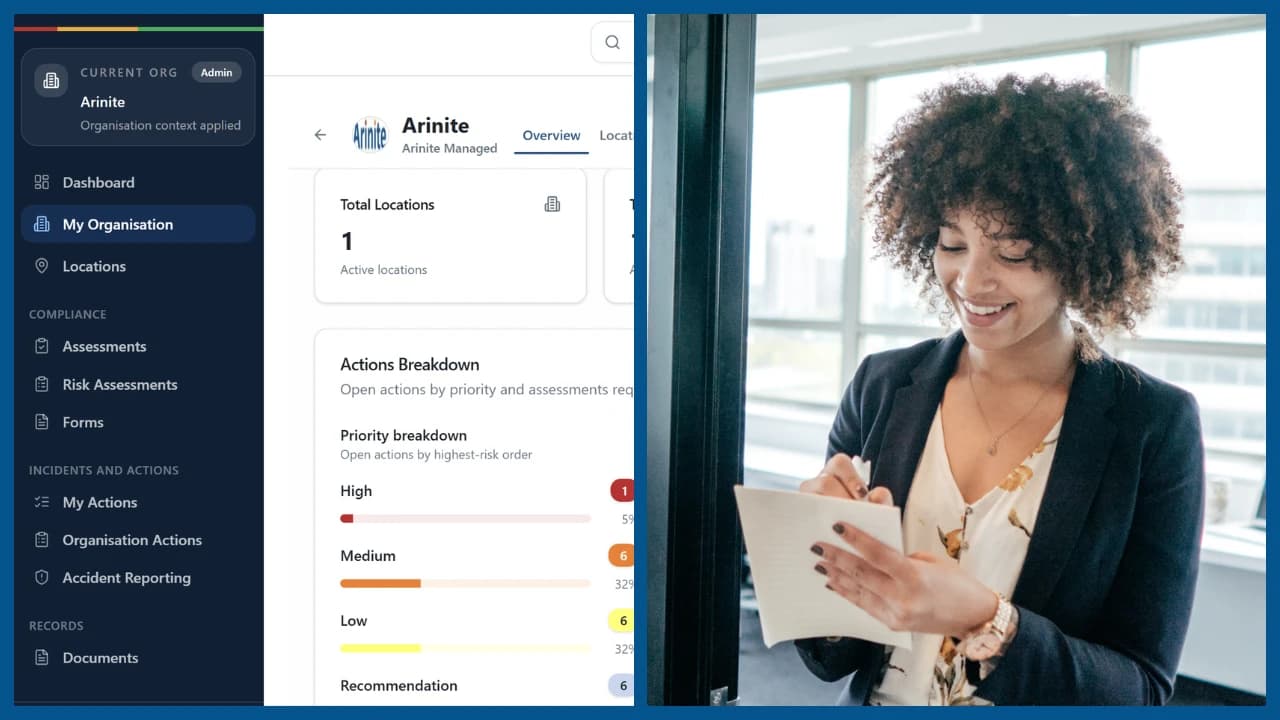
Compliance
Traditional consultancies audit, report and leave. You get a document and the job of implementing it.
Control
Software companies give you dashboards and workflows without the knowledge to use them.
Coverage
Global businesses need consultants who know compliance in every jurisdiction.
Arinite
We are not a consultancy that adds external software. We are not a software company that recommends consultants.
We are the place where those two things finally become one.
50+ Countries. Global Safety. Local Trust.
Headquartered in London, UK, with Qualified health and safety consultants in 50+ countries. Whether you need a health and safety audit in Manchester, a fire risk assessment in Birmingham, or outsourced workplace health and safety compliance in Singapore, we have consultants near you.
We're expanding globally

Operations Director, Arinite
I have been in the health and safety business for 35+ years. In that time, I have had one consistent experience across every sector and every country I have worked in.
Every business we speak to already knows, somewhere, that their workplace health and safety compliance has not kept pace with their growth. It is not ignorance. It is business. It is the assumption that because nothing has gone wrong yet, the gaps are probably manageable.
What stops most businesses from doing something about it is not the cost of outsourcing health and safety support. It is the fear of finding out how significant the gaps are.
The Free Gap Analysis Call exists for exactly that moment.
You get the full picture of your workplace health and safety position in 30 minutes.
“In 35+ years, I have not once had someone tell us they wished they had stayed in the dark.”
No video testimonials available at the moment.
Join 1,500+ organisations that trust Arinite as their health and safety consultants.
Common questions about workshop risk assessment, CDM 2015 designer duties, PUWER, and LOLER
Our Qualified health and safety consultants are here to help with any queries about workplace safety, compliance, or our services.
Download our comprehensive library of expert guides, checklists, and templates.
Browse LibraryHave a question or need expert advice? We're here to help.
Fill out the form below and our team will get back to you within 24 hours.
Headquarters
29 Throgmorton St
London EC2N 2AT