EV Charging at the Office: 6 Things Fire Risk Assessments Miss
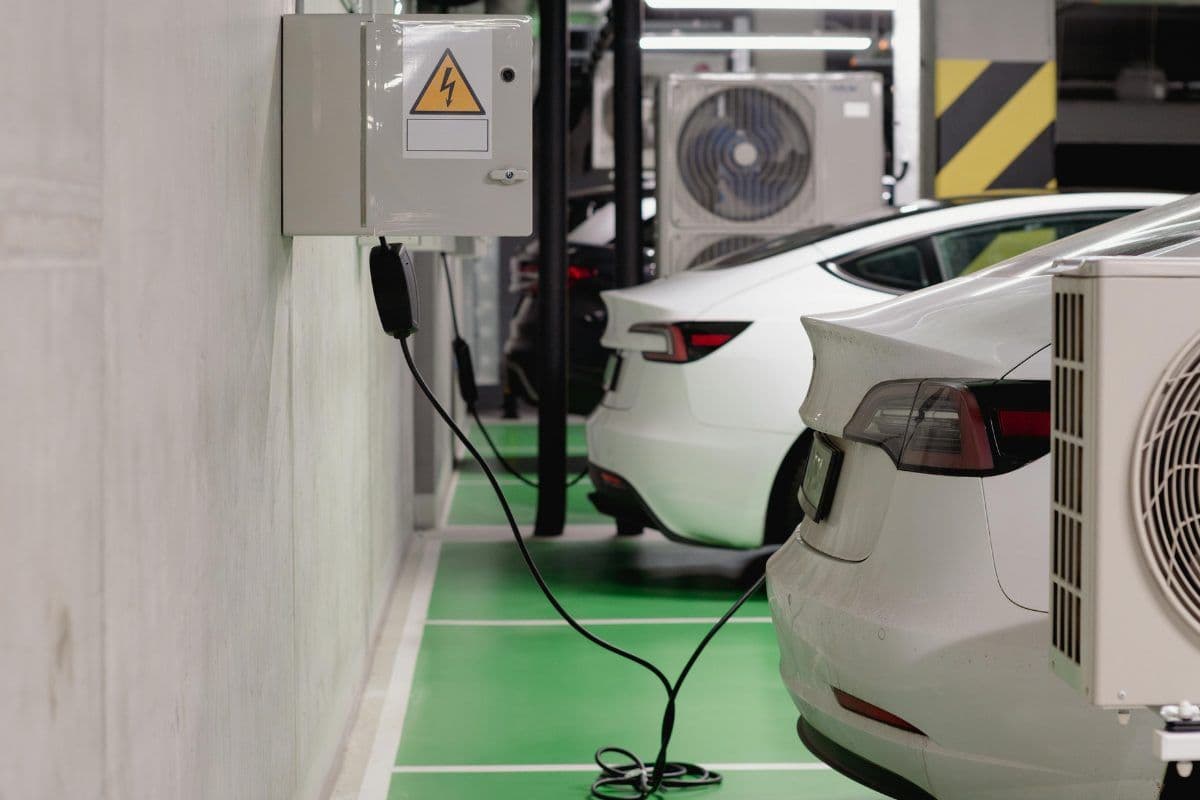
Two things arrived in office buildings over the past few years and almost nothing in the safety documentation changed to reflect either.
Charge points appeared in car parks, driven by fleet electrification, staff demand and building regulations. And employees started arriving on e-bikes and e-scooters, which they bring inside, store in cycle rooms or under desks, and sometimes charge at work.
Both introduce energy storage into premises whose fire strategy was written before either existed. The fire risk assessment that covers your building is very likely to describe a car park with cars in it and a cycle store with bicycles in it, which is no longer an accurate description.
Six things it probably misses.
1. The fire risk assessment was not reviewed when the chargers went in
The foundational gap, and the easiest to check.
Article 9 of the Regulatory Reform (Fire Safety) Order 2005 requires the responsible person to make a suitable and sufficient assessment of the risks, and to review it if it is no longer valid or if there has been a significant change.
Installing electrical vehicle charging infrastructure into a car park is a significant change. So is converting a cycle store into a place where lithium batteries are charged. In practice both are usually procured by facilities or property teams as an amenity project, with electrical sign-off and no fire safety review at all.
If your building acquired chargers and your assessment has the same date it had before, that is the first thing to correct.
2. Enclosed and underground car parks are a different problem
Where the risk concentrates, and where a great many city offices sit.
An open surface car park and a basement or multi-storey structure present very different fire scenarios: heat cannot dissipate, smoke fills the volume, access for firefighting is constrained, and structural consequences are more serious. Adding charging points changes the profile again, because vehicles are stationary, connected and unattended for extended periods, often overnight when the building is empty.
The relevant questions are where charge points are sited relative to escape routes and structural elements, what detection and suppression exists in that space, whether the fire and rescue service can reach a vehicle, and what your evacuation and salvage assumptions are. These are questions for a competent fire risk assessor rather than for a charge point supplier, and the two are not the same conversation.
3. E-bikes and e-scooters are the more likely source
Need Expert H&S Guidance?
Our qualified consultants can help you implement the right health & safety measures for your business.
The counterintuitive point, and the one most organisations have back to front.
Attention naturally goes to cars because they are large and visible. The evidence from fire services across the UK has repeatedly pointed at e-bikes and e-scooters as a growing cause of serious fires, with particular concern about aftermarket and incompatible chargers, second-hand or converted batteries, and cells that have been damaged in ordinary use.
Those devices come into your building in a way cars never do. They are carried into lobbies, stored in cycle rooms, left in corridors, and charged from wall sockets in break rooms and under desks. The battery on a converted e-bike charging next to a fire door is a more realistic ignition scenario than anything in your car park.
Our existing coverage of disposable vapes and lithium-ion batteries sets out the underlying battery risk in more detail.
4. There is usually no policy on where charging may happen
The control that costs nothing and is almost always absent.
Most organisations have not decided whether staff may charge personal devices at work, where, or under what conditions. In the absence of a decision, people charge wherever there is a socket, which tends to be wherever they are sitting.
A workable position is short and specific: whether personal e-bike and e-scooter charging is permitted at all, and if so in a designated location with separation, detection and no obstruction of escape routes. Some organisations prohibit charging while permitting storage, some prohibit both, and some provide a properly designed facility. All three are defensible. Having no position is not.
Where flammable or explosive atmospheres could arise, HSE guidance on DSEAR is relevant, and the electrical installation itself sits under the Electricity at Work Regulations 1989 framework.
5. Damaged batteries have nowhere to go
The gap that appears the first time something goes wrong.
A swollen, dropped or visibly damaged battery is the highest risk item on this list, and in most workplaces there is no procedure for it. It gets left in the cycle store, put in a cupboard, or taken home.
What is needed is unglamorous: a way to report a damaged battery, a quarantine location away from the building and from escape routes, and a disposal route through an appropriate waste contractor rather than general waste. The Office for Product Safety and Standards publishes material on product safety, and safe disposal is a waste question as well as a fire one.
6. Nobody has agreed who is responsible in a leased building
The question that stalls everything above, and the same one that recurs across every shared premises topic.
In a leased or serviced building the landlord or operator typically owns the car park, procured the chargers and holds the premises fire risk assessment. You employ the people, occupy the floor and control the cycle store your staff actually use. Where more than one person has fire safety duties in respect of the same premises, the law requires them to co-operate and co-ordinate.
Three questions settle it in writing: who assessed the fire risk arising from the charging infrastructure, what the building's position is on personal e-bike and e-scooter charging and storage, and how an incident involving a battery is reported and to whom. An operator who cannot answer the first has given you a useful answer to a different question.
Note also that building regulations in England have required electric vehicle charge point provision in specified circumstances for new buildings and major renovations, through Approved Document S. A newly fitted-out building may therefore have arrived with charging infrastructure that nobody in your organisation asked for or assessed.
The six, summarised
| Item | Question | Typical position | |---|---|---| | Assessment currency | Was the fire risk assessment reviewed when chargers were installed? | Same date as before | | Car park type | Is the space enclosed, and does the assessment reflect that? | Generic car park treatment | | Personal devices | Are e-bikes and e-scooters in the building? | Yes, unassessed | | Charging policy | Is there a stated position on where charging may occur? | None | | Damaged batteries | Is there a reporting, quarantine and disposal route? | None | | Shared premises | Is the split with the landlord agreed in writing? | Assumed |
Rows three, four and five are the ones to act on first, because they cost almost nothing, they address the more likely ignition source, and none of them requires the landlord's agreement.
For multi-site and international groups
Two additional considerations.
Fire safety requirements are national and diverge more than most safety topics, so the arrangements at a London office are not a template for Frankfurt, Amsterdam or Singapore. What travels is the question set rather than the answer.
And this is a topic where insurers are increasingly interested. Expect questions at renewal about charging infrastructure, storage of personal electric vehicles, and battery handling, in the same way that questions about premises documentation already arise. Having a considered position recorded before that conversation is considerably easier than assembling one during it.
Holding assessments, actions and site-level positions in one register across every location is where health and safety consultants and software are worth more together than either alone, and periodic health and safety audits confirm the arrangements match what is actually in the building.
Where Arinite fits
Arinite assesses buildings as they are currently used rather than as they were designed, which for this topic is the entire point. We support 1,500+ businesses across 50+ countries and protect 100,000+ employees, with 95%+ client retention over 15+ years. Our health and safety consultants work extensively with finance and banking, legal and IT and software organisations, and our fire risk assessment work covers infrastructure added after the original strategy was written.
Where sites span several countries, our global health and safety consultants confirm what each jurisdiction requires, and our international health and safety consultants keep that current as buildings change.
If your car park gained charge points and your fire risk assessment did not change, a free gap analysis will tell you what else moved with them.
Related Articles
Written by
Arinite Health & Safety Consultants
Health & Safety Expert at Arinite