What Does COSHH Stand For? 15 Things Every UK and Global Business Must Know
If your workforce handles cleaning chemicals, fuels, paints, solvents, dust, fumes, biological agents, or any substance more hazardous than tap water, you are already inside the scope of COSHH. Yet a remarkable number of UK directors, HR leaders, and international managers cannot answer the simple question their auditors keep asking: what does COSHH stand for?
The short answer: COSHH is one of the most enforced sets of regulations in British health and safety law, and the one most often cited in HSE prosecutions for ill-health. The longer answer is that COSHH shapes how you buy chemicals, how you store them, how you train your people, what you write down, and what you can prove when the regulator walks through your door. Get it right, and you protect both your workforce and your reputation. Get it wrong, and the consequences range from sickness absence and insurance disputes to fines, prohibition notices and prosecutions.
This guide is for business owners, HR leaders, facilities managers, safety officers and international heads of compliance who need a clear, plain-English answer, plus the wider picture of how COSHH fits into a modern, multi-jurisdictional health and safety programme. Below are the 15 essentials every UK and global business should know in 2026.
1. COSHH Stands for the Control of Substances Hazardous to Health Regulations
The straightforward answer to "what does COSHH stand for" is the Control of Substances Hazardous to Health Regulations, currently in force as COSHH 2002, set out in Statutory Instrument 2002 No. 2677. It is enforced by the Health and Safety Executive and places a legal duty on UK employers to prevent or adequately control workplace exposure to hazardous substances.
COSHH is not just "the chemical rules." It is a complete management framework: identify, assess, control, train, monitor, review. If your organisation cannot demonstrate each of those five steps for every hazardous substance on site, you are exposed.
2. COSHH Sits Inside a Wider UK Legal Framework
COSHH does not work in isolation. It builds on the Health and Safety at Work etc. Act 1974 and the Management of Health and Safety at Work Regulations 1999, which require risk to be assessed and controlled across all work activities. COSHH simply zooms in on the subset of those risks that involve hazardous substances.
If your organisation is unclear on how these instruments connect, our explainer on workplace health and safety law maps the full picture for UK and global teams.
3. COSHH Covers Far More Than Just "Chemicals"
Need Expert H&S Guidance?
Our qualified consultants can help you implement the right health & safety measures for your business.
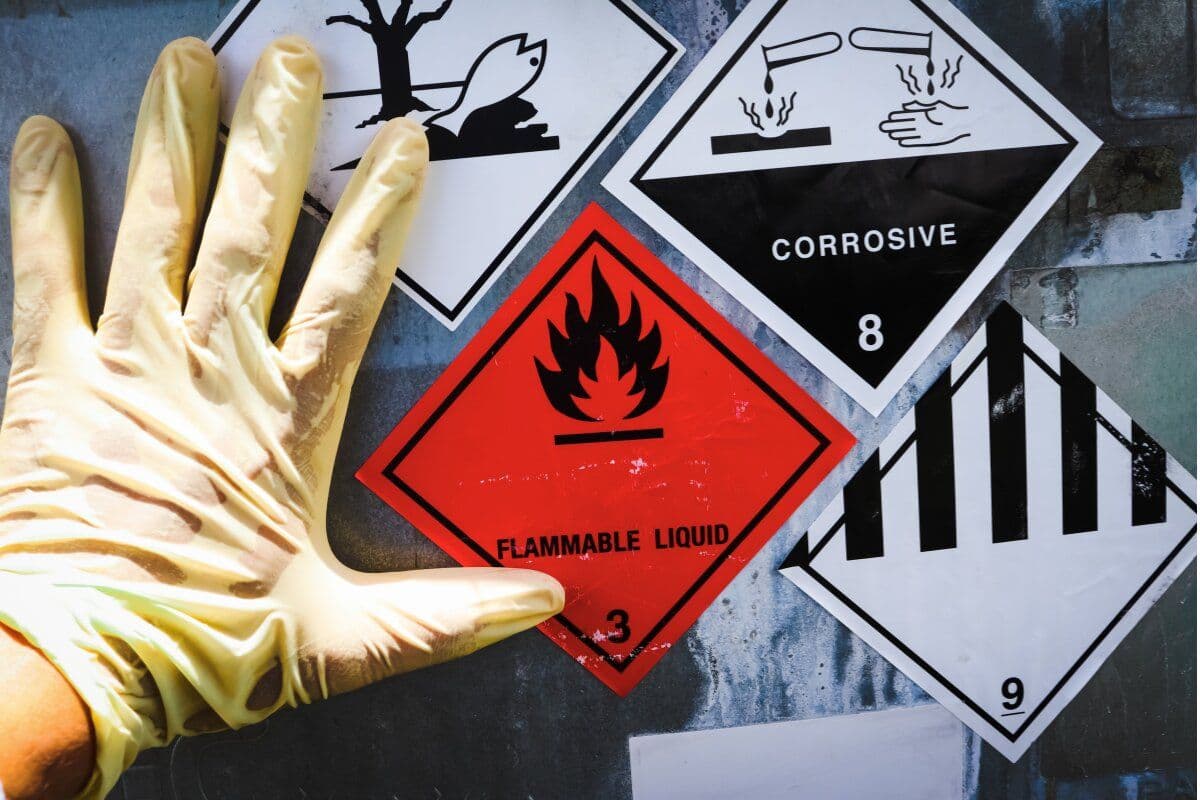
A frequent mistake is to assume COSHH only applies to obviously hazardous liquids labelled with skull-and-crossbones symbols. In reality, COSHH covers a much wider set of substances, including:
- Chemicals and chemical products (cleaning agents, paints, solvents, adhesives, fuels)
- Fumes, gases, mists, vapours and dust
- Biological agents (bacteria, viruses, fungi, blood-borne pathogens)
- Germs that cause diseases such as Legionnaires' disease
- Naturally occurring substances such as flour dust or silica
The simple test: if it can harm someone through inhalation, ingestion, absorption through the skin, or contact with the eyes, COSHH probably applies.
4. COSHH Does Not Cover Everything
Equally important is what COSHH does not cover, because these substances have their own dedicated regimes:
- Asbestos: regulated under the Control of Asbestos Regulations 2012, supported by our asbestos service page
- Lead: regulated under the Control of Lead at Work Regulations 2002
- Radioactive substances: regulated under separate ionising radiation regulations
Mistaking which regime applies is a classic compliance error. If you handle any of the above, a quick review with your competent person is well worth the investment.
5. The Five COSHH Steps Form the Backbone of Compliance
The HSE's COSHH guidance sets out a clear, five-step approach that every employer should be able to evidence:
- Assess the risks to health from hazardous substances used in or created by your activities
- Decide what precautions are needed before any work starts
- Prevent or adequately control exposure, using the hierarchy of controls
- Ensure control measures are used and maintained
- Monitor exposure, carry out health surveillance, and prepare for emergencies
Our existing guide on COSHH key steps to compliance walks through each step in practical detail.
6. COSHH Assessments Are a Legal Requirement, Not a Template Exercise
Every workplace that uses substances hazardous to health must complete a COSHH assessment for each substance and task. Generic templates copied between sites will not pass scrutiny. A proper assessment identifies the substance, the people exposed, the route of exposure, the level of risk, the controls in place, and the residual risk.
The principles mirror the wider risk assessment process but with a specific lens on chemical and biological agents. If your assessments are out of date, missing, or applied inconsistently across sites, that is a gap any auditor or inspector will find quickly.
7. The Hierarchy of Controls Drives Every Decision
COSHH expects employers to follow the hierarchy of controls, in this order:
- Eliminate the hazardous substance entirely
- Substitute it with something less harmful
- Engineer controls (extraction, ventilation, enclosure)
- Administrative controls (procedures, training, signage)
- Personal Protective Equipment (PPE) as a last resort
The most common failure is jumping straight to PPE. PPE is the last line of defence, not the first. A consultancy review through outsourced health and safety services often reveals quick wins higher up the hierarchy that save money on PPE while reducing actual risk.
8. COSHH Training Is Not Optional
Regulation 12 of COSHH 2002 requires employers to provide employees with suitable and sufficient information, instruction and training on the hazards, controls and procedures relevant to their work. That includes new starters, contractors working on your premises, and anyone whose role has materially changed.
Tailored health and safety training is far more effective than generic e-learning, particularly for sectors with high chemical exposure such as manufacturing, hospitality kitchens, cleaning, healthcare, beauty, automotive, and agriculture.
9. Health Surveillance Is Often Triggered by COSHH
For certain substances and tasks, COSHH requires health surveillance, which is the ongoing medical monitoring of exposed workers. Common triggers include exposure to substances that cause occupational asthma, dermatitis, hand-arm vibration risks, or hearing loss in combined exposure scenarios.
Many UK businesses miss this entirely until an HSE inspection or insurance audit catches it. Building health surveillance into your annual health and safety programme ensures it is not forgotten.
10. Safety Data Sheets Are Where Most Investigations Start
Every hazardous substance you bring into the workplace should come with a Safety Data Sheet (SDS) from the supplier. SDSs are governed by the GB CLP Regulation (formerly the EU CLP Regulation) and provide the data you need to complete COSHH assessments accurately.
If an incident occurs, the first thing investigators ask for is the relevant SDS, your COSHH assessment, and the training record for the affected worker. Missing or out-of-date SDSs are one of the most common findings in health and safety audits. Modern health and safety software makes SDS management trivial, but only if it is set up properly.
11. International Equivalents Exist Across Every Major Market
COSHH is uniquely British in name, but the principle of controlling exposure to hazardous substances is universal. International equivalents include:
- European Union: the REACH and CLP regulations, supported by EU-OSHA guidance, with country-specific application in France, Germany, Italy, Spain, the Netherlands and beyond
- United States: OSHA's Hazard Communication Standard (HazCom) 29 CFR 1910.1200
- Globally: the Globally Harmonised System of Classification and Labelling of Chemicals (GHS), supported by the ILO
- ISO 45001 organisations: clauses 8.1.2 and 8.1.3 of ISO 45001:2018 cover hazardous substance controls
Multinationals with UK operations must align UK COSHH compliance with these wider regimes. Our international health and safety consultants design unified chemical safety management systems that work across jurisdictions.
12. COSHH Failures Drive a Disproportionate Share of HSE Enforcement
Hazardous substance failures are one of the largest categories of HSE enforcement action. Common outcomes include improvement notices, prohibition notices, and prosecution under both COSHH and the Health and Safety at Work Act. Beyond the financial penalty, prosecution is now public record, accessible to procurement teams, insurers and prospective clients for years.
Building a defensible audit trail, through regular health and safety audits and live software-based evidence, is the single most effective protection.
13. COSHH Is Increasingly a Procurement and Tender Issue
Buyers, particularly in the public sector, healthcare, education and large industrial supply chains, routinely score suppliers on their hazardous substance management. Membership schemes like SSIP, CHAS, Constructionline and Achilles often ask for evidence of COSHH assessments, training records and accident statistics.
Good COSHH practice is therefore a commercial asset, not just a regulatory cost. Strong evidence supports the work of any health and safety tenders submission.
14. The Right COSHH System Combines Expert Advice and Smart Software
The most resilient employers combine three elements: an experienced competent person, regular advisory input from global health and safety consultants, and purpose-built health and safety consultants and software that keeps assessments, SDSs, training records and incident data in one auditable system.
Software alone is not enough, since data without judgement just creates a different kind of risk. Consultancy alone is not enough either, since insight without evidence is hard to defend. The blend is what wins.
15. COSHH Excellence Saves Money, Wins Contracts and Protects People
The often-missed truth: organisations that get COSHH right have fewer cases of occupational ill-health, lower insurance premiums, fewer days lost to sickness, stronger retention, better tender scores, and far lower exposure to enforcement. Aligning your hazardous substance controls with ISO 45001 is one of the most effective long-term investments you can make.
A mature COSHH programme is not a defensive expense. It is a commercial asset, and a marker of a workplace that treats its people seriously.
Where UK and Global Businesses Go from Here
If you have read this far and you are not certain that your COSHH process is fully aligned with the 2002 regulations and current HSE guidance, you almost certainly have gaps worth closing. The good news is that they are nearly always fixable, often quickly, and the resulting confidence pays back across audits, insurance, tenders and culture.
At Arinite, we have spent decades helping UK and international organisations move from reactive COSHH paperwork to genuinely proactive hazardous substance management. Whether you are a single-site UK SME, a multi-site national operator, or a global group with a UK presence, our health and safety consultants can review your current arrangements alongside the rest of your wider safety system.
Book a Free Gap Analysis Call
Find out exactly where your COSHH process stands against UK regulations and international expectations, and what to fix first. Book a Free Gap Analysis Call with an Arinite specialist today.
Written by
Arinite Health & Safety Consultants
Health & Safety Expert at Arinite