HSE inspections up 47% - HSE carried out over 13,200 workplace inspections in 2024/25.
Guide to UK health and safety legislation: the Act, regulations, employer duties, penalties, and international frameworks.
The Health and Safety at Work Act 1974 (HSWA) is the primary piece of health and safety legislation in the UK. It establishes the general duties that employers, employees, and self-employed persons owe to each other and to the public.
Every employer must ensure, so far as is reasonably practicable, the health, safety, and welfare at work of all employees. This includes providing and maintaining safe systems of work, ensuring the safe use, handling, storage, and transport of articles and substances, providing information, instruction, training, and supervision, maintaining the workplace in a safe condition, and providing a safe working environment with adequate welfare facilities.
Every employer with five or more employees must prepare a written statement of their general policy on health and safety and bring it to the attention of employees.
Employers must conduct their undertaking in a way that does not expose non-employees (visitors, contractors, members of the public) to health and safety risks.
Every employee must take reasonable care for their own health and safety and that of others, and must cooperate with the employer on health and safety matters.
Where an offence is committed with the consent, connivance, or neglect of any director, manager, or similar officer, that individual can be prosecuted personally.
Penalties under the Act include unlimited fines and, for the most serious offences, imprisonment for up to two years.
The Health and Safety at Work Act provides the framework. The detailed requirements come from secondary regulations made under the Act. The most important are listed below.
The overarching regulations requiring employers to assess risks, appoint competent persons (Regulation 7), make arrangements for health and safety management, provide health surveillance where appropriate, and establish emergency procedures. These regulations apply to every employer regardless of size or sector.
Requires the responsible person to carry out a fire risk assessment for all non-domestic premises and to implement appropriate fire precautions. Amended by the Fire Safety Act 2021 to cover external walls and flat entrance doors in multi-occupied residential buildings.
Requires employers to assess workstations used by habitual DSE users and to provide adequate breaks, eye tests, and corrective appliances where necessary. Applies to office-based, home-working, and hybrid employees.
Requires employers to avoid hazardous manual handling operations so far as is reasonably practicable, assess the risk of operations that cannot be avoided, and reduce the risk to the lowest level reasonably practicable.
Requires employers to assess the risk of exposure to hazardous substances, prevent or control exposure, and ensure employees are informed, instructed, and trained. Applies to chemicals, dusts, fumes, biological agents, and any substance that may cause harm.
Requires employers to report specified workplace injuries, occupational diseases, and dangerous occurrences to the HSE. Fatalities and specified injuries must be reported without delay; over-seven-day incapacitation injuries within 15 days.
Sets minimum standards for the working environment including temperature, ventilation, lighting, space, cleanliness, floors, traffic routes, windows, doors, and welfare facilities (toilets, washing, drinking water, rest areas).
Requires all work equipment to be suitable, maintained, inspected, and used only by people who have received adequate information, instruction, and training. Covers everything from office chairs to industrial machinery.
Requires employers to assess noise exposure, provide hearing protection and health surveillance where exposure exceeds action values, and take measures to reduce noise exposure at source.
Requires employers to avoid work at height where possible, use appropriate equipment where it cannot be avoided, and plan, organise, and supervise all work at height activities.
Creates the offence of corporate manslaughter where an organisation's gross breach of a duty of care causes a person's death. The offence is committed by the organisation, not individual directors (although directors can be prosecuted separately under Section 37 of the Health and Safety at Work Act).
Under UK health and safety law, every employer must provide a safe working environment with adequate welfare facilities, assess all risks to employees and anyone affected by the business activities, appoint one or more competent persons to assist with compliance, prepare a written health and safety policy (if five or more employees), provide information, instruction, training, and supervision, report specified injuries, diseases, and dangerous occurrences under RIDDOR, carry out a fire risk assessment and implement appropriate fire precautions, consult with employees on health and safety matters, and ensure all work equipment is suitable, maintained, and used safely.
These duties apply regardless of business size, sector, or perceived risk level. The standard is 'reasonably practicable': you must do everything that is reasonable to protect people, balancing the risk against the cost, time, and difficulty of the measures needed.
The Health and Safety Executive (HSE) and local authorities enforce health and safety legislation in the UK. Enforcement tools include improvement notices (requiring specific improvements within a specified timescale), prohibition notices (stopping an activity immediately where there is a serious risk), and prosecution (criminal charges in the magistrates' or Crown court).
Penalties for health and safety offences are unlimited fines in the Crown Court. The Sentencing Council guidelines introduced in 2016 significantly increased fine levels, with fines now routinely reaching six or seven figures for larger organisations.
For the most serious offences (including corporate manslaughter and breaches causing death), imprisonment of up to two years is available. Directors face personal prosecution under Section 37 where the offence was committed with their consent, connivance, or neglect.
Health and safety law varies by jurisdiction. For businesses operating internationally, understanding the framework in each country is essential.
The Occupational Safety and Health Act of 1970 (OSHA) is the primary federal legislation. It is enforced by the Occupational Safety and Health Administration. Individual states may have their own OSHA-approved plans with additional requirements.
Health and safety is regulated at both federal and provincial/territorial levels. Each province has its own occupational health and safety legislation. Federal workplaces are covered by the Canada Labour Code Part II.
The model Work Health and Safety (WHS) laws provide a harmonised framework adopted by most states and territories. Individual jurisdictions may have variations.
The Safety, Health and Welfare at Work Act 2005 is the primary legislation, broadly mirroring UK law but with distinct enforcement powers and documentation requirements.
The EU Framework Directive 89/391/EEC establishes general principles for health and safety at work. Member states implement these through national legislation. Key common requirements include risk assessment, competent person appointment, and employee consultation.
The Workplace Safety and Health Act is the primary legislation, enforced by the Ministry of Manpower.
The Health and Safety at Work Act 2015 replaced the previous legislation and introduced duties on 'persons conducting a business or undertaking' (PCBUs) rather than just employers.
Arinite operates in 50+ countries and provides locally compliant health and safety services in every jurisdiction. For country-specific guidance, contact us or visit our international health and safety page.
Health and safety legislation is complex and it changes. Keeping up with regulatory amendments, new guidance, and evolving enforcement priorities is a significant burden, particularly for businesses without a dedicated health and safety professional.
Arinite's Chartered consultants monitor legislative changes on your behalf. As part of any ongoing engagement (Done For You or Done With You), we update your documentation when regulations change, advise on any actions required, and ensure your compliance framework reflects current law.
Our health and safety software platform maintains a live record of your compliance status, so you can demonstrate to inspectors, clients, and auditors that your arrangements are aligned with current legislation at any point.
Understanding the legislation is the first step. Implementing it is the second. Arinite's Chartered consultants ensure your business is compliant with every piece of legislation that applies to your activities, your premises, and your sector.
Book a free gap analysis call. In 30 minutes, we will assess your current arrangements against the legal requirements and identify the compliance gaps that matter.
From Reactive Firefighting to Proactive Health & Safety Compliance
No formal HSE systems in place. Everything is reactive, waiting for something to go wrong. Documentation is missing or outdated.
This isn't just "non-compliant." It's criminally negligent. Directors face personal prosecution.
Basic HSE documentation is in place. Minimum legal requirements met. You can pass a basic audit.
Compliance is where most consultants get you, then leave. You're legal, but you're not optimised.
Systems run proactively, preventing problems before they occur. Compliance is distributed, not dependent on one person.
That's why 95%+ of clients renew year after year.

Robert Winsloe
Managing Director, Arinite
“We work with you to deliver peace of mind. We tailor our service provision to your business to provide proactive, pragmatic health and safety advice and that helps reduce costs by ensuring compliance with relevant health and safety legislation.”
Other Consultants
Get you to Stage 2 (Compliant) and disappear.
Arinite
Gets you to Stage 3 (Proactive) and keeps you there.
That's why we call it transformation, not just compliance.
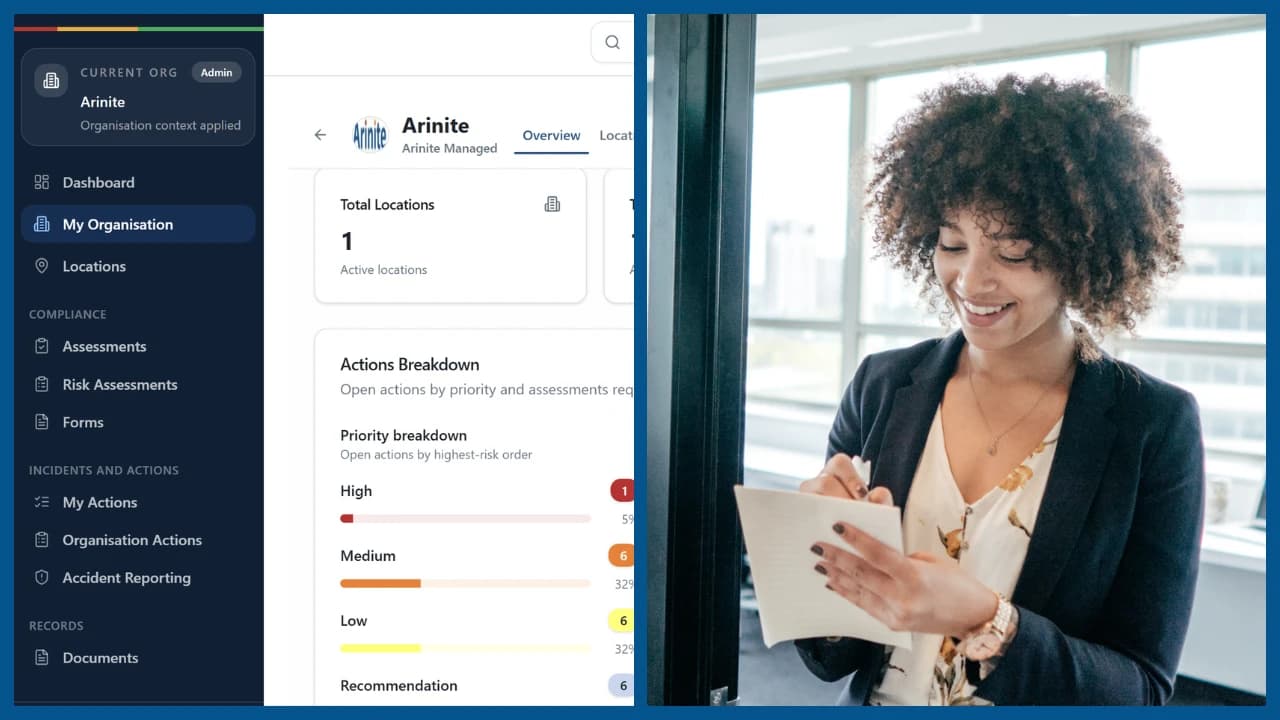
Compliance
Traditional consultancies audit, report and leave. You get a document and the job of implementing it.
Control
Software companies give you dashboards and workflows without the knowledge to use them.
Coverage
Global businesses need consultants who know compliance in every jurisdiction.
Arinite
We are not a consultancy that adds external software. We are not a software company that recommends consultants.
We are the place where those two things finally become one.
50+ Countries. Global Safety. Local Trust.
Headquartered in London, UK, with Chartered health and safety consultants in 50+ countries. Whether you need a health and safety audit in Manchester, a fire risk assessment in Birmingham, or outsourced workplace health and safety compliance in Singapore, we have consultants near you.
We're expanding globally

Operations Director, Arinite
I have been in the health and safety business for 35+ years. In that time, I have had one consistent experience across every sector and every country I have worked in.
Every business we speak to already knows, somewhere, that their workplace health and safety compliance has not kept pace with their growth. It is not ignorance. It is business. It is the assumption that because nothing has gone wrong yet, the gaps are probably manageable.
What stops most businesses from doing something about it is not the cost of outsourcing health and safety support. It is the fear of finding out how significant the gaps are.
The Free Gap Analysis Call exists for exactly that moment.
You get the full picture of your workplace health and safety position in 30 minutes.
“In 35+ years, I have not once had someone tell us they wished they had stayed in the dark.”
No video testimonials available at the moment.
Join 1,500+ organisations that trust Arinite as their health and safety consultants.
Common questions about UK health and safety law and regulations
Our IOSH Chartered health and safety consultants are here to help with any queries about workplace safety, compliance, or our services.
Download our comprehensive library of expert guides, checklists, and templates.
Browse LibraryHave a question or need expert advice? We're here to help.
Fill out the form below and our team will get back to you within 24 hours.
Headquarters
29 Throgmorton St
London EC2N 2AT