HSE inspections up 47% - HSE carried out over 13,200 workplace inspections in 2024/25.
COSHH guide: assessments, employer duties, training, and compliance explained by Chartered consultants.
COSHH stands for Control of Substances Hazardous to Health. The COSHH Regulations 2002 require employers to assess and control exposure to hazardous substances in the workplace so that workers are not harmed.
The regulations apply to almost every UK workplace because 'hazardous substances' is a broad category. It includes chemicals such as cleaning products and solvents, dusts such as those produced by sanding wood or cutting stone, fumes from welding, soldering, or cooking, biological agents such as bacteria and viruses, and asphyxiating gases. Even substances that seem harmless, such as printer toner or flour, can be hazardous at certain exposure levels.
If your employees come into contact with any substance that could harm their health, the COSHH Regulations apply to you.
The COSHH Regulations cover substances classified as hazardous under the CLP Regulation (Classification, Labelling and Packaging of substances and mixtures), substances that have a workplace exposure limit set by the HSE in EH40, biological agents (bacteria, viruses, fungi, other microorganisms), and any other substance that creates a comparable hazard to those listed above.
COSHH does not cover asbestos (regulated under the Control of Asbestos Regulations 2012), lead (regulated under the Control of Lead at Work Regulations 2002), ionising radiation, or substances hazardous only because they are flammable, explosive, or at extreme temperatures (these are covered by other regulations).
For practical workplace examples: cleaning chemicals used by facilities teams, solvents and adhesives in workshop environments, dust from construction, woodworking, or stoneworking activities, welding fumes, laboratory chemicals, paints and coatings, pesticides and biocides, and hairdressing products all fall within COSHH.
The COSHH Regulations place specific duties on employers.
Regulation 6: Carry out a suitable and sufficient COSHH assessment before work begins.
Regulation 7: Prevent or, where not reasonably practicable, adequately control exposure to hazardous substances.
Regulation 8: Ensure that control measures are used and maintained.
Regulation 9: Maintain, examine, and test control measures such as ventilation systems and respiratory protective equipment.
Regulation 10: Monitor exposure levels in the workplace where appropriate.
Regulation 11: Provide health surveillance where there is a reasonable likelihood of an identifiable disease or health effect.
Regulation 12: Provide information, instruction, and training to employees about the substances they work with and the controls in place.
Regulation 13: Have arrangements in place to deal with accidents, incidents, and emergencies involving hazardous substances.
Each duty is enforceable by the HSE or local authority. Failure to comply can result in improvement notices, prohibition notices, prosecution, and unlimited fines.
A COSHH risk assessment is a structured review of the hazardous substances used or produced in your workplace and the controls needed to protect health. The HSE recommends a five-step approach.
List every substance used, produced, or created in the workplace. Check safety data sheets (SDS) for classification information. Include dusts, fumes, and biological agents, not just labelled chemical products.
Identify the employees, contractors, visitors, or members of the public who could be exposed. Consider how exposure happens: inhalation, skin contact, ingestion, or injection. Note any particularly vulnerable groups such as pregnant workers or young persons.
Assess the level of risk based on the hazard, the quantity used, the duration of exposure, and existing controls. Apply the hierarchy of control: eliminate the substance, substitute with a less hazardous alternative, use engineering controls (local exhaust ventilation), implement administrative controls (safe systems of work), and provide personal protective equipment as a last resort.
Document the assessment, the identified risks, and the controls in place. Communicate findings to affected employees. Implement the controls and provide the necessary training, equipment, and supervision.
Review the assessment when circumstances change (new substances, new processes, new employees, incidents) or at least annually. Update the record and re-communicate any changes to employees.
Safety data sheets are the starting point for any COSHH assessment. Under the CLP Regulation, suppliers must provide a safety data sheet for any hazardous substance they supply. The SDS contains 16 sections covering identification, hazards, composition, first aid measures, firefighting, accidental release, handling and storage, exposure controls, physical properties, stability, toxicology, ecology, disposal, transport, regulatory information, and other information.
For a COSHH assessment, the key sections are Section 2 (hazards identification), Section 8 (exposure controls and personal protection), and Section 11 (toxicological information). These sections tell you what the hazards are, what controls are needed, and what the health effects are.
Safety data sheets should be kept current, accessible to employees, and referenced in your COSHH assessments. Collecting and maintaining SDS is part of a functioning COSHH management system.
Some hazardous substances have workplace exposure limits set by the HSE and published in document EH40. A workplace exposure limit (WEL) is the maximum concentration of a substance that employees can be exposed to over a specified time period, usually an 8-hour time-weighted average or a 15-minute short-term exposure limit.
WELs exist for common workplace substances including ammonia, benzene, carbon monoxide, chromium, formaldehyde, hydrogen sulfide, isocyanates, lead compounds, and hundreds of others.
Where a WEL applies, your COSHH assessment must demonstrate that exposure is controlled below the limit. For some substances this requires air monitoring and health surveillance. Where no WEL is set, exposure must be controlled to as low as reasonably practicable.
Employees who work with hazardous substances must receive COSHH training. The level of training depends on the role.
Covers the legal framework, how to recognise hazardous substances, how to read safety data sheets, and the control measures in place. Suitable for all employees whose work involves any exposure.
Qualifies employees to carry out COSHH assessments within their organisation. Covers the five-step process, hierarchy of control, SDS interpretation, and documentation requirements.
Covers the specific substances and procedures relevant to a particular role: laboratory workers, cleaners, maintenance teams, welders, and so on.
Arinite delivers COSHH training at all three levels, on-site or online. Training is tailored to your actual substances, your actual processes, and your actual workplace. See our full health and safety training page for details.
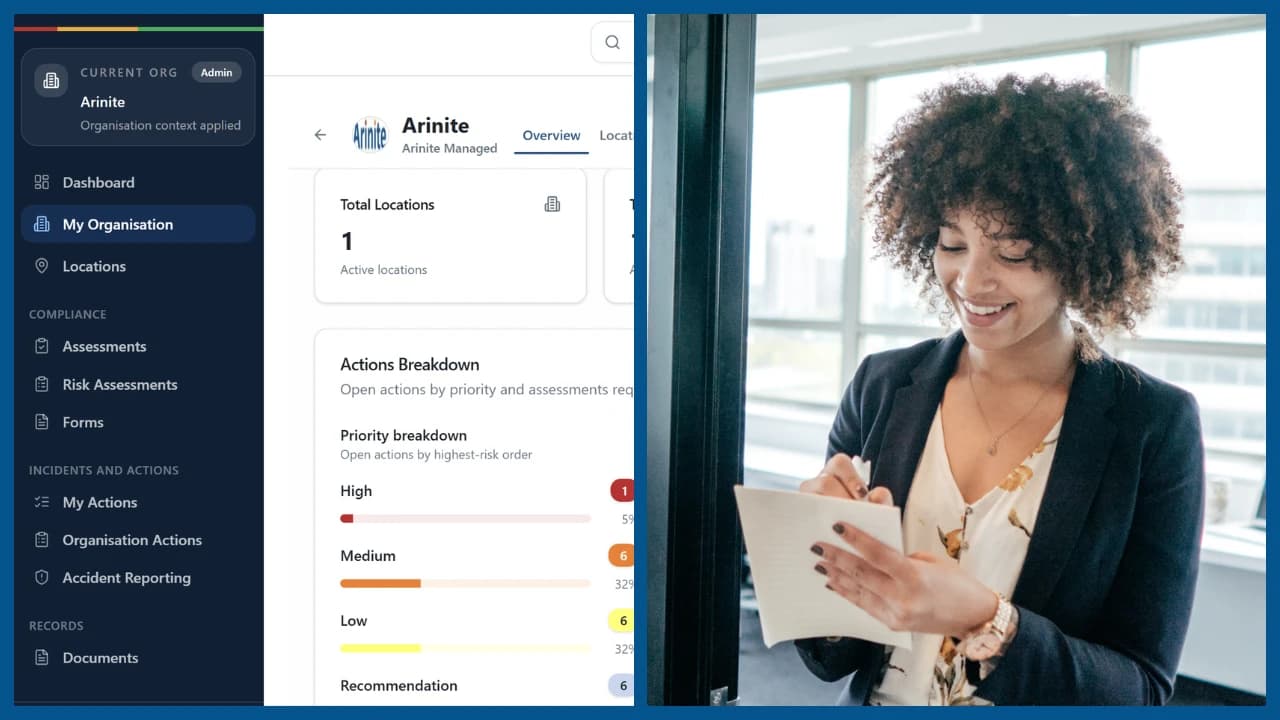
Arinite's Chartered health and safety consultants deliver COSHH compliance support as a standalone service or as part of an ongoing outsourced health and safety package. The service includes initial COSHH gap analysis to establish your current compliance position, creation or review of your COSHH assessments for every hazardous substance in your workplace, development of your COSHH management system with procedures, controls, and documentation, delivery of COSHH training to employees at all required levels, arrangement of health surveillance and exposure monitoring where the regulations require it, and ongoing maintenance of COSHH records within Arinite's health and safety software platform.
For businesses on Done For You or Done With You packages, COSHH is included in the service. Your assessments stay current, your records stay in order, and your compliance is continuously maintained rather than scrambled together when an inspector arrives.
COSHH compliance is one of the most scrutinised areas in HSE inspections. A COSHH failure is rarely a minor finding: it usually triggers an improvement notice, a prohibition notice, or prosecution, particularly if employees have been exposed without adequate assessment or control.
Book a free gap analysis call. In 30 minutes, one of our Chartered consultants will review your current COSHH arrangements, identify the gaps that would fail an inspection, and recommend the right approach.
From Reactive Firefighting to Proactive Health & Safety Compliance
No formal HSE systems in place. Everything is reactive, waiting for something to go wrong. Documentation is missing or outdated.
This isn't just "non-compliant." It's criminally negligent. Directors face personal prosecution.
Basic HSE documentation is in place. Minimum legal requirements met. You can pass a basic audit.
Compliance is where most consultants get you, then leave. You're legal, but you're not optimised.
Systems run proactively, preventing problems before they occur. Compliance is distributed, not dependent on one person.
That's why 95%+ of clients renew year after year.

Robert Winsloe
Managing Director, Arinite
“We work with you to deliver peace of mind. We tailor our service provision to your business to provide proactive, pragmatic health and safety advice and that helps reduce costs by ensuring compliance with relevant health and safety legislation.”
Other Consultants
Get you to Stage 2 (Compliant) and disappear.
Arinite
Gets you to Stage 3 (Proactive) and keeps you there.
That's why we call it transformation, not just compliance.
Compliance
Traditional consultancies audit, report and leave. You get a document and the job of implementing it.
Control
Software companies give you dashboards and workflows without the knowledge to use them.
Coverage
Global businesses need consultants who know compliance in every jurisdiction.
Arinite
We are not a consultancy that adds external software. We are not a software company that recommends consultants.
We are the place where those two things finally become one.
50+ Countries. Global Safety. Local Trust.
Headquartered in London, UK, with Chartered health and safety consultants in 50+ countries. Whether you need a health and safety audit in Manchester, a fire risk assessment in Birmingham, or outsourced workplace health and safety compliance in Singapore, we have consultants near you.
We're expanding globally

Operations Director, Arinite
I have been in the health and safety business for 35+ years. In that time, I have had one consistent experience across every sector and every country I have worked in.
Every business we speak to already knows, somewhere, that their workplace health and safety compliance has not kept pace with their growth. It is not ignorance. It is business. It is the assumption that because nothing has gone wrong yet, the gaps are probably manageable.
What stops most businesses from doing something about it is not the cost of outsourcing health and safety support. It is the fear of finding out how significant the gaps are.
The Free Gap Analysis Call exists for exactly that moment.
You get the full picture of your workplace health and safety position in 30 minutes.
“In 35+ years, I have not once had someone tell us they wished they had stayed in the dark.”
No video testimonials available at the moment.
Join 1,500+ organisations that trust Arinite as their health and safety consultants.
Common questions about COSHH regulations, assessments, training, and compliance
Our IOSH Chartered health and safety consultants are here to help with any queries about workplace safety, compliance, or our services.
Download our comprehensive library of expert guides, checklists, and templates.
Browse LibraryHave a question or need expert advice? We're here to help.
Fill out the form below and our team will get back to you within 24 hours.
Headquarters
29 Throgmorton St
London EC2N 2AT