Falls From Heights
B
Brendan TuiteOctober 31, 2019
4 min read

Disturbing video footage from Edmonton Alberta shows a window-cleaner dangling perilously from his platform, saved only by his fall-arrest harness.
Admittedly, one has to question why he was working in such high winds, and when I ask people their thoughts on the biggest killers at work, they often come out with all sorts of exotic causes such as people being electrocuted, blown up, or poisoned by chemical substances.
Health & Safety Executive statistics show that only five causes accounted for more than half of the 147 traumatic[1] workplace deaths in 2018/2019:
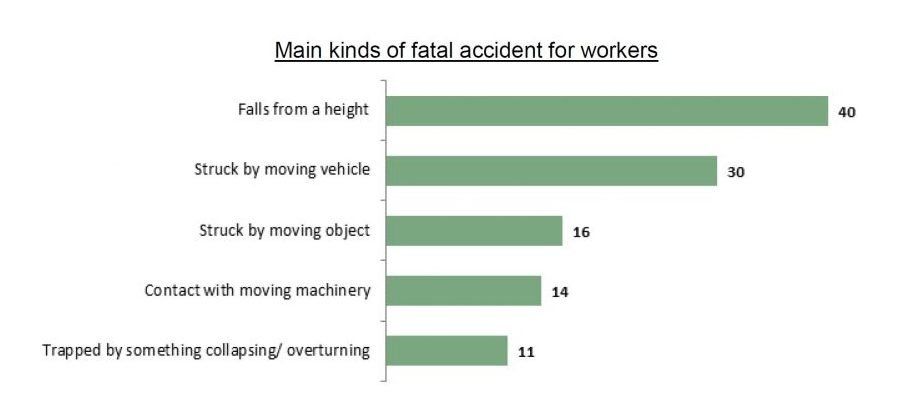 Far more mundane causes than you might have thought, and causes that, in most cases, could equally apply to workers in “safe” occupations like office work as to those in high-risk occupations such as construction, agriculture and manufacturing. Or window-cleaning.
So why is it that falls from height are the number one killer?.
When I joined the paper industry as a rookie, I was intrigued to visit a warehouse loading bay whose canopy had been fitted with inertia-reel fall-arrest wires. Lorry drivers (to their chagrin) were required to wear a harness and hook onto a wire whenever standing on the flat bed of their lorry. Story was that an unfortunate driver had once tumbled off the back of his trailer whilst sheeting-up a tarpaulin. He had fallen only about 5 feet (60cm) onto his skull – and died. When I recounted this story on a training course, one delegate told me how his cousin had stumbled out of her bath, cracked her head on the wall opposite, and died too.
It is clear therefore that human beings do not need to fall very far to cause grievous or fatal injuries.
We’ve probably all experienced that spine-jarring moment when we’ve missed, or nearly missed, our footing – and it’s not pleasant.
The main risks from head injuries are:
Far more mundane causes than you might have thought, and causes that, in most cases, could equally apply to workers in “safe” occupations like office work as to those in high-risk occupations such as construction, agriculture and manufacturing. Or window-cleaning.
So why is it that falls from height are the number one killer?.
When I joined the paper industry as a rookie, I was intrigued to visit a warehouse loading bay whose canopy had been fitted with inertia-reel fall-arrest wires. Lorry drivers (to their chagrin) were required to wear a harness and hook onto a wire whenever standing on the flat bed of their lorry. Story was that an unfortunate driver had once tumbled off the back of his trailer whilst sheeting-up a tarpaulin. He had fallen only about 5 feet (60cm) onto his skull – and died. When I recounted this story on a training course, one delegate told me how his cousin had stumbled out of her bath, cracked her head on the wall opposite, and died too.
It is clear therefore that human beings do not need to fall very far to cause grievous or fatal injuries.
We’ve probably all experienced that spine-jarring moment when we’ve missed, or nearly missed, our footing – and it’s not pleasant.
The main risks from head injuries are:
Far more mundane causes than you might have thought, and causes that, in most cases, could equally apply to workers in “safe” occupations like office work as to those in high-risk occupations such as construction, agriculture and manufacturing. Or window-cleaning.
So why is it that falls from height are the number one killer?.
When I joined the paper industry as a rookie, I was intrigued to visit a warehouse loading bay whose canopy had been fitted with inertia-reel fall-arrest wires. Lorry drivers (to their chagrin) were required to wear a harness and hook onto a wire whenever standing on the flat bed of their lorry. Story was that an unfortunate driver had once tumbled off the back of his trailer whilst sheeting-up a tarpaulin. He had fallen only about 5 feet (60cm) onto his skull – and died. When I recounted this story on a training course, one delegate told me how his cousin had stumbled out of her bath, cracked her head on the wall opposite, and died too.
It is clear therefore that human beings do not need to fall very far to cause grievous or fatal injuries.
We’ve probably all experienced that spine-jarring moment when we’ve missed, or nearly missed, our footing – and it’s not pleasant.
The main risks from head injuries are:
- Haematoma where the blood clots outside the blood vessels, putting pressure on the brain.
- Haemorrhage where blood leaks into the space around the brain or amongst the brain tissue.
- Concussion where the brain strikes the inside of the skull.
- Oedema where fluid compresses the brain.
- Start by looking at the task and discussing the safest way with the people carrying out the work. Often they will have the best ideas - but apply your own judgments too. Sometimes, in their enthusiasm to get the job done, employees will devise all sorts of makeshift - and life threatening - techniques. You've seen the photos from around the world, I'm sure.
- Assess the risks properly,seeking competent expertise where necessary.
B
Written by
Brendan Tuite
Health & Safety Expert at Arinite