Where Will We See The Largest SME Savings Across Europe

A survey of CFO and Financial leaders from March revealed that the majority of businesses are planning to shift 5% of their staff to remote work permanently post covid. With 5 months of working from home, Arinite analysts predict that these numbers are closer to 20%.
Office rental is the second highest cost behind wages for most companies, so Arinite have analysed the rental costs in different European cities to reveal the potential savings that SMEs will make with this move towards remote work.
The European Cities With The Largest Office Rental Reductions Per Year For SMEs.
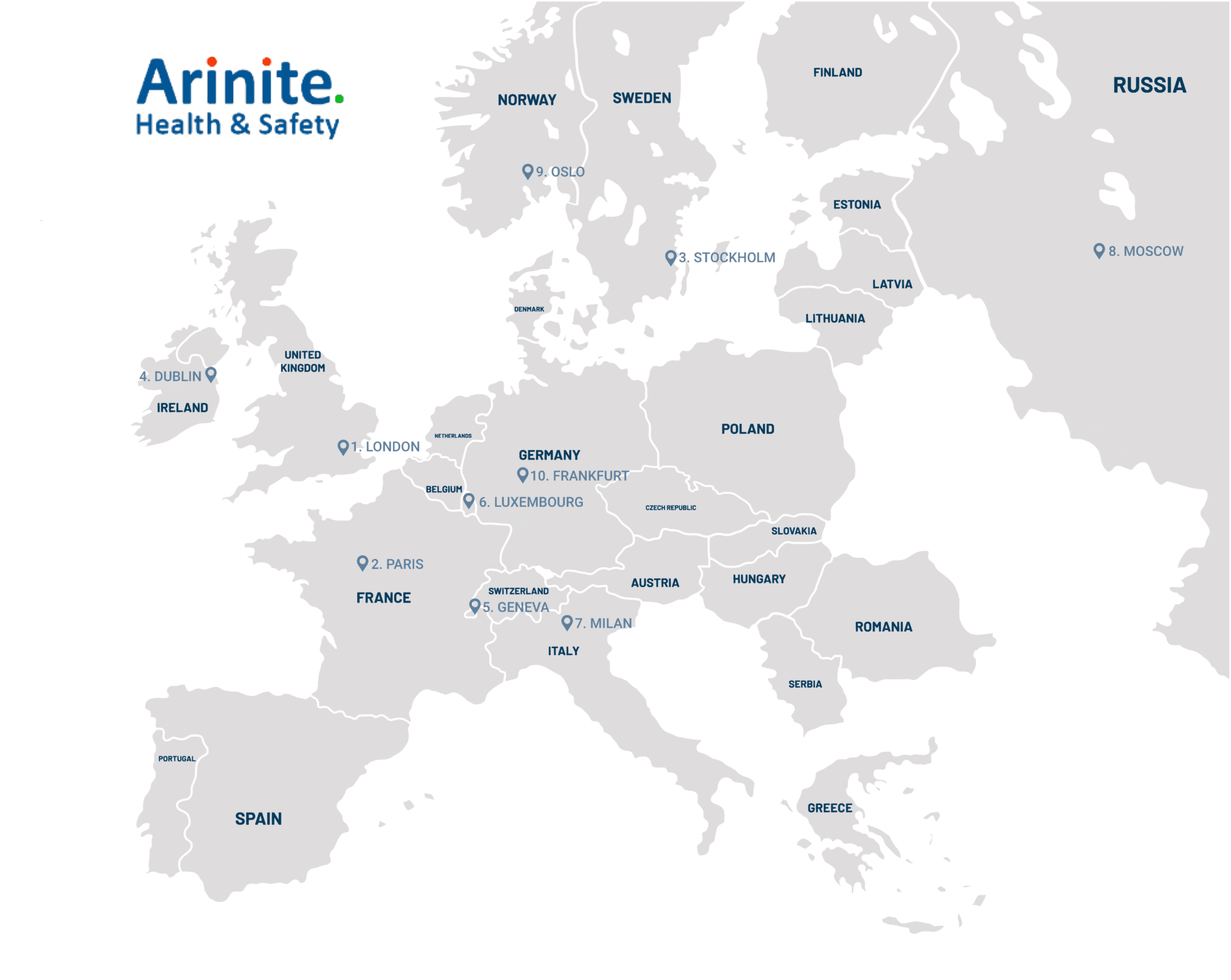
Sources - Gartner / Arinite / Global Financial Centre Index / hubblehq / BNP Paribas
The Top Rental Savings Per Year
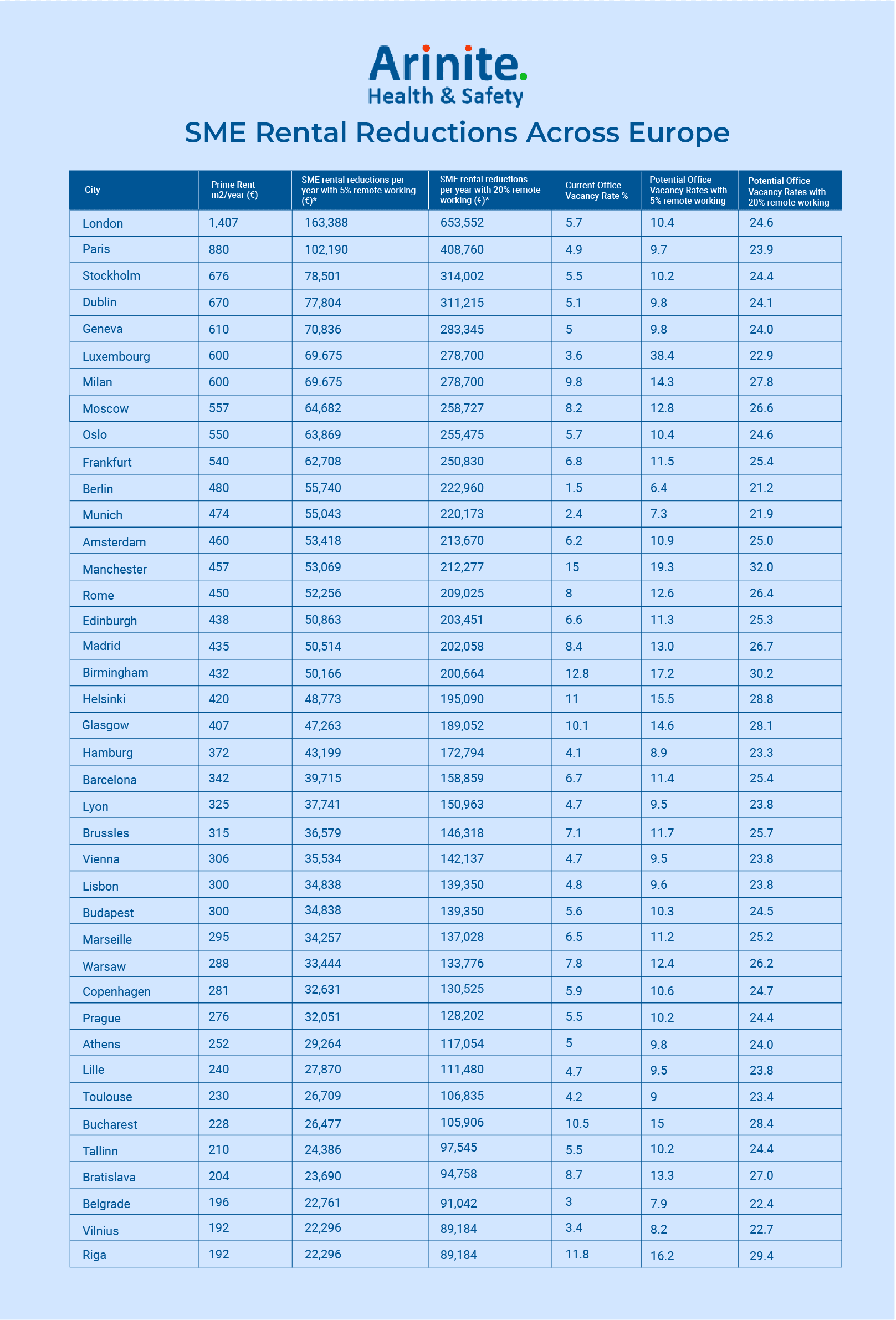
As you can see from the table above, London tops this list, with office rental savings anywhere between €163,388 - €653,552 for the average SME downsizing office by 5% - 20%. This is a massive saving, especially considering the next place on the list, Paris, has a saving almost half of this. As the financial centre of Europe (2nd worldwide to New York City), London hosts many SMEs that’d benefit from this move to remote working, while still maintaining office presence in the UK capital.
Savings for a downsizing SME in Paris could range from €102,190 - €408,760 yearly, a significant saving considering that the lower vacancy rates of 4.9% drive rent costs above other European cities higher on the Financial Sector Index, such as Geneva and Frankfurt.
Geneva could become even more popular for SMEs looking to relocate, as the yearly savings of €70,836 - €283,345 could offset the costs of €610 per square metre of office space. With Geneva ranked as the 2nd financial centre of Europe (9th worldwide) this saving in office space could attract lots of new business.
Predicted Office Vacancy Rates
Manchester currently has office vacancy rates around 15%. With this reduction in office size, this number will jump to a minimum of 19.3%, the highest office vacancy rates in Europe. The benefit of this excess supply could be further lowering of office rental pricings to fill vacancies, which could attract new business and more SMEs to Manchester.
Berlin has the lowest office vacancy rate, at 1.5%, with a potential predicted minimum office vacancy rate of 6.4%. This is far below other capital city vacancy rates - Paris and London have predicted minimum office vacancy rates of 9.7% and 10.4% respectively. This could be due to lower prime rent costs of 480 m2/year encouraging more demand, which may even counteract a move to remote work and encourage continued investment in office space.
Where Could There Be Investment?
Riga could become a popular city for office investment, with the lowest rent on this list, at 192 m2/year, and high office vacancy rates of 11.8%, which could become 16.2% - 29.4% with more remote working. This could reduce office prices further, attracting more investment and business.
With views on happiness and work/life balance changing due to lockdown, SMEs may consider locating to the happiest city in the world: Helsinki in Finland. Savings of €48,773 - €195,090, along with office vacancy rates of 11%, predicted to be 15.5% - 28.8%, could attract SMEs looking for the best quality of life for their employees.
Are There Any Downsides To This News?
While these changes to the office space may positively affect SMEs currently looking to move office location, any companies that have recently signed lease agreements could be tied in for several years, without the need for the office space. Therefore, they may face unnecessary costs, losing the same amount that could be saved on rent.
For the UK, the move to remote working could affect the success of infrastructure development HS2. With the UK government focused on developing links between the capital, Birmingham and Manchester, we could see a trend of SMEs moving to these lower rental cost areas. Or, with more focus on remote and online working, we could see SMEs move to smaller offices in London instead, reducing the effectiveness of HS2 links for encouraging the economies of Manchester and Birmingham.
Robert Winsloe, Managing Director at Arinite, has this to say:
“Since the Gartner study in March, we've had 5 months of working from home and our analysts suspect that if they did the survey again the number would be much higher than 5%. From our own figures, ranging from 5% to 50% planned reductions in office size, we predict the average company will move 20% of their staff to permanent remote working.
“Several companies are planning to adopt working from home as a matter of policy and renting a space for team meetings. Arinite (as an SME) has been operating that way since its formation in 2011.
“At the most extreme end of working transformations, there is an opportunity not just to reduce the cost of office space but to eliminate it completely, and then shift this cost to improving home working environments.
“The larger SMEs (or large companies) could have permanent team collaboration space available for teams to book and use whenever needed. The smaller companies will just rent space on an ad hoc basis as and when they need it. And they will contract with companies like WeWork and Regus for those who need a desk when travelling in business away from home.
“There are massive implications for the inevitable reduction in demand for office space. Initially this will result in dramatic reductions in office space costs. Eventually though, as the market reacts, a lot of office space will be converted to residential, demand and supply for office space will rebalance and the prices will start to rise again. While not definite, this process could take around 5 years.
“This process will also change the demand for types of services in cities, with an increased number of residential buildings, parking, public transportation, pedestrianisation and bike lanes etc to be seen around cities in the future.”
View the full dataset here: SME Office Rental Reductions per year in European Cities
For further information on the effects of Covid-19 on the workplace, follow our coronavirus updates and advice, or get in touch with one of our consultants.
Written by
Brendan Tuite
Health & Safety Expert at Arinite