HSE inspections up 47% - HSE carried out over 13,200 workplace inspections in 2024/25.
DUERP compliance for UK businesses with French operations. Code du Travail, CSE, SPST, PAPRIPACT.
DUERP stands for Document Unique d'Évaluation des Risques Professionnels (sometimes abbreviated DUER). It is France's mandatory workplace risk assessment document, required of every employer in France under Article R. 4121-1 of the French Labour Code (Code du Travail).
The DUERP is not a UK-style risk assessment. It is a specific legal document with defined content requirements, format expectations, and disclosure obligations. It must be made available to employees, the Comité Social et Économique (CSE), the medical officer (médecin du travail), and the labour inspectorate (inspection du travail) on request.
Every employer operating in France must prepare a DUERP on day one of employment (from the first employee onwards), update it at least annually, and retain it for at least 40 years. Failure to maintain a compliant DUERP is a criminal offence punishable by fines up to €1,500 per employee and potential civil liability where an employee injury could have been prevented.
Understanding the DUERP requires understanding the wider French occupational safety framework. The key elements are:
The general employer obligation to ensure the health and physical and mental safety of workers. This is the foundational duty from which all other obligations flow.
The specific requirement for the DUERP, its content, update frequency, and availability.
Significantly strengthened DUERP requirements, introduced the obligation to retain historical versions for 40 years, and created a new programme for risk prevention (Programme Annuel de Prévention des Risques Professionnels, PAPRIPACT) for businesses with 50+ employees.
The employee representative body required in businesses with 11+ employees. The CSE must be consulted on the DUERP. For businesses with 300+ employees, a specialist health and safety commission (CSSCT) is required within the CSE.
Occupational health physicians, typically provided through a registered occupational health service (Service de Prévention et de Santé au Travail, SPST). Every employee must have access to occupational health consultations.
The French labour inspectorate, with powers to inspect workplaces, require documentation, and issue sanctions.
A DUERP must document, for every work unit (unité de travail) in the organisation:
Physical, chemical, biological, ergonomic, and psychosocial risks. The psychosocial element (risques psychosociaux, RPS) includes workload, relationships, autonomy, recognition, and work-life balance. This is a specific legal requirement in France since 2013 and is commonly missed by UK businesses applying UK-style risk assessment templates.
A structured scoring or assessment method demonstrating how each risk has been evaluated. The CNAM provides recommended methodologies, though employers may choose any method provided it is rigorous and documented.
The specific actions taken or planned to eliminate or reduce each risk. Must follow the nine general principles of prevention set out in Article L. 4121-2 of the Code du Travail: avoid the risk, evaluate unavoidable risks, combat at source, adapt work to workers, adapt to technical progress, replace the dangerous with the less dangerous, plan prevention coherently, prioritise collective over individual protection, provide appropriate instructions.
A clear action plan showing what will be done, by whom, and when. For businesses with 50+ employees, this must be formalised as the PAPRIPACT (annual programme of risk prevention actions) agreed with the CSE.
The DUERP must be updated at least annually, whenever there is a significant change to work conditions, and following any occupational accident or disease. Historical versions must be retained for 40 years.
Beyond the DUERP itself, French employers have specific duties that UK businesses often underestimate:
Prepare and maintain the DUERP from day one of employment, not just for businesses over a certain size.
Consult the CSE on health and safety matters, including the DUERP, the PAPRIPACT (where applicable), and any significant change affecting work conditions.
Register with an occupational health service (SPST) and ensure every employee has access to the required occupational medical consultations.
Provide health and safety training (formation à la sécurité) on hiring, periodically, and when work conditions change. Training must be documented.
Declare workplace accidents to the CPAM (Caisse Primaire d'Assurance Maladie) within 48 hours.
Make the DUERP and related documents available to employees, the CSE, the SPST, and the Inspection du Travail.
Respond to any formal notice (mise en demeure) from the Inspection du Travail within the specified timescale.
Failure to comply can result in criminal penalties for the employer as a legal person, personal liability for directors, civil liability for employee injuries, and operational sanctions including temporary workplace closure.
UK businesses with French operations routinely fail French compliance in predictable ways. The most common gaps are:
UK businesses sometimes assume their UK risk assessment satisfies the French requirement. It does not. The DUERP is a specific French legal document with defined format and content requirements.
The DUERP must be accessible to French-speaking employees, the CSE, and the Inspection du Travail. English-only documentation fails the accessibility requirement.
UK risk assessment templates typically do not include RPS (risques psychosociaux). French law requires it explicitly.
The CSE must be consulted on the DUERP and any significant change to work conditions. UK businesses often treat the CSE as a purely employee-relations body.
Registration with an occupational health service is mandatory from the first employee. Missing registration is a serious compliance failure.
For 50+ employee businesses, the annual risk prevention programme is a specific legal requirement introduced in 2021 that UK businesses frequently have no UK equivalent for.
The 40-year retention requirement is unique to France and is frequently missed.
Arinite's international health and safety service identifies and resolves each of these gaps as part of standard French compliance onboarding.
Arinite provides French compliance as part of our international health and safety service. The model combines UK-based programme management with locally qualified French consultants.
Our French consultants hold recognised qualifications and work directly with clients in French. They prepare the DUERP, conduct PAPRIPACT planning where applicable, interface with the CSE and SPST, and provide the day-to-day compliance support that French law requires.
Your named Chartered consultant at Arinite UK manages the programme. You have a single UK point of contact who coordinates French (and any other international) compliance activity, reports to your UK board or HQ, and ensures the programme aligns with your wider international health and safety strategy.
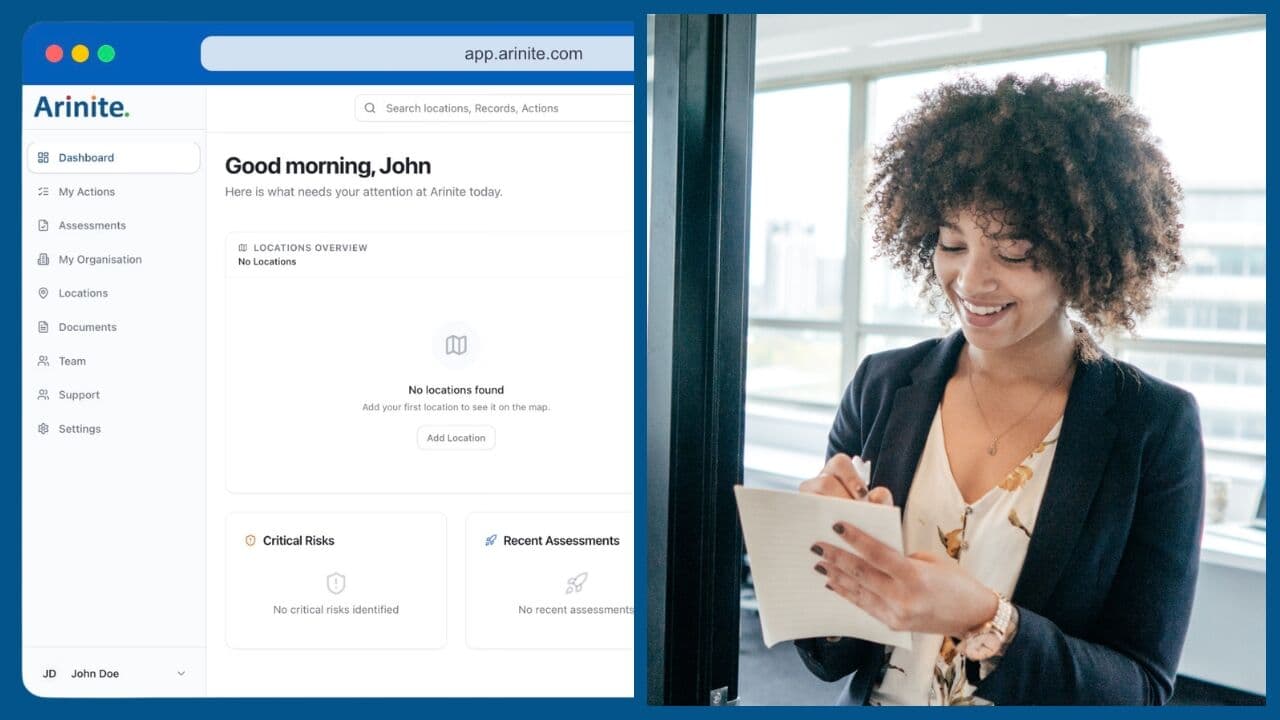
All French compliance activity is maintained in Arinite's health and safety software platform alongside your UK and other international operations. One dashboard, every country.
The Code du Travail is amended regularly and Inspection du Travail enforcement priorities shift. We monitor changes and update your documentation as required.
French compliance is also available as part of Arinite's outsourced health and safety packages. See also our country-specific guides for Germany (DGUV) and Netherlands (RI&E).
Whether you are opening your first French office or managing compliance across a mature French operation, Arinite delivers locally compliant health and safety support coordinated from the UK.
Book a free international gap analysis call. In 30 minutes, one of our Chartered consultants will review your French arrangements, identify the gaps that matter, and recommend the right approach.
From Reactive Firefighting to Proactive Health & Safety Compliance
No formal HSE systems in place. Everything is reactive, waiting for something to go wrong. Documentation is missing or outdated.
This isn't just "non-compliant." It's criminally negligent. Directors face personal prosecution.
Basic HSE documentation is in place. Minimum legal requirements met. You can pass a basic audit.
Compliance is where most consultants get you, then leave. You're legal, but you're not optimised.
Systems run proactively, preventing problems before they occur. Compliance is distributed, not dependent on one person.
That's why 95%+ of clients renew year after year.

Robert Winsloe
Managing Director, Arinite
“We work with you to deliver peace of mind. We tailor our service provision to your business to provide proactive, pragmatic health and safety advice and that helps reduce costs by ensuring compliance with relevant health and safety legislation.”
Other Consultants
Get you to Stage 2 (Compliant) and disappear.
Arinite
Gets you to Stage 3 (Proactive) and keeps you there.
That's why we call it transformation, not just compliance.
Compliance
Traditional consultancies audit, report and leave. You get a document and the job of implementing it.
Control
Software companies give you dashboards and workflows without the knowledge to use them.
Coverage
Global businesses need consultants who know compliance in every jurisdiction.
Arinite
We are not a consultancy that adds external software. We are not a software company that recommends consultants.
We are the place where those two things finally become one.
50+ Countries. Global Safety. Local Trust.
Headquartered in London, UK, with Chartered health and safety consultants in 50+ countries. Whether you need a health and safety audit in Manchester, a fire risk assessment in Birmingham, or outsourced workplace health and safety compliance in Singapore, we have consultants near you.
We're expanding globally

Operations Director, Arinite
I have been in the health and safety business for 35+ years. In that time, I have had one consistent experience across every sector and every country I have worked in.
Every business we speak to already knows, somewhere, that their workplace health and safety compliance has not kept pace with their growth. It is not ignorance. It is business. It is the assumption that because nothing has gone wrong yet, the gaps are probably manageable.
What stops most businesses from doing something about it is not the cost of outsourcing health and safety support. It is the fear of finding out how significant the gaps are.
The Free Gap Analysis Call exists for exactly that moment.
You get the full picture of your workplace health and safety position in 30 minutes.
“In 35+ years, I have not once had someone tell us they wished they had stayed in the dark.”
No video testimonials available at the moment.
Join 1,500+ organisations that trust Arinite as their health and safety consultants.
Common questions about DUERP, French compliance, and support for UK businesses
Our IOSH Chartered health and safety consultants are here to help with any queries about workplace safety, compliance, or our services.
Download our comprehensive library of expert guides, checklists, and templates.
Browse LibraryHave a question or need expert advice? We're here to help.
Fill out the form below and our team will get back to you within 24 hours.
Headquarters
29 Throgmorton St
London EC2N 2AT