Risk Assessment Template: Complete Guide for UK and International Businesses
Every UK employer must assess the risks to which employees and others are exposed. The risk assessment is not a bureaucratic exercise: it is the legal foundation of workplace safety management and the first document an HSE inspector will ask to see following a workplace incident. Choosing the right template, populating it correctly, and keeping it current are all more complex than they first appear. A poorly structured template leads to gaps in hazard identification, inadequate control measures, and exposure to enforcement action and civil liability. This guide explains what a risk assessment template must contain, which types of template are needed for different activities and hazards, how international requirements differ from the UK framework, and how Arinite's Health and Safety Consultants provide expert-built templates calibrated to your specific operations.
Why the Right Risk Assessment Template Matters
The risk assessment sits at the centre of UK health and safety law. Under Regulation 3 of the Management of Health and Safety at Work Regulations 1999, every employer must conduct a suitable and sufficient assessment of the risks to which employees and others are exposed. Employers with five or more employees must record the significant findings in writing.
The law does not prescribe a specific format. What it requires is substance: that the assessment genuinely identifies hazards, evaluates their significance, specifies who is at risk and how, and records what controls are in place and what further action is needed. A template provides the structure that ensures these requirements are consistently met.
The consequences of inadequate risk assessment are serious. In the event of a workplace accident, the HSE will examine whether a risk assessment existed, whether it covered the hazard that caused the accident, whether the identified controls were implemented, and whether the assessment had been reviewed. An absent, generic, or outdated assessment is treated as evidence of employer failure and significantly increases liability exposure.
The right template does three things: it prompts comprehensive hazard identification, it creates a clear record of evaluation and decision-making, and it connects identified risks directly to control actions with accountable ownership. A generic template downloaded without expert input rarely achieves all three.
Health and Safety Consultants provide templates built specifically for your sector, activities, and risk profile, rather than one-size-fits-all documents that leave critical gaps.
The Legal Framework for Risk Assessment in the UK
The Core Obligation
Regulation 3 of the Management of Health and Safety at Work Regulations 1999 requires employers to make a suitable and sufficient assessment of:
- The risks to the health and safety of employees to which they are exposed while at work
- The risks to the health and safety of persons not in their employment arising from their work activities
The assessment must be sufficient to enable the employer to identify and implement appropriate preventive and protective measures.
What "Suitable and Sufficient" Means
The HSE has articulated what these words require in practice:
Suitable means that the assessment must genuinely address the significant risks relevant to the workplace and its activities. It must reflect real conditions, not idealised or assumed ones.
Sufficient means thorough enough to identify all measures needed to comply with relevant statutory provisions. Significant hazards must not be missed, and the evaluation of each risk must be adequate to support proportionate control decisions.
The assessment does not need to be perfect or exhaustive. The HSE expects a practical, proportionate approach. It does need to reflect how work is actually done, who is actually at work, and what could actually go wrong.
The Recording Requirement
For employers with five or more employees, the significant findings must be recorded in writing. This includes:
- The hazards identified
- The people who could be harmed and how
- The existing control measures in place
- Any further action needed, who is responsible, and by when
- The date of the assessment and when it will be reviewed
Even for smaller employers, written records are strongly recommended. They demonstrate due diligence and provide the basis for review when circumstances change.
Review Obligations
Risk assessments are not static documents. They must be reviewed:
- When there is reason to suspect they are no longer valid
- Following significant changes in the workplace, activities, equipment, or workforce
- Following any workplace accident, near miss, or dangerous occurrence
- Periodically, to ensure they remain current
Annual review is the widely accepted minimum frequency for most workplace assessments.
What a Risk Assessment Template Must Include
Need Expert H&S Guidance?
Our qualified consultants can help you implement the right health & safety measures for your business.
While format is flexible, content is not. A legally compliant and practically effective risk assessment template must capture the following elements.
1. Business and Assessment Identification
Every template should record the organisation name, site or location, department or work area, and the name of the person conducting the assessment. It should also record the date of the assessment and the date of the next planned review. These details establish that the assessment relates to a specific context and was conducted by an identified individual at a specific time.
2. Description of the Work Activity or Area Being Assessed
The assessment must be grounded in a specific work activity, process, or area. A generic "office risk assessment" that applies equally to every office in every business is unlikely to be suitable or sufficient for any particular office. The template should prompt the assessor to describe the specific work activity or environment, any equipment involved, and the people who carry out the work.
3. Hazard Identification
This is the most important and most commonly under-performed element of risk assessment. The template must prompt systematic identification of all significant hazards, covering:
Physical hazards: Slips, trips, falls, manual handling, working at height, machinery, electricity, workplace transport, fire, noise, and vibration.
Chemical and biological hazards: Hazardous substances, carcinogenic or mutagenic agents, biological agents, and inhalation, ingestion, or skin contact risks.
Ergonomic hazards: Display screen equipment, repetitive tasks, sustained posture, and workstation design.
Psychosocial hazards: Work-related stress, workload, bullying and harassment, lone working, and violence and aggression.
Environmental hazards: Lighting, temperature, ventilation, and the condition of the physical environment.
A template that prompts only physical hazards and omits psychosocial risks is structurally incomplete for most workplaces.
4. Who Is at Risk and How
For each hazard, the template must identify who could be harmed and the mechanism of harm. This goes beyond listing "employees." It should distinguish between specific employee groups with different exposures, contractors, visitors, members of the public, and any group with particular vulnerability, including young workers, new or expectant mothers, lone workers, and workers with disabilities.
5. Existing Controls
The template must record what is already in place to control each risk. This may include engineering controls, safe systems of work, training, personal protective equipment, supervision arrangements, or management procedures. Recording existing controls honestly is essential: assessors must describe what actually exists, not what should theoretically exist.
6. Risk Evaluation
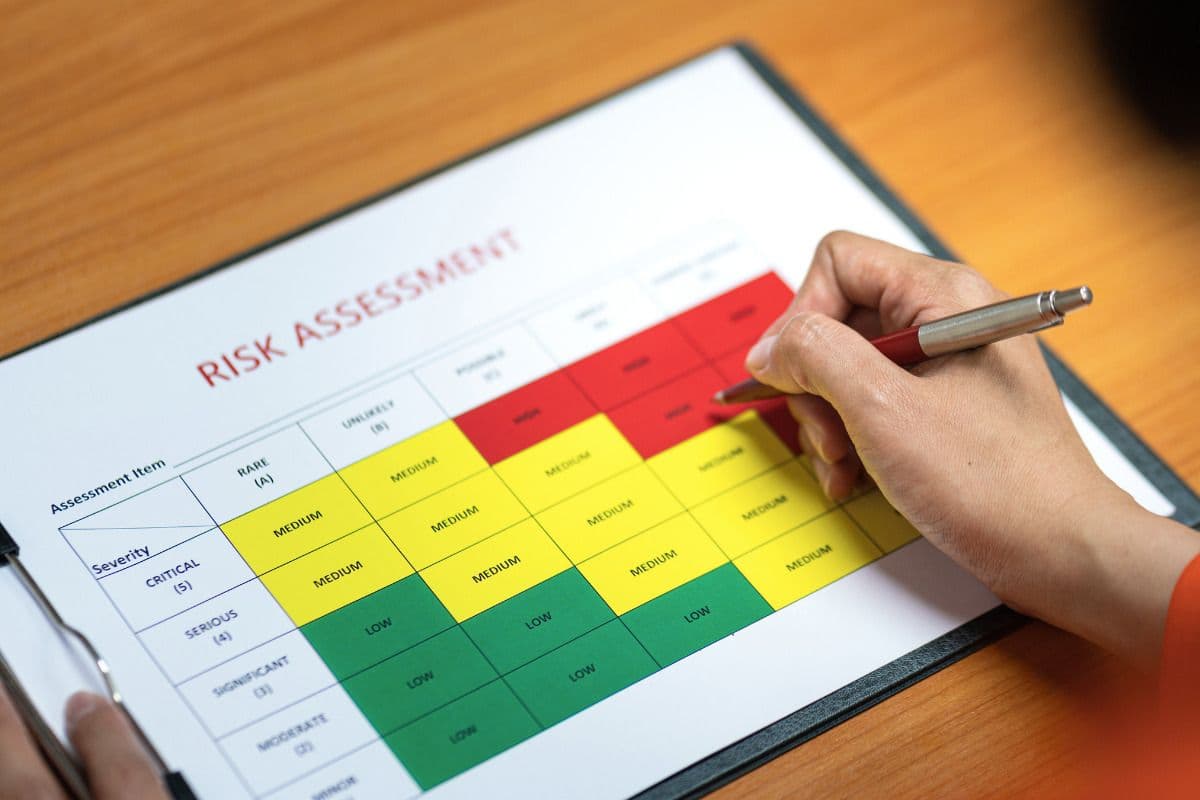
The assessment must evaluate the level of risk remaining after existing controls are considered. Most templates use a risk matrix combining likelihood and severity to produce a risk rating. Common formats use a 3x3, 4x4, or 5x5 matrix producing ratings from low through to critical.
The risk evaluation drives prioritisation: higher-rated risks require more urgent and more robust action. The template should capture both the inherent risk (before controls) and the residual risk (after controls) to demonstrate the effectiveness of existing measures.
7. Further Action Required
Where the residual risk is not adequately controlled, the template must record what additional action is needed, who is responsible for implementing it, and by when. This converts the risk assessment from a record of status into a driver of action. Actions that are never assigned or never completed represent one of the most common failures in risk assessment management.
8. Hierarchy of Control
The template should reflect the legal hierarchy of controls, giving priority to measures higher up the hierarchy:
- Elimination: Remove the hazard entirely
- Substitution: Replace with something less hazardous
- Engineering controls: Physical barriers, enclosures, ventilation
- Administrative controls: Safe systems of work, training, supervision
- Personal protective equipment (PPE): Last resort, not a primary control
A template that defaults to PPE as the first line of defence leads to inadequate risk control.
9. Residual Risk Rating and Sign-Off
After additional controls are applied, the template should record the expected residual risk. It should include a sign-off section capturing the name and signature of the assessor, and ideally the countersignature of a manager or director confirming that the assessment has been reviewed and the identified actions are approved.
10. Review Date and Review Record
The template should capture the planned review date and provide space to record the history of reviews, confirming that the assessment remains current and that any changes since the previous review have been captured.
Types of Risk Assessment Template
Different types of assessment are required for different hazards, activities, and regulatory obligations. Understanding which template is needed for which purpose prevents both over-documentation and critical gaps.
General Workplace Risk Assessment Template
The general workplace assessment covers the everyday hazards arising from the physical environment and normal work activities. It is typically produced at the level of a work area, department, or office and addresses:
- Slips, trips, and falls
- Workplace transport and pedestrian routes
- Fire safety (though a detailed fire assessment is separate)
- Manual handling in the general work environment
- Electrical safety
- Welfare facilities and environmental conditions
- Housekeeping and storage
This is usually the starting point for all workplaces, but it does not replace specialist assessments where specific hazards require detailed attention.
Display Screen Equipment (DSE) Assessment Template
Required by the Health and Safety (Display Screen Equipment) Regulations 1992 for all habitual screen users. A DSE template covers:
- Screen position, height, and distance
- Keyboard and mouse arrangement
- Chair height, back support, and adjustability
- Lighting and glare control
- Environmental conditions
- Work patterns and break arrangements
- Software usability
DSE assessments are required for both office and home workstations. A template that applies only to office environments will leave home workers unassessed, creating a compliance gap that the HSE confirmed in 2025 remains prevalent.
Manual Handling Assessment Template
Required where manual handling operations involve risk of injury under the Manual Handling Operations Regulations 1992. A manual handling template uses the TILEO or RULA framework to assess:
- Task: The nature of the activity and the demands it places on the body
- Individual: Any characteristics of the person that make them more susceptible to injury
- Load: Weight, size, shape, stability, and grip of what is being handled
- Environment: Space, floor conditions, lighting, and temperature
- Other factors: Repetition, sustained posture, and pace of work
COSHH Assessment Template
Required for any work involving hazardous substances under the Control of Substances Hazardous to Health Regulations 2002. A COSHH template addresses:
- Substance identification and Safety Data Sheet reference
- Hazards associated with the substance
- Routes of exposure (inhalation, skin contact, ingestion, injection)
- Exposure limits and monitoring requirements
- Control measures in priority order
- Health surveillance requirements
- Emergency procedures and first aid
- PPE requirements as a supplementary control
Fire Risk Assessment Template
Required for all non-domestic premises under the Regulatory Reform (Fire Safety) Order 2005. Arinite provides dedicated fire risk assessment support. A fire-specific template covers:
- Sources of ignition, fuel, and oxygen
- People at risk from fire, including any with mobility limitations
- Existing fire precautions: detection, alarms, suppression, signage, lighting
- Means of escape and their adequacy
- Emergency procedures and staff training
- Maintenance records for fire safety equipment
Lone Worker Risk Assessment Template
Where employees work alone, a dedicated lone working assessment addresses:
- The nature and location of the lone work activity
- Communication arrangements and check-in protocols
- Access to first aid and emergency services
- Environmental risks specific to the lone working context
- Procedures if the lone worker cannot be contacted
Work at Height Risk Assessment Template
Required where work is carried out at a height from which a person could fall and be injured, under the Work at Height Regulations 2005. The template covers:
- The nature and duration of the work at height
- Equipment selection and inspection
- Edge protection and fall arrest systems
- Rescue procedures in the event of a fall
- Competence of those working at height
- Weather and environmental conditions for outdoor work
Stress Risk Assessment Template
Work-related stress must be assessed as part of the employer's duty to assess psychosocial risks. Arinite provides stress risk assessment support structured around the HSE Management Standards. A stress template evaluates the six HSE Management Standards factors:
- Demands
- Control
- Support
- Relationships
- Role
- Change
New and Expectant Mothers Risk Assessment Template
Where the workforce includes or may include new or expectant mothers, a specific assessment is required covering risks from particular work activities, substances, posture, and working hours that may affect pregnant or breastfeeding workers.
Young Workers Risk Assessment Template
Where workers under 18 are employed, a specific assessment is required covering their particular vulnerability to certain hazards and the restrictions on certain types of work that apply to young persons.
Task-Specific and Activity Risk Assessment Templates
Beyond the above category templates, task-specific assessments are needed for particular high-risk activities, including:
- Confined space entry
- Hot work (welding, cutting)
- Excavation and ground work
- Machinery use and maintenance
- Chemical handling and transfer
- Electrical work
- Working in or around water
Common Mistakes in Risk Assessment Templates and How to Avoid Them
Even well-intentioned risk assessments frequently fall short. Understanding the most common errors helps businesses avoid them.
Copying Generic Templates Without Adaptation
Generic templates downloaded from the internet and used without adaptation are one of the most widespread failures. A risk assessment must reflect actual conditions, actual activities, and actual control measures in a specific workplace. A template for a restaurant used unmodified in a school, or an office assessment applied to a warehouse, will miss the hazards that most matter.
Every template used by Arinite is adapted to the specific business, sector, activities, and workforce before use.
Assessing What Should Happen Rather Than What Does Happen
Risk assessments frequently describe ideal conditions rather than actual ones. A manual handling assessment that describes correct lifting technique without noting that training has not been delivered, or that the equipment described is not available, is not an accurate record and will not withstand scrutiny.
Completing the Assessment but Not Implementing the Actions
A risk assessment that identifies significant residual risks and specifies required actions, but where those actions are never implemented, is not compliant. The assessment must drive change, not simply document problems. Clear ownership, realistic deadlines, and follow-up monitoring are essential.
Failing to Review When Circumstances Change
Risk assessments become invalid when the conditions they describe change. New equipment, new processes, new employees, a workplace incident, or a change in layout can all create hazards not captured in the original assessment. A review process with clear triggers is essential.
Inadequate Hazard Identification
Assessments that identify only the most obvious physical hazards while overlooking psychosocial risks, chemical exposures, or activity-specific risks will miss significant sources of harm. A comprehensive template prompts the assessor across all relevant hazard categories.
Treating PPE as a Primary Control
Templates that list PPE as the first or only control measure reflect a misunderstanding of the hierarchy of controls. PPE is a last resort, not a substitute for elimination, engineering controls, or safe systems of work. The template should prompt consideration of the full hierarchy.
Missing Specific Groups at Heightened Risk
Generic assessments that refer only to "employees" without considering contractors, visitors, young workers, new and expectant mothers, lone workers, or workers with health conditions will fail to protect these groups and leave the employer legally exposed.
Outdated Assessments with Passed Review Dates
An assessment with a review date that has passed is, in regulatory terms, almost as problematic as no assessment at all. It indicates that the employer has failed to maintain oversight of their risk management obligations.
Risk Assessment Templates for International Operations
UK businesses operating internationally need to understand that risk assessment obligations differ significantly between jurisdictions, and that a UK template does not satisfy international requirements.
European Union Variations
The EU Framework Directive 89/391/EEC provides a common foundation, but national implementation varies considerably in format, documentation requirements, and review frequency.
Netherlands: The RI&E (Risico-Inventarisatie en -Evaluatie) is the mandatory Dutch risk assessment. Unlike the UK framework, it requires certified review by a qualified expert for companies with 25 or more employees. The template must cover all hazards including psychosocial workload (PSA) and include an action plan. Sector-specific approved RI&E instruments exist for certain industries.
France: The DUERP (Document Unique d'Évaluation des Risques Professionnels) is mandatory from the first employee, must be retained for 40 years, must be accessible to the CSE (works council), and for companies with 50 or more employees must link directly to a PAPRIPACT annual prevention programme. The template is more prescribed in its required content than the UK equivalent.
Germany: DGUV regulations require risk assessments (Gefährdungsbeurteilung) that are sector-specific and validated through the Berufsgenossenschaften system. Works council rights over documentation are more extensive than UK safety representative rights.
Italy: RSPP requirements mandate a responsible safety officer for all employers, with specific documentation obligations attached to the role.
ISO 45001: The International Framework
ISO 45001 provides an internationally recognised framework for occupational health and safety management. Its hazard identification and risk assessment requirements (Clause 6.1) form the international gold standard for risk assessment methodology and documentation, applied by organisations in over 100 countries.
ISO 45001 requires organisations to:
- Identify hazards on an ongoing basis, covering all activities, locations, and people
- Assess OH&S risks and other risks to the management system
- Use the hierarchy of controls when determining controls
- Maintain and retain documented information on the assessment process
A risk assessment template built to ISO 45001 requirements is suitable for use in international operations and provides a defensible framework for regulatory scrutiny in multiple jurisdictions.
International Health and Safety Consultants provide templates and assessment methodologies that meet both local regulatory requirements and ISO 45001 standards, enabling consistent documentation across global operations.
International Health and Safety Audits
Health and Safety Audits verify that risk assessment templates are not only structurally sound but appropriately completed, kept current, and linked to implemented control actions. For multi-site international operations, international health and safety audits provide group-level visibility of risk assessment compliance across all locations.
The Role of Technology in Risk Assessment Templates
Health and Safety Consultants and Software solutions transform risk assessment from a static paper exercise into a dynamic, managed compliance process.
What Digital Risk Assessment Platforms Enable
Consistent template use: Ensuring the same template is used across all sites, departments, and assessors, preventing format drift and omissions.
Guided completion: Prompt-based digital templates guide assessors through hazard categories systematically, reducing the risk of omission.
Action tracking: Directly linking identified actions to named owners, deadlines, and completion verification within the same system as the assessment.
Review scheduling: Automatic alerts when assessments are approaching or have passed their review date.
Version control: Maintaining an audit trail of assessment versions, showing what changed, when, and who approved the change.
Cross-site visibility: Management dashboards showing assessment status, overdue reviews, and outstanding actions across all locations.
Regulatory reporting: Generating reports in formats suitable for regulatory inspection, management review, or board reporting.
Multi-jurisdiction support: Storing assessments in formats appropriate to different national requirements within a single managed system.
How Arinite Provides Risk Assessment Templates and Support
Arinite provides risk assessment templates and comprehensive assessment support to businesses across the UK and internationally.
Why Arinite Templates Are Different
Built for your sector and activities: Arinite templates are not generic documents. They are developed and reviewed by CMIOSH-qualified consultants with sector-specific expertise, calibrated to the actual hazards and activities of your business.
Legally complete: Templates are structured to meet the requirements of the Management of Health and Safety at Work Regulations 1999, specific subject regulations, and international frameworks including ISO 45001.
Practical and proportionate: Arinite's philosophy is keeping health and safety simple. Templates are designed to be completed by those doing the work, not only by specialists.
International capability: For businesses with international operations, Arinite provides templates adapted to local requirements including the RI&E, DUERP and PAPRIPACT, DGUV, and RSPP, as well as ISO 45001-aligned templates for global use.
Supported by expertise: Templates alone are not enough. Arinite consultants support the assessment process, train assessors, review completed assessments for adequacy, and provide the competent person oversight required by law.
The Full Range of Templates Available
Arinite provides templates covering:
- General workplace risk assessment
- Display screen equipment (DSE) assessment
- Manual handling assessment
- COSHH assessment
- Fire risk assessment
- Lone worker risk assessment
- Work at height risk assessment
- Stress and psychosocial risk assessment
- New and expectant mothers assessment
- Young workers assessment
- Task and activity-specific assessments
- Sector-specific templates for hospitality, construction, retail, care, manufacturing, and others
- International-format templates for Dutch RI&E, French DUERP, and ISO 45001 compliance
Get Your Templates Through a Gap Analysis Call
The most effective way to access Arinite's risk assessment templates is through a structured consultation. Every business has a different risk profile, different activities, and different compliance gaps. A conversation with an Arinite consultant identifies which templates you need, what they must cover for your specific operations, and how to implement them effectively.
Book a free Gap Analysis Call with one of our CMIOSH-qualified consultants. In thirty minutes, we will identify your risk assessment obligations, clarify which templates are needed, and explain how we can provide templates tailored to your business and support you in using them effectively.
This is a more valuable starting point than a generic download. A risk assessment template that does not reflect your business is not compliant, regardless of how professionally it is formatted.
Frequently Asked Questions
Is there a legal risk assessment template format I must use?
No. UK law does not prescribe a specific format. What matters is that the assessment is suitable and sufficient, meaning it genuinely covers significant hazards and identifies adequate controls. The format can be paper, digital, or any other medium, as long as the required content is present and accessible.
Do I need separate templates for different hazards?
Yes, in most cases. A general workplace assessment covers everyday hazards but does not replace specialist assessments for fire, manual handling, COSHH, DSE, or work at height. Each specialist assessment uses a template structured around the specific hazard and regulatory requirements.
How often must risk assessments be reviewed?
Risk assessments should be reviewed at least annually and whenever significant changes occur in the workplace, activities, equipment, or workforce. They must also be reviewed following any workplace accident or near miss. Some higher-risk assessments may require more frequent review.
Do risk assessment requirements differ in other countries?
Yes, significantly. The Dutch RI&E requires certified external review. The French DUERP must be retained for 40 years and linked to a PAPRIPACT action programme. German DGUV assessments are sector-specific. International Health and Safety Consultants provide templates and support adapted to each jurisdiction.
Can I use a generic template downloaded online?
A generic template can provide a useful starting structure, but it must be adapted to your specific workplace, activities, and workforce before use. An unadapted generic template is unlikely to be suitable or sufficient for any particular business and will not withstand regulatory scrutiny following an incident.
What happens if my risk assessment is found to be inadequate after an accident?
An inadequate risk assessment significantly increases employer liability. It may be treated as evidence of failure to take reasonable precautions. The HSE may issue enforcement notices, initiate prosecution, and apply Fee for Intervention charges. In civil proceedings, an inadequate assessment is strong evidence of negligence. Health and Safety Audits help identify and address inadequacies before incidents occur.
Do risk assessments need to cover home workers?
Yes. Employers carry the same duty of care for home workers as for office-based staff. DSE assessments must cover home workstations. General home working risk assessments are required. The HSE confirmed in 2025 that DSE obligations extend to all screen users wherever they work.
How does ISO 45001 relate to risk assessment templates?
ISO 45001 provides an internationally recognised framework for hazard identification and risk assessment. Templates built to ISO 45001 requirements meet a globally recognised standard and are suitable for international operations. Certification requires documented risk assessment processes and ongoing hazard identification.
What is the best way to get risk assessment templates for my business?
Book a free Gap Analysis Call with Arinite. Our consultants will identify which templates you need, what they must cover for your operations, and provide templates built for your business rather than generic documents requiring substantial adaptation.
How can Arinite support risk assessment across international offices?
Arinite's Global Health and Safety Consultants provide risk assessment templates and support adapted to local requirements across 50+ countries. For European offices, this includes RI&E, DUERP, DGUV, and RSPP format assessments. ISO 45001-aligned templates provide consistent methodology across all locations.
Get Your Risk Assessment Templates from Arinite
A well-structured risk assessment template is the starting point for effective workplace safety management. But the template is only as good as the expertise behind it. A document that does not reflect your actual activities, workforce, and hazards will not protect your people or your business.
Book your free Gap Analysis Call today. In thirty minutes with an Arinite consultant, you will understand exactly which risk assessment templates your business needs, what they must contain for your specific operations, and how to get expert-built templates that meet UK and international legal requirements.
Book a free Gap Analysis Call to get your tailored risk assessment templates and the expert support to use them effectively.
You can also take our Health and Safety Quiz to assess your current compliance position across key areas including risk assessment documentation.
Contact Arinite to learn how our Health and Safety Consultants support businesses across the UK and 50+ countries with risk assessment templates, training, audits, and ongoing compliance management.
Arinite provides specialist Health and Safety Consultants services, including comprehensive risk assessment template development and support, to over 1,500 global businesses across 50+ countries. Our CMIOSH-qualified consultants deliver practical, legally compliant risk assessment programmes for businesses of all sizes, from growing SMEs to established international enterprises.
Written by
Arinite Health & Safety Consultants
Health & Safety Expert at Arinite